Bismarck, North Dakota: Named to Catch German Money
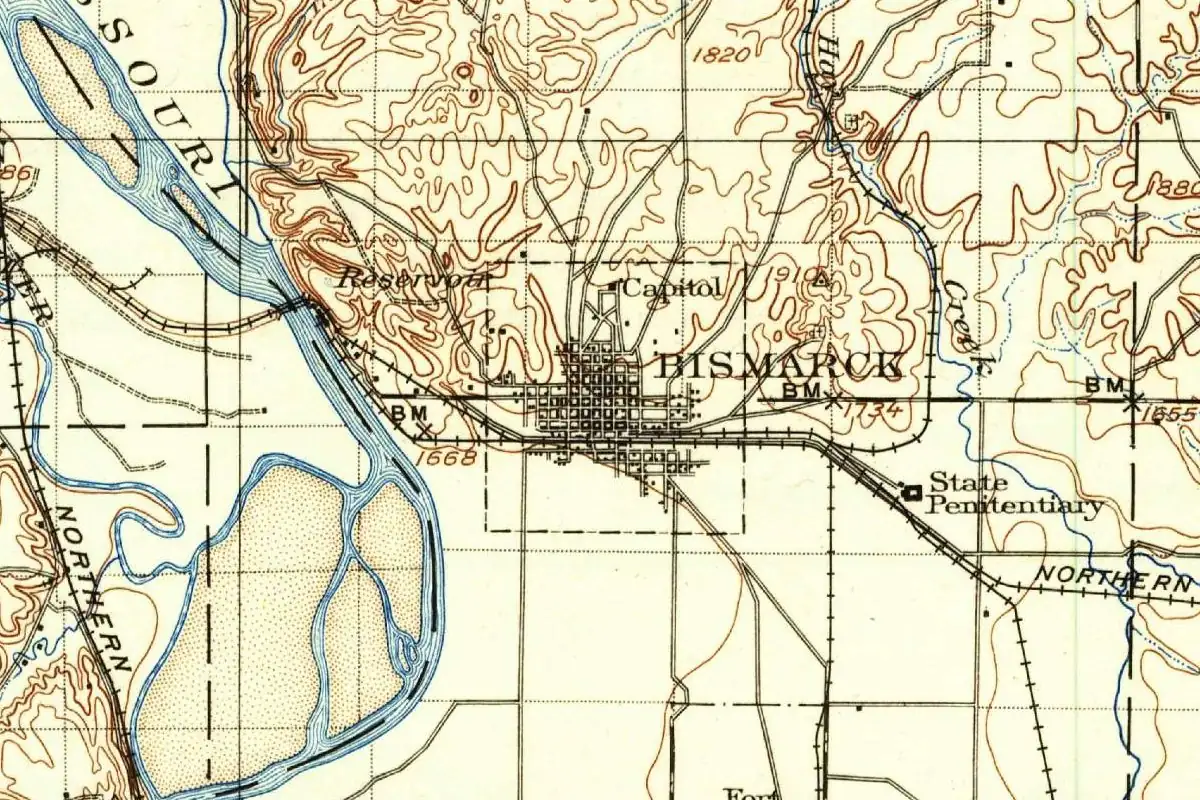
Bismarck, North Dakota, took the name of Germany’s chancellor in 1873 for a business reason: the Northern Pacific Railroad wanted German investors to notice. Before that, the little town on the Missouri River was called Edwinton, after one of the railroad’s own engineers.
The Crossing, then Edwinton
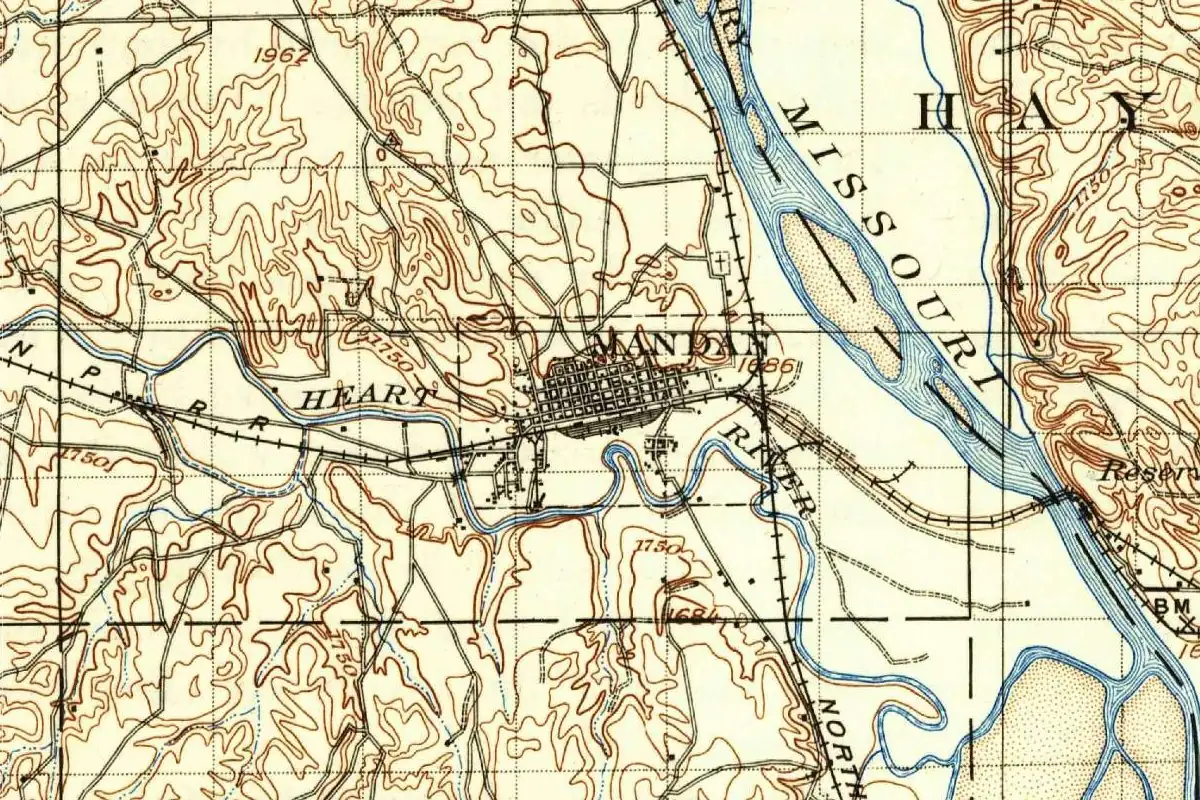
The town exists because the railroad needed a place to cross the Missouri. GNIS, the government’s official index of place names, says the spot was first known simply as The Crossing, in 1871. In May 1872, according to Clement Lounsberry’s 1917 history of the state, Thomas H. Canfield, who was picking town sites for the Northern Pacific, chose where the line would cross the river and laid out the town. Its first name was Edwinton, “in honor of Edwin F. Johnson,” the railroad’s chief engineer.
So the town’s first name was a railroad name, picked to honor the company’s own chief engineer.
A postmaster’s account of the switch
Linda W. Slaughter was there for the change, and Lounsberry printed her account. In December 1872, she writes, the people of Edwinton petitioned for a post office. The post office was established on February 7, 1873, and she opened it that March. She ran it, first as a deputy and then, because “a married woman could not file a bond,” as assistant to her husband, Dr. B. F. Slaughter, who held the title. The pay was $12 a year.
Then came the new name. “In June, 1873, the office was changed in name from Edwinton to Bismarck,” Slaughter writes, “so named in order to attract the attention of German capital to the Northern Pacific Railroad, then under construction.” Lounsberry tells it the same way in his section on Canfield: the town was “at first called Edwinton,” then Bismarck, “for the purpose of attracting German capital in the completion of the enterprise.” That same month, he notes, the railroad was completed to Bismarck.
If you’re wondering whether a chancellor in Berlin ever heard about it, Slaughter says he did. “The great chancellor acknowledged the compliment in an autograph letter to Secretary Wilkinson of the Northern Pacific Railroad.” We didn’t find a copy of that letter, so you’re getting it secondhand, from her.
One of many Bismarcks
Henry Gannett’s 1905 place-names book for the U.S. Geological Survey lists Bismarck, North Dakota, next to a Bismarck in Missouri “and many other places, named for Prince Otto von Bismarck of Germany.” This one is the one that became a state capital.
It also became the newsroom where another name took hold. In 1882, Lounsberry’s Bismarck Tribune started printing “North Dakota” in its dateline, years before there was a state to go with it. We tell that part in How North Dakota Got Its Name.
Sources & further reading
- Clement A. Lounsberry, North Dakota History and People, vol. 1 (1917). Canfield’s choice of the Missouri crossing in May 1872, Edwinton for Edwin F. Johnson, and the German-capital reason (p. 327); the railroad reaching Bismarck in June 1873 (pp. 327–328); Linda W. Slaughter’s account of the post office, the June 1873 renaming and the chancellor’s letter (pp. 491–492); the Bismarck Tribune dateline (p. 41).
- Life of Thomas Hawley Canfield (1889). Edwin F. Johnson as the Northern Pacific’s chief engineer, and Canfield laying out Bismarck in 1872.
- Henry Gannett, The Origin of Certain Place Names in the United States (USGS, 1905), p. 47. Bismarck named for “Prince Otto von Bismarck of Germany.”
- GNIS feature 1035849 (U.S. Geological Survey). The federal record: The Crossing (1871), Edwinton (1872), then Bismarck.
Spot something wrong, or know more? Tell us here. You can also email us or use our contact page. Corrections are noted here with their date, never made silently.