Grand Forks, North Dakota: A Fur Traders' Name for Two Rivers
Fur traders called this spot Grandes Fourches, the big forks, by 1801, about 70 years before Alexander Griggs helped start Grand Forks, North Dakota. The forks are where the Red Lake River runs into the Red River of the North, and the town simply kept the traders’ name in English.
Two rivers, one name
There’s no hidden person behind this one. Henry Gannett’s 1905 book of American place names says the county and city “take their name from the junction of the Red River of the North with Red Lake River.” Clement Lounsberry’s 1917 history gives the same reason in fewer words: “On account of the confluence of the Red Lake and Red rivers at Grand Forks.”
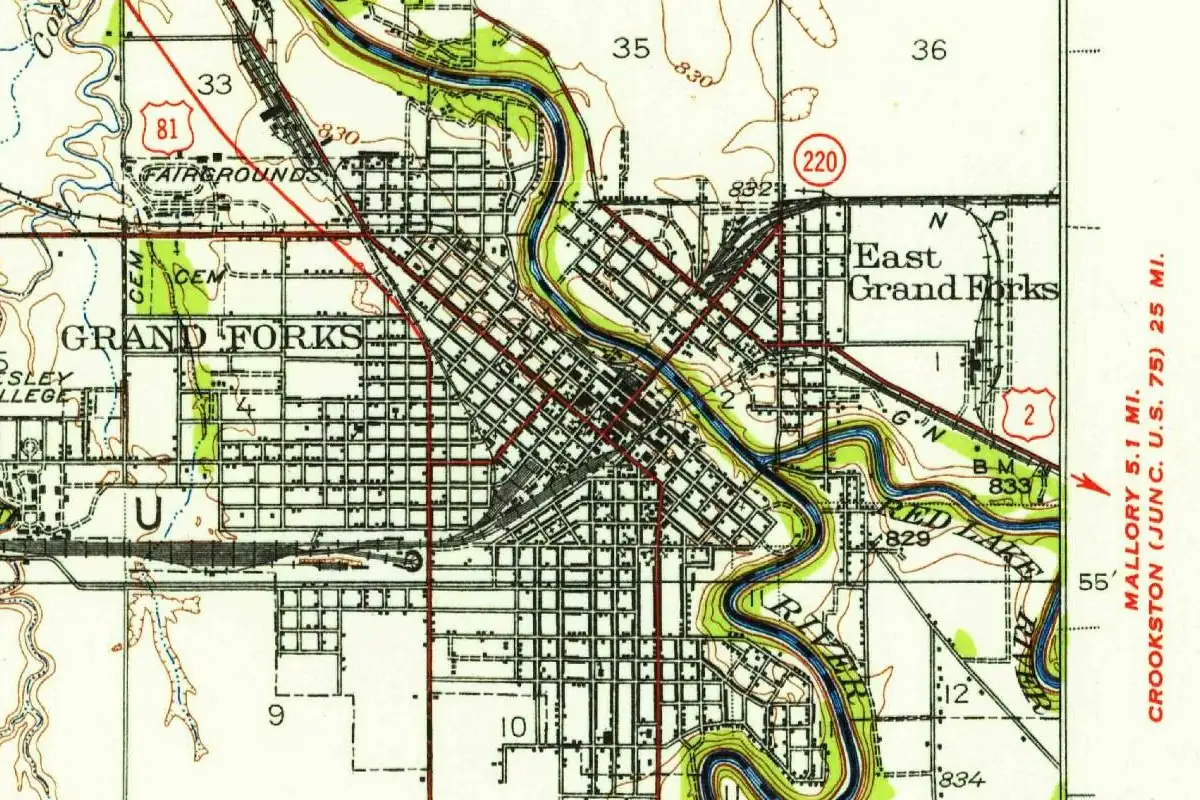
You can see it on the 1934 map above. Grand Forks sits on the west bank, the Red Lake River comes in from the east, and East Grand Forks, across the Red, sits right in the angle between the two.
Beaver at Grandes Fourches
The French part comes from the fur trade. Alexander Henry, a trader for the North West Company, ran posts along the Red River around 1800. The State Historical Society’s 1906 gazetteer of early pioneers says Henry sent a man named John Cameron to “Grandes Fourches (Grand Forks)” on September 1, 1801, to start a post there.
Lounsberry has the tally from that first season: 410 beaver skins, along with bear, wolf, fox, raccoon, fisher, otter and mink. In April 1803, he writes, another of Henry’s men, Augustine Cadotte, was sent back to rebuild the post, a building 100 by 20 feet. Wherever Henry’s company went, rival traders followed, so the forks were a busy place long before there was a town.
The name may be older still. Lounsberry writes that the French explorer La Vérendrye, who was building trading posts in the region in the 1730s, pushed his explorations as far as Grand Forks, “which appears to have been so called by him from the confluence.” Note the “appears.” He doesn’t give a document, so 1801 is the earliest date these sources pin down.
The steamboat captain
The town came with the steamboats. Lounsberry calls Captain Alexander Griggs “founder of Grand Forks and identified with the earliest navigation of the Red River,” and an 1895 roster of Red River Valley old settlers lists him first, at Grand Forks, as of November 1870. That matches GNIS, the government’s gazetteer, which gives 1870 as the founding year. In 1871, Griggs was master of the Selkirk, a new steamboat on the river, and he’s on Lounsberry’s short list of the first settlers that year, along with a sawmill, a ferry, a stage station and a Hudson’s Bay Company store and hotel.
So if you’re from Grand Forks, your city’s name is older than the city by at least seven decades, and the earliest version in these sources is French, from men who came for beaver pelts.
Sources & further reading
- Henry Gannett, The Origin of Certain Place Names in the United States (USGS, 1905), p. 141. The name from the junction of the Red River of the North and the Red Lake River.
- Clement A. Lounsberry, North Dakota History and People, vol. 1 (1917). John Cameron’s 1801–02 season and Augustine Cadotte’s 1803 rebuild (pp. 43–44); Griggs and the Selkirk in 1871 (p. 349); the 1895 old settlers’ roster (p. 355); the confluence and Griggs as founder, in the list of county names (p. 484); the first settlers of 1871 (p. 507); the hedged suggestion that La Vérendrye named the forks (p. 30).
- “Gazetteer of Pioneers and Others in North Dakota,” Collections of the State Historical Society of North Dakota, vol. 1 (1906). Cameron sent to “Grandes Fourches (Grand Forks)” on September 1, 1801 (p. 358); Henry’s posts at Grandes Fourches (p. 367).
- GNIS feature 1029197 (U.S. Geological Survey). The federal record for Grand Forks. Founded 1870.
Spot something wrong, or know more? Tell us here. You can also email us or use our contact page. Corrections are noted here with their date, never made silently.