Devils Lake, North Dakota: The Spirit Water Behind the Name
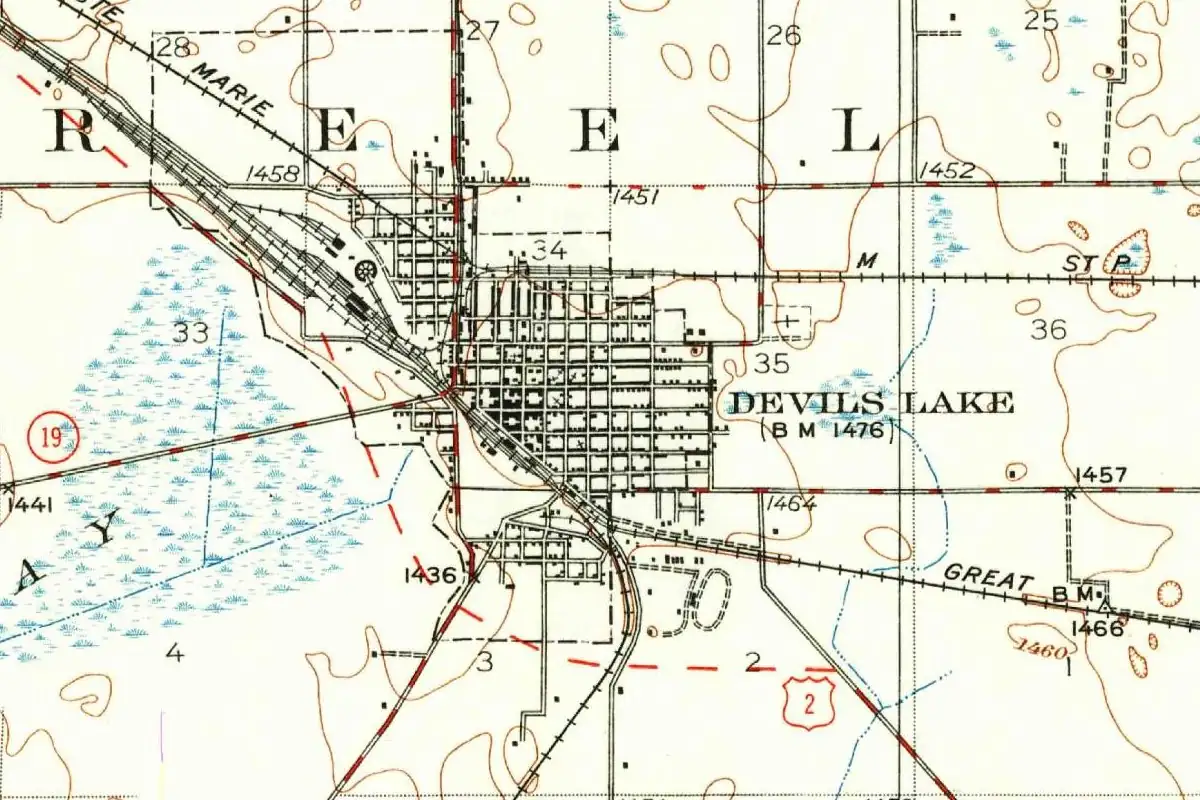
The lake that gave Devils Lake, North Dakota, its name was Minnewaukan in Dakota, and the old translations of that word say “spirit water,” not “devil.” The town itself started out as Creel City and took the lake’s English name in 1884.
Water, and something sacred
The Dakota name has two parts, and you can look both up. Stephen Riggs’s Dakota-English dictionary, published by the federal government in 1890, defines mini as “water.” It defines wakan as “spiritual, sacred, consecrated; wonderful, incomprehensible,” and adds a note that it also means “mysterious,” something not understood and so “dangerous to meddle with.”
The old English translations of the lake’s name follow that second word in different directions:
- Henry Gannett’s 1905 place-names book for the U.S. Geological Survey, under the village of Minnewaukan: “spirit water.”
- The territory’s official 1889 abstract: “Minnewaukan or Spirit Lake of the Indians.”
- Mary R. Brennan, writing for the State Historical Society in 1906: “Mysterious Water.”
- Howastena (Beautiful Voice), born by the lake in 1863, in a story Brennan printed in the same piece (translated by Father Jerome): “Minnewaukan or Holy-Lake.”
- The federal place-names database: a corruption of an Indian name meaning “Lake Holy or Great One.”
None of those is “devil.” For that, Riggs’s dictionary has a different word, wakan-sica (simplified spelling), “the Bad Spirit; the devil.”
The devil was already in a trader’s journal by 1800
So where did the devil come from? The sources we checked don’t say who first put it there, but they show it’s old. Alexander Henry, a fur trader working the Red River around 1800, wrote in his journal about grizzly bears at “Lac du Diable,” some 30 leagues to the west. The State Historical Society printed the passage in 1910. Lac du Diable is French for the devil’s lake, so the name was in use among the traders long before any town.
First, Creel City
The town didn’t start with the lake’s name. The same federal record says it was named for Heber Creel, an early postmaster, and took its current name in 1884. A church committee report from the spring of 1884, printed by the State Historical Society, still calls the place “Creel City, (Devils Lake).”
A legend, told as a legend
Brennan’s 1906 piece retells a Dakota legend about the name. In her version, a war party sets out across the lake against the Ojibwe, a storm wrecks the returning boats, and the mourners’ cry of “Minnewaukan” goes out over the water. She presents it as a story, and so do we. It doesn’t settle the translation, but you can see why “mysterious” made sense to her.
If you’d rather have the Dakota name, it’s still on the map. Gannett lists Minnewaukan as a post village in Benson County, and the 1889 abstract puts the lake partly in that county. The village kept the Dakota word, while its bigger neighbor went with the devil.
Sources & further reading
- Stephen R. Riggs, A Dakota-English Dictionary (1890). Mini, water (p. 315); wakan, “spiritual, sacred,” with the note on “mysterious” (pp. 507–508); wakan-sica, “the Bad Spirit; the devil” (p. 508). Spellings here are simplified from Riggs’s.
- Henry Gannett, The Origin of Certain Place Names in the United States (USGS, 1905), p. 210. Minnewaukan, “spirit water.”
- Frank H. Hagerty, The Territory of Dakota (1889), p. 49. “Minnewaukan or Spirit Lake of the Indians,” in Ramsey and Benson counties.
- Cora Dean, “Early Fur Trading in the Red River Valley, from the Journals of Alexander Henry, Jr.,” Collections of the State Historical Society of North Dakota, vol. 3 (1910), p. 362. Henry’s “Lac du Diable (Devils lake),” with the English in parentheses as printed.
- Mary R. Brennan, “Some Devils Lake Notes,” Collections, vol. 1 (1906), pp. 476–478. The legend of Minnewaukan, which Brennan subtitles “Mysterious Water,” and Howastena’s story, “Minnewaukan or Holy-Lake.”
- Collections of the State Historical Society of North Dakota, vol. 4 (1913), p. 126. The 1884 report that names “Creel City, (Devils Lake).”
- GNIS feature 1028672 (U.S. Geological Survey). The federal record: Creel, the “Lake Holy or Great One” translation and the 1884 name change.
Spot something wrong, or know more? Tell us here. You can also email us or use our contact page. Corrections are noted here with their date, never made silently.