Fargo, North Dakota: The Town That Started Out as Centralia
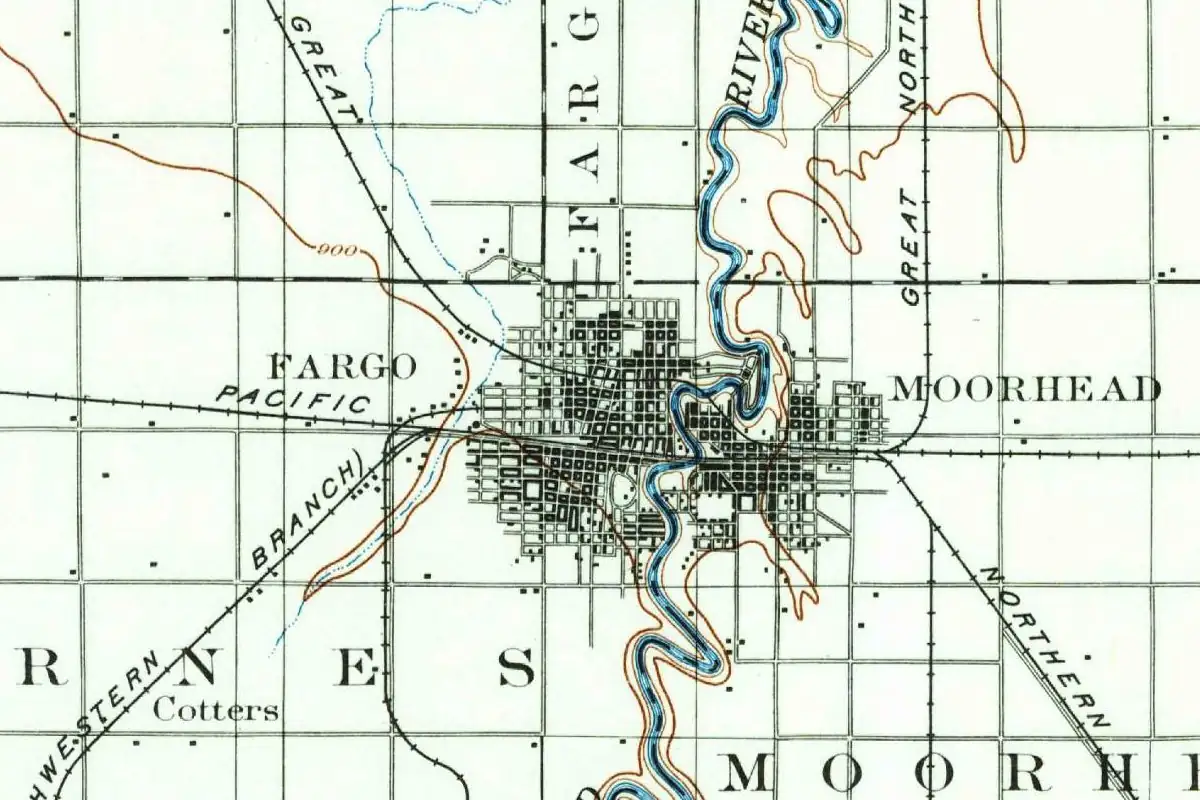
Fargo, North Dakota, got its first post office in 1871 under another name, Centralia, and only switched to Fargo in 1873. The new name honored William G. Fargo, an express-company man from Buffalo, New York, who sat on the board of the railroad that built the town.
Centralia, mostly on paper
The Northern Pacific was laying track toward the Red River in 1871, and the town at the crossing needed mail service. Clement Lounsberry, writing for the State Historical Society in 1906, says the post office “was established in September, 1871, as Centralia,” with Gordon J. Keeney as postmaster. The federal place-names database explains the choice: Centralia was meant to show that the new town would be the central point of Dakota Territory’s development.
It didn’t stick. “The name was changed to Fargo in 1873,” Lounsberry writes, “and the point never became widely known as Centralia.”
Mr. Fargo and the railroad
Henry Gannett’s 1905 survey of American place names says Fargo was “named for one of the members of the Wells, Fargo Express Company,” and adds that “several other places bear his name.” The federal database calls William G. Fargo a founder of Wells-Fargo.
If you want to know why his name landed here, follow the railroad. A biography of Thomas H. Canfield, published in 1889, lists “William G. Fargo, of Buffalo, New York,” among the investors who joined the Northern Pacific syndicate, and says he was elected to the railroad’s board when six old directors resigned. The same book describes him at that point as president of the American Express Company. Canfield, Lounsberry wrote in 1917, located the Red River crossing at Fargo in 1870 and came back the next spring to locate Moorhead and Fargo.
Two Fargos in one winter
You could argue the town had too many Fargos before it had one. G. F. Keeney, who spent the winter of 1871–72 there, wrote that “Fargo in the Timber” was a camp of about 600 people in the woods by the river, mostly the “End of the Track Gang” that followed railroad construction, with saloons, gambling houses and two dance halls. Up on the higher ground, General Thomas L. Rosser’s Northern Pacific engineers camped in tents. “This large settlement of General Rosser’s engineer corps was called Fargo on the Prairie,” Keeney wrote, and there was “not the best of good will” between them.
Just before Christmas, he says, the timber crowd ambushed a wagon of potatoes bound for the engineers. They loosened the end-board as it climbed the riverbank, fired off revolvers, and the team ran away, leaving potatoes along the trail. “The mess of which I was one succeeded in getting nine good sized potatoes for our Christmas dinner.”
The timber camp didn’t last. In February 1872, Keeney writes, troops rounded up the camp, held the people they had warrants for and ordered the rest across the river, and that spring’s high water “drove the last lingering settler from Fargo in the Timber to the high lands of the prairie.”
Sources & further reading
- C. A. Lounsberry, “Early Development of North Dakota,” Collections of the State Historical Society of North Dakota, vol. 1 (1906), pp. 305–309. The Centralia post office of September 1871, postmaster Gordon J. Keeney, and the 1873 change to Fargo (p. 308).
- G. F. Keeney, “Fargo in the Timber,” same volume, pp. 318–321. A firsthand account of the winter of 1871–72: Fargo in the Timber, Fargo on the Prairie, the potato raid and the eviction.
- Life of Thomas Hawley Canfield (1889). William G. Fargo in the Northern Pacific syndicate and on its board; General Thomas L. Rosser’s full name.
- Clement A. Lounsberry, North Dakota History and People, vol. 1 (1917), p. 327. Canfield locating the Red River crossing at Fargo.
- Henry Gannett, The Origin of Certain Place Names in the United States (USGS, 1905), p. 123. Fargo named for a member of the Wells, Fargo Express Company.
- GNIS feature 1028945 (U.S. Geological Survey). The federal record: Centralia, its meaning, and Fargo for William G. Fargo.
Spot something wrong, or know more? Tell us here. You can also email us or use our contact page. Corrections are noted here with their date, never made silently.