Danville, Virginia, and the River William Byrd Called the Dan
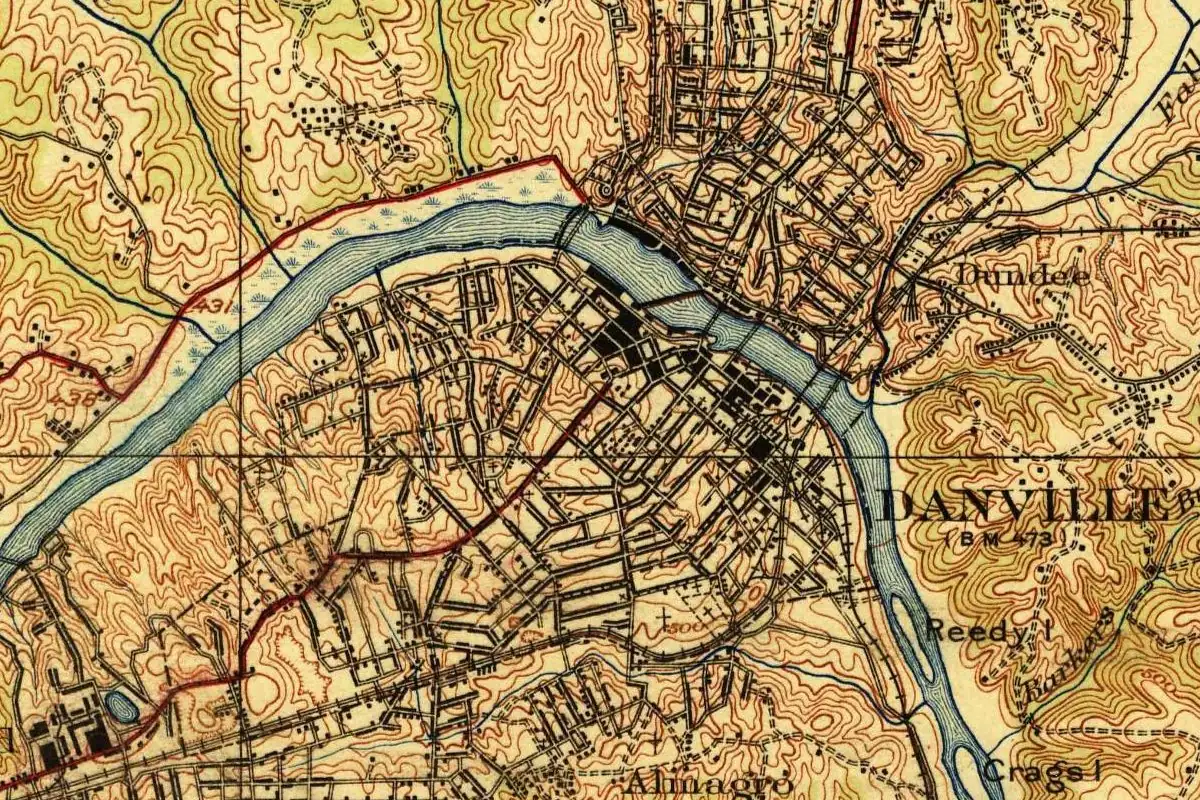
Danville, Virginia, is named for the Dan River, a name William Byrd’s surveying party gave it in October 1728 without ever writing down why. They crossed it, and Byrd’s journal simply says they “call’d” it the Dan. The best-known explanation, about a Bible phrase, came along much later, and you won’t find it in his journal.
“Which we call’d the Dan”
In 1728, Byrd was one of the Virginia commissioners running the boundary line between Virginia and North Carolina. He wrote it all up in The History of the Dividing Line. In his entry for October 10, the line crossed “the South Branch of Roanoak River the first time, which we call’d the Dan.” The river was about 200 yards wide where they forded it, and the far bank was lined with a forest of tall canes so thick they spent a long time cutting a path through.
Earlier in the book, describing the Roanoke, Byrd says it forks into two branches. “The Southern, now call’d the Dan, runs up the farthest,” and the northern branch is “call’d the Staunton.”
That’s the record. Byrd says they named it. He doesn’t say what they had in mind.
The Dan-to-Beersheba story
The federal place-names database does have an explanation, but look at where it comes from. Its note on Danville says the river “was reportedly named for William Byrd, who visited the area in 1728, and supposing himself to be in the land of plenty, felt he had wandered ‘from Dan to Beersheba.’” (It says “for,” but the rest of the sentence makes clear it means Byrd did the naming.) The source it gives is the Danville Chamber of Commerce website, 2001.
“From Dan to Beersheba” is an old Bible phrase, and it’s a nice story. But “reportedly” is doing a lot of work there. Byrd’s own account of that day doesn’t mention Beersheba. It does start well: after a hungry night, they shot a fat doe and some wild turkeys, and “the Plenty of the Morning made amends.” Then a man in the party got publicly scolded for wishing he were back home, and after that, Byrd writes, nobody “pretended so much as to wish himself in Paradise.” At the river, they even thought for a minute the sparkly sand was gold dust. But Byrd never ties any of it to the river’s name.
A tobacco town at Winn’s Falls
The town came 65 years later. Virginia’s General Assembly met in the fall of 1793, and in an act “to establish several towns,” passed November 23, it set aside 25 acres belonging to John Barnett “adjoining Winn’s falls, on the south side of Dan river, in the county of Pittsylvania.” Trustees were to lay them out in half-acre lots and establish “a town, by the name of Danville.”
A second law that session, passed December 3, set up a tobacco inspection on Barnett’s land by the same falls, a warehouse, in the law’s words, “for the reception and inspection of tobacco,” with houses “to be called and known by the name of Danville warehouse.” So the name went into the law books twice in about ten days.
The federal record spells the old place Wynne’s Falls and says the village was renamed Danville by that 1793 act. The law itself writes “Winn’s falls.” Henry Howe’s 1845 history quotes it the same way.
Not another Daniel
Here’s a small surprise if you flip through Henry Gannett’s 1905 list of American place names. Most of the Danvilles in it go back to a person called Dan or Daniel: Dan Beckwith in Illinois, Daniel Bales in Indiana, Walker Daniel in Kentucky, Daniel M. Boone in Missouri, Gen. Daniel Montgomery in Pennsylvania. Virginia’s entry stands apart. It’s “so named because situated on the river Dan.”
Sources & further reading
- John Spencer Bassett, ed., The Writings of “Colonel William Byrd” (1901), pp. 114 and 132–134. The Roanoke’s two branches, “the Southern, now call’d the Dan” (p. 114); the entry for October 10, 1728, with “the Plenty of the Morning” and the man scolded for wishing himself home (p. 132), the first crossing, “which we call’d the Dan” (p. 133), and the “Gold-Dust” that turned out to be isinglass (pp. 133–134).
- Samuel Shepherd, The Statutes at Large of Virginia, vol. 1, pp. 260 and 266–267. The act passed December 3, 1793, for “Danville warehouse” on John Barnett’s land at Winn’s falls (p. 260), and the act passed November 23, 1793, establishing “a town, by the name of Danville” (pp. 266–267).
- GNIS feature 1492837 (U.S. Geological Survey). Wynne’s Falls renamed Danville in 1793, and the “from Dan to Beersheba” story, credited to the Danville Chamber of Commerce website (2001).
- Henry Gannett, The Origin of Certain Place Names in the United States (USGS, 1905), p. 100. Virginia’s Danville “so named because situated on the river Dan,” next to the Danvilles named for men called Dan or Daniel.
- Henry Howe, Historical Collections of Virginia (1845), pp. 243 and 429. Byrd as one of the Virginia commissioners who ran the line in 1728 (p. 243); Danville on the Dan River, established by law in 1793 on the land of “John Barnett, adjoining Winn’s Falls.”
Spot something wrong, or know more? Tell us here. You can also email us or use our contact page. Corrections are noted here with their date, never made silently.