Roanoke, Virginia: How Big Lick Traded Up Its Name
Until 1882, Roanoke, Virginia, was Big Lick, named for a salt lick. When two railroads made it their junction, the town took the name of its river and county. The new name is much older than the city, and it goes back to an Algonquian word that English colonists picked up in the 1580s.
The lick
The old name was literal. The 1942 history Roanoke: Story of County and City, compiled by workers of the federal Work Projects Administration’s Writers’ Program in Virginia, describes “the great salt lick” in the valley, with springs nearby. Animals wore trails to it, and Native hunters followed those trails, coming to hunt and to “make” salt. “For uncounted years,” the book says, “the lick remained the meeting place of beast and Indian.”
A village grew up around it. Big Lick got a railroad depot in 1852 and was chartered as a town in 1874, with John Trout as mayor. There was also a second community, Old Lick.
The railroads come to town
In 1881, word got around that two railroads, the Shenandoah Valley and the Norfolk and Western, were looking for a place to meet. Their officials settled on Big Lick. The WPA history says there were fewer than 700 people in Big Lick and Old Lick put together that year.
Then came the boom, and the rename. “In 1882 Old Lick and Big Lick were united,” the book says. “Because the names that the two communities had borne scarcely befitted a prosperous city, Old Lick and Big Lick became Roanoke in 1882.” In other words, the town wanted a name that sounded like a city’s, and it borrowed the one already on the river and the county.
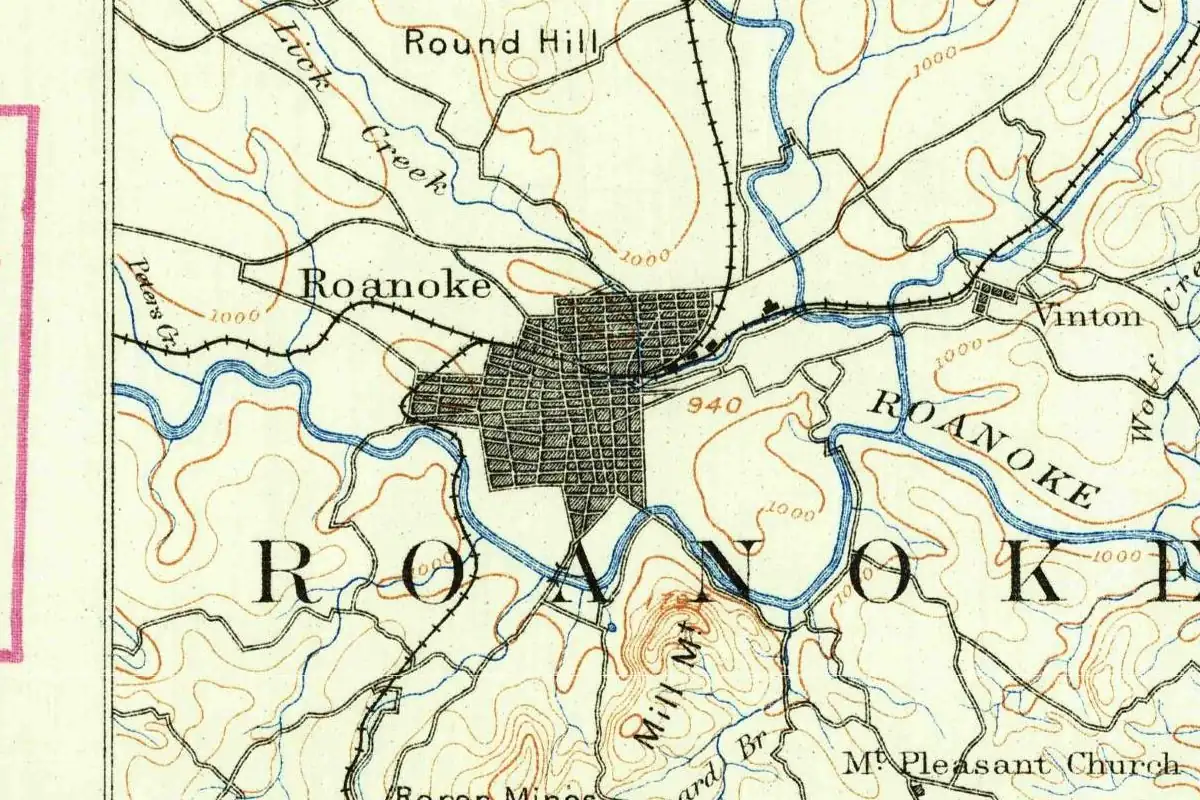
Records from the time back up the dates. In July 1881, the Railroad Gazette reported that the name of Big Lick station, “the point of junction with the Shenandoah Valley Railroad, has been changed to Roanoke.” The town followed: an 1888 article in the Manufacturers’ Record says the place was “called Big Lick until June, 1882, when the name of the village was changed to Roanoke.” If you look at the old U.S. Geological Survey map from 1890, you can still see the original name hiding in plain sight: the stream running in from the north is Lick Creek.
What “Roanoke” means
That part isn’t settled, and the old sources point in two directions.
Shell beads. Henry Gannett’s 1905 federal place-name book calls Roanoke “an Indian word designating a kind of shell used for money.” The WPA history says the same, spelling the word “Rawenoke.” The Handbook of American Indians, published by the Smithsonian’s Bureau of American Ethnology, backs up the link to beads. In an entry by the contributor W. R. Gerard, it says Virginia colonists used “roanoke” for the shell beads that nearby Native people wore and traded. Gerard notes that Captain John Smith wrote the Powhatan word as “rawrenock” and “rawranoke,” and that William Strachey defined “rarenaw” as “a chain of beads.” Gerard thought the original word “may have been” one meaning “smoothed shells.” That “may” is his, not ours.
A people’s name. The same Handbook has a separate entry, also by Gerard, for Roanoak as the name of a people, which he translates as “northern people.” These were the Native people that the English explorers Amadas and Barlowe met in 1584, on the island in what’s now North Carolina that came to be called Roanoke Island. According to Gerard, their name became “fixed, in the form Roanoke,” first for the island, and “later it was applied to a river of Virginia and North Carolina, a city and county of Virginia.”
Either way, it’s an Algonquian word from the coast, and Gerard traces the name from the island to the river and then to the county and city. What the sources disagree on is whether it first meant shell beads or a group of people. These sources don’t settle it, and you’ll see both translations depending on where you look.
A river named long before the city
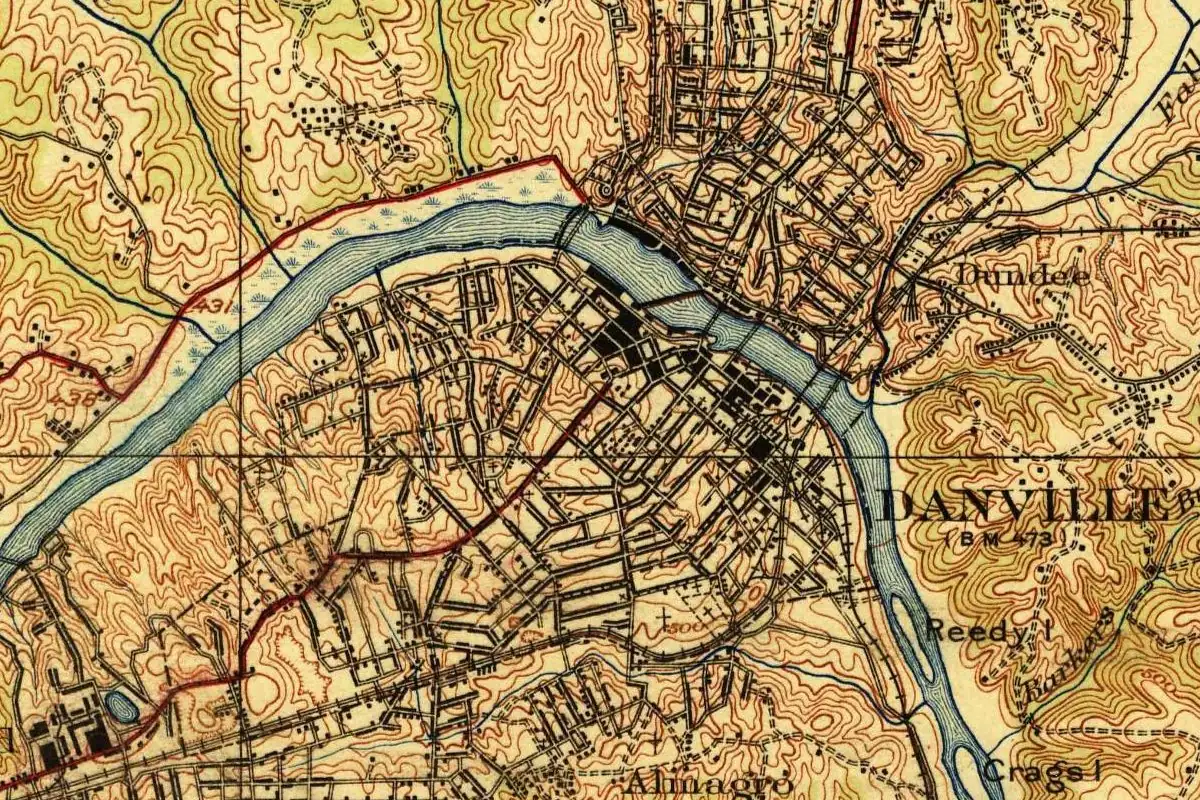
The river had the name long before Big Lick did. When William Byrd ran the boundary line between Virginia and North Carolina in 1728, he wrote about “the great Falls of Roanoak” and the place where the river forks. One branch, he wrote, was “now call’d the Dan.” That’s the river that later gave Danville its name, so two Virginia cities ended up named for the same river system.
Sources & further reading
- Writers’ Program of the Work Projects Administration in Virginia, Roanoke: Story of County and City (1942). The salt lick (p. 14); Big Lick’s depot in 1852, its 1874 charter and the 1881 junction decision (pp. 133–134); the 1882 union of Old Lick and Big Lick as Roanoke, the word “Rawenoke,” and fewer than 700 people in 1881 (pp. 134–135).
- The Railroad Gazette, July 29, 1881. A news item: the name of Big Lick station, “the point of junction with the Shenandoah Valley Railroad, has been changed to Roanoke.”
- Manufacturers’ Record, July 14, 1888. A business article on the young city: “called Big Lick until June, 1882, when the name of the village was changed to Roanoke.”
- Frederick Webb Hodge, ed., Handbook of American Indians North of Mexico, Part 2 (Bureau of American Ethnology Bulletin 30, 1912 printing). W. R. Gerard’s entries “Roanoak” (“northern people,” and the name’s path from the island to the river, county and city) and “Roanoke” (the shell-bead word, Smith’s “rawrenock” and “rawranoke,” Strachey’s “rarenaw,” and the guess “smoothed shells”).
- Henry Gannett, The Origin of Certain Place Names in the United States (USGS, 1905), p. 264. “An Indian word designating a kind of shell used for money.”
- GNIS feature 1499971 (U.S. Geological Survey). The federal record repeats Gannett’s line about shell money.
- John Spencer Bassett, ed., The Writings of “Colonel William Byrd” (1901), pp. 114, 133. Byrd’s 1728 notes on the Roanoke River, its falls and its fork, and the branch “now call’d the Dan.”
Spot something wrong, or know more? Tell us here. You can also email us or use our contact page. Corrections are noted here with their date, never made silently.