Lynchburg, Virginia: The Quaker's Ferry, Not the Colonel
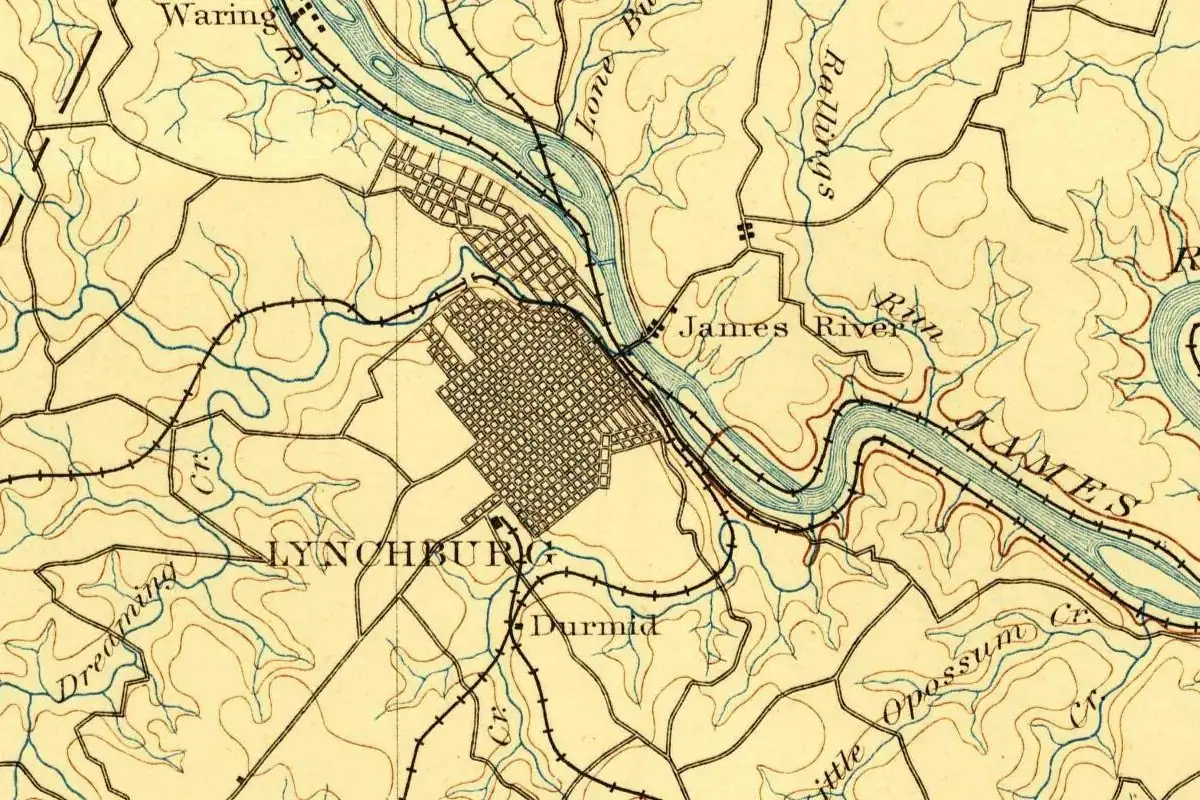
Lynchburg, Virginia, was laid out on John Lynch’s land beside his ferry on the James River, and the 1786 law that created it gave it his family name. John was a Quaker. If you’ve heard of a different Lynch, it’s probably his brother Charles, the Revolutionary War colonel whose name, according to an 1845 history, gave us the term “lynch law.”
Forty-five acres by the ferry
The law is short and specific. In October 1786, Virginia’s General Assembly passed “An act to establish a town on the lands of John Lynch, in the County of Campbell.” It says “forty-five acres of land, the property of John Lynch, and lying contiguous to Lynch’s ferry,” would go to a board of trustees, who would lay them off “into lots of half an acre each, with convenient streets, and established a town by the name of Lynchburg.”
So the family name went on the town, the land and the ferry all at once.
Henry Howe’s Historical Collections of Virginia fills in the family story. John Lynch’s father was “an Irish emigrant” who took up land in the area before the Revolution. When the father died, the town site “fell to his son John, by whose exertions the town was established.” Howe describes the founder as “a member of the denomination of Friends,” which is the formal name for the Quakers, and “a plain man, of strict integrity and great benevolence of character.”
Only one house
It’s hard to picture now, but Howe says that when the town was formed “there was but a single house, the ferry-house.” A tobacco warehouse and two or three stores went up under the hill after that. By 1845, Howe was calling Lynchburg the fifth-largest town in Virginia.
The brother with the other legacy
Here’s the part that’s easy to mix up. Howe writes that Col. Charles Lynch, “a brother of the founder of Lynchburg,” was an officer in the Revolution who lived in the southwestern part of Campbell County. During the war, Howe says, he caught and punished a band of Tories and outlaws “without any superfluous legal ceremony,” and “Hence the origin of the term ‘Lynch Law.’”
A Charles Lynch does show up in the town’s founding law, but only as one of the ten trustees. The land was John’s, and a 1785 law calls the crossing “John Lynch’s ferry.”
Even the federal government’s 1905 place-name book muddies it a bit. Henry Gannett wrote that Lynchburg was “named for a rich settler and officer of the Revolution.” Going by Howe, the Revolutionary officer in the family was Charles, while the founder was John, the Quaker with the ferry. If you read Gannett’s line on its own, you’d get the wrong brother. The 1786 law is the better witness, and it points to John.
Sources & further reading
- William Waller Hening, The Statutes at Large, vol. 12, pp. 65 and 398–399. The October 1785 act for a tobacco inspection “at John Lynch’s ferry” (p. 65), and the October 1786 act establishing a town “on the lands of John Lynch” next to Lynch’s ferry, “by the name of Lynchburg,” with a Charles Lynch among the trustees (pp. 398–399).
- Henry Howe, Historical Collections of Virginia (1845), pp. 210–212. The Lynch family’s Irish father, John Lynch as the Quaker founder, the single ferry-house, and Col. Charles Lynch and the origin of “lynch law.”
- Henry Gannett, The Origin of Certain Place Names in the United States (USGS, 1905), p. 192. “Named for a rich settler and officer of the Revolution,” a description that doesn’t match the founder Howe and the 1786 law describe.
- GNIS feature 1479007 (U.S. Geological Survey). The federal record for Lynchburg, with its location. It has no note on the name.
Spot something wrong, or know more? Tell us here. You can also email us or use our contact page. Corrections are noted here with their date, never made silently.