How Williamsburg, Virginia Got Its Name From King William
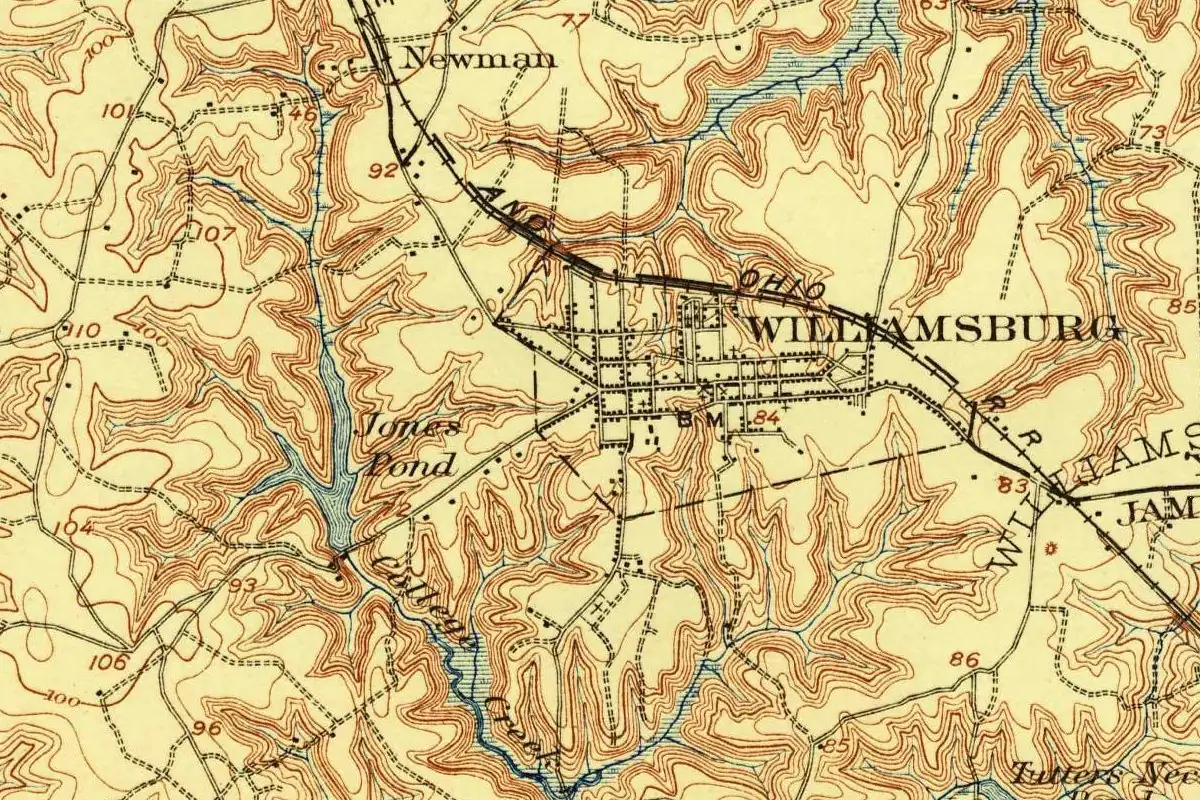
Williamsburg, Virginia, spent more than 60 years as Middle Plantation, until the capital moved there from Jamestown and the town was renamed for King William. That’s William III of England, who was on the throne when Jamestown’s statehouse burned and Virginia’s government picked up and moved inland.
Middle Plantation
The first name was about geography, not royalty. In 1907, Lyon Gardiner Tyler, then president of the College of William and Mary, wrote a history of the town. He explains that in the early 1630s the colony ran a line of palisades, a wall of sharpened stakes, about six miles long from one creek to another, and “on the ridge between, a settlement called Middle Plantation, (afterwards Williamsburg), was made.” Tyler calls it a palisade “across the Peninsula,” the strip of land between the James and York rivers.
In 1693, the colony picked Middle Plantation as the site for the new College of William and Mary, building it, in the words of the act Tyler quotes, “as neare the church now standing in Middle Plantation old fields as convenience will permit.”
A fire at Jamestown
The big change came in October 1698, when the statehouse at Jamestown fell “again a victim to flames,” as Tyler puts it. Governor Francis Nicholson moved the seat of government to Middle Plantation. The assembly praised the spot for its “serene and temperate air” and its “wholesome springs.” A chaplain named Hugh Jones, whose book Henry Howe quoted in 1845, added a less formal reason: the new place was “freer from the annoyance of moschetoes.”
Then the place got its new name. Tyler puts it simply: “The place was now newly named Williamsburg, after the reigning monarch, King William.” The federal government’s 1905 place-name book by Henry Gannett agrees that it was “named for William III, of England.” Tyler dates the act “for the building of Williamsburg” to 1699.
A town shaped like letters
Hugh Jones wrote that Nicholson “laid out the city of Williamsburg” in “the form of a cipher, made of W and M.” Tyler, writing in 1907, is more careful. He says Nicholson “at first entertained the fanciful idea” of a W-and-M layout but dropped it as inconvenient, “though there is still a suggestion of these letters in the make-up of the eastern and western ends.” So if you squint at a map of the old town, you’re looking for something the governor gave up on.
Nicholson did leave his own name on the streets, though. Tyler points out that Duke of Gloucester Street, the main street, was flanked by Francis Street on the south and Nicholson Street on the north. Cross the main street from one to the other and you’ve walked the governor’s full name.
Sources & further reading
- Lyon Gardiner Tyler, Williamsburg, the Old Colonial Capital (1907). The palisade across the peninsula and the name Middle Plantation (p. 10); the 1693 college act, the 1698 fire, the move of the capital, “newly named Williamsburg, after the reigning monarch, King William,” the W-and-M idea, and Francis and Nicholson streets (pp. 19–21). Tyler also refers to “the act of 1699 for the building of Williamsburg.”
- Henry Howe, Historical Collections of Virginia (1845), p. 321. Middle Plantation, the move of the government in 1698, and the passage from Hugh Jones’s The Present State of Virginia about mosquitoes and the W-and-M “cipher.”
- Henry Gannett, The Origin of Certain Place Names in the United States (USGS, 1905), p. 325. “Named for William III, of England.”
- GNIS feature 1498551 (U.S. Geological Survey). The federal record for Williamsburg, which it lists as the seat of James City County.
Spot something wrong, or know more? Tell us here. You can also email us or use our contact page. Corrections are noted here with their date, never made silently.