Pomona, California: A Town Lot for Naming a Goddess
A nurseryman won a town lot for naming Pomona, California, after the Roman goddess of fruit, or so a 1920 history of the valley tells it. The contest rests on that one book, Frank Brackett’s, but the federal place-names records agree on the goddess part: Pomona is named for the Roman goddess of fruit, from the Latin pomum, “fruit.”
A prize for the best name
In 1875 there wasn’t much on the spot yet. The Southern Pacific had reached Spadra, and the first train ran there from Los Angeles on April 4, 1874. A Los Angeles company with a mouthful of a name, the Los Angeles Immigration and Land Co-operative Association, took over about 2,700 acres of rancho land, along with water rights, and set out to sell it in small tracts for settlement.
The new town needed a name, and Brackett says the company held a little contest. Drawing on the recollections of A. L. Tufts and L. M. Holt, he writes that there was “a prize offer of a town lot for the best name proposed and adopted for the town.” The winner was “Solomon Gates, the nurseryman,” who was “familiar with the Pomona of the Grangers, and aware of the mythological character of Pomona, the Goddess of Fruit.” Holt was the company’s secretary.
You can’t check the contest against the company’s own minutes, because we didn’t find them. But Gates was real and really was in the nursery business: an 1889 county history mentions a nursery partnership “with S. Gates, near Pomona” that ran from 1882 to 1885.
The goddess came by way of the Grange
So what’s “the Pomona of the Grangers”? J. M. Guinn, in a 1901 history of Los Angeles and its neighbors, called the Grange a farmers’ secret order that was very popular in the county at the time. He explained that Pomona, Ceres and Flora were three goddesses “personated at Grange meetings by three young ladies” who looked after the farmers’ interests in fruits, grain and flowers.
Guinn went further than Brackett. He thought it “not probable” that the founders went digging through mythology for a name (he called Pomona a Grecian goddess, though she’s Roman) and wrote that the name was “no doubt a suggestion from the Grange.” Since the town was meant to be a fruit-growing colony, he said, it got the goddess of fruits. The two accounts fit together fine: Gates knew the goddess from the Grange and from the myths, and in Brackett’s telling he’s the one who proposed it.
Here’s a detail that ties it up neatly. The first piece of the new town to be sold, a ten-acre tract, went to Judge J. M. Hamilton. Brackett identifies him as Master of the State Grange of California, and an 1880 county history shows him organizing a county “Pomona Grange.” So the goddess, the farmers’ lodge and the town’s first buyer all point the same way.
Five miles past Spadra
The Los Angeles Star reported on November 13, 1875, that Pomona was “a new settlement about five miles beyond Spadra,” so about 5 miles (8 km) east of the old end of the line. The big land auction opened on February 22, 1876. Brackett says a band played, water ran down open ditches along the streets for the day, and the excursion crowd from the city got dinner at the new hotel before the bidding.
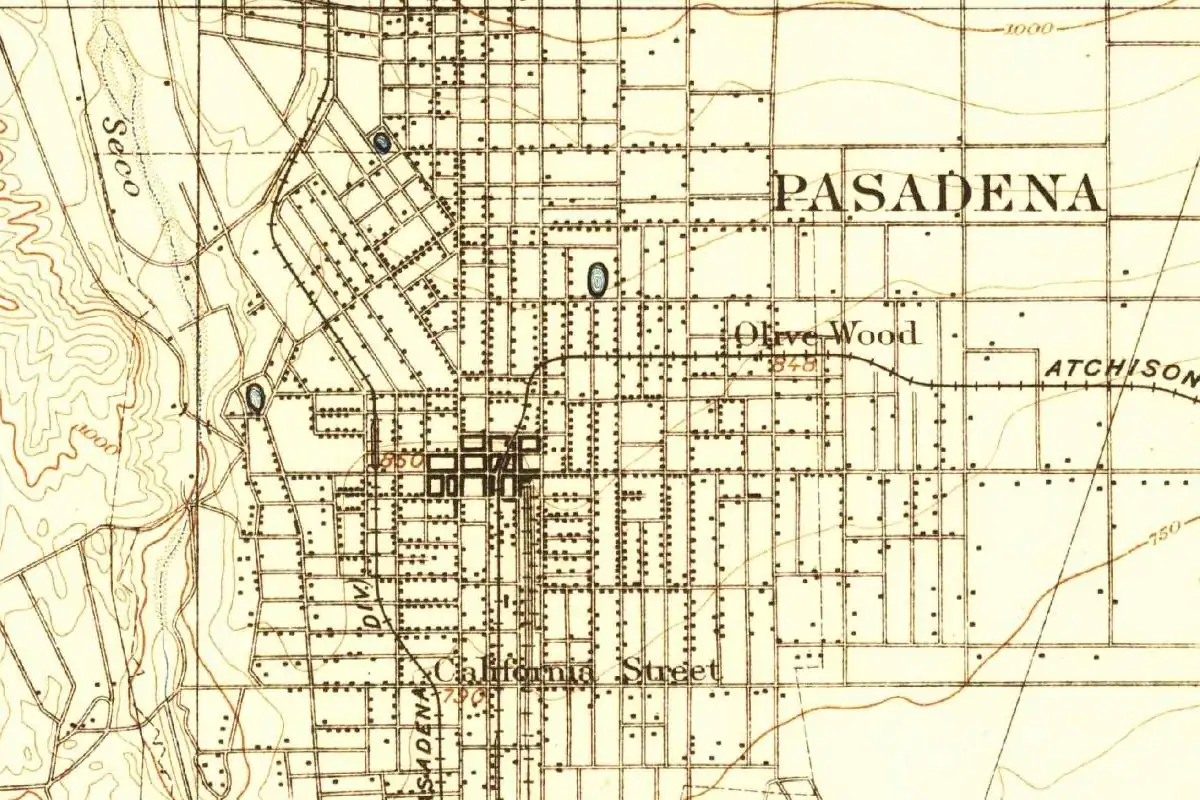
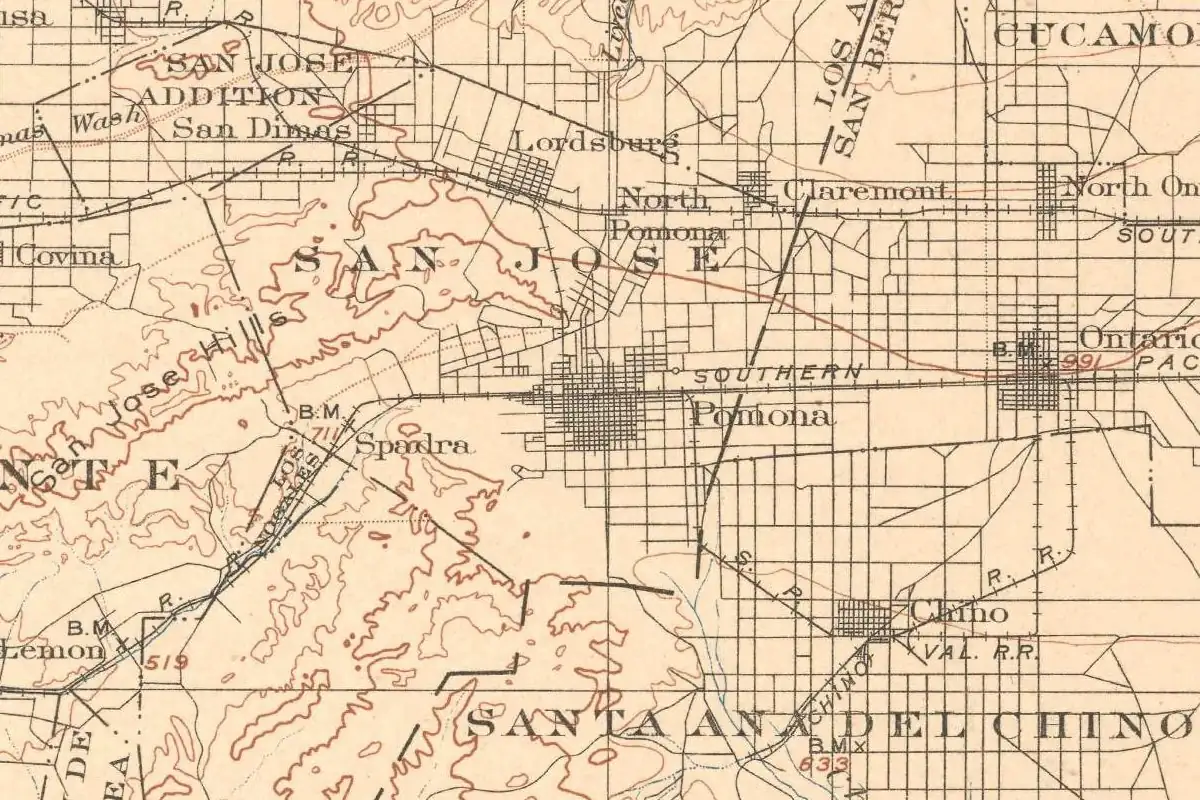
Pomona was a child of the same colony years as Pasadena, Guinn wrote, and both towns picked their names in 1875. Pasadena’s settlers voted on a word from a missionary’s list. Pomona’s land company, in Brackett’s telling, paid for its name with a town lot. On the 1901 Geological Survey map at the top of this page, you can see how it turned out: Pomona’s tight street grid sits right on the Southern Pacific line, with Spadra just to the west and the words SAN JOSE, the old rancho’s name, spread across the valley.
Where Route 66 meets Pomona
If you’re driving the old road with a 1939 guidebook, you won’t find Pomona among its stops. The WPA’s guide to California runs US 66 along the foothills from Claremont straight to La Verne, and it describes Pomona itself on another tour, as a stop on US 60-70.
The road and the city do meet, though, on Foothill Boulevard. The National Register paperwork for U.S. Highway 66 in California, filed with the National Park Service in 2011, follows the old highway along Foothill Boulevard between San Bernardino and Pasadena. A 2017 California Assembly committee analysis of a bill to mark the road’s 100th anniversary lists today’s state Route 66 as running from Route 210 near San Dimas “to the eastern city limit of the City of Pomona.” And a 2022 Caltrans permit record covers a traffic signal “at the intersection of Route 66 (Foothill Boulevard) and Garey Avenue in the City of Pomona.” That’s the same Garey Avenue, named for the land company’s president, Thomas A. Garey. For more stops along the road, see our Route 66 towns.
A goddess in marble
The town didn’t stop at the name. The Rev. C. F. Loop, one of the valley’s pioneer fruit growers, saw an ancient statue of Pomona in the Uffizi Gallery in Florence while traveling in 1888. He had a life-size marble copy made in the studio of Antonio Frilli and gave it to the city, which unveiled it on July 4, 1889. Brackett says the library moved into new rooms partly because the statue needed a proper home.
So, as Brackett tells it, a fruit town got its name from a nurseryman, its goddess from a farmers’ lodge, and finally a marble version of her shipped all the way from Italy.
Quick answers
What is Pomona, California, named after?
Pomona, the Roman goddess of fruit. Both Gannett (1905) and the federal place-names database give that origin and trace the word to the Latin pomum, “fruit.”
Who named Pomona, California?
Solomon Gates, a nurseryman, according to Brackett’s 1920 history. Brackett, drawing on the recollections of A. L. Tufts and L. M. Holt, says Gates proposed the name and won the land company’s prize of a town lot.
Is Pomona named after the Grange?
In part, according to Guinn. He wrote in 1901 that the name was “no doubt a suggestion from the Grange,” where Pomona was one of three goddesses played by young women at meetings. Brackett says Gates knew “the Pomona of the Grangers” as well as the goddess of the myths.
Is Pomona on Route 66?
Partly. The National Park Service’s Route 66 documentation for California follows the old highway along Foothill Boulevard, and Caltrans records Route 66 (Foothill Boulevard) at Garey Avenue in the City of Pomona. The 1939 WPA guide, though, ran US 66 from Claremont to La Verne and listed Pomona itself on US 60-70.
Key dates
- 1874April 4: The first Southern Pacific train runs from Los Angeles to Spadra.
- 1875The land company lays out the new town of Pomona, named for the Roman goddess of fruit.
- 1876February 22: The big auction of lots and farms opens on the new townsite.
- 1889July 4: A marble statue of the goddess Pomona, a gift from Rev. C. F. Loop, is unveiled.
- 1939The WPA guide to California runs US 66 from Claremont to La Verne and puts Pomona on US 60-70.
Getting there
The closest airports, Amtrak stations and intercity bus stops, measured in a straight line from the center of Pomona.
Airports
- Ontario International (ONT) 9 mi 14 km
- John Wayne/Orange County (SNA) Santa Ana 27 mi 44 km
Amtrak trains
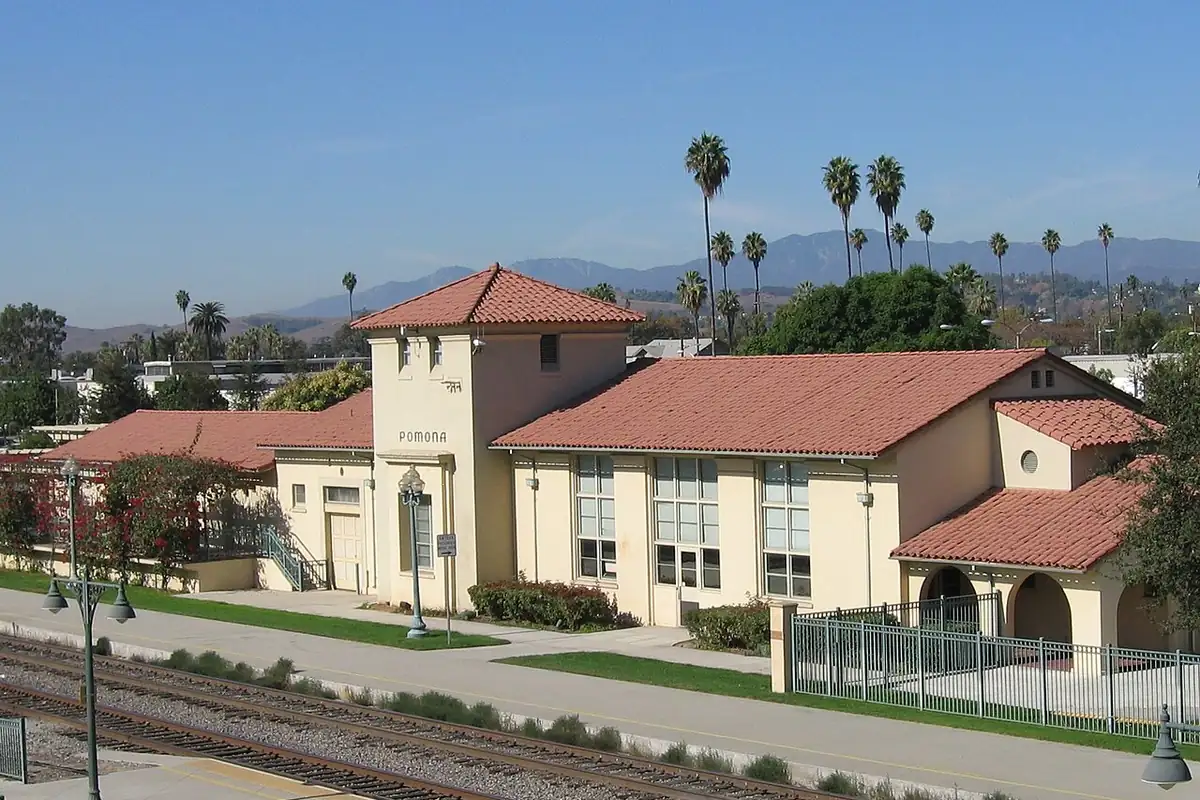
- Pomona station (POS) under 1 mi 0.5 km
- Ontario station (ONA) 6 mi 9 km
Intercity buses
- Mexicoach Pomona 2 mi 4 km
- Gold Runner Claremont-Metrolink 3 mi 5 km
- Amtrak Chartered Vehicle Amtrak Connecting Service · Claremont Amtrak Station 3 mi 5 km
Distances are as the crow flies, not by road. We don't list schedules or fares because they change; check with the airline, Amtrak or the bus company before you go. Official data (FAA commercial service airports (2025), FAA airport locations, Amtrak stations and Intercity Bus Atlas) from the FAA and the U.S. Bureau of Transportation Statistics, checked Nov 2, 2026.
Historical Sources & References
- Frank P. Brackett, History of Pomona Valley, California (1920). The first train to Spadra on April 4, 1874 (p. 114); the land company and the “prize offer of a town lot for the best name,” won by “Solomon Gates, the nurseryman,” as told by A. L. Tufts and L. M. Holt (p. 115); the February 22, 1876, auction and the first sale to Judge J. M. Hamilton, “Master of the State Grange of California” (p. 116); the Loop statue and the library (pp. 169-170).
- J. M. Guinn, Historical and Biographical Record of Los Angeles and Vicinity (1901). The name as “no doubt a suggestion from the Grange,” with Pomona, Ceres and Flora “personated at Grange meetings by three young ladies”; the colony era of Pasadena and Pomona; the 1837 rancho grant and the land company (pp. 191-192).
- An Illustrated History of Los Angeles County (Lewis Publishing, 1889). The Pomona chapter: the rancho, the land association, the first sale to J. M. Hamilton and the railroad’s former terminus at Spadra. Also the nursery partnership “with S. Gates, near Pomona,” and Loop’s statue, “a fac simile of the famous Antique No. 74, of the Uffizi Gallery,” unveiled July 4, 1889.
- History of Los Angeles County, California (Thompson & West, 1880). The Los Angeles Star of November 13, 1875, on “a new settlement about five miles beyond Spadra” and Garey Avenue (p. 134); Judge J. M. Hamilton, Master of the State Grange, organizing the county’s Pomona Grange (p. 126).
- Henry Gannett, The Origin of Certain Place Names in the United States (USGS, 1905). Pomona, California, “named for the Roman goddess of fruit. From the Latin pomum, ‘fruit.’” (p. 250)
- Federal Writers’ Project, California: A Guide to the Golden State (1939). US 66 from Claremont to La Verne in Tour 12c (pp. 618-619), and Pomona, “named for the Roman goddess of fruits at its founding in 1875,” on the US 60-70 tour (p. 633).
- National Park Service, National Register documentation, U.S. Highway 66 in California (2011). “U.S. Highway 66 along Foothill Boulevard,” with Foothill Boulevard “between San Bernardino and Pasadena” widened in the 1930s (section E, maps 31-32).
- California Assembly Committee on Transportation, analysis of AB 542 (2017). The committee’s summary of state law, describing state Route 66 as running from Route 210 near San Dimas “to the eastern city limit of the City of Pomona,” in a bill about the road’s centennial.
- Caltrans DIME, project 993579. A 2022 permit for a traffic signal “at the intersection of Route 66 (Foothill Boulevard) and Garey Avenue in the City of Pomona.”
- U.S. Geological Survey, Southern California Sheet No. 1 (1901). The map at the top of this page, with Pomona, Spadra and the San Jose rancho name.
- GNIS feature 1661247, Pomona (U.S. Geological Survey). The official name and coordinates of the city, with the note “Named for the Roman goddess of fruit. From the Latin pomum, ‘fruit.’”
Spot something wrong, or know more? Tell us here. You can also email us or use our contact page. Corrections are noted here with their date, never made silently.