Breckenridge, Colorado: One Letter, Two Namesakes
Breckenridge, Colorado, is spelled differently from Vice President John C. Breckinridge, the man old histories say it’s named for, and nobody agrees why. An 1895 history says the founders picked his name to get a post office, and the spelling switched to an e after he went with the Confederacy, but a local historian says the e was there first, and that it belonged to somebody else.
A post office for the vice president
The gold came before the town. Wilbur Fisk Stone’s History of Colorado (1918) dates it to August 10, 1859, and quotes Reuben J. Spalding: his party sank a hole on a bar near the Blue River and got 13 cents of gold out of the first pan. It was “the first recorded discovery on Blue River,” as Spalding put it, and a rush followed, the kind that put names on gold rush towns all over the West.
Frank Hall tells the naming story in his History of the State of Colorado (1895). A prospecting company led by George E. Spencer, later a U.S. senator from Alabama, showed up in August 1859 and started building cabins half a mile (0.8 km) above the mouth of French Gulch. In the spring of 1860, Spencer & Co. claimed 320 acres under the federal town site law, had it surveyed, and christened the place “in honor of John C. Breckinridge, then Vice-president of the United States.”
Hall even gives you the reason. The founders wanted a post office and a mail route from Denver, so they asked B. D. Williams, a Kentucky-born Democrat who was lobbying Congress for the Pike’s Peak settlers. Williams told them that naming the town for the vice president would help their chances. It worked, Hall says: the office was set up and Spencer was appointed postmaster, though he left the country before his commission arrived.
The letter that changed
Then comes Hall’s explanation for the e. “At a later period the orthography of the name was changed to ‘Breckenridge,’” Hall writes, “owing to the prominent part which Mr. John C. Breckinridge assumed on the Confederate side in the late civil war.”
That’s a good story, and it may well be true. But Hall wrote it three decades after the war and didn’t give a date for the change. He says his notes on the early camps came mainly from the recollections and letters of pioneers. We weren’t able to check it against a town record or a newspaper from the 1860s. Stone’s 1918 history only says the camp was called “Breckinridge, (afterward changed to Breckenridge),” with no reason given.
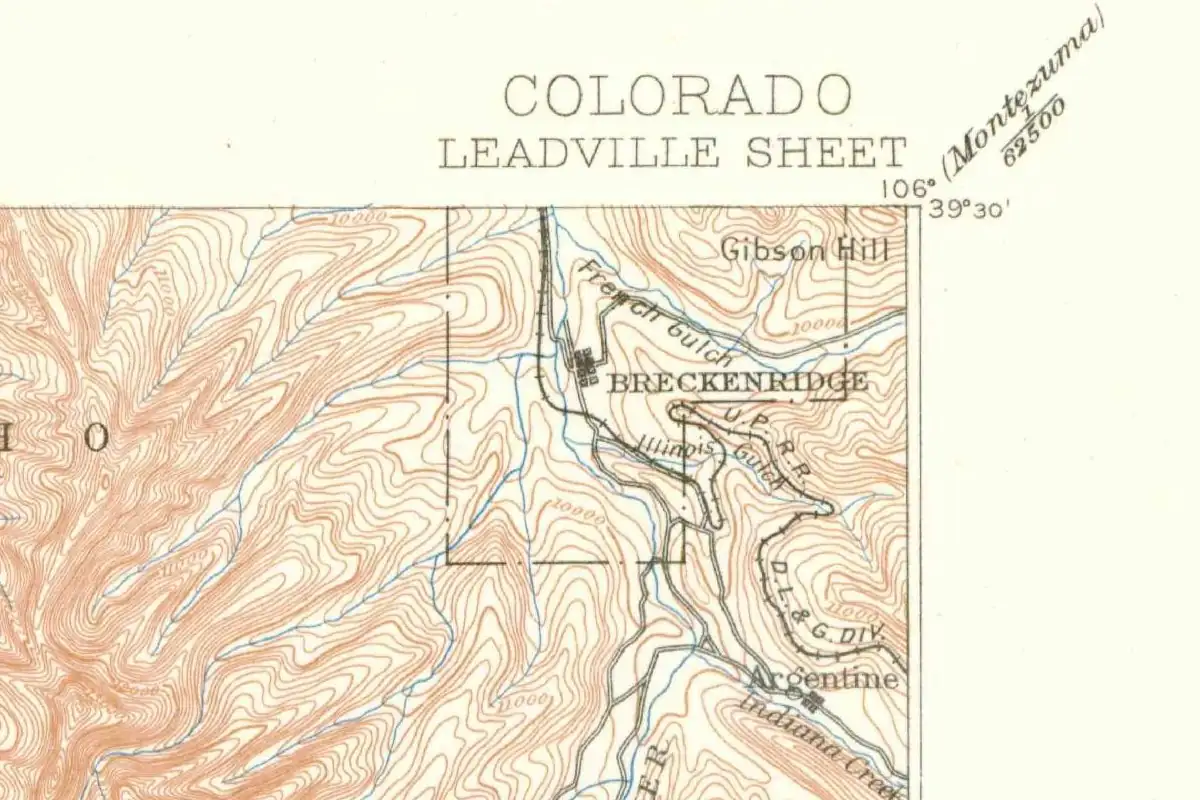
The old spelling didn’t vanish overnight, either. Frank Fossett’s 1880 guide to Colorado heads its entry on the Summit County seat “Breckinridge,” while the rest of the book mostly spells it with an e. Nine years later, the U.S. Geological Survey’s Leadville sheet, the map at the top of this page, printed BRECKENRIDGE. And Henry Gannett’s federal place-name book of 1902 managed to get it backward: it spelled the vice president “John C. Breckenridge.” The 1905 edition fixed him to Breckinridge and still credits him as the town’s namesake.
Thomas Breckenridge’s claim
Here’s where the story splits. Sandra F. Mather, writing in 2022 on the Breckenridge History website, says there are “two stories” and that “both have elements of truth.” The second one is about Thomas E. Breckenridge, who, she writes, rode with John C. Frémont’s expeditions of 1845 and 1848.
According to Mather, Thomas Breckenridge’s memoirs say the town was named for him, and so does his obituary. She writes that newspaper accounts until about June 1860, and a map drawn as early as 1859, spelled the name with an e. Drawing on research by Bill Fountain, she says Spencer named the town for a nearby pass that Frémont had named for Thomas, after Thomas spent two days hunting for a lost burro there in 1845. Then Spencer wrote “Breckinridge,” with an i, on the post office application to honor the vice president.
Mather says residents changed the spelling after Breckinridge joined the Confederacy in 1861. If she’s right, that wasn’t a new spelling. It was the old one coming back. You should know what we could and couldn’t check, though. Frémont’s own memoirs of 1887 do name a Thomas Breckenridge among his men, but in the volume we searched they say nothing about a pass named for him. We couldn’t read Thomas Breckenridge’s memoirs, his obituary, those 1859 and 1860 newspapers or the map ourselves.
Which version weighs more
On paper, the vice president wins. Hall, both editions of Gannett and the federal place-names record all name John C. Breckinridge, and none of them mentions Thomas. The Thomas version rests on documents that a local historian describes but that we haven’t seen. Both stories agree on one thing: the i was there for the vice president’s sake.
So if you’re standing on Main Street wondering about that e, you’ve got two choices. It’s either a mining camp taking back a compliment from a man who’d gone over to the Confederacy, or a camp going back to the name it had before anybody asked Washington for a post office.
Quick answers
Is Breckenridge named after John C. Breckinridge?
Not everybody agrees. Frank Hall’s 1895 history, Henry Gannett’s place-name books and the federal record all say the town was named for the vice president. A 2022 article from Breckenridge History says the name first came from Thomas E. Breckenridge, and the i was added for the vice president when the town applied for a post office.
Why is Breckenridge spelled with an e?
Nobody’s proven it. Hall says the spelling was changed because of the part Breckinridge took on the Confederate side, but he gives no date and no specific source. Breckenridge History says residents went back to the original e after he joined the Confederacy.
When did Breckenridge get its name?
In 1859 or 1860, depending on the source. Hall says Spencer & Co. claimed the town site and named it in the spring of 1860, and Stone dates the founding to the late spring of that year. Breckenridge History says a map drawn as early as 1859 already spelled the name with an e.
Who was Thomas Breckenridge?
A member of John C. Frémont’s western expeditions. Frémont’s 1887 memoirs list him among the men he left at Santa Barbara, and Breckenridge History says his own memoirs claimed the Colorado town was named for him.
Key dates
- 1859August 10: Reuben J. Spalding's party pans the first recorded gold on the Blue River, near today's Breckenridge.
- 1859August: George E. Spencer's company arrives and starts building cabins on the town site.
- 1860Spring: Spencer & Co. claim 320 acres, and the town is named for Vice President John C. Breckinridge, Frank Hall writes.
- 1880Frank Fossett's Colorado guide still heads its entry "Breckinridge."
- 1889The U.S. Geological Survey's Leadville sheet prints the name BRECKENRIDGE.
- 1895Hall's history says the spelling changed because of Breckinridge's role on the Confederate side.
Getting there
The closest airports, Amtrak stations and intercity bus stops, measured in a straight line from the center of Breckenridge.
Airports
- Aspen-Pitkin County/Sardy Field (ASE) 48 mi 77 km
- Eagle County Regional (EGE) 48 mi 77 km
- Denver International (DEN) 77 mi 124 km
Amtrak trains
- Winter Park station (WPR) 32 mi 51 km
- Fraser-Winter Park station (WIP) 34 mi 55 km
Intercity buses
- OurBus Breckenridge, CO (Across the street from the Breckenridge Station at 150 Watson Avenue, Breckenridge, CO. Look for a van with Peak 1 Express written on it.) under 1 mi 0.8 km
- Colorado Department of Transportation Bustang · Frisco Transit Center 8 mi 13 km
- Greyhound Frisco Transit Center 8 mi 13 km
Distances are as the crow flies, not by road. We don't list schedules or fares because they change; check with the airline, Amtrak or the bus company before you go. Official data (FAA commercial service airports (2025), FAA airport locations, Amtrak stations and Intercity Bus Atlas) from the FAA and the U.S. Bureau of Transportation Statistics, checked Oct 31, 2026.
Historical Sources & References
- Frank Hall, History of the State of Colorado, vol. 4 (1895), pp. 327–328. The Spencer company’s arrival in August 1859, the 320-acre claim in spring 1860, the naming for the vice president, B. D. Williams and the post office, and the spelling change “owing to” Breckinridge’s Confederate role.
- Henry Gannett, The Origin of Certain Place Names in the United States, 2nd ed. (1905), p. 56. Breckenridge “named for John C. Breckinridge, vice-president of the United States.”
- Henry Gannett, The Origin of Certain Place Names in the United States, 1st ed. (1902), p. 51. The same entry, with the vice president’s name misspelled “Breckenridge.”
- Wilbur Fisk Stone, ed., History of Colorado, vol. 1 (1918), pp. 151–152, 265. Spalding’s first pan on August 10, 1859; the town “founded in the late spring of 1860”; “Breckinridge, (afterward changed to Breckenridge).”
- Frank Fossett, Colorado: Its Gold and Silver Mines (1880), p. 88. A guidebook entry still headed “Breckinridge” in 1880.
- Sandra F. Mather, “The Naming of Breckenridge,” Breckenridge History (2022). The Thomas E. Breckenridge version, the early e spelling and the post office application, based on Bill Fountain’s research.
- John Charles Frémont, Memoirs of My Life, vol. 1 (1887). Confirms that a Thomas Breckenridge served with Frémont.
- GNIS feature 204681 (U.S. Geological Survey). The federal record, coordinates and the note “Named for John C. Breckinridge, Vice-president of the United States.”
Spot something wrong, or know more? Tell us here. You can also email us or use our contact page. Corrections are noted here with their date, never made silently.