Shenandoah Valley: 20 Spellings and No Sure Meaning
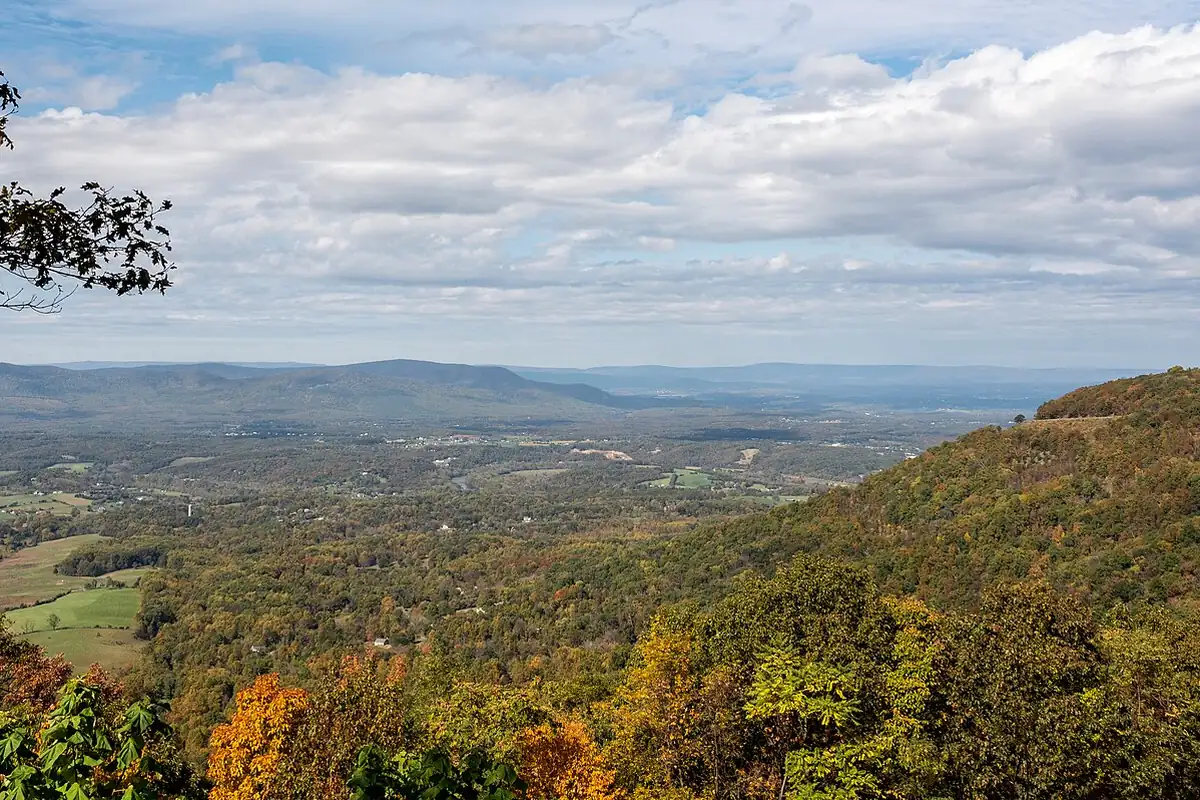
The Shenandoah Valley takes its name from a river that early records spelled at least 20 ways, from Gerundo to Zynodoa, and nobody knows what it meant. The National Park Service, which runs the park on the valley’s eastern rim, puts it plainly: the origins of the name “are unknown, though it is generally believed to be of American Indian origin.”
A river spelled 20 ways
The valley is, in a sense, the river’s backyard. In 1907 the Virginia historian John W. Wayland defined the Shenandoah Valley as the nine counties the Shenandoah drains: Augusta, Rockingham, Shenandoah, Page, Warren, Frederick and Clarke in Virginia, plus Berkeley and Jefferson, which are now in West Virginia. By his count, the river runs about 140 miles (225 km) from its headwaters to the Potomac at Harpers Ferry.
The name itself gave everybody trouble. In a footnote, Wayland lined up the forms he’d found: “Chanador, Chanetor, Chanithor, Gerando, Gerundo, Scandar, Schanathor, Shanando, Shanidore, Shannando,” and ten more, ending with “Tschanator, Zynodoa.” He joked that it looked like “a series of attempts to demonstrate the law of permutations,” but suspected “it is chiefly a case of bad spelling,” made worse by “imperfect pronunciation and defective hearing.” One example came from a German soldier serving the British during the Revolution, who waded across the river “Scandar or Jonathan.”
You can watch the spelling wobble in the land records. When Jacob Stover sold off tracts in 1735, the Orange County deed books placed them “on Gerundo River” and on “a small branch of Sherando River.” Wayland added a note in his 1912 history of Rockingham County: “‘Gerundo’ is merely another form of Shenandoah.” Samuel Kercheval, writing in 1833, put the sequence in a single line: “This water course was first written Gerando, then Sherandoah, now Shenandoah.” The federal place-names database still lists Gerundo River and Sherando River among the river’s old variants. It records Shenandoah River as the official name by a 1931 decision of the U.S. Board on Geographic Names.
The Euphrates that didn’t stick
Before the deeds, a party of Virginians tried out a name of their own. In September 1716, Virginia’s governor, Alexander Spotswood, led a party over the Blue Ridge, and one of the men, John Fontaine, kept a journal. On September 6 he wrote: “We crossed the river, which we called Euphrates. It is very deep; the main course of the water is north.”
After dinner they drank the king’s health in Burgundy and fired a volley. By 1912, Wayland wrote, it was “generally agreed” that they’d come down to the river “at or near Elkton.” The Euphrates didn’t stick, though: by the 1730s, the deeds were saying Gerundo and Sherando.
Sprucy stream, clear water or stars
Several old sources did offer a meaning. They just don’t agree with each other, and none of them shows how it got there.
“The sprucy stream”
In 1822, the Moravian missionary John Heckewelder, a longtime friend of the Delaware people, drew up a list of place names he believed came from their language. His entry reads: “Shenandoah, corrupted from Schindhandowí, or Schindhandowik, signifying, the sprucy stream, i.e., a stream flowing past spruce-pines.” When his list was printed in 1872, the editors added a note from an old Delaware spelling book: “Schind, the spruce tree.” Henry Gannett’s 1905 federal book on place names repeats the idea with a hedge: “An Indian word said to mean ‘sprucy stream.’”
“Clear water”
Joseph Martin’s 1835 Gazetteer of Virginia went another way: “Shenandoah is an Indian name, signifying clear water, and like most of the Indian names is very appropriate, these rivers being remarkable for their transparent waters.” He doesn’t say who told him.
The Senedos
Kercheval passed along a tradition that a people “called the Senedos” once lived on the North Fork of the Shenandoah, in today’s Shenandoah County, and were wiped out by “Southern Indians” before white settlers arrived. Wayland picked that up in 1907. He thought it “probable” that the Senedos took their name from the river, or the river from them, “though other derivations for the term ‘Shenandoah’ are suggested.” Kercheval told it as tradition, from an old man’s memory passed on to an early settler, and that’s how it should be read.
“Daughter of the Stars”
This is the one you’ve probably heard. In the 1950s, Shenandoah National Park’s own brochures told visitors that “Shenandoah, an Indian name, is reputed to mean ‘Daughter of the Stars.’” The Park Service has since walked that back. At McCormick Gap Overlook on Skyline Drive, its page now calls “Beautiful Daughter of the Stars” “the most common, romantic theory” and adds that “there is no more evidence for this theory than any other.”
Why nobody can settle it
None of these writers explains how he knew. Heckewelder is the only one who offered a Delaware word to go with his meaning, and even Gannett, 83 years later, still wrote “said to.” The 1730s deeds were already switching between Gerundo and Sherando, so even the starting point is fuzzy. That’s why the Park Service’s answer is still the safest one you’ll get: probably Native American, meaning unknown.
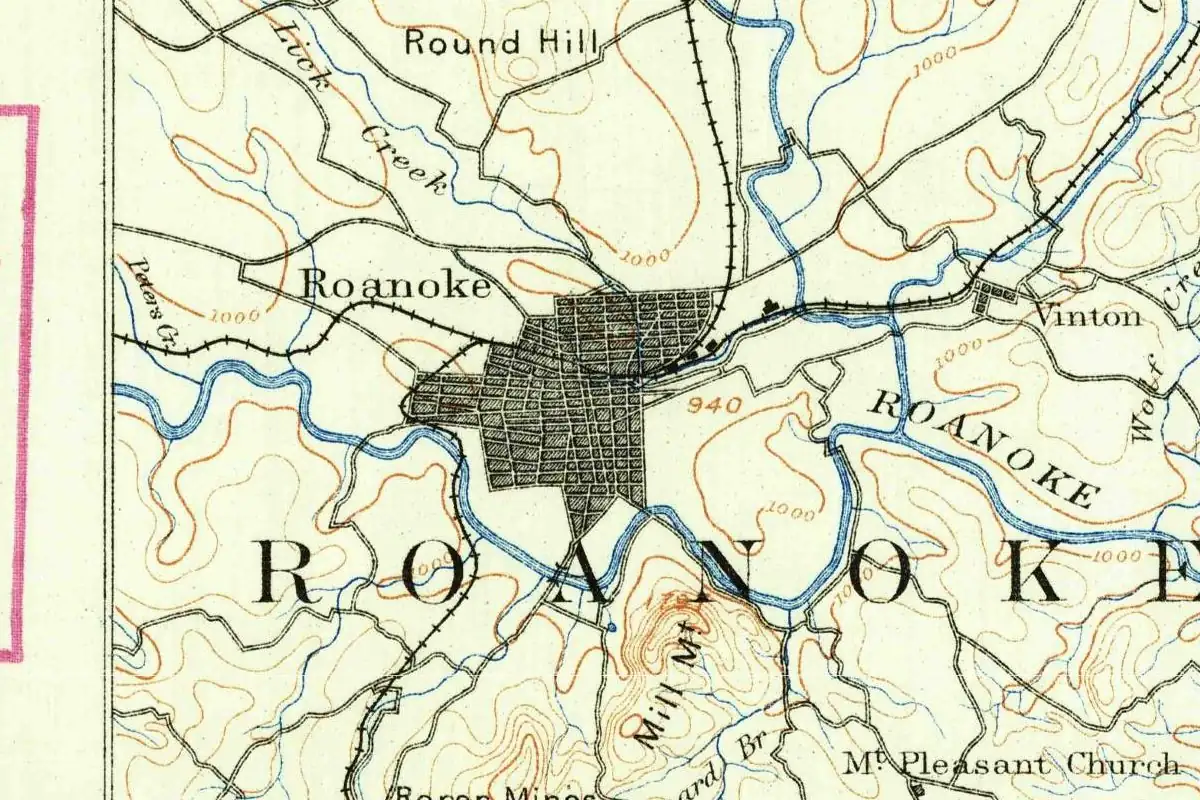
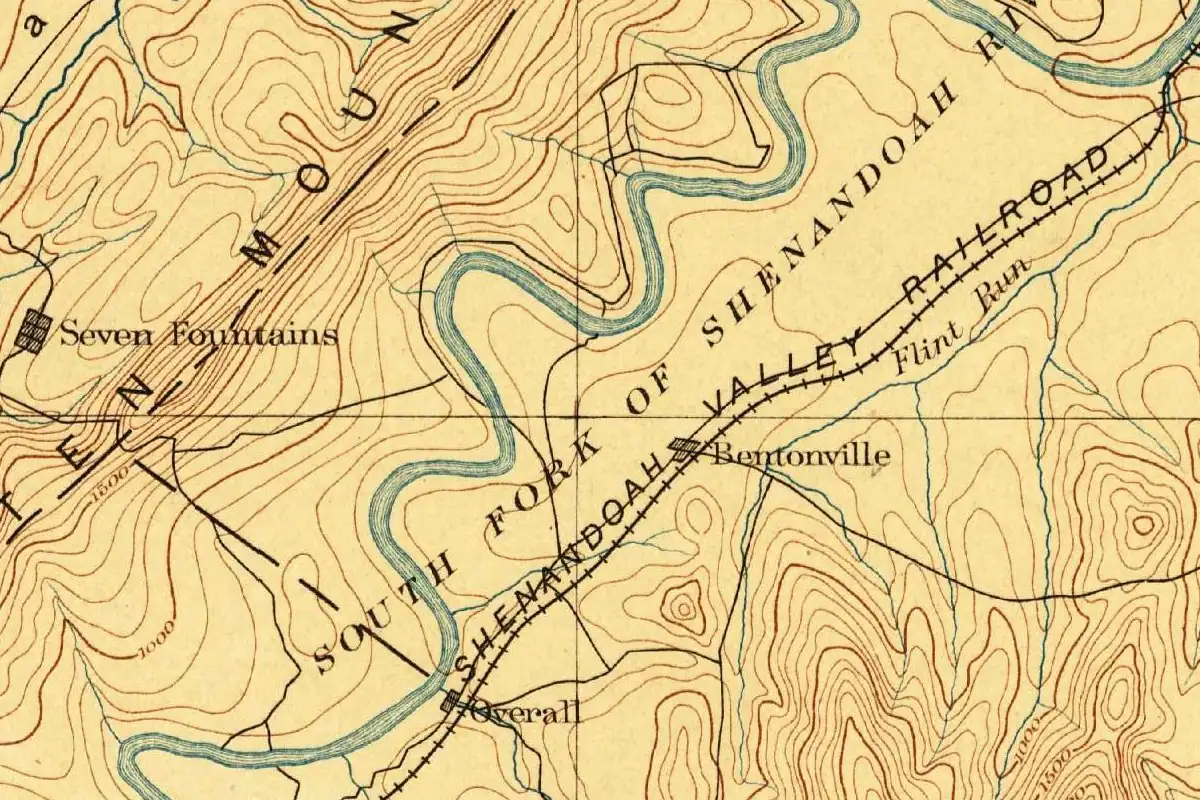
The valley’s name kept traveling anyway. On the 1893 survey map below, the Shenandoah Valley Railroad runs right beside the South Fork. Its junction with the Norfolk and Western was a station called Big Lick, and in July 1881 the Railroad Gazette reported that the station’s name “has been changed to Roanoke.” Roanoke has the rest of that story. As for the state that holds most of the valley, Virginia can trace its name straight back to Queen Elizabeth I. The Shenandoah doesn’t have a paper trail like that, just a pile of spellings and a few good guesses.
Quick answers
What does Shenandoah mean?
Nobody knows. John Heckewelder wrote in 1822 that it meant “the sprucy stream,” Joseph Martin’s 1835 gazetteer said “clear water,” and the National Park Service now says the name’s origins are unknown, though it’s generally believed to be Native American.
Does Shenandoah really mean “Daughter of the Stars”?
Nobody’s shown that it does. Park brochures in the 1950s said the name was “reputed” to mean that, but the Park Service now says there’s “no more evidence for this theory than any other.”
Why are there so many spellings of Shenandoah?
Bad spelling, mostly, in John W. Wayland’s view, plus “imperfect pronunciation and defective hearing.” He found at least 20 forms, including Gerundo, Sherando, Scandar and Zynodoa.
Was the Shenandoah River ever called the Euphrates?
Briefly. On September 6, 1716, John Fontaine wrote, “We crossed the river, which we called Euphrates,” but the name didn’t last.
Key dates
- 1716September 6: John Fontaine's party crosses the river and calls it the Euphrates.
- 1735Orange County land deeds call the river Sherando and Gerundo.
- 1822Missionary John Heckewelder writes that the name means "the sprucy stream."
- 1833Samuel Kercheval says the river was written Gerando, then Sherandoah, then Shenandoah.
- 1835Joseph Martin's gazetteer says the name signifies "clear water."
- 1907John W. Wayland lists 20 spellings of Shenandoah.
- 1931The U.S. Board on Geographic Names decides on the name Shenandoah River.
- 1953A park brochure says Shenandoah is "reputed" to mean "Daughter of the Stars."
Historical Sources & References
- John W. Wayland, The German Element of the Shenandoah Valley of Virginia (1907). The valley as the nine counties drained by the Shenandoah, including Berkeley and Jefferson in West Virginia, and the river’s 140-mile course to Harpers Ferry (p. 1); the footnote listing 20 spellings, “bad spelling,” the soldier’s “Scandar or Jonathan,” and the Senedos (pp. 2–3).
- John W. Wayland, A History of Rockingham County, Virginia (1912). The 1735 Orange County deeds “on Gerundo River” and on “a small branch of Sherando River,” with the note that Gerundo “is merely another form of Shenandoah” (pp. 40–41); Spotswood’s 1716 expedition and the crossing near Elkton (pp. 426–427).
- John Fontaine’s journal, in Ann Maury, Memoirs of a Huguenot Family (1853). The entry for September 6, 1716: “We crossed the river, which we called Euphrates” (p. 288).
- Samuel Kercheval, A History of the Valley of Virginia (1833). The tradition of the Senedos on the North Fork (p. 50); “first written Gerando, then Sherandoah, now Shenandoah” (p. 65).
- John Heckewelder, Names Which the Lenni Lennape or Delaware Indians Gave to Rivers, Streams and Localities (1822; 1872 edition). Shenandoah from “Schindhandowí,” “the sprucy stream,” with the editors’ note “Schind, the spruce tree” (p. 53).
- Joseph Martin, A New and Comprehensive Gazetteer of Virginia (1835). “Shenandoah is an Indian name, signifying clear water” (p. 448).
- Henry Gannett, The Origin of Certain Place Names in the United States (1905). “An Indian word said to mean ‘sprucy stream’” (p. 281).
- National Park Service, Shenandoah National Park brochure (1953). “Shenandoah, an Indian name, is reputed to mean ‘Daughter of the Stars.’” Also online: the 1955 brochure, with the same line.
- National Park Service, McCormick Gap Overlook. Origins of the name “are unknown, though it is generally believed to be of American Indian origin,” and no more evidence for “Beautiful Daughter of the Stars” than for any other theory.
- The Railroad Gazette, July 29, 1881. Big Lick station, “the point of junction with the Shenandoah Valley Railroad, has been changed to Roanoke.”
- GNIS feature 2037758, Shenandoah Valley (U.S. Geological Survey). The official name and location of the valley, in Rockingham County, Virginia, and the variant Valley of Shenandoah.
- GNIS feature 1556740, Shenandoah River (U.S. Geological Survey). Official name by Board decision of 1931, the mouth at Harpers Ferry, West Virginia, and old variants including Gerundo River, Sherando River and Shanandoah River.
Spot something wrong, or know more? Tell us here. You can also email us or use our contact page. Corrections are noted here with their date, never made silently.