Cuyahoga Valley: A River So Crooked It Named a Town

In Ohio’s Cuyahoga Valley, the river loops back to within about 50 feet (15 m) of itself at Peninsula, and that bend gave the village its name. The valley is named for the Cuyahoga River, and that name is a harder case: it’s usually said to mean “crooked,” but the old books also offer “jawbone,” “lake river,” “news carrier” and “the fork of the stream,” and they don’t agree.
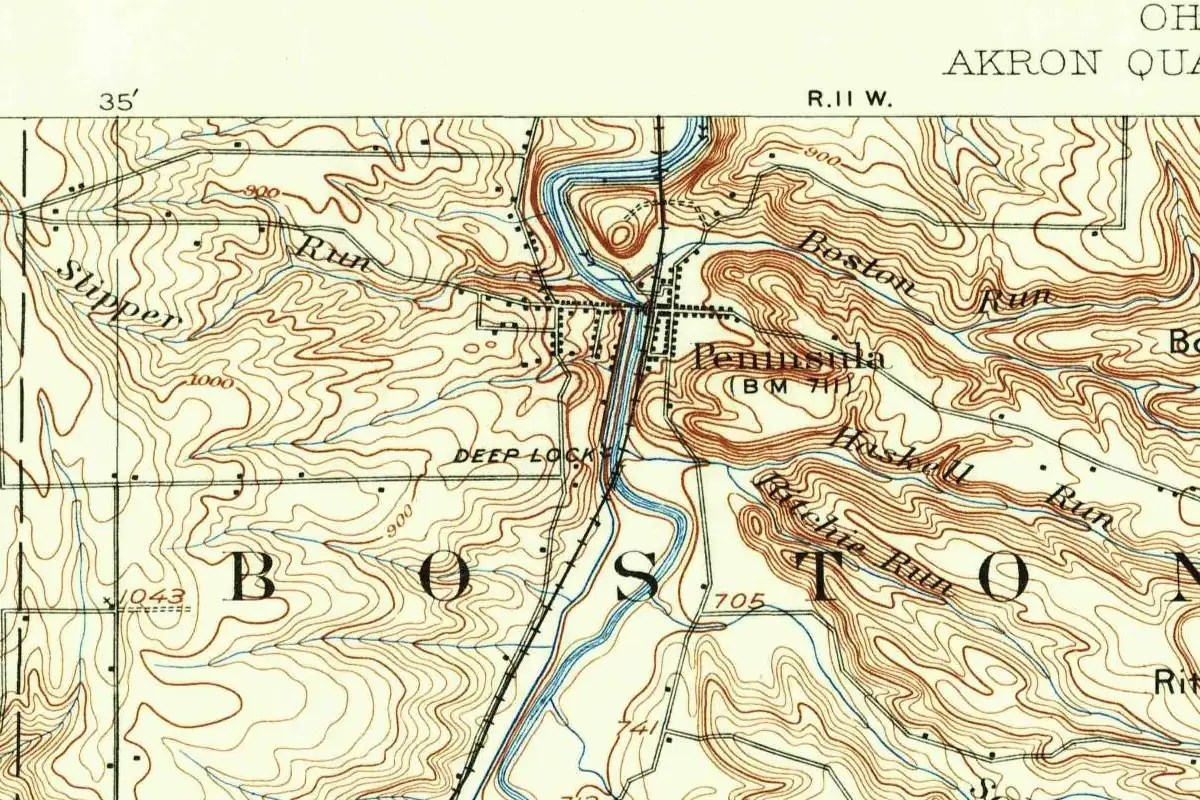
The bend that named Peninsula
Samuel A. Lane, who wrote the big 1892 history of Akron and Summit County, described the spot in Boston Township. The river, he wrote, “makes an abrupt turn to the eastward,” circles around some 18 or 20 acres of bottom land, and “comes back to within about 50 or 60 feet of the point of divergence.” Then it picks up its northwesterly course to Lake Erie as if nothing happened.
That loop drops nearly 8 feet (2.4 m) on the way around, and somebody saw what that meant. An 1881 county history edited by William Henry Perrin says Herman Bronson tunneled through the narrow neck of land in 1832, about fifty-two feet (16 m) of it, and built a gristmill that was still running when the book came out. In 1837 Bronson had a surveyor lay off 71 lots on the west side of the river and named the new village “Peninsula,” Perrin writes, “after the natural bend in the river.” Lane put it his own way: “This eccentricity of the river has furnished its very appropriate name for the flourishing village of Peninsula.”
The National Park Service says Bronson established the village in 1824 and that it boomed after the Ohio & Erie Canal opened in 1827, with 14 bars and five hotels for canal workers. Today, the Park Service says, “Peninsula is an island,” a private village surrounded by Cuyahoga Valley National Park. So you’ve got a village named for a peninsula that the Park Service now calls an island.
“Crooked,” by most accounts
The river’s own name is the one everybody repeats and nobody can pin down. Henry Howe’s Historical Collections of Ohio, in its 1891 edition, says Cuyahoga County was formed in 1807 and named for the river, and the river’s name “is said to signify, in the Indian language, ‘crooked,’ a term significant of the river, which is very winding.” Lane gives the same meaning, “generally supposed,” because of the river’s “almost infinite variety of zig-zag turnings and twistings,” and he points to Peninsula as the place where it’s “often almost doubling upon itself.”
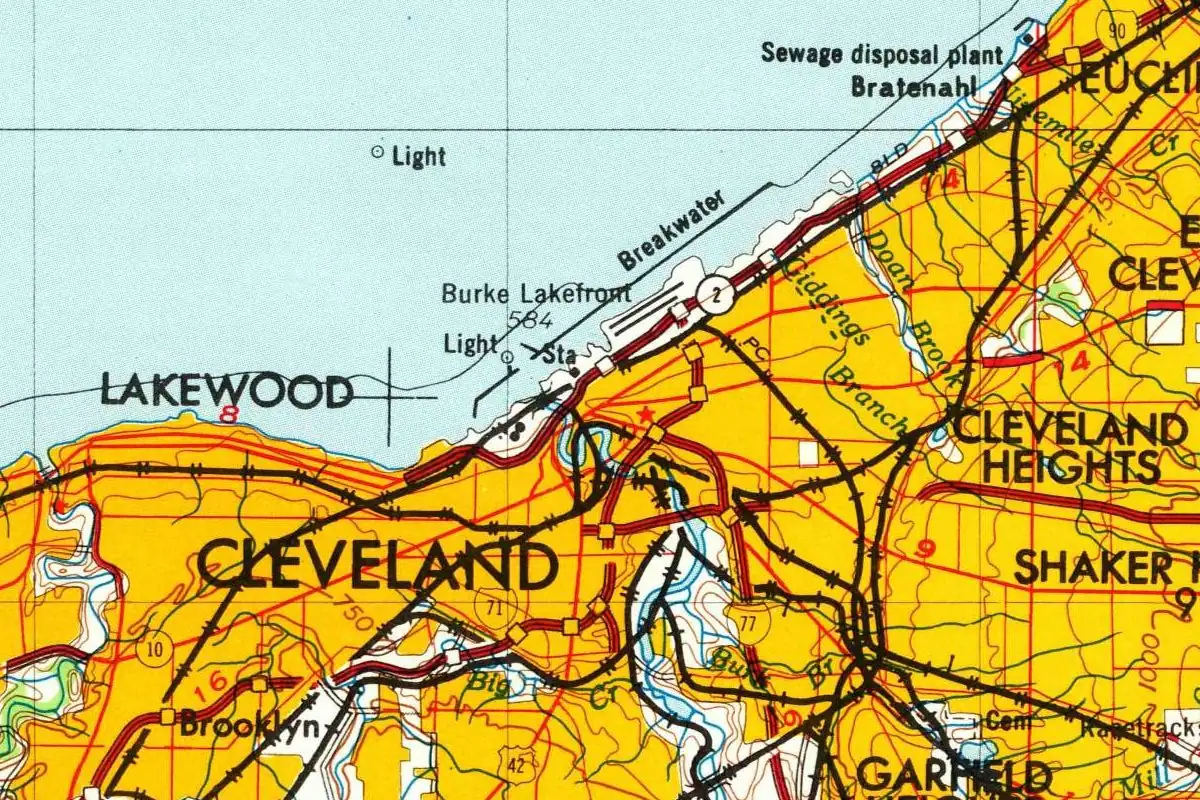
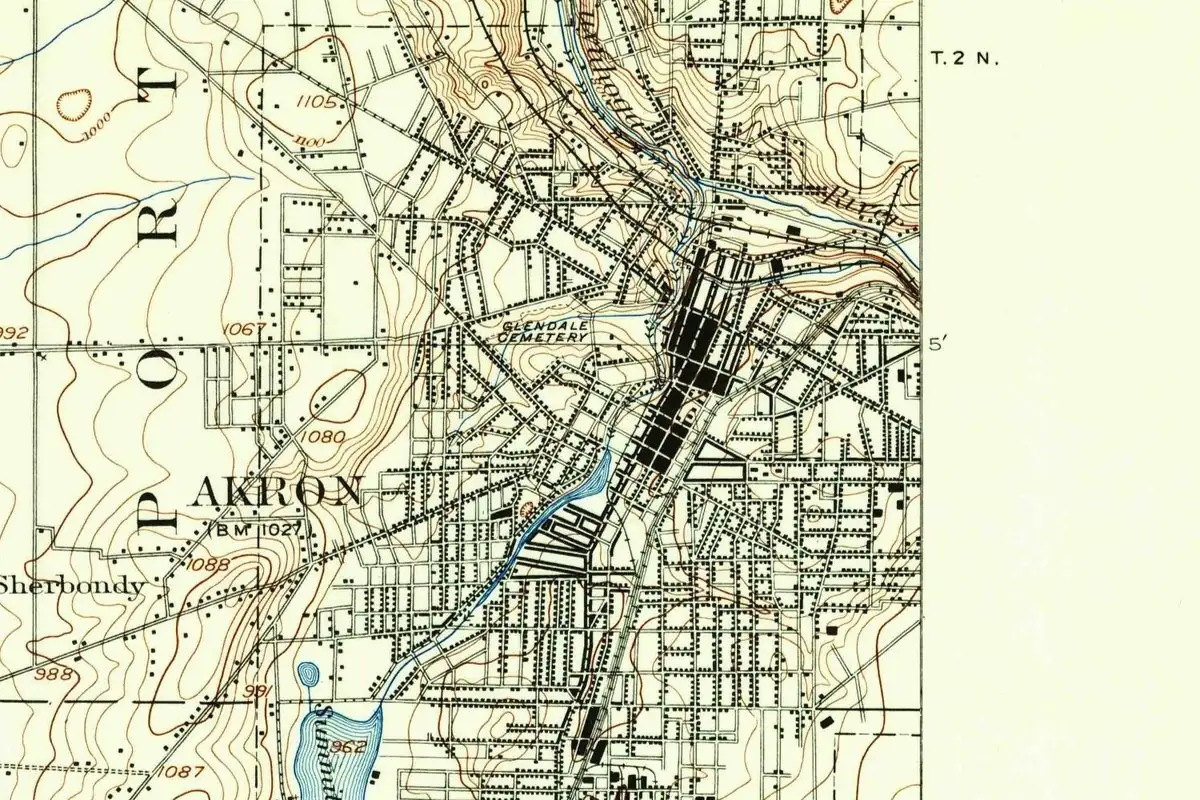
You can see why the idea stuck. The Encyclopedia of Cleveland History, from Case Western Reserve University, says the river runs southwest to Cuyahoga Falls, then turns sharply north, “thus forming the letter U.” Samuel P. Orth, in his 1910 history of Cleveland, called it “a great bow, the middle of which is at Akron,” and said the shape fooled early surveyors, whose maps “often show it ending near Akron.” Orth states the meaning without any hedge: “The Indian term for crooked, or ‘Cayhaga’ was applied to it.” The Cleveland encyclopedia hedges more. “It is believed,” it says, that the Mohawk meant “crooked river” when they called it “Cayagaga.”
Even the National Park Service doesn’t commit. A trail panel in the park says the river “got its name from an Iroquoian word for crooked or jawbone.”
Four other answers
“Lake river”
Caleb Atwater, writing his History of the State of Ohio in 1838, had a different idea. The river, “as the Indians called it ‘Cuyahoghan-uk,’” was the “Lake river,” he wrote, because “it rises in lakes, and falls into a lake.” He also pictured it starting out on the high ground “in doubt, whether to unite its waves with the Mississippi or St. Lawrence” before it made up its mind and ran for Lake Erie.
The jawbone
Lane didn’t leave “crooked” alone. He wrote that D. E. Shongo of Salamanca, New York, “an educated Seneca Indian, and a highly accomplished civil engineer,” had told him that meaning “is erroneous.” According to Shongo, Cuyahoga is a Seneca word built on a root that “means a ‘jaw,’ or ‘jaw-bone,’” so Ca-yo-ha-ga is “the geographical locality of the jaw-bone.” He said the Senecas gave the name because “a mammoth jaw-bone” had once been found in the river’s deposits about five miles (8 km) east of Cleveland, near Newburg, and “from all accounts it must have been the skeleton of the mastodon.” That’s Shongo’s explanation as Lane reported it, and the jawbone hasn’t gone away. The Cleveland encyclopedia says the Senecas called the river “Cuyohaga,” or “place of the jawbone.”
“News carrier”
Henry Gannett’s 1905 book of place names for the U.S. Geological Survey lays out three choices in two sentences. Some say it’s from cayahaga, “crooked,” he wrote, “but Atwater derives it from cuyahogan-uk, ‘lake river.’ Another authority gives carrihoga, meaning ‘news carrier.’” He never says who that other authority was.
“The fork of the stream”
The Handbook of American Indians North of Mexico, published by the Smithsonian’s Bureau of American Ethnology in 1907, has an entry for Cayahoga, a village “perhaps belonging to the Wyandot” on the northeast side of the river near Akron. It glosses the name as Kaya’ha’ge’, “the fork of the stream,” from J. N. B. Hewitt of the bureau. The handbook also shows how many ways colonial writers spelled that village: Kichaga in a document of 1747, Cajuhaga in 1750, Cayahagah in 1751, and Cayahoga on Thomas Hutchins’s map of 1764.
More spellings than meanings
The spelling wandered almost as much as the river. Orth notes that Jedediah Morse’s outline map of 1797 called the river “Cayuga and also Cayahoga.” The federal names database still lists about 20 old variants, from Cayahaga and Cuahoga to Gwahoga and Kiahagoh, and they include French names too, like Riviere Blanch and Riviere a Seguin. Its official name is Cuyahoga River, and its record says the river flows 137 kilometers (85 miles) into Lake Erie.
So which meaning carries the most weight? None of the sources that give “crooked” explains how the word gets that meaning, and most of them hedge with “is said to” or “it is believed.” The jawbone reading comes from a named Seneca source who broke the word into parts, but only secondhand, through Lane. “The fork of the stream” comes from a professional ethnologist, but it’s given for a village, not the river. “Crooked” is the answer you’ll hear most often. It isn’t the best-documented one.
A name that went everywhere
Whatever it means, the name got around. Orth says the town laid out at the river’s mouth in 1796 was “originally proposed” as Cuyahoga, but its “Indian accents were evidently not pleasing to the surveyors,” and they urged their boss, Moses Cleaveland, to give it his own name instead. The county got the name in 1807, and like Ohio itself, it took it from a river. The federal record for the county even says flatly that the name “translates to ‘crooked river.’”
The valley got its turn last. It became Cuyahoga Valley National Recreation Area in 1974 and Cuyahoga Valley National Park in 2000. If you walk the Towpath Trail there today, you’re following a river whose name colonial mapmakers were already writing down in the 1760s, and people are still arguing about what it means.
Quick answers
What does Cuyahoga mean?
Nobody’s sure. “Crooked” is the most common answer, but 19th- and early 20th-century sources also give “jawbone,” “lake river,” “news carrier” and “the fork of the stream,” and none of them settles it.
Does Cuyahoga really mean “crooked river”?
Maybe. Henry Howe wrote in 1891 that it “is said to signify” crooked, and Samuel Lane called that the “generally supposed” meaning, but Lane also printed a Seneca engineer’s view that it was “erroneous” and that the word meant the place of the jawbone.
Why is Peninsula, Ohio, called Peninsula?
Because of a bend in the river. County histories from 1881 and 1892 say the Cuyahoga loops around and comes back to within about 50 feet (15 m) of itself there (the 1892 one says “50 or 60”), and Herman Bronson named the village Peninsula in 1837 after that bend.
Where does the jawbone story come from?
From D. E. Shongo, a Seneca civil engineer from Salamanca, New York, quoted in Lane’s 1892 history. He said the name meant the place of the jawbone, after a huge jawbone found near Newburg that he thought was a mastodon’s.
Key dates
- 1764Thomas Hutchins's map marks a village on the river as Cayahoga.
- 1807Cuyahoga County is formed, named for the river.
- 1832Herman Bronson tunnels through the neck of the river's loop to power a gristmill.
- 1837Bronson lays out lots and names the village Peninsula, after the bend.
- 1838Caleb Atwater writes that the Indians called it Cuyahoghan-uk, "Lake river."
- 1892Samuel Lane prints D. E. Shongo's Seneca reading: the place of the jawbone.
- 1907The Smithsonian's Handbook of American Indians gives "the fork of the stream," from J. N. B. Hewitt.
- 1974The valley becomes Cuyahoga Valley National Recreation Area.
- 2000The valley becomes Cuyahoga Valley National Park.
Historical Sources & References
- Samuel A. Lane, Fifty Years and Over of Akron and Summit County (1892). The loop in Boston Township that “comes back to within about 50 or 60 feet,” the fall of nearly eight feet and the river’s “eccentricity” that named Peninsula (p. 654); “crooked” as the “generally supposed” meaning, the river “almost doubling upon itself, as at Peninsula,” and D. E. Shongo’s Seneca “jaw-bone” derivation with the mastodon near Newburg (p. 726).
- William Henry Perrin, ed., History of Summit County, with an Outline Sketch of Ohio (1881). The river’s detour “within fifty feet from where it started,” Bronson’s 1832 tunnel and gristmill, and the 71 lots of 1837 named “Peninsula,” “after the natural bend in the river” (p. 541).
- Henry Howe, Historical Collections of Ohio, Ohio Centennial Edition, vol. 1 (1891). Cuyahoga County formed in 1807 and named for the river, which “is said to signify, in the Indian language, ‘crooked’” (p. 493).
- Caleb Atwater, A History of the State of Ohio, Natural and Civil (1838). “Cuyahoghan-uk,” “Lake river”; “it rises in lakes, and falls into a lake”; the river “in doubt” between the Mississippi and the St. Lawrence (p. 52).
- Henry Gannett, The Origin of Certain Place Names in the United States, 2nd ed. (USGS Bulletin 258, 1905). Under Cuyahoga Falls: cayahaga, “crooked”; Atwater’s cuyahogan-uk, “lake river”; and carrihoga, “news carrier,” from “another authority” (p. 98).
- Frederick Webb Hodge, ed., Handbook of American Indians North of Mexico, part 1 (Bureau of American Ethnology, 1907). The village of Cayahoga near Akron, Kaya’ha’ge’, “the fork of the stream,” from Hewitt, and its colonial spellings from 1747 to Hutchins’s map of 1764 (p. 222).
- Samuel P. Orth, A History of Cleveland, Ohio, vol. 1 (1910). “The Indian term for crooked, or ‘Cayhaga,’” the river as “a great bow” and the surveyors’ maps (p. 26); Morse’s 1797 map with “Cayuga and also Cayahoga” (pp. 92-93); the town first proposed as Cuyahoga (p. 96).
- Encyclopedia of Cleveland History (Case Western Reserve University), “Cuyahoga River”. The river’s U-shaped course; “It is believed” the Mohawk meant “crooked river” by “Cayagaga,” while the Senecas called it “Cuyohaga,” “place of the jawbone.”
- National Park Service, “Cuyahoga’s Floodplain Panel”. The park’s own wording: the river “got its name from an Iroquoian word for crooked or jawbone.” Also online: “Village of Peninsula” (Bronson in 1824, the canal in 1827, “Peninsula is an island”) and the park’s FAQ (national recreation area in 1974, national park in 2000).
- GNIS feature 1072205, Cuyahoga River (U.S. Geological Survey). Official name Cuyahoga River; “Flows for 137 kilometers into Lake Erie”; variants including Cayahaga, Cuahoga, Gwahoga, Kiahagoh, Riviere Blanch and Riviere a Seguin. Also online: GNIS 1074030, Cuyahoga County, named for the river, which “translates to ‘crooked river.’”
Spot something wrong, or know more? Tell us here. You can also email us or use our contact page. Corrections are noted here with their date, never made silently.