Altoona, Pennsylvania: Latin, German or Cherokee?
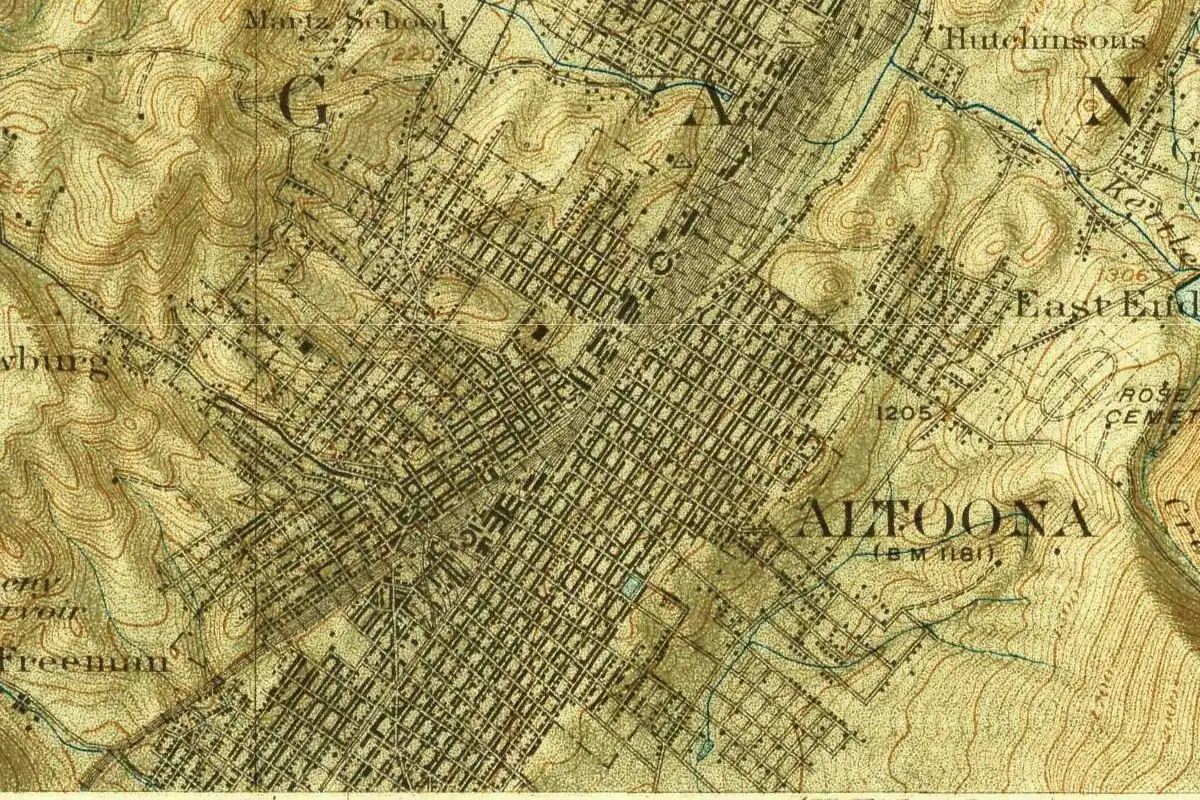
The name Altoona, Pennsylvania, has three competing explanations: a Latin word for high, a German city on the Elbe and a word from Cherokee country in Georgia. All three were in print by 1925, and the two Pennsylvania books that weigh in, from 1883 and 1925, agree on just one thing: it wasn’t the Latin.
A railroad town on a bought farm
Altoona was a railroad idea from the start. An 1880 history of the city says the Pennsylvania Railroad picked the site in 1849 for its main shops. Archibald Wright of Philadelphia bought David Robison’s farm for the purpose, and the original plot of Altoona was laid out on it. (The same book tells a story about that sale: the buyer’s agent dropped a letter allowing him to pay up to $10,000, Mrs. Robison read it, and $10,000 is what he paid.) The federal place-name database also gives 1849 as the founding year.
None of these books quotes a record from 1849 that explains the name, though. That’s how you end up with three stories.
The Latin version
Henry Gannett’s 1902 place-names book for the U.S. Geological Survey had a tidy answer. Altoona was “so named because of its high situation in the Allegheny Mountains,” he wrote, and the name is “a derivative of the Latin word altus, ‘high.’” It’s easy to see the appeal. The town sits at the eastern foot of the Alleghenies and is popularly known as the Mountain City.
The local historians weren’t buying it. In 1883, J. Simpson Africa’s history of Blair County said the name was not from the Latin, nor from the French, “as has frequently been asserted and published.” In 1925, A. Howry Espenshade said flatly in Pennsylvania Place Names that it “has no direct or indirect etymological relation” to the Latin word.
The Cherokee version
Africa’s own answer was Allatoona, which he called a Cherokee word, and he had it from the man who chose the name. In a footnote, he credits it to “Mr. Wright, of Philadelphia,” who had lived for years in the Cherokee country in Georgia and liked the sound of its place names. Wright took “Allatoona” to mean “the high lands of great worth.”
Espenshade tells the same story about John A. Wright, Archibald’s son, who laid out the lots and “was responsible for the naming of the town.” But he went one step further. Espenshade cites the opinion of James Mooney of the Bureau of American Ethnology: there is a Cherokee word, eladuni, meaning “high lands” or “where it is high.” But to a Cherokee, Allatoona and eladuni are “so different that the former could hardly be derived from the latter.” So the Allatoona story may well be how the name was picked, but Wright’s translation doesn’t have a linguist behind it, and you shouldn’t take it as settled.
The German version
Here’s where Espenshade parts ways with Africa. The explanation he found “most natural and reasonable” came from a letter by Henry W. Shoemaker, chairman of the Pennsylvania Historical Commission. Shoemaker passed along what he’d heard from Robert Steele, the engineer who drove the first train into Altoona in 1851. According to Steele, Colonel Beverly Mayer, a civil engineer who laid out the railroad yard tracks, named the place after Altona, a city on the Elbe just west of Hamburg, in Germany.
Which one wins?
Nobody can prove it either way. If you’re weighing them, the Allatoona story has one big thing going for it: Africa got it from the man both books say did the naming, and he printed it in 1883. The Altona story reached Espenshade secondhand, through two people, more than seventy years after the fact. Espenshade still preferred it. The Latin one is the only version both Pennsylvania books reject.
For a stretch in 2011, the city had a fourth name to explain. The federal database records that on April 27, 2011, Altoona changed its name to “POM Wonderful Presents The Greatest Movie Ever Sold” for a 60-day movie promotion. That one, at least, has a clear origin.
Sources & further reading
- A. Howry Espenshade, Pennsylvania Place Names (1925), pp. 175-176. Rejects the Latin, gives both the Altona story (from Shoemaker’s letter and Robert Steele) and the Allatoona story (John A. Wright), and quotes James Mooney on eladuni.
- J. Simpson Africa, History of Huntingdon and Blair Counties (1883), p. 135. Says the name came from “Allatoona,” on the authority of Mr. Wright, and rejects the Latin and French theories.
- Henry Gannett, The Origin of Certain Place Names in the United States (USGS Bulletin 197, 1902). The Latin theory: altus, “high.”
- James H. Ewing and Harry Slep, eds., History of the City of Altoona and Blair County (1880), pp. 61-62. The railroad’s choice of the site in 1849, Archibald Wright and the Robison farm.
- GNIS feature 1192069 (U.S. Geological Survey). Founded 1849, a city since 1868, and the 2011 promotional name.
Spot something wrong, or know more? Tell us here. You can also email us or use our contact page. Corrections are noted here with their date, never made silently.