Harrisburg, Pennsylvania: The Capital That Was Almost Louisbourg
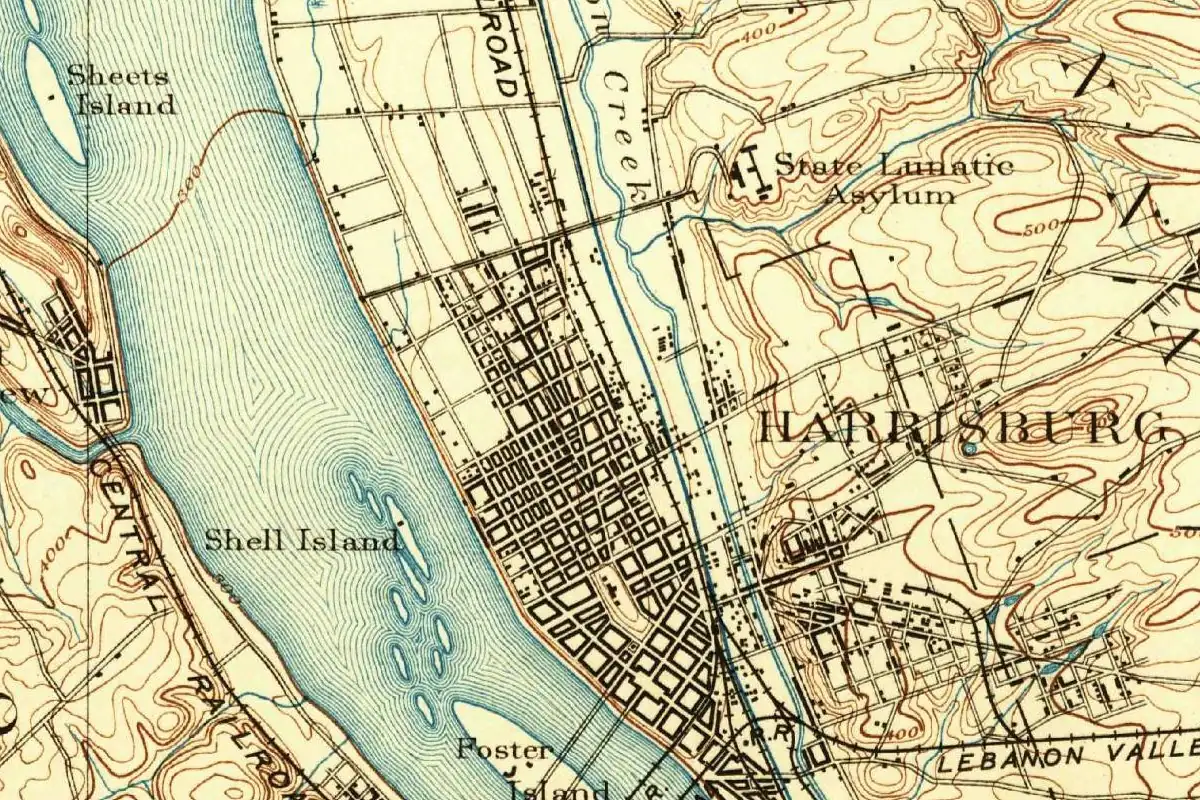
In 1786, Pennsylvania officials renamed Harrisburg Louisbourg, for the king of France. John Harris, who had laid out the town and named it for his family, wouldn’t go along, and in the end his name is the one that stuck.
A trader, a ferry and a family name
The Harris name was on this stretch of the Susquehanna long before there was a town. A. Howry Espenshade’s Pennsylvania Place Names (1925) says the first John Harris was a Yorkshireman who came to America with sixteen guineas to his name, got a license as an Indian trader in 1705 and settled at Paxtang, “now the site of Harrisburg.” The Penns granted him 500 acres there in 1725.
His son, John Harris Jr., got the right to run a ferry across the river in 1753, and from then on the place was “known far and wide as Harris’s Ferry.” In 1785, the same year Dauphin County was created, Harris and his son-in-law William Maclay laid out a town at the ferry “and called it Harrisburg.” The new county put its seat there. The federal government’s 1902 book of place names, by Henry Gannett, sums it up in one line: named for “John Harris, the original proprietor.”
Enter Louis XVI
That’s where it gets interesting. Dauphin County was named for the Dauphin, the young son of Louis XVI, at a time when France was hugely popular in America for helping win the Revolution. Some officials decided the county seat should match. William Henry Egle’s 1883 county history quotes the court minutes for August 3, 1786:
“The name of the County Town or Seat of the Courts is altered from Harrisburg to Louisbourgh in consequence of the Supreme Executive Council of the Commonwealth so styling it in the commissions of the Justices of the said Town.”
Egle didn’t think much of it. He called the change “surely a piece of impertinence,” since Harris had laid out the town and offered lots for county use, and with that came the right to name it. Egle also suggests, with a “perhaps,” that Chief Justice Thomas McKean pushed for Louisbourg partly because he and Harris had had a personal falling-out.
“Louisbourgh as much as they pleased”
Harris didn’t budge. According to Egle, he told the judges they “might ‘Louisbourgh’ as much as they pleased, but that he would never execute a title for any lot in any other name than that of Harrisburg.” In other words, you weren’t getting a deed from him that said Louisbourg. Espenshade passes on the same line and is careful to say Harris “is said to have” put it that way, so you should treat the wording as tradition, not a transcript.
Officially, the French name hung on for a while. Espenshade says the town was “still officially known as Louisbourg” in 1791, the year Harris died, “but the new name never came into popular use and was soon dropped.” Egle puts it more bluntly: Harris’s “determination prevailed.”
The capital he planned for
Harris seems to have had big plans for his town. Espenshade says he set aside four acres on what’s now Capitol Hill “in trust for public use,” foreseeing that the capital might end up there. It did. A law passed in 1810 moved the state government from Lancaster to Harrisburg in 1812, and Maclay added ten more acres to Harris’s four. So the capital landed on ground the town’s founder had set aside for public use, in a town that still carries his name and not the king’s.
Sources & further reading
- A. Howry Espenshade, Pennsylvania Place Names (1925), pp. 63-66. The two John Harrises, Harris’s Ferry, the 1785 town plan, the Louisbourg episode, Harris’s reported reply and the move of the capital.
- William Henry Egle, History of the Counties of Dauphin and Lebanon (1883), p. 297. The court minutes of August 3, 1786, the McKean theory and Harris’s answer to the judges.
- Henry Gannett, The Origin of Certain Place Names in the United States (USGS Bulletin 197, 1902). Named for “John Harris, the original proprietor.”
- GNIS feature 1213649 (U.S. Geological Survey). The federal record for Harrisburg, “Capital of Commonwealth of Pennsylvania.”
Spot something wrong, or know more? Tell us here. You can also email us or use our contact page. Corrections are noted here with their date, never made silently.