Scranton, Pennsylvania: Eight Names, Ending With the Ironmakers'
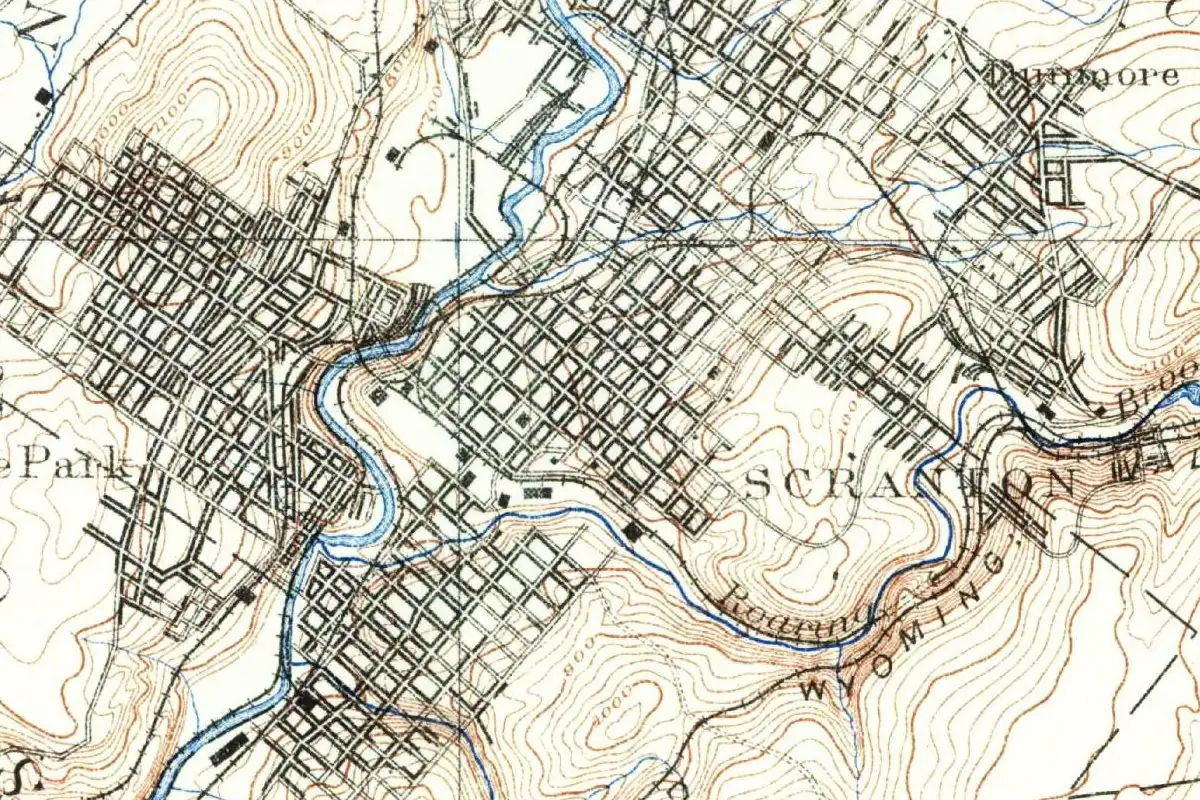
Scranton, Pennsylvania, has had eight names by one 1925 count, and the one that stuck is the family name of the men who built its ironworks. Along the way it carried a president’s name. Another was just the name of the company.
Before the Scrantons
A. Howry Espenshade opens his entry on the city in Pennsylvania Place Names (1925) with a line you don’t see often: Scranton “has had eight different names.” The first belonged to an Indian village, Capouse, which he says was named for a chief of the Monseys. Its wigwams, he writes, disappeared in 1771.
After that the spot was Deep Hollow, until 1798. Then the Slocum family moved in, and for about forty years it was Slocum Hollow. The Slocums themselves wanted it called Unionville. According to Espenshade, they “tried in vain.”
Iron, anthracite and a president
In 1840, brothers George W. and Selden T. Scranton came over from New Jersey and found, in Espenshade’s words, “nothing but a village of five old weather-beaten houses.” What drew them was iron ore and anthracite coal. With their partners they formed Scrantons, Grant and Company and set out to make iron using anthracite as fuel. Espenshade says they got there only after “frequent discouragements.”
The new crowd brought new names. They renamed the place Harrison, after President William Henry Harrison. Espenshade dates that to 1845; Horace Hollister’s History of the Lackawanna Valley ties it to “the memorable days of ‘hard cider’” and says the first day’s work on “the Harrison furnace” was done on September 11, 1840. So you’ll see different dates depending on which book you open. Next, for a while, the place simply went by the company’s name, Lackawanna Iron Works.
Scrantonia, then plain Scranton
Money was tight, so the brothers borrowed $10,000 from a cousin, Joseph Hand Scranton of Augusta, Georgia. He came north in 1847, bought out Sanford Grant’s share and soon took charge. Espenshade calls the three Scrantons “the real founders” of the city.
The family name went on the post office first, as Scrantonia. Espenshade says that office opened in April 1850, and that less than a year later the town and post office both became Scranton. Hollister gives 1848 for the post office, so the exact year isn’t settled. He also has the best line about the change: “the brief vowels ia were erased, leaving plain Scranton in possession of the field.”
Which Scranton?
The answer depends on who you ask. Henry Gannett, writing for the U.S. Geological Survey in 1902, credits just one man, Joseph H. Scranton, “its founder.” Espenshade says the city bears the name of all three. The federal place-name database also lists three founders, though it gives the cousin as “John H” Scranton, which looks like a slip for Joseph.
Hollister, for his part, wasn’t sold on the final choice. He asked whether “the aboriginal Capoose” or the old Indian names for the local streams “have been more musical and appropriate.” The city went with the ironmakers anyway.
Sources & further reading
- A. Howry Espenshade, Pennsylvania Place Names (1925), pp. 137-138. The “eight different names,” Capouse, Deep Hollow, Slocum Hollow and Unionville, the Scranton brothers, Harrison, Lackawanna Iron Works, Joseph H. Scranton and Scrantonia in 1850.
- Horace Hollister, History of the Lackawanna Valley (1885), pp. 232 and 252. Harrison in the “hard cider” days and the Harrison furnace of 1840, Scrantonia in 1848, the dropped “ia” and his vote for Capoose.
- Henry Gannett, The Origin of Certain Place Names in the United States (USGS Bulletin 197, 1902). Credits Joseph H. Scranton alone.
- GNIS feature 1213652 (U.S. Geological Survey). Names three Scrantons as founders and lists the city as seat of Lackawanna County.
Spot something wrong, or know more? Tell us here. You can also email us or use our contact page. Corrections are noted here with their date, never made silently.