El Paso, Texas: The Town That Used to Be Franklin
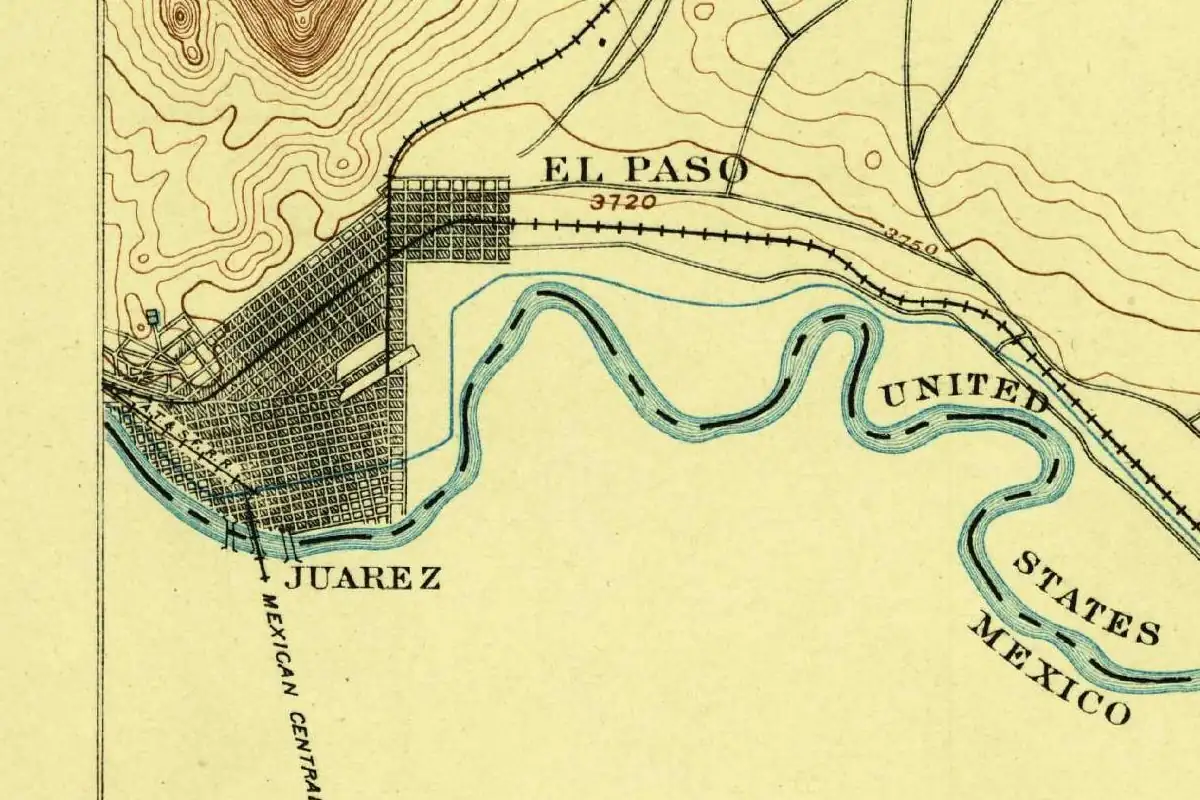
When Anson Mills reached El Paso, Texas, in 1858, the American town was called Franklin, after a man who named the post office for himself. The name El Paso, “the pass,” belonged to the much bigger Mexican town across the Rio Grande, and Mills later wrote that bringing it over was his idea.
A crossing from 1598
The name is older than either town. H. H. Bancroft’s 1889 history of New Mexico follows Juan de Oñate’s colonists up the Rio Grande. On May 4, 1598, local people showed them “a convenient ford,” and the whole column crossed. Bancroft was sure of the spot: “I have no doubt that this ‘ford of the river of the north’ was the original El Paso del Norte, a name that has been retained ever since for the locality.”
So paso here could mean a place to get across the river as much as a gap in the mountains. The federal place-names bulletin Henry Gannett published in 1905 says the city takes its name “from the presence of a pass,” that of the Rio Grande, and that the Spanish word “means ‘the pass,’ ‘the gap,’ or ‘the passage.’” An 1886 booster pamphlet from the El Paso Bureau of Information went for the simple version, “Two Spanish words, meaning ‘The Pass,’” and told readers to check any map to see “how appropriately the name has been applied.”
A ranch called Franklin
For a long time the town that carried the name was on the south bank. In 1858, Mills says, Mexican girls sold fruit grown “on the opposite side of the river at what was known as Paso del Norte, a city of thirteen thousand people.” On the Texas side there wasn’t much: “The town on the American side was simply a ranch owned by ‘Uncle Billy’ Smith, an illiterate Kentuckian.”
Then came the post office. In Mills’s words: “One Franklin Coontz asked to be made postmaster, and when the Post Office Department informed him he would first have to name the office, he named it after himself, ‘Franklin.’” The 1886 pamphlet adds that the land under the American town had been granted in 1827 to Juan María Ponce de León, a resident of Paso del Norte.
A surveyor picks a new name
Mills was a young surveyor. Smith, who owned the old Ponce grant under Franklin, went into a company with a few partners, and they hired Mills to lay out a proper town, since the houses “had been built at random.” He was paid a hundred dollars and four lots.
Then, he says, “Franklin Coontz turned out an undesirable citizen, and it was suggested that I rename the city.” He thought about where the place sat: “the north and south pass of the Rio Grande through the Rocky Mountains” and also the only workable route east to west across the river “for hundreds of miles.” So “I suggested that El Paso would indicate the importance of the location. It was decided to so name it.”
You should know that’s Mills’s own story, published in 1918, sixty years after he arrived, and he doesn’t give a date or say who did the deciding. No other source here contradicts it, and none confirms it either.
Two towns, one name
For a while there were two El Pasos facing each other across the river. Mills’s brother, W. W. Mills, listing the leading citizens of the late 1850s in his 1901 memoir, writes of “Paso del Norte (now Juarez).” By then the Mexican town had a new name and the Texas town had the old one. If you’re in El Paso and look south across the Rio Grande, you’re looking at the town that carried the name first.
Sources & further reading
- Anson Mills, My Story (1918), pp. 51-54. His arrival on May 8, 1858, Paso del Norte, the Smith ranch, Franklin Coontz naming the post office for himself, the town plat and the suggestion to rename it El Paso.
- H. H. Bancroft, History of Arizona and New Mexico, 1530-1888 (1889), p. 128. Oñate’s crossing on May 4, 1598, and the “original El Paso del Norte.”
- W. W. Mills, Forty Years at El Paso, 1858-1898 (1901), p. 20. “Paso del Norte (now Juarez).”
- El Paso Bureau of Information, The City and County of El Paso, Texas (1886). “Two Spanish words, meaning ‘The Pass,’” and the 1827 Ponce de León grant.
- Henry Gannett, The Origin of Certain Place Names in the United States (USGS, 1905). El Paso named for the pass of the Rio Grande, “the pass,” “the gap,” or “the passage.”
- GNIS feature 1380946 (U.S. Geological Survey). The federal record and coordinates for El Paso.
Spot something wrong, or know more? Tell us here. You can also email us or use our contact page. Corrections are noted here with their date, never made silently.