Houston, Texas: A Town Named in the Middle of a Campaign
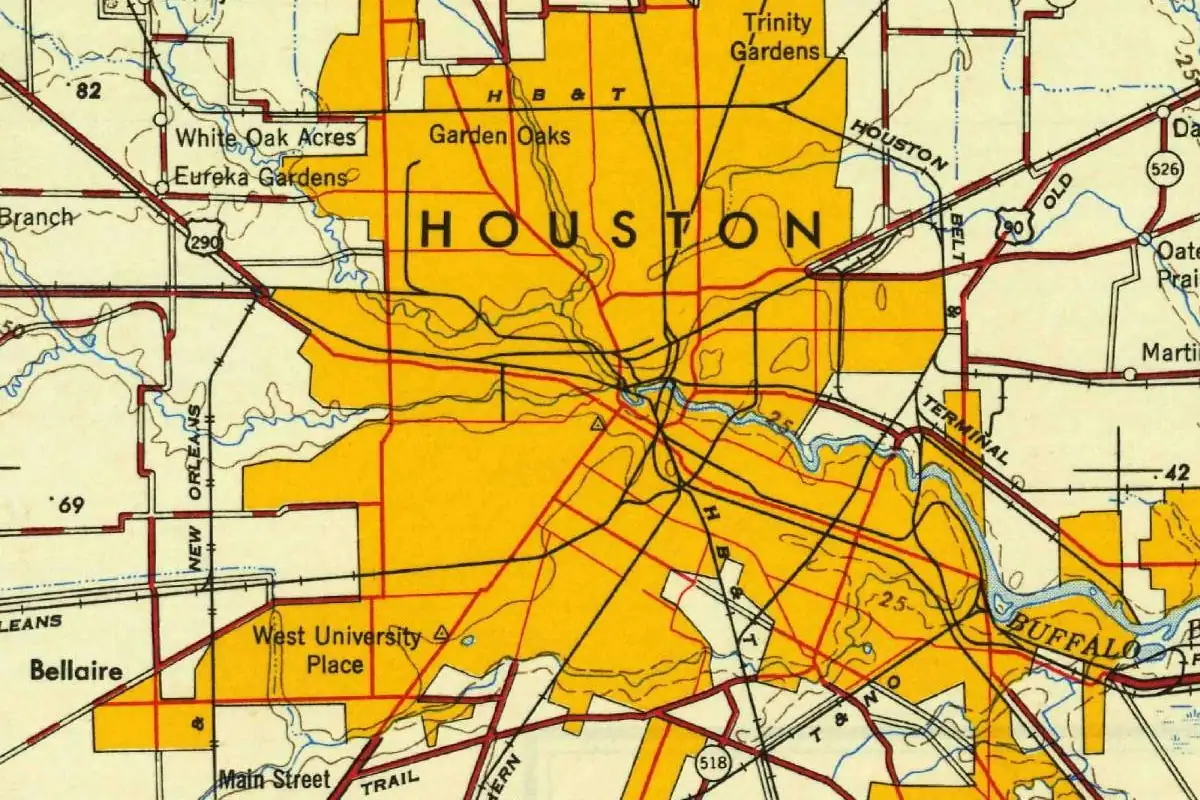
The Allen brothers put the Town of Houston, Texas, up for sale in August 1836, while Sam Houston was still a candidate for president of the new republic. They named it for the general who had won at San Jacinto that spring, and within a couple of months he was president.
A deed, an ad and an election
Two New York speculators, A. C. and J. K. Allen, bought the land on August 26, 1836, according to the Standard History of Houston that B. H. Carroll edited in 1912. For $5,000 they got half of a league on Buffalo Bayou, near the head of tide water. Four days later their first ad ran in the Telegraph. Ernest William Winkler reprinted it in 1906, and it starts: “The Town of Houston, Situated at the head of navigation, on the West bank of Buffalo Bayou, is now for the first time brought to public notice.”
Now line that up with the election. Henderson Yoakum’s 1855 history says Sam Houston was nominated “by more than six hundred persons at Columbia” on August 20, for a vote set for the first Monday in September. Houston himself, in a letter Yoakum quotes, said he wouldn’t let his name be used until “within fourteen days of the election.” He won “by a large majority” and was sworn in on October 22. So the name went into print while the man it honored was a brand-new candidate. You can read the whole ad in Winkler’s article; it runs for most of a page.
Francis Lubbock, who later went up the bayou to the new town with one of the brothers, put it simply in his memoirs: the Allens “had laid out the new town of Houston, named in honor of the President of the Republic.” Henry Gannett’s 1905 list for the U.S. Geological Survey agrees that the Harris County city is named for “Gen. Samuel Houston, president of the Texas republic.”
The pitch was the capital
The ad didn’t stop at mud and lots. “Nature appears to have designated this place for the future seat of Government,” it said, calling the site “handsome and beautifully elevated.” Carroll’s history takes a dry look at that 76 years later: “the feature of beautiful elevation in the advertisement was a trifle difficult to find.”
It worked anyway. Winkler counts “the naming of the place” among the moves that showed “the shrewdness, sagacity and enterprise of the promoters.” Congress picked Houston as the temporary capital, and Lubbock says the brothers got the government moved there “to remain until 1840.”
A little Austin in Houston
One detail you’d miss on today’s map: Carroll says the Allens’ land was part of a league originally granted to John Austin. And on the first town map, Austin Street was Homer Street, and La Branch Street was Milton Street. Both got renamed, one for Stephen F. Austin and one for Alcée La Branche, the U.S. chargé d’affaires to Texas. In Carroll’s words, “Epic poets of Greece and England were thus forced to give place to American heroes and statesmen.”
The capital didn’t stay. In 1839 Congress voted for a new one, and the law named it for Austin before the site was even chosen.
Sources & further reading
- Ernest William Winkler, “The Seat of Government of Texas,” Quarterly of the Texas State Historical Association, vol. 10 (1906), pp. 167-169. The full text of the Allens’ ad of August 30, 1836, and the Allens’ role in winning the temporary capital.
- B. H. Carroll, ed., Standard History of Houston, Texas (1912), pp. 26-30. The deed of August 26, 1836, the John Austin league, the “beautiful elevation” remark and the renamed streets.
- Francis Richard Lubbock, Six Decades in Texas (1900), p. 45. The town “named in honor of the President of the Republic.”
- Henderson K. Yoakum, History of Texas, vol. 2 (1855), pp. 192-194, 198. Houston’s nomination on August 20, 1836, his own account, the election and the inauguration on October 22.
- S. O. Young, A Thumb-Nail History of the City of Houston (1912). The portrait caption calling Sam Houston “The hero of San Jacinto, in whose honor the City of Houston is named.”
- Henry Gannett, The Origin of Certain Place Names in the United States (USGS, 1905). Houston named for “Gen. Samuel Houston.”
- GNIS feature 1380948 (U.S. Geological Survey). The federal record and coordinates for Houston.
Spot something wrong, or know more? Tell us here. You can also email us or use our contact page. Corrections are noted here with their date, never made silently.