Waco, Texas: Named for the Village That Stood There First
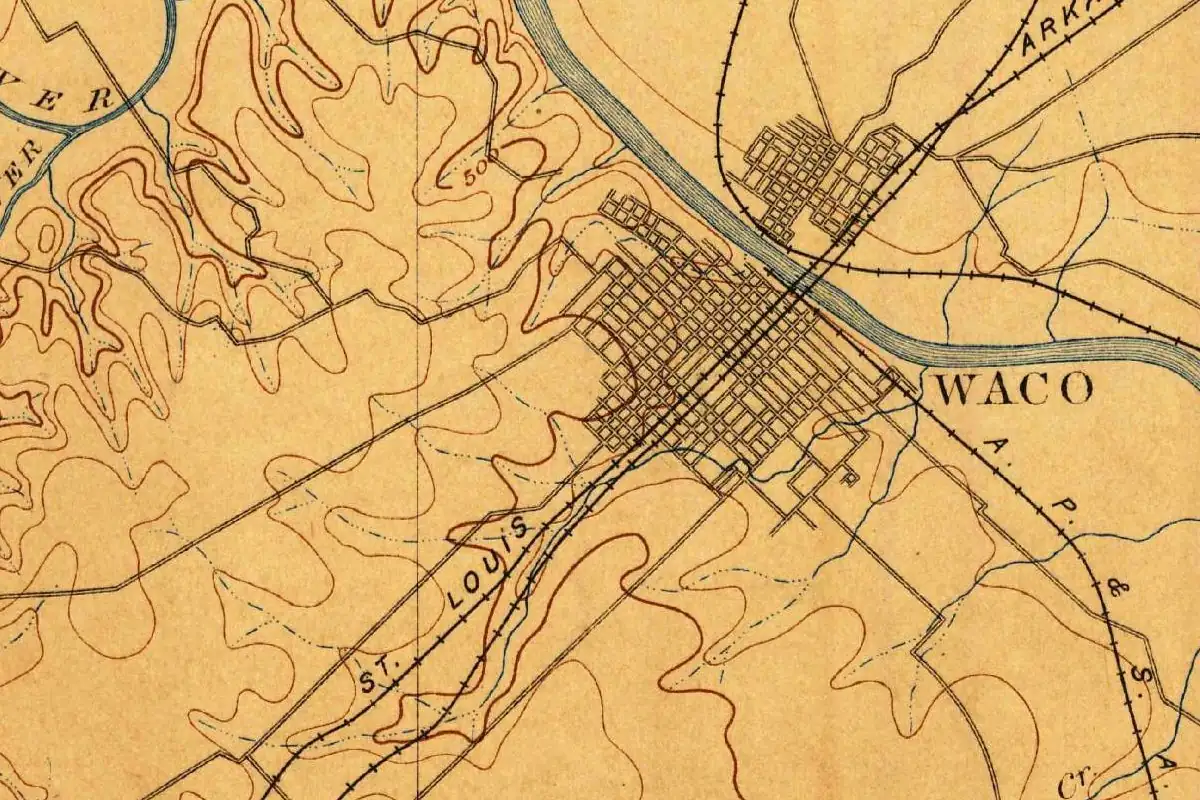
Waco, Texas, is named for the Waco, a people whose village stood where the city is now, and a 1902 government book once said the name meant heron. The 1905 edition of that book quietly dropped the heron, and the Smithsonian’s Handbook of American Indians doesn’t give the name any meaning at all.
The Waco village on the Brazos
The Handbook’s 1910 entry, signed with the initials of Herbert E. Bolton, calls the Waco “one of the divisions of the Tawakoni, whose village stood until after 1830 on the site of the present city of Waco, Texas.” It also says the name “does not seem unmistakably to appear until after 1820, occurring first in Anglo-American accounts.”
One of those accounts came from Stephen F. Austin. The Handbook cites his description from about 1824: a main village of 33 grass houses on some 40 acres, home to about 100 men, a smaller village half a mile below, and about 200 acres of corn behind brush fences. The Waco were later included in U.S. treaties with the Wichita in 1835 and 1846, and in 1872 their reservation was set up in what’s now Oklahoma.
The heron that flew off
This is where you have to be careful. Henry Gannett’s 1902 bulletin for the U.S. Geological Survey says Waco was “named for an Indian tribe, the name meaning ‘heron.’” His 1905 second edition keeps the first half and drops the meaning: “named for an Indian tribe.” Gannett doesn’t explain the change.
The Handbook doesn’t back up the heron. What it gives instead is a long list of how outsiders wrote the name: Hueco in a Texas state record of 1826, Wacco, Wacoah, Wako, Wecos. It also records “Weko” as the Tonkawa name for the group and “We-kush” as the Wichita name. None of those entries comes with a translation, so the honest answer on the meaning is that these sources don’t have one.
A surveyor who had been stationed there
George B. Erath, a surveyor, was the man who laid out the town. In his memoirs, printed in the Southwestern Historical Quarterly in 1923, he says, “In 1837 I had been stationed at the Waco village,” and that he saw it then as a good site for a town. His chance came when the land agent Jacob De Cordova hired him to sell off the tract. On March 1, 1849, Erath laid off the main street and a batch of lots and sold them “at five dollars apiece.”
He also left a picture of the place that day. “Native post oaks, peach trees planted by the Indians, bones, and old Indian fortifications were about.”
Almost Lamartine
Decca Lamar West’s 1912 sketch of Waco adds a twist you won’t find in Erath’s own account. “When Major Erath was instructed to lay out the town it was to be called ‘Lamartine,’” she writes, “but on May 5th, 1849, it was decided to call it ‘Waco Village.’” West doesn’t say who made either call or where she got the story, and hers is the only source we found that mentions Lamartine at all, so take it as one local writer’s account. She does say she’s glad the pioneers “kept the name of ‘Waco’; the tribe who first discovered her charms is entitled to have its name perpetuated.”
The “Village” part fell away. The rest of the name still points to the people whose village was on that ground first.
Sources & further reading
- Frederick Webb Hodge, ed., Handbook of American Indians North of Mexico, part 2 (1910), “Waco,” pp. 887-888. The Waco as a division of the Tawakoni, the village on the city’s site, the name’s first appearance after 1820, Stephen F. Austin’s description, the treaties and reservation, and the list of spellings and names in other languages.
- “Memoirs of Major George B. Erath,” Southwestern Historical Quarterly, vol. 27 (1923), pp. 146-148. Erath at the Waco village in 1837, the land sale through De Cordova and the town laid off on March 1, 1849.
- Decca Lamar West, The Legend of Lovers’ Leap and an Historical Sketch of Waco, Texas (1912). The planned name Lamartine and the decision of May 5, 1849, to call it Waco Village. A local sketch that cites no source; it’s the only one we found for both details.
- Henry Gannett, The Origin of Certain Place Names in the United States (USGS, 1902). The first edition’s “heron.”
- Henry Gannett, The Origin of Certain Place Names in the United States, 2nd ed. (USGS, 1905). The second edition, “named for an Indian tribe,” with no meaning given.
- GNIS feature 1370701 (U.S. Geological Survey). The federal record and coordinates for Waco.
Spot something wrong, or know more? Tell us here. You can also email us or use our contact page. Corrections are noted here with their date, never made silently.