Kingman, Arizona: The Railroad Surveyor Behind the Name
In March 1883, before the tracks reached Kingman, Arizona, a nearby paper mocked it as a “paper town” and joked about a fake neighbor, Lizardville. The real town took its name from Lewis Kingman, the engineer who located the Atlantic and Pacific Railroad’s line across northern Arizona. And that same month, with the rails still short of town, he quit to go build railroads in Mexico.
Lewis Kingman’s survey across Arizona
The Atlantic and Pacific was building west from New Mexico toward California, with the Atchison, Topeka and Santa Fe in control. In April 1880, the Phoenix Herald reported that two locating parties of 20 men each had started work. F. A. Holbrook would run the line west from Albuquerque, and Kingman, starting at the Continental Divide, “will run west through Arizona.” A month later his party was camped in Apache County with five large teams and pack mules, moving west about 10 miles (16 km) a day.
He stayed out there a long time. In March 1881 a Las Vegas, New Mexico, paper noted he was “still on the surveys of the Atlantic & Pacific in western Arizona.” That winter, now called the road’s chief engineer, he set up winter quarters near Flagstaff. In February 1882, it was a dispatch from him that told the division superintendent west of Hackberry to stop work on that stretch, at least for the moment.
His family followed the line west. In August 1881, Mrs. Lewis Kingman and the children came through Las Vegas from Topeka and went on to Albuquerque “in hopes of meeting Mr. Kingman.”
A new town near Beale Spring
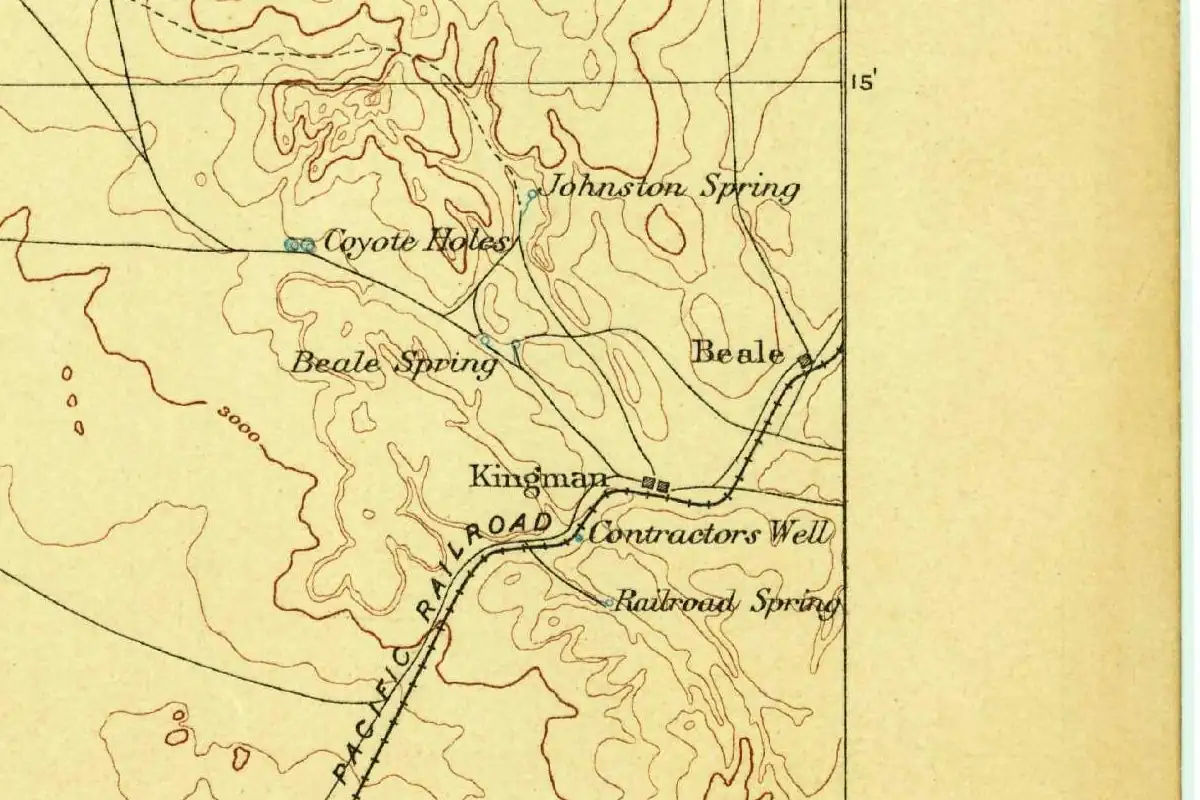
The town got started before the trains showed up. In November 1882, papers in Tombstone and Tucson passed along the news that “a new town has been laid out near Beale Spring called Kingman,” where new smelting works were going up. You can see it on the 1886 Geological Survey map at the top of this page: two little black squares on a line marked Pacific Railroad, with Beale Spring just to the northwest.
There’s a loose end, though. Kingman’s tourism office says the Mineral Park paper Alta Arizona announced in October 1882 that Middleton would from then on be named Kingman. And a list of Atlantic and Pacific stations printed in Tucson in March 1883 still puts a Middleton right after Beal Springs, with no Kingman on it at all. We couldn’t find the Alta Arizona itself, so you’ll have to take the tourism office’s word on that switch. None of the sources we read says who actually chose the name.
What they do agree on is the man behind it. When Lewis Kingman died in a Mexico City hospital on January 24, 1912, the Mohave County Miner called him “the engineer after whom the town of Kingman was named,” and the Coconino Sun in Flagstaff ran the news a week later. Both papers spelled his first name Louis, though the papers of the 1880s mostly wrote Lewis. Will C. Barnes went with Lewis in his 1935 book Arizona Place Names: “After Lewis Kingman, locating engineer, Santa Fe R. R.” So the spelling wobbled, but the person didn’t.
“The new paper town of Kingman”
Not everybody was impressed. Mineral Park, the county seat, sat about 10 miles (16 km) from the new station, according to an 1883 guide to the territory. On March 18, 1883, its paper, the Mohave County Miner, ran a mock prospectus for a company that would raise lizards for meat, because immigration “to the new town of Kingman will be so vast” there wouldn’t be enough beef in Arizona. The company had “taken up a town-site adjoining the new paper town of Kingman,” named it Lizardville, and offered a free lot with every share of stock.
The joke was partly at the expense of Conrad Shenfield, the railroad contractor who, the tourism office says, sold lots in Kingman before anyone had clear title to the land. The ad calls the place “Shenfield’s new paper city.” Yet the same page carried a straight report from Kingman, dated March 14: the end of the track was “within about twenty miles of this place,” and a visiting sawmill owner thought Kingman had “a wonderful growth for a town started so far ahead of the railroad.”
That same week, a Las Vegas paper reported that Lewis Kingman had resigned as the Atlantic and Pacific’s chief engineer to take the same job on the Mexican Central, starting April 1. By the Miner’s later account, he went on from the Mexican Central to become chief engineer of the National Railway of Mexico, and he died in Mexico City.
Route 66 down Front Street
Kingman’s next big road ran right beside the rails. The 1940 WPA guide to Arizona says US 66 followed Front Street, “which has business buildings on one side and on the other the tracks and station of the Santa Fe Railway, the town’s one link for many years with the outside world.” Front Street is Andy Devine Avenue today, the tourism office says.
The National Park Service notes that the Bureau of Land Management designated the 42-mile (68 km) stretch of Route 66 between Kingman and Topock as a Backcountry Byway, and its list of Arizona’s Route 66 sites in the National Register includes the Kingman Commercial Historic District. If you’re working your way through the Route 66 towns, this is where the old road heads west for the Colorado River.
Not the Kansas Kingman
If you go looking for Kingman, you’ll trip over a few others. Henry Gannett’s 1905 book on American place names lists a Kingman County and a city of Kingman in Kansas, named for Chief Justice S. A. Kingman, a Kingman in Maine named for R. S. Kingman, and a Kingman Pass in Yellowstone named for Lieutenant D. C. Kingman. Arizona’s Kingman isn’t in the book at all.
As for the Mohave County Miner, the paper that laughed at the “paper town” moved there itself in 1886, the tourism office says, the same year a county vote made Kingman the county seat. By 1912 its page headings read “Mohave County Miner, Kingman, Arizona.” So the obituary that tied the town’s name to Lewis Kingman came from the very paper that once printed the Lizardville joke.
Quick answers
Who is Kingman, Arizona, named after?
Lewis Kingman, the locating engineer who ran the Atlantic and Pacific Railroad’s line across Arizona. Barnes says so in Arizona Place Names (1935), and the Mohave County Miner called him “the engineer after whom the town of Kingman was named” when he died in 1912.
Was Kingman, Arizona, once called Middleton?
Possibly. Kingman’s tourism office says the Alta Arizona reported in October 1882 that Middleton would be renamed Kingman, and a March 1883 station list still shows a Middleton next to Beal Springs. We couldn’t read the 1882 paper ourselves, so it isn’t confirmed.
Is Kingman, Arizona, named for the same person as Kingman, Kansas?
No. Gannett’s 1905 book says Kingman, Kansas, was named for Chief Justice S. A. Kingman, while the Arizona town honors the railroad engineer Lewis Kingman.
When was Kingman, Arizona, founded?
In 1882. Arizona papers reported that November that a new town called Kingman had been laid out near Beale Spring, and the 1940 WPA guide says it had been the area’s shopping and shipping center “since 1882.”
Key dates
- 1880Lewis Kingman's locating party starts running the Atlantic and Pacific line west through Arizona.
- 1882November: Arizona papers report a new town called Kingman laid out near Beale Spring.
- 1883March: The Mohave County Miner mocks "the new paper town of Kingman," and Lewis Kingman resigns to join the Mexican Central.
- 1886The Mohave County Miner moves to Kingman, and a county vote makes it the county seat.
- 1912January 24: Lewis Kingman dies in Mexico City. The Miner calls him the engineer the town was named for.
- 1940The WPA guide to Arizona describes US 66 running down Front Street beside the Santa Fe tracks.
Getting there
The closest airports, Amtrak stations and intercity bus stops, measured in a straight line from the center of Kingman.
Airports
- Laughlin/Bullhead International (IFP) Bullhead City 29 mi 46 km
- Grand Canyon West (1G4) Peach Springs 57 mi 91 km
- Harry Reid International (LAS) Las Vegas 87 mi 140 km
Amtrak trains
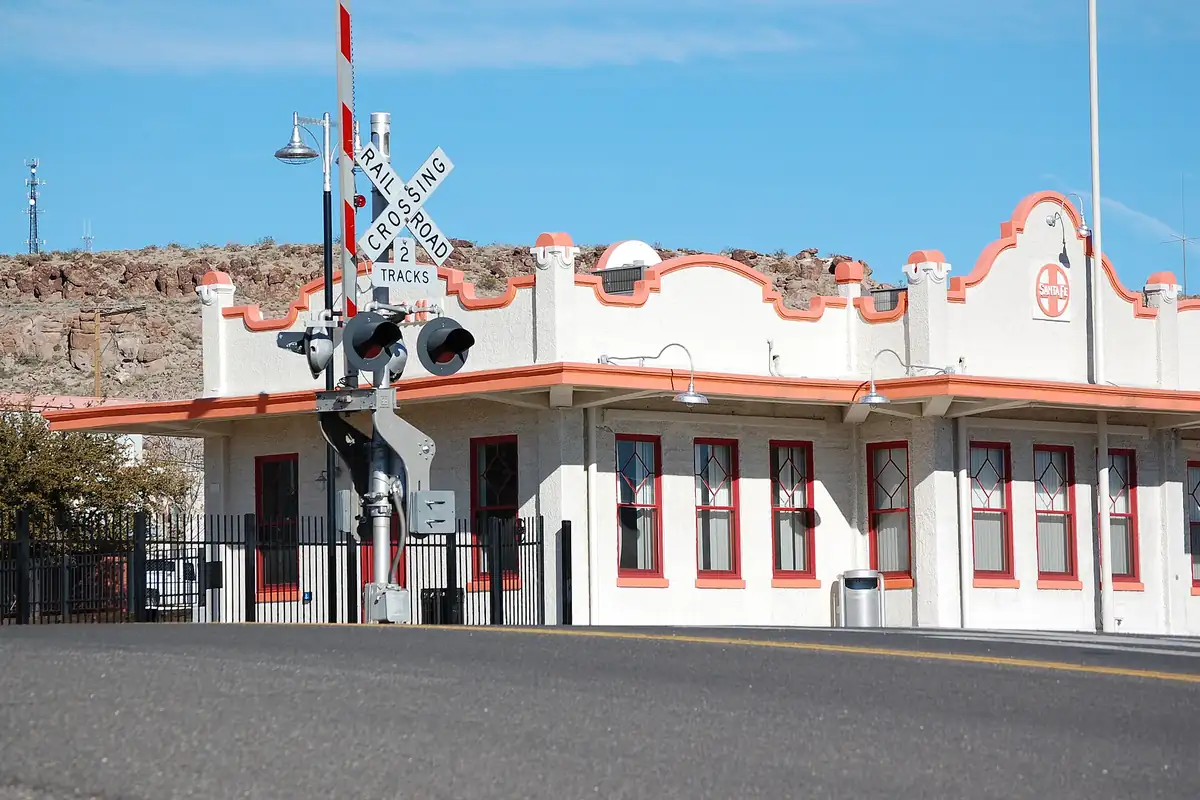
- Kingman station (KNG) under 1 mi 0.1 km
- Needles station (NDL) 40 mi 64 km
Intercity buses
- Vegas Airporter Amtrak Connecting Service · Kingman under 1 mi 0.1 km
- FlixBus Kingman S 1 mi 2 km
- Greyhound Kingman McDonald's 3 mi 5 km
Distances are as the crow flies, not by road. We don't list schedules or fares because they change; check with the airline, Amtrak or the bus company before you go. Official data (FAA commercial service airports (2025), FAA airport locations, Amtrak stations and Intercity Bus Atlas) from the FAA and the U.S. Bureau of Transportation Statistics, checked Nov 2, 2026.
Historical Sources & References
- Will C. Barnes, Arizona Place Names (University of Arizona, 1935). From the Kingman entry (the book is a restricted loan online, so we read only a search snippet): “Important mining and business town. After Lewis Kingman, locating engineer, Santa Fe R. R.”
- Mohave County Miner, February 24, 1912, p. 2. “Louis Kingman, the engineer after whom the town of Kingman was named,” died at the general hospital in Mexico City “on the 24th of last month”; chief engineer of “the old Atlantic & Pacific, now the Santa Fe.”
- Mohave County Miner, April 13, 1912, p. 5. A page heading that reads “Mohave County Miner, Kingman, Arizona, April 13, 1912.”
- The Coconino Sun, March 1, 1912, p. 2. The same news from Flagstaff: the civil engineer of the old A. & P. “after whom the town of Kingman was named.”
- Arizona Republican, April 22, 1920, p. 4. Reprint of the Phoenix Herald of April 22, 1880: Holbrook and Kingman, each with 20 men, start locating the Atlantic and Pacific line; Kingman “will run west through Arizona.”
- Daily Gazette (Las Vegas, N.M.), May 20, 1880, p. 4. Kingman’s locating party in Apache County, with “five large teams, mule packs,” moving “about ten miles a day.”
- Las Vegas Morning Gazette, March 31, 1881, p. 4. Kingman “still on the surveys of the Atlantic & Pacific in western Arizona.”
- Las Vegas Daily Gazette, August 2, 1881, p. 4. Mrs. Lewis Kingman and her children arriving from Topeka on their way to Albuquerque.
- The Pinal Drill, December 31, 1881, p. 8. Kingman, “chief engineer of the Atlantic and Pacific road,” in winter quarters near Flagstaff.
- Arizona Weekly Citizen, February 12, 1882, p. 3. The dispatch from the chief engineer stopping work west of Hackberry.
- Tombstone Weekly Epitaph, November 18, 1882, p. 3. “A new town has been laid out near Beale Spring called Kingman,” where smelting works were going up. Also online: the same item in the Arizona Weekly Citizen, November 19, 1882, p. 1.
- Arizona Weekly Citizen, March 11, 1883, p. 4. The list of Atlantic and Pacific stations west of Williams, with Middleton after Beal Springs and no Kingman.
- Las Vegas Daily Gazette, March 13, 1883, p. 4. Kingman resigns as chief engineer of the Atlantic and Pacific for the Mexican Central, starting April 1.
- Mohave County Miner, March 18, 1883, p. 3. The mock lizard prospectus (“the new paper town of Kingman,” “Shenfield’s new paper city,” Lizardville) and the Kingman report of March 14 on the end of the track.
- Patrick Hamilton, The Resources of Arizona (1883), p. 62. Mineral Park as county seat, with Kingman “about 10 miles distant” as its nearest station.
- Kingman Tourism, “History”. The Alta Arizona items of June and October 1882, including Middleton “to be hereafter named Kingman”; Shenfield’s lots; the Miner’s move and the county-seat vote of 1886; Front Street as Andy Devine Avenue.
- Writers’ Program, Arizona: A State Guide (1940), p. 324. Kingman as a shipping center “since 1882,” and US 66 following Front Street beside the Santa Fe tracks.
- National Park Service, “Route 66: Arizona”. The 42-mile Backcountry Byway between Kingman and Topock, and the Kingman Commercial Historic District on its list of Route 66 National Register sites.
- Henry Gannett, The Origin of Certain Place Names in the United States (USGS, 1905), p. 175. The Kingmans in Kansas, Maine and Yellowstone, each named for a different man; no entry for Arizona.
- U.S. Geological Survey, Camp Mohave sheet (1886). The map at the top of this page, with Kingman on the railroad near Beale Spring.
- GNIS feature 6704, Kingman (U.S. Geological Survey). The official name and coordinates of the town.
Spot something wrong, or know more? Tell us here. You can also email us or use our contact page. Corrections are noted here with their date, never made silently.