Barstow, California: The Santa Fe Boss's Middle Name
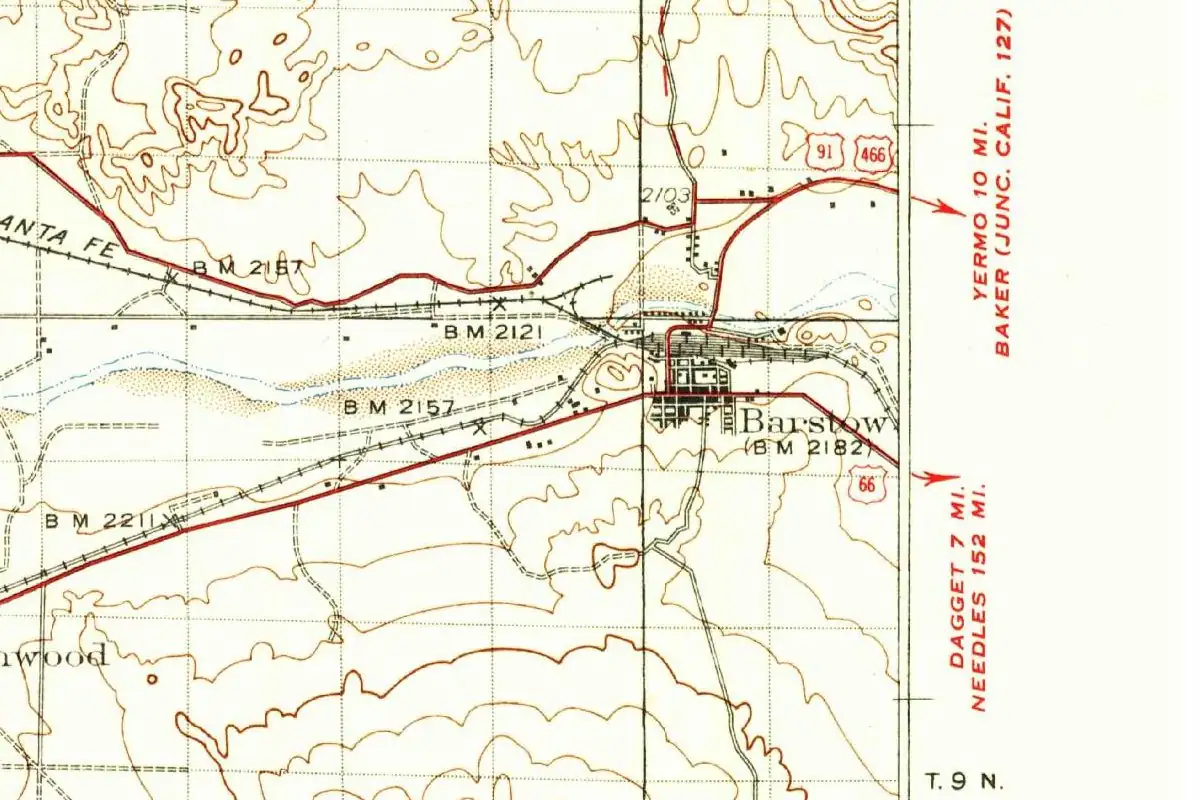
Barstow, California, carries the middle name of William Barstow Strong, who was president of the Santa Fe railroad when its new line got there in 1885. At first the place was a desert junction called Waterman, and the switch to Barstow was announced in January 1886.
Waterman Junction, briefly
The town started as a meeting point of two railroads. In September 1885, the Sacramento Daily Record-Union reported that “Waterman Junction, a new town on the Mojave desert at the junction of the California Southern and Atlantic and Pacific railroads, is being rapidly built up.” The Santa Fe had bought the California Southern, and in February 1886 the same paper reported the Santa Fe’s first vice president as saying the company then built “100 miles additional from Colton,” finished on November 1, “to Barstow, the junction with the Atlantic and Pacific road.”
San Bernardino threw a party for it. A 1922 county history by John Brown Jr. and James Boyd says that on November 15, 1885, the citizens “turned out en masse with fireworks to greet the first continental train” over the new line “from San Bernardino to Waterman (now Barstow).” That stretch, they add, completed the Santa Fe’s line between Kansas City and San Diego, “at that time the terminus of the road.”
The old name had a neighbor. In January 1886 the Los Angeles Daily Herald described R. W. Waterman of San Bernardino as “the well known silver miner of Waterman Station,” and that August it reported the Waterman mill at Barstow crushing ore from “the mine of the same name,” seven or eight miles (11 to 13 km) east in the hills. Waterman was elected lieutenant governor that fall and became governor of California in 1887, Brown and Boyd write. None of the papers we read says in so many words that the junction was named for him, though. So the town’s first name and the future governor’s mine shared a name, and that’s as far as the paperwork goes.
“Waterman Junction is to be called Barstow”
The change came fast. On January 5, 1886, the Record-Union ran a short dispatch from Daggett, which sits 7 miles (11 km) to the east on the map at the top of this page. It was dated the day before. It had two lines of news: the Calico mining district’s output, and “Waterman Junction is to be called Barstow.”
The new name took a while to stick. In March the Herald listed mail coming “from Daggett, Barstow or Waterman’s,” and in February it noted a guest “of Barstow, nee Waterman.” Brown and Boyd were still adding “(formerly Waterman)” and “(now Barstow)” in 1922.
Whose Barstow?
The dispatch didn’t say why, and we didn’t find an 1886 paper that did. The explanation comes from the National Register of Historic Places nomination for the town’s Harvey House, which the City of Barstow’s planning department prepared in 1974: “Waterman Junction was promptly renamed Barstow, after William Barstow Strong.”
That’s the man the railroad answered to. A 1915 Vermont Historical Society book lists William Barstow Strong, born May 16, 1837, as “President of the Atchison, Topeka & Santa Fe Railroad, 1880-1889.” His last name was on the map, too. Henry Gannett’s 1905 federal place-names book lists Strong, a city in Chase County, Kansas, “named for W. B. Strong, president, Atchison, Topeka and Santa Fe Railroad Company.” So a desert junction on the boss’s railroad ended up with the boss’s middle name.
One small wrinkle. The nomination calls Strong “a former president of the Atlantic & Pacific Railroad,” which it describes as a Santa Fe subsidiary. The other sources we read call him president of the Santa Fe itself. Either way, you end up with the same man.
Was it ever Grapevine?
If you’ve read that Barstow was once called Grapevine, here’s what we found. We couldn’t confirm that the town itself ever went by that name. The oldest source we read that mentions it, Brown and Boyd, uses it for a mining district: “the Grapevine district, north of Barstow (formerly Waterman),” where Waterman and a partner named Porter relocated an old silver claim and put up a ten-stamp mill.
Harvey House, then Route 66
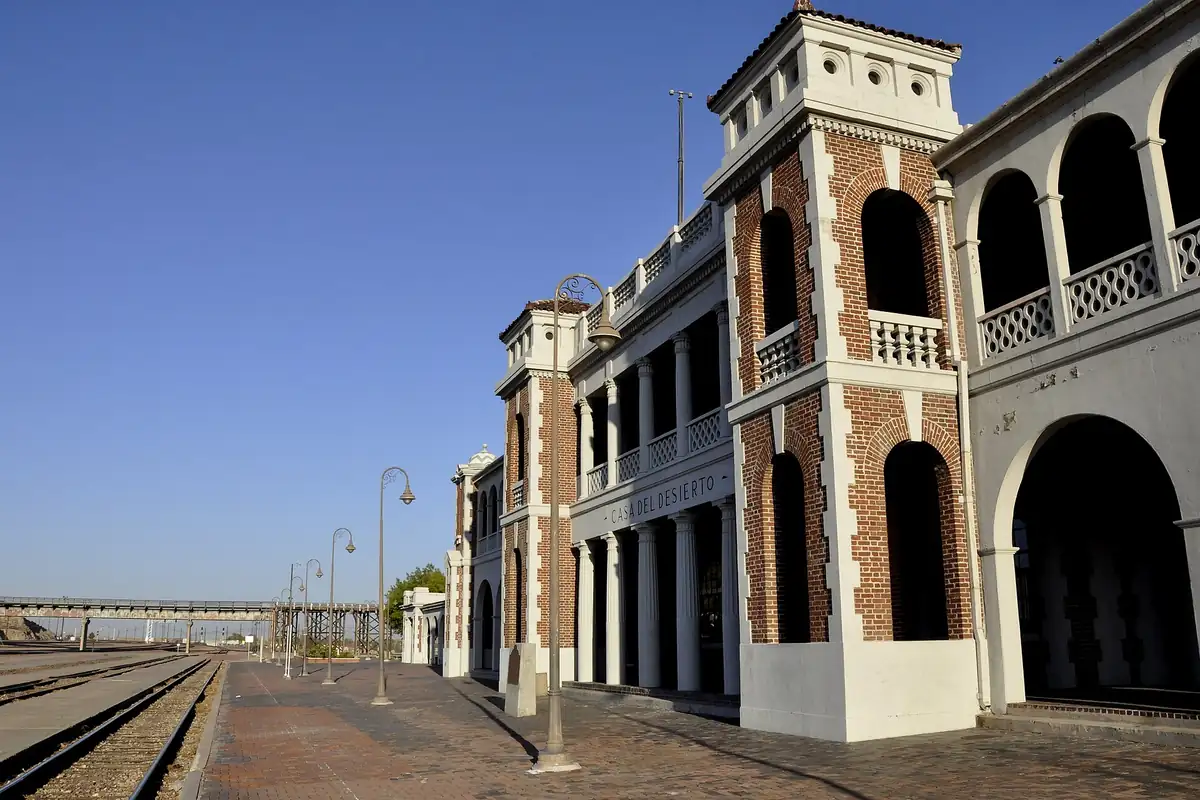
A wooden depot and a wooden restaurant and hotel went up by the tracks in 1885, the 1974 nomination says. Fred Harvey took over all the hotels and restaurants on the Santa Fe line in 1893, the wooden building burned in 1908, and the brick-and-arches Harvey House you see today, Casa del Desierto, went up between 1910 and 1913. The town itself didn’t incorporate until 1947, according to the federal place-names database. The nomination also traces the Harvey idea back to Topeka, Kansas, where the Santa Fe opened its first lunchroom in 1872 and sold it to Fred Harvey in 1876.
The junction mattered for the mail, too. In December 1885 the Los Angeles Board of Trade drew up a petition saying eastern mail that came “via Waterman and Colton” and went on by Wells, Fargo express reached Los Angeles 15 hours ahead of the government mail over the Southern Pacific via Deming. It asked that all mail “east of Albuquerque destined for Los Angeles” be sent that way.
Then the cars came. California’s 1939 WPA guide follows U.S. 66 “along the tree-lined dry wash of the Mojave River” into Barstow, by then a town of 2,549 and “a division point of the Santa Fe Ry., whose shops employ 85 percent of its workmen.” The National Park Service calls the road between Needles and Barstow, “on the western edge of the Mojave,” “one of the hottest legs of the road anywhere along Route 66’s more than 2,000 mile length,” and it lists Barstow’s Harvey House Railroad Depot among the state’s Route 66 sites on the National Register. You can follow the rest of the road in our Route 66 towns collection.
So the next time you pull into Barstow, you’re stopping in a town that got its name from a railroad and later landed on Route 66. And the name on the signs isn’t the boss’s last name. It’s the one in the middle.
Quick answers
Who is Barstow, California, named after?
William Barstow Strong, president of the Atchison, Topeka & Santa Fe in the 1880s. No 1886 paper we found gives the reason, but the 1974 National Register nomination for the town’s Harvey House says Waterman Junction was “promptly renamed Barstow, after William Barstow Strong.”
What was Barstow called before?
Waterman Junction, or just Waterman. A Daggett dispatch printed on January 5, 1886, said “Waterman Junction is to be called Barstow,” and a county history from 1922 still writes “Waterman (now Barstow).”
Was Barstow ever called Grapevine?
Not in the sources we read. The 1922 county history uses Grapevine for a silver-mining district “north of Barstow (formerly Waterman),” not for the town itself.
Is Barstow on Route 66?
Yes. The National Park Service names the stretch between Needles and Barstow as one of the hottest on all of Route 66, and the 1939 WPA guide routes U.S. 66 straight through town.
Key dates
- 1885September: a Sacramento paper reports Waterman Junction, a new town at the junction of two railroads, is being rapidly built up.
- 1885November: the California Southern line from San Bernardino is finished to the junction, and San Bernardino greets the first transcontinental train.
- 1886January 4: a dispatch from Daggett reports that Waterman Junction is to be called Barstow.
- 1893Fred Harvey takes over all the hotels and restaurants on the Santa Fe line.
- 1908The wooden Harvey House at Barstow burns. The present depot and hotel go up in 1910-1913.
- 1939The state's WPA guide follows U.S. 66 into Barstow, a Santa Fe division point of 2,549 people.
- 1947Barstow is incorporated.
Getting there
The closest airports, Amtrak stations and intercity bus stops, measured in a straight line from the center of Barstow.
Airports
- San Bernardino International (SBD) 57 mi 91 km
- Ontario International (ONT) 67 mi 108 km
Amtrak trains
- Barstow station (BAR) under 1 mi 0.7 km
- Victorville station (VRV) 29 mi 47 km
Intercity buses
- Gold Runner Barstow - Amtrak under 1 mi 0.7 km
- Alvand Transportation Amtrak Connecting Service · Barstow under 1 mi 0.7 km
- FlixBus Barstow East Main Street 1611 1 mi 2 km
Distances are as the crow flies, not by road. We don't list schedules or fares because they change; check with the airline, Amtrak or the bus company before you go. Official data (FAA commercial service airports (2025), FAA airport locations, Amtrak stations and Intercity Bus Atlas) from the FAA and the U.S. Bureau of Transportation Statistics, checked Nov 2, 2026.
Historical Sources & References
- Sacramento Daily Record-Union, September 18, 1885, p. 2. “Waterman Junction, a new town on the Mojave desert at the junction of the California Southern and Atlantic and Pacific railroads, is being rapidly built up.” Also online: the same paper on February 20, 1886, p. 8, reporting the Santa Fe’s first vice president on the 100 miles “from Colton … to Barstow,” completed November 1.
- Sacramento Daily Record-Union, January 5, 1886, p. 1. The Daggett dispatch of January 4: “Waterman Junction is to be called Barstow.”
- Los Angeles Daily Herald, January 7, 1886, p. 5. R. W. Waterman of San Bernardino, “the well known silver miner of Waterman Station.”
- Los Angeles Daily Herald, February 28, 1886, p. 6. A hotel guest “of Barstow, nee Waterman.” Also online: March 10, 1886, p. 4, with mail “from Daggett, Barstow or Waterman’s.”
- Los Angeles Daily Herald, December 19, 1885, p. 5. The Board of Trade petition to route eastern mail “via Waterman and Colton,” including all mail “east of Albuquerque destined for Los Angeles.”
- Los Angeles Daily Herald, August 4, 1886, p. 6. The Waterman mill at Barstow and the mine “of the same name seven or eight miles off in the hills to the eastward.”
- John Brown Jr. and James Boyd, History of San Bernardino and Riverside Counties, vol. 1 (1922). The 1884 announcement that the line “would be completed to Waterman,” and San Bernardino’s first transcontinental train in November 1885 (p. 97); “the Grapevine district, north of Barstow (formerly Waterman)” and the Waterman and Porter mill (p. 110); R. W. Waterman elected lieutenant governor in 1886 and governor in 1887 (p. 138); the fireworks for the first train “to Waterman (now Barstow)” on November 15, 1885, which completed the Santa Fe line between Kansas City and San Diego (p. 152).
- National Register of Historic Places nomination, Harvey House (Casa del Desierto), Barstow (1974). Prepared by the City of Barstow Planning Department. “Waterman Junction was promptly renamed Barstow, after William Barstow Strong, a former president of the Atlantic & Pacific Railroad”; the wooden buildings of 1885, Fred Harvey in 1893, the fire of 1908, the present buildings of 1910-1913, and the first Santa Fe lunchroom in Topeka.
- Dorman B. E. Kent, One Thousand Men (Vermont Historical Society, 1915), p. 39. “William Barstow Strong. President of the Atchison, Topeka & Santa Fe Railroad, 1880-1889,” born May 16, 1837.
- Henry Gannett, The Origin of Certain Place Names in the United States (USGS, 1905), p. 292. Strong, a city in Chase County, Kansas, “named for W. B. Strong, president, Atchison, Topeka and Santa Fe Railroad Company.”
- Federal Writers’ Project, California: A Guide to the Golden State (1939), p. 612. U.S. 66 into Barstow, its 2,549 people, and the Santa Fe division point whose shops “employ 85 percent of its workmen.”
- National Park Service, “Route 66: California”. The Needles-to-Barstow stretch as “one of the hottest legs of the road anywhere along Route 66,” and the Harvey House Railroad Depot among the state’s National Register sites.
- U.S. Geological Survey, Barstow sheet (1932 edition, 1956 printing). The map at the top of this page.
- GNIS feature 1652670, Barstow (U.S. Geological Survey). The official name and coordinates, and the note “Incorporated in 1947.”
Spot something wrong, or know more? Tell us here. You can also email us or use our contact page. Corrections are noted here with their date, never made silently.