Jonesboro, Arkansas: Two Senators, Two Names, One Bill
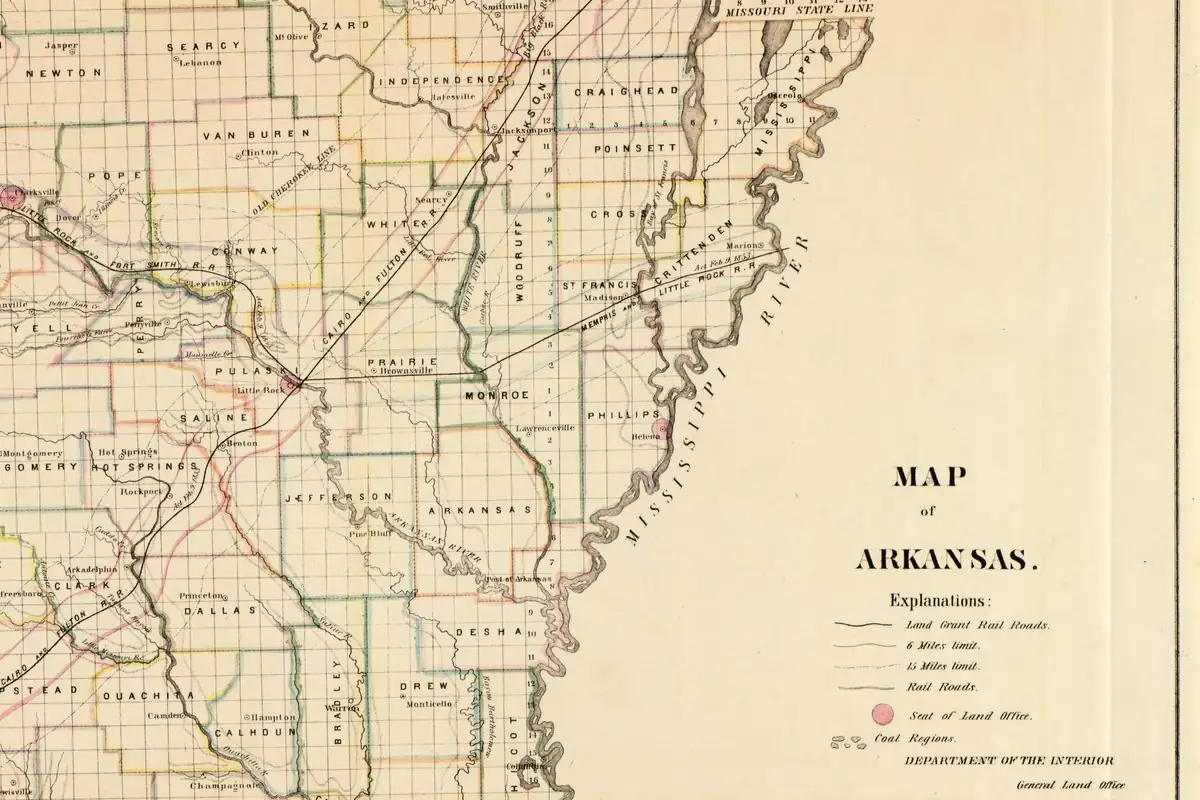
Jonesboro is named for William A. Jones, an Arkansas state senator who pushed through the 1859 act that created Craighead County. The county itself honors Thomas B. Craighead, the senator who opposed that bill. An 1889 county history says Craighead's name went in while he was away; a modern account says the two senators swapped the honors.
Jonesboro, Arkansas, is named for state senator William A. Jones, and the county around it for Thomas B. Craighead, the senator who opposed Jones’s bill. So when you drive into Jonesboro, Craighead County, you’re reading two names from the same fight in the Arkansas Senate, back in 1858 and 1859.
Two senators and a new county
The fullest early telling comes from a thick 1889 history of northeast Arkansas put out by the Goodspeed Publishing Company, just 30 years after the county was formed. It says the county was organized under an act of the legislature “approved February 19, 1859.” Two senators had very different feelings about that act.
Craighead, who then represented Mississippi and Crittenden counties, “was opposed to the bill creating the new county.” Jones, who represented St. Francis and Poinsett counties, “was its principal supporter.” Then comes the twist. Here’s how Goodspeed tells it:
“The bill was called up for passage when the former was absent from his seat, and upon returning he found that it had been passed, and that his own name had been inserted in the space left blank for the name of the county.”
In other words, the man who didn’t want the county got it named after him anyway. And the man who did want it got the county seat. A few pages later the same book says Jonesboro “was named in honor of William A. Jones, State Senator for the counties of St. Francis and Poinsett, for his able support of the act creating the county.”
A trade, in the modern telling
The CALS Encyclopedia of Arkansas, in an entry by Nancy Hendricks of Arkansas State University, tells it a little more politely. In 1858, it says, Jones proposed a new county that would take in land from the area Craighead represented, and Craighead opposed the idea. When the bill passed, Jones proposed that the county be named for Craighead, “who, in turn, proposed that the county seat be named for Jones.”
So which was it, a name slipped in behind Craighead’s back or a courteous swap between two colleagues? The sources don’t settle it. What they agree on is the part that answers the question: the town honors Jones, and Jones was the senator behind the bill.
Henry Gannett’s 1905 rundown of how American places got their names, published by the U.S. Geological Survey, keeps it short. Jonesboro, in Craighead County, was “named for Senator William A. Jones.” Craighead County was “named for Thomas B. Craighead, of the State senate.” Neither entry mentions the quarrel.
Gannett’s page also shows how easy it is to mix up your Joneses. Right below the Arkansas town, he lists three more Jonesboros, each for a different man: one in Illinois for “Doctor Jones, a prominent settler,” one in Maine for John C. Jones, one of the original proprietors, and one in Tennessee for William Jones, “a North Carolinian statesman.” Same name, four different Joneses. The Arkansas one is the senator.
Jonesborough on a ridge
The encyclopedia adds that the town started out as “Jonesborough,” with the spelling later simplified. It doesn’t say when the shorter form took over, and neither does anything else on this page.
The site itself came with a built-in advantage. Crowley’s Ridge, the encyclopedia says, is a crescent-shaped rise and the highest point in northeast Arkansas, and it stayed safe from the floods that hit the low country around it. A settler named Benjamin Crowley had built a homestead there in 1821 to get away from the seasonal water, and the area came to be called Crowley’s Ridge. Farmer Fergus Snoddy donated fifteen acres for the town site, in what’s now downtown.
The dates don’t line up perfectly, which is worth knowing if you go digging. The encyclopedia says Craighead County and Jonesboro were “officially born” on February 19, 1859. Goodspeed says the site of Jonesboro was picked as the permanent seat of justice “about two years after the county’s organization.” Goodspeed also has a good excuse for any fuzziness: the county’s courthouses burned in 1869, 1876 and 1878, and in those fires “the early public records of the county were all destroyed.”
From 150 people to a railroad town
Jonesboro started small. Goodspeed says William Puryear moved his store from his farm to the town site and became its first merchant, and that the place had about 150 people when the Civil War began. The encyclopedia gives a rougher figure of about seventy-five at secession. Either way, it was a small courthouse town.
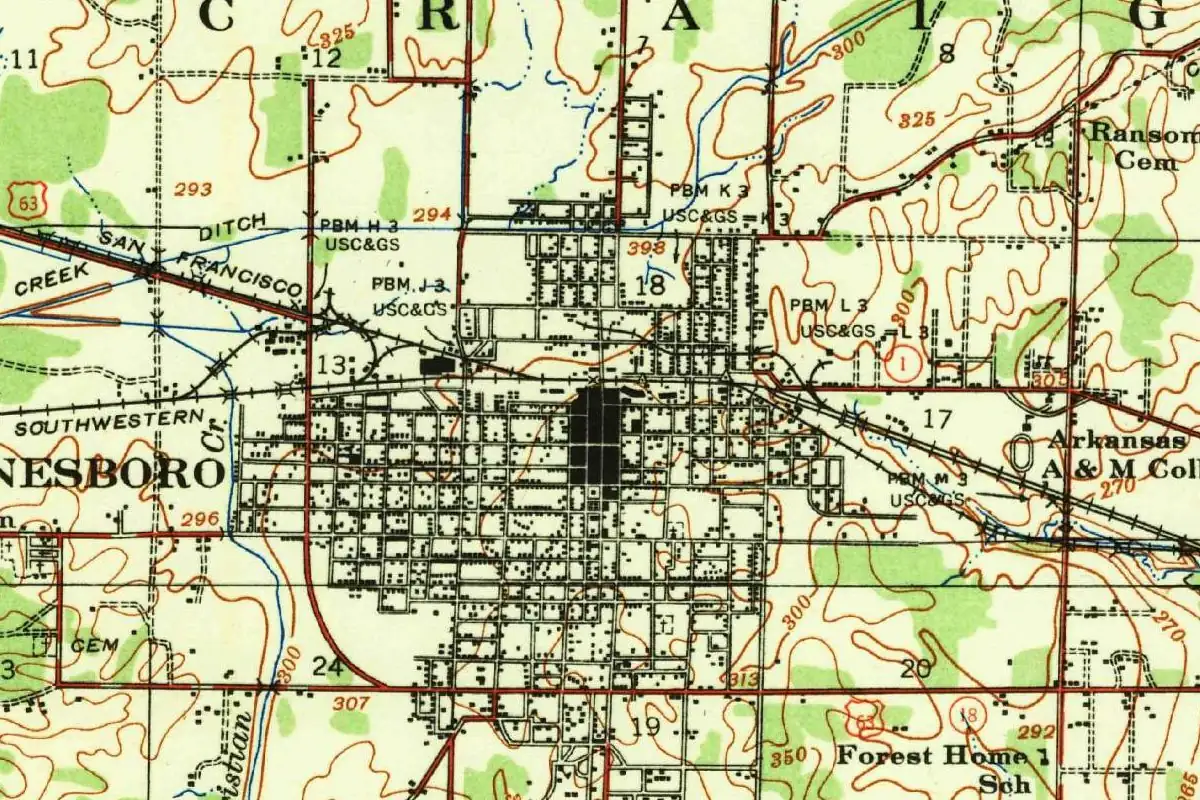
The railroads changed that. The encyclopedia says the Cotton Belt laid track north of downtown in 1881, and voters approved incorporation in 1883, on February 16. Look at the 1939 map at the top of this page and you can see what that growth looked like by then: a tight grid of blocks, rail lines cutting across on the diagonal and, at the right edge, a college labeled “Arkansas A & M.” Spread across the top in big spaced-out letters is the county name, C-R-A-I-G-H-E-A-D. The two senators still share the sheet.
Next door, another name built from two men
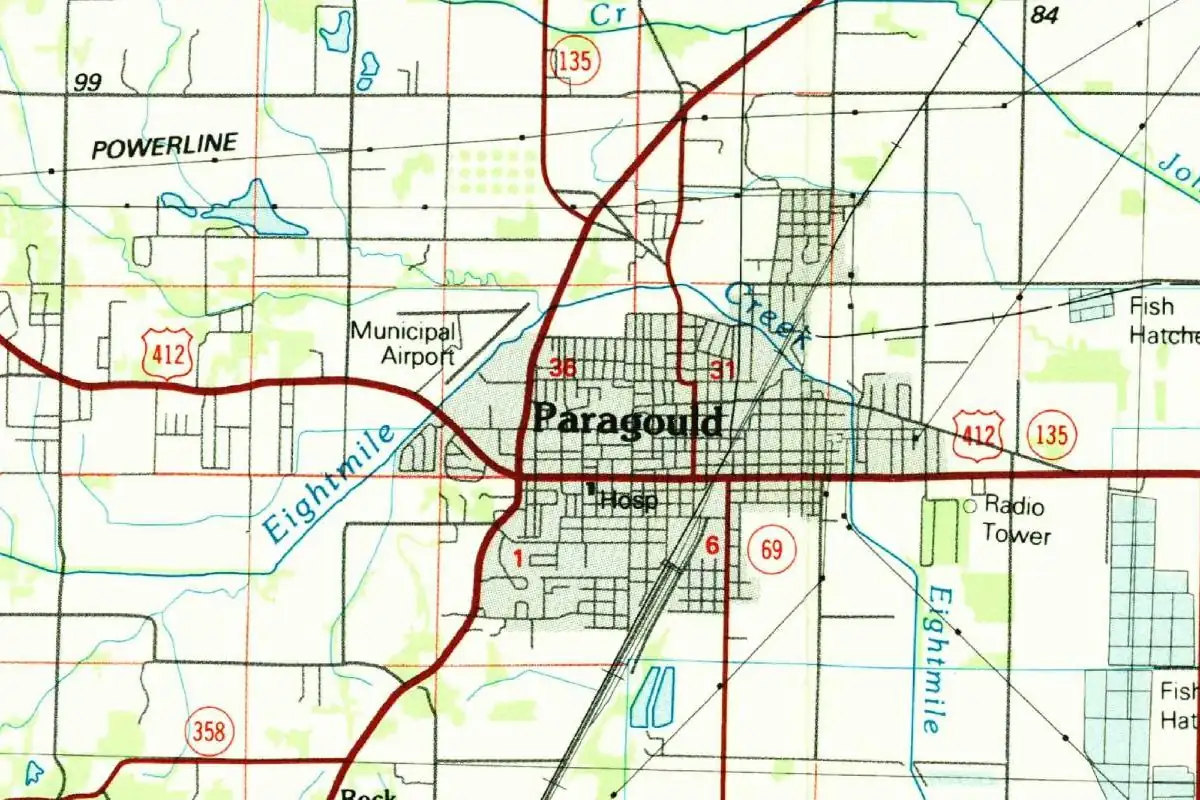
Jonesboro isn’t the only town in this corner of the state with a name that takes two people to explain. Up the road in Greene County, Paragould got its name from two railroad presidents, Paramore and Jay Gould, and the same Goodspeed history tells that story too. You can find more of the state’s name stories on our Arkansas page.
Quick answers
Who is Jonesboro, Arkansas, named after?
William A. Jones, an Arkansas state senator. Goodspeed’s 1889 history says the town was named for him “for his able support of the act creating the county,” and Gannett’s 1905 bulletin also lists it as named for Senator William A. Jones.
Why is it Craighead County if Jones pushed the bill?
Because Thomas B. Craighead, the senator who opposed it, ended up with the county named for him. Goodspeed says his name was put in while he was absent; the Encyclopedia of Arkansas says Jones proposed it and Craighead returned the favor.
Was Jonesboro once spelled Jonesborough?
Yes. The Encyclopedia of Arkansas says the town was created as “Jonesborough,” with the spelling later simplified.
When did Jonesboro become a city?
It was incorporated in 1883, on February 16, according to the Encyclopedia of Arkansas, more than two decades after the county was created in 1859.
Key dates
- 1858Senator William A. Jones proposes a new county, the Encyclopedia of Arkansas says, over the objections of Senator Thomas B. Craighead.
- 1859On February 19, the act creating Craighead County is approved.
- 1881The Cotton Belt railroad lays track north of downtown Jonesboro.
- 1883Jonesboro is incorporated on February 16.
Things to do in Jonesboro, Arkansas
Arkansas State University Museum
An accredited university museum on the Arkansas State campus that tells the history of Northeast Arkansas, with a Tinkering Studio for hands-on making.
Craighead Forest Park
A city park on Crowley's Ridge with hiking and mountain bike trails, fishing, a boat ramp, an RV campground and picnic pavilions. The Encyclopedia of Arkansas says work on its lake began in 1937.
Forrest L. Wood Crowley's Ridge Nature Center
A state nature center that tells the story of the ridge rising above the Mississippi Delta, with a two-story diorama, live native animals and 3.1 miles (5 km) of trails that connect to Craighead Forest Park.
Lake Frierson State Park
A state park on the shore of 335-acre Lake Frierson, about 10 miles (16 km) north of Jonesboro, known for year-round fishing for bream, catfish, crappie and bass.
Getting there
Open Jonesboro in Google Maps
Opens in a new tab. The pin is the center of Jonesboro in the USGS place-name record.
The closest airports, Amtrak stations and intercity bus stops, measured in a straight line from the center of Jonesboro.
Airports
- Frederick W Smith International/Memphis (MEM) 69 mi 111 km
- Jackson Regional (MKL) 102 mi 164 km
Amtrak trains
- Walnut Ridge station (WNR) 21 mi 34 km
- Memphis station (MEM) 61 mi 98 km
Intercity buses
- Greyhound Jonesboro Jet Transfer Station 2 mi 3 km
Distances are as the crow flies, not by road. We don't list schedules or fares because they change; check with the airline, Amtrak or the bus company before you go. Official data (FAA commercial service airports (2025), FAA airport locations, Amtrak stations and Intercity Bus Atlas) from the FAA and the U.S. Bureau of Transportation Statistics, checked Nov 14, 2026.
Sponsored
Staying in Jonesboro?
Compare hotels in Jonesboro, Arkansas, on Expedia.
See hotels in JonesboroWe may earn a commission if you buy through this link. It never changes what we write. Read our affiliate disclosure
Historical Sources & References
- Biographical and Historical Memoirs of Northeast Arkansas (Goodspeed, 1889), p. 312. The act “approved February 19, 1859”; Craighead opposed, Jones “its principal supporter”; the quoted passage on the bill passing while Craighead was absent; the site picked “about two years after the county’s organization”; the courthouse fires and the loss of “the early public records of the county.”
- Biographical and Historical Memoirs of Northeast Arkansas (Goodspeed, 1889), p. 315. Jonesboro “named in honor of William A. Jones … for his able support of the act creating the county”; William Puryear as first merchant; about 150 people at the start of the Civil War.
- Henry Gannett, The Origin of Certain Place Names in the United States (1905), p. 170. Jonesboro “named for Senator William A. Jones”; the Jonesboros of Illinois, Maine and Tennessee, each named for a different Jones.
- Henry Gannett, The Origin of Certain Place Names in the United States (1905), p. 94. Craighead County “named for Thomas B. Craighead, of the State senate.”
- Nancy Hendricks, “Jonesboro (Craighead County),” CALS Encyclopedia of Arkansas. The 1858 proposal and the exchange of names; “Jonesborough” and the simplified spelling; the February 19, 1859, date; Crowley’s Ridge and Benjamin Crowley; Fergus Snoddy’s fifteen acres; about seventy-five people at secession; the Cotton Belt in 1881; incorporation on February 16, 1883.
- GNIS feature 77389 (U.S. Geological Survey). The USGS place-name entry for Jonesboro, in Craighead County.
- U.S. Geological Survey, Jonesboro sheet (1939). The 1:62,500 quadrangle the map at the top of this page was cropped from.
Spot something wrong, or know more? Tell us here. You can also email us or use our contact page. Corrections are noted here with their date, never made silently.