Why Is It Called Jekyll Island? Oglethorpe's Backer
James Oglethorpe named the island for Sir Joseph Jekyll (1663-1738), an English lawyer who backed the new Georgia colony. The Spanish had called it Isla de Ballenas, Island of Whales. For two centuries maps spelled it Jekyl or Jykill, until the U.S. Board on Geographic Names settled on Jekyll, with two l's, in 1940.
Jekyll Island, Georgia, carries the name of Sir Joseph Jekyll, an English lawyer who backed the colony that James Oglethorpe founded in 1733. For two centuries after that, maps spelled the name three different ways.
Why is it called Jekyll Island?
Every source we checked agrees on the man. The U.S. Board on Geographic Names summed it up on its 1940 decision card: “Named by Gen. Oglethorpe for Sir Joseph Jekyll.” The Jekyll Island Authority, the state agency that runs the island, says Oglethorpe gave the island “its present name in honor of Sir Joseph Jekyll, a financial backer of the young colony,” and its timeline calls Jekyll “his friend and financier from England.” In an entry for the New Georgia Encyclopedia, John Hunter of the Authority calls him “a supporter of Oglethorpe’s efforts to establish the colony of Georgia.”
The explanation is older than all three. Turn to page 169 of the Geological Survey’s Bulletin 258, where in 1905 Henry Gannett traced thousands of names back to their sources, and you’ll find the island in a single entry that keeps the old spelling: “Jekyl; island in Georgia, named for Sir Joseph Jekyl.”
What nobody pins down is the date. The Authority’s timeline sets the naming under 1733, the year Oglethorpe landed the first colonists at Savannah, but none of the sources quotes a document from the moment. By the spring of 1736 the name was in use: Francis Moore’s account of a trip south that April mentions both “Jekyl sound” and “Jekyl island.” The encyclopedia adds that William Horton set out from Frederica the same month to claim land “to the neighboring island of Jekyll.”
Before the English, the island had other names. The encyclopedia says the Spanish called it Isla de Ballenas, “Island of Whales.” Federal name records add a string of variants, among them Gualdaquini, Ospo and Isle de la Somme, though they don’t say where each one comes from.
Who was Sir Joseph Jekyll?
The board’s card answers in a note: the Dictionary of National Biography “lists Sir Joseph Jekyll (1663-1738) master of rolls, barrister, etc.” The Georgia sources stress something else: his money and his backing for the colony. So you’ve got an island named, in effect, for a supporter in London.
One L or two?
Here’s where the island’s name gets messy. The 1940 decision card lists the spellings it found, map by map:
- Jekyl, on a 1763 map of part of Georgia by Brahm.
- Jykill, on maps from 1818 to 1842.
- Jekyl again, from an 1847 map through 1927, including an Army engineers’ tactical map of the Brunswick area in 1920.
- Jekyll, on a 1927 map of southeast Georgia and in a Georgia legislative resolution of July 31, 1929.
The old spelling didn’t go quietly. The card notes that the 1936 Rand McNally atlas and the 1938 Light List still printed Jekyl. Locally, though, two l’s had won: the card cites the Jekyll Island Club in 1930, and the Glynn County planning board, the Brunswick Board of Trade and Georgia’s secretary of state in 1939. The Coast and Geodetic Survey asked for a ruling in December 1938, and on October 31, 1940, the board decided: “Jekyll Island. (Not Jekyl Island nor Jykill Island.)”
The two-l spelling matches the man. The board’s own note on him, and the Georgia sources, spell Sir Joseph’s name Jekyll.
Jekyll Island history: Horton, the Wanderer and the club
Horton turned the island into a plantation that supplied Frederica, on St. Simons Island next door. The Authority says the Spanish wrecked his house and crops in 1742 as they retreated after the Battle of Bloody Marsh. The tabby walls you can see today belong to a house the Authority dates to 1743, the year after. After Horton died, the island passed through several owners until Christophe Poulain DuBignon, a Frenchman, bought it in 1792.
In 1858 the yacht Wanderer landed captives from Africa on Jekyll. The encyclopedia puts the landing on November 29 with 409 people aboard; the Authority dates it November 28 and says more than 400. They were among the last enslaved Africans brought into the country.
Then came the millionaires. The encyclopedia says Newton Finney paid the DuBignon family $125,000 for the island in 1886 on behalf of a new club, the Jekyll Island Club, and the clubhouse opened in January 1888. Members built “cottages,” and in 1904 Munsey’s Magazine called it “the richest, the most exclusive, the most inaccessible club in the world.” The club era faded with World War II. On October 7, 1947, Georgia bought the whole island for $675,000 through condemnation, and in 1948 it opened as a state park. In 1978 the old club district was named a National Historic Landmark.
Jekyll isn’t the only coastal place in this part of the South where an official ruling sorted out the name. In Siesta Key, Florida, the board picked Sarasota Key in 1922 and switched to the local name, Siesta Key, three decades later.
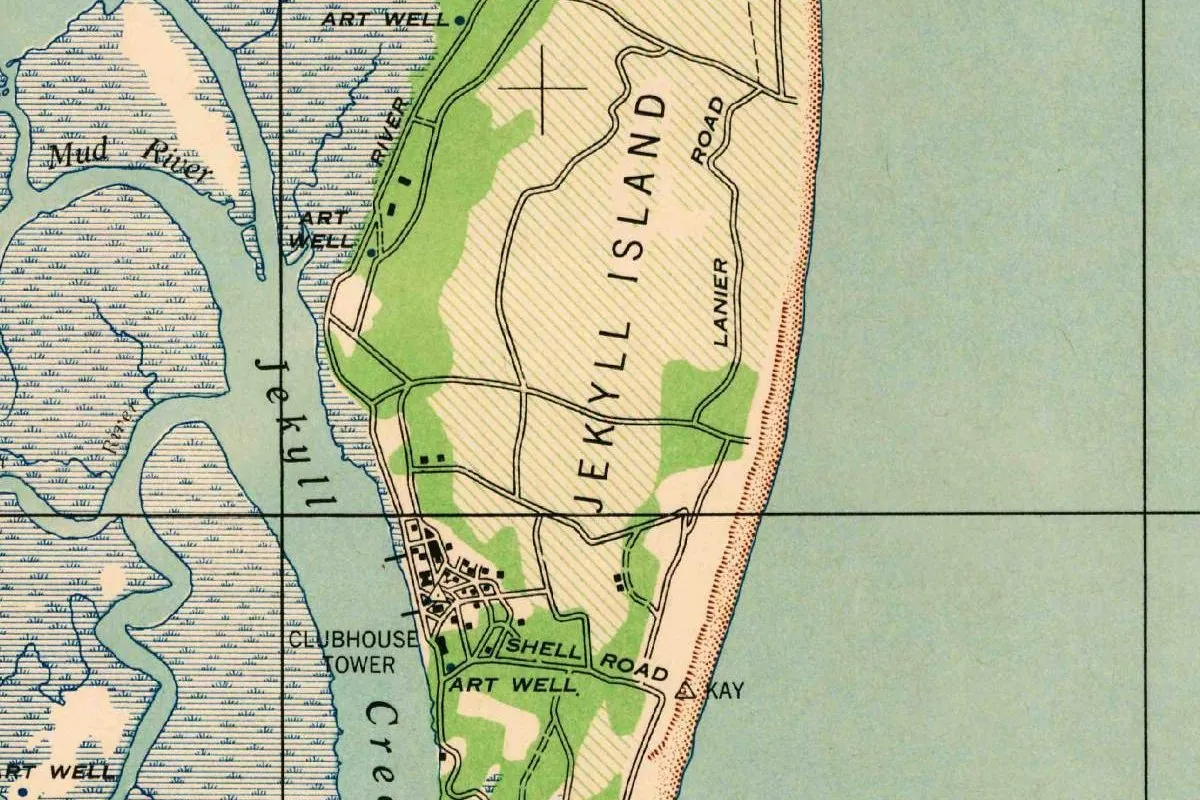
Jekyll Island on the 1945 map
The map at the top comes from the Brunswick quadrangle, 15-minute series, at 1:62,500, marked “First Edition (AMS 1), 1945.” The Army Map Service prepared it for the Corps of Engineers, with planimetry compiled from 1942 aerial photographs taken for the Army Air Forces, and relief taken from the engineers’ Brunswick sheet surveyed in 1912.
In the crop, Jekyll Island is lettered down the middle of the island, with Jekyll Creek on the marsh side. If you look near the creek you’ll find Clubhouse Tower next to a cluster of buildings, the old club grounds, with Shell Road and Lanier Road running off across the island. The full sheet also shows Jekyll Sound, and farther up, St. Simon and Brunswick.
Oglethorpe’s name-giving didn’t stop here. On his trip south in 1736, Moore says, he named the next island past Cumberland Amelia, across what’s now the Florida line.
Quick answers
Who was Jekyll Island named after?
Sir Joseph Jekyll (1663-1738), an English lawyer and master of the rolls who backed Oglethorpe’s colony. Gannett listed it that way in 1905, and the federal board repeated it in 1940.
Is it Jekyl or Jekyll?
Jekyll. Maps used Jekyl and Jykill for two centuries, but Georgia’s 1929 resolution used two l’s and the federal naming board settled on that spelling in 1940.
What did the Spanish call Jekyll Island?
Isla de Ballenas, “Island of Whales,” according to the New Georgia Encyclopedia.
Key dates
- 1733James Oglethorpe founds the Georgia colony; the island's official history puts the naming for Sir Joseph Jekyll here.
- 1736William Horton sets out from Frederica in April to claim land on Jekyll.
- 1763A map of part of Georgia by Brahm spells the island Jekyl.
- 1858The Wanderer lands enslaved Africans on Jekyll, one of the last such voyages to reach the United States.
- 1886The Jekyll Island Club buys the island from the DuBignon family for $125,000.
- 1929A resolution of the Georgia legislature uses the Jekyll spelling.
- 1940The U.S. Board on Geographic Names adopts Jekyll Island, not Jekyl or Jykill.
- 1947The state of Georgia buys the island for $675,000 through condemnation.
- 1948Jekyll Island opens to the public as a state park.
- 1978The Jekyll Island Club district becomes a National Historic Landmark.
Things to do in Jekyll Island, Georgia
Mosaic, Jekyll Island Museum
The island's history museum, with interactive exhibits built entirely inside the footprint of the old club stables.
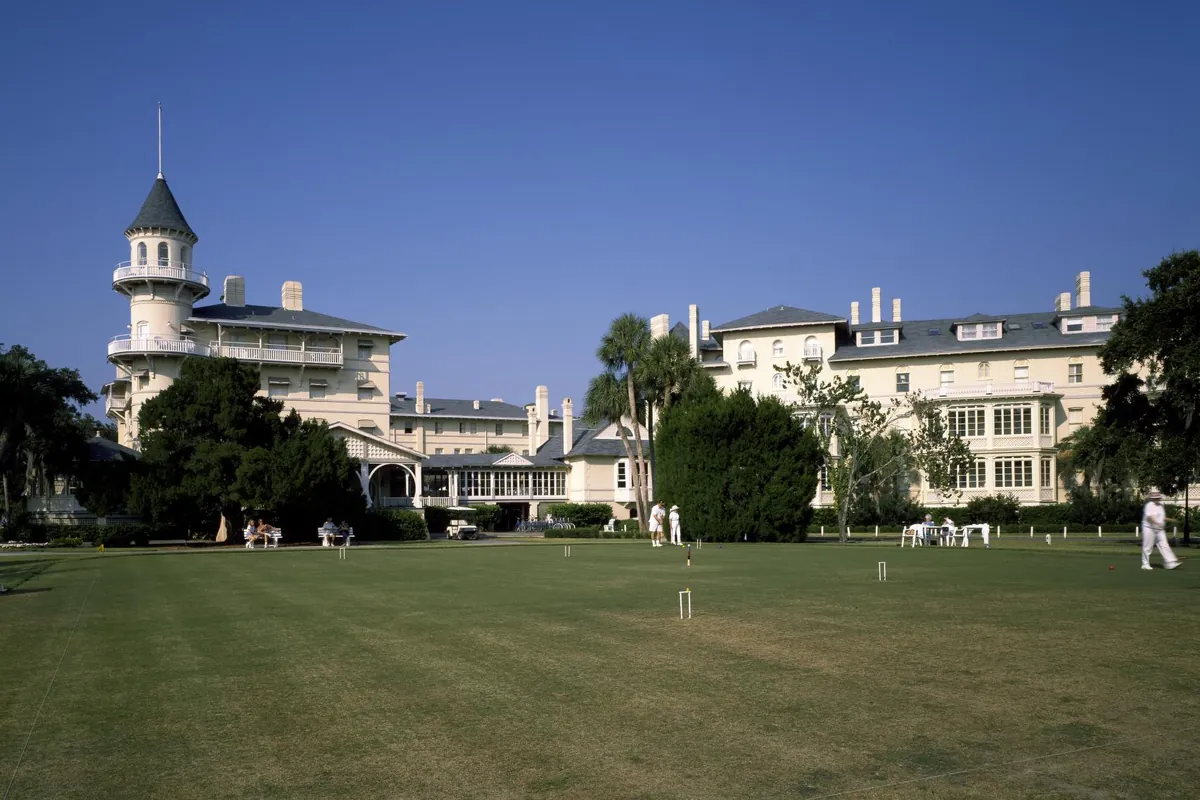
Jekyll Island Club National Historic Landmark District
The former club grounds, a 240-acre (97 ha) site with 34 historic buildings, among them the clubhouse, the members' cottages and Faith Chapel, finished in 1904.
Horton House
The tabby walls of William Horton's 1743 house, one of the oldest tabby buildings left in Georgia and listed on the National Register. Signs explain the site, and a small DuBignon family cemetery sits across the road.
Georgia Sea Turtle Center
The state's only center for sea turtle rehabilitation and education, treating sick and injured turtles since 2007, with exhibits where you can watch the rehab work.
Wanderer Memory Trail
A trail and memorial telling the story of the people brought to Jekyll on the Wanderer in 1858, among the last enslaved Africans landed in the United States.
Getting there
Open Jekyll Island in Google Maps
Opens in a new tab. The pin is the center of Jekyll Island in the USGS place-name record.
The closest airports, Amtrak stations and intercity bus stops, measured in a straight line from the center of Jekyll Island.
Airports
- Brunswick Golden Isles (BQK) 14 mi 22 km
- Jacksonville International (JAX) 43 mi 69 km
Amtrak trains
- Jesup station (JSP) 46 mi 74 km
- Jacksonville station (JAX) 52 mi 84 km
Intercity buses
- FlixBus Brunswick Sunoco 10 mi 17 km
- Greyhound Kingsland Hospitality Ave 24 mi 38 km
- Amtrak Chartered Vehicle Amtrak Connecting Service · Jacksonville 52 mi 84 km
Distances are as the crow flies, not by road. We don't list schedules or fares because they change; check with the airline, Amtrak or the bus company before you go. Official data (FAA commercial service airports (2025), FAA airport locations, Amtrak stations and Intercity Bus Atlas) from the FAA and the U.S. Bureau of Transportation Statistics, checked Nov 18, 2026.
Sponsored
Staying in Jekyll Island?
Compare hotels in Jekyll Island, Georgia, on Expedia.
See hotels in Jekyll IslandWe may earn a commission if you buy through this link. It never changes what we write. Read our affiliate disclosure
Historical Sources & References
- Henry Gannett, The Origin of Certain Place Names in the United States, 2nd ed. (USGS Bulletin 258, 1905), p. 169. “Jekyl; island in Georgia, named for Sir Joseph Jekyl.” Checked against the page image.
- U.S. Board on Geographic Names, decision card “Jekyll Island” (1940). The ruling of October 31, 1940; the Coast and Geodetic Survey’s request of 1938; the spellings from 1763 to 1938; the 1929 resolution; local usage; Oglethorpe and the note on Sir Joseph Jekyll.
- Jekyll Island Authority, “Island History”. The naming and the “financial backer”; the timeline from 1733 to 1950, including 1742, 1792, 1886 and 1947-48; the Munsey’s quote.
- John Hunter, “Jekyll Island,” New Georgia Encyclopedia. Isla de Ballenas; Horton in 1736; the Wanderer’s landing; the 1886 purchase and the 1888 opening; the 1947 purchase; the 1978 landmark listing.
- Francis Moore, A Voyage to Georgia (1744), in Collections of the Georgia Historical Society, vol. 1. “Jekyl sound” and “Jekyl island” in April 1736, and the naming of Amelia (pp. 122-124).
- Jekyll Island Authority pages on Mosaic, the Georgia Sea Turtle Center, the Horton House, the landmark district and Black history on Jekyll. The details in the things-to-do list.
- U.S. Geological Survey, GNIS feature 356335. Jekyll Island in Glynn County and its list of variant names.
- Army Map Service, Brunswick quadrangle, First Edition (AMS 1), 1945. The sheet the map at the top was cropped from.
Spot something wrong, or know more? Tell us here. You can also email us or use our contact page. Corrections are noted here with their date, never made silently.