What Does Frankenmuth Mean? Courage of the Franconians
Frankenmuth combines Franken, for Franconia, the Bavarian region the first settlers came from, with the German word for courage, spelled mut on the state marker and muth by the church. St. Lorenz Lutheran Church says Pastor Wilhelm Loehe chose it to remind the 1845 colonists of their homeland and the courage their mission would take.
Frankenmuth, Michigan, joins Franken, for the Bavarian region of Franconia that its settlers left, to the German word for courage, and dates from 1845. The Michigan historical marker by St. Lorenz Lutheran Church spells that word mut, while the church and the visitors bureau write it muth.
What does Frankenmuth mean?
Three sources give the same two halves. The state marker, put up by the Bureau of Michigan History in 1994, says “The settlers named the ‘colony’ Frankenmuth” and that they did it “by combining the name of their home region, Franconia, with mut, the German word for courage.”
The Frankenmuth Convention & Visitors Bureau spells it out a little more. Its history says “Franken” stands for “the Province of Franconia in the Kingdom of Bavaria” and “Muth” means courage, “thus the city name Frankenmuth means ‘courage of the Franconians.’”
St. Lorenz Lutheran Church, the congregation founded with the town, gives the reason behind it. “Frankenmuth was so named by Pastor Loehe,” its history says, “to remind the settlers of their homeland (Franconia) and the ‘muth’ (courage) required to fulfill their mission destiny.”
Who named Frankenmuth?
The church and the visitors bureau both credit Johann Konrad Wilhelm Loehe, who served as Lutheran pastor at Neuendettelsau, a village in Franconia. We didn’t find the letter or paper in which he first wrote the name, so the credit rests on those two accounts; the state marker, for its part, says only that “The settlers named the ‘colony’ Frankenmuth.”
The idea for the colony started on this side of the Atlantic. The visitors bureau says Frederick Wyneken, a German missionary working in Indiana, Ohio and Michigan, wrote an appeal in 1840 to Lutherans in Germany describing settlers without pastors, churches or schools. Loehe answered. According to the bureau, he had the pastor of a Swabian colony in Michigan recommend a site for a mission colony, then approved a site on the Cass River and named it.
A mission colony is what it was meant to be. The marker says Michigan circuit riders had asked for help reaching the Chippewa of the Saginaw Valley. Loehe chose August Craemer to lead the group as its pastor; the visitors bureau says Craemer was an Erlangen graduate teaching German at Oxford in 1844.
Frankenmuth history: the Caroline and the Cass River
The first group was small. The marker counts Craemer “and fourteen other immigrants,” and the bureau says most of the 15 were farmers from around Neuendettelsau, eight of them from Rosstal. The church says they sailed from Bremen on the Caroline on April 20, 1845, and spent 50 days at sea, with icebergs, storms, seasickness and smallpox. Smallpox killed a two-year-old traveling with them, Margaretha Haspel. On June 8 they reached New York.
Their land was a 680-acre (275 ha) tract of forest on the Cass River. The visitors bureau says they bought it from the federal government, out of Chippewa reservation land, for $1,700, and that on August 18 they piled their goods on an oxcart and covered the roughly 12 miles (19 km) from Saginaw on foot. The church dates the founding of the community to that day.
The Chippewa mission didn’t go the way Loehe planned. The bureau says the Native families were already leaving the area as the forest was cleared, and by 1847 most lived along rivers 30 to 80 miles (48 to 129 km) to the west. Meanwhile about 90 more emigrants arrived in 1846, many looking for a better life rather than mission work, and a log church was finished by December 26 of that year.
Germans were settling other parts of the country that same year. On March 21, 1845, settlers sent by Prince Carl of Solms-Braunfels’s emigration society reached the Comal River in Texas and started New Braunfels, called after the Solms family’s seat on the Lahn.
Frankentrost, Frankenlust and the other colonies
Loehe didn’t stop at one name with Franken in it. The visitors bureau says he set up three more Michigan colonies: in 1847 Frankentrost, some six miles (10 km) north; Frankenlust, 22 miles (35 km) north, in 1848; and a fourth in 1850 meant to help poor or unmarried Bavarians. The point of Frankentrost and Frankenlust, it says, was to keep Bavarian Lutherans clustered together.
Over the winter of 1846-47, Dutch settlers following their pastor, Albertus C. Van Raalte, reached the Black Lake country of Michigan and named their colony Holland, for the country they had left. Out in Nebraska, two sources credit German homesteader Fred Bredemeier with giving Minden the name of his old hometown.
The visitors bureau sums up what followed: mills, beer, cheese and sausage, then, after World War II, tourism, and the nickname it uses today, “Little Bavaria.”
Frankenmuth on the 1963 map
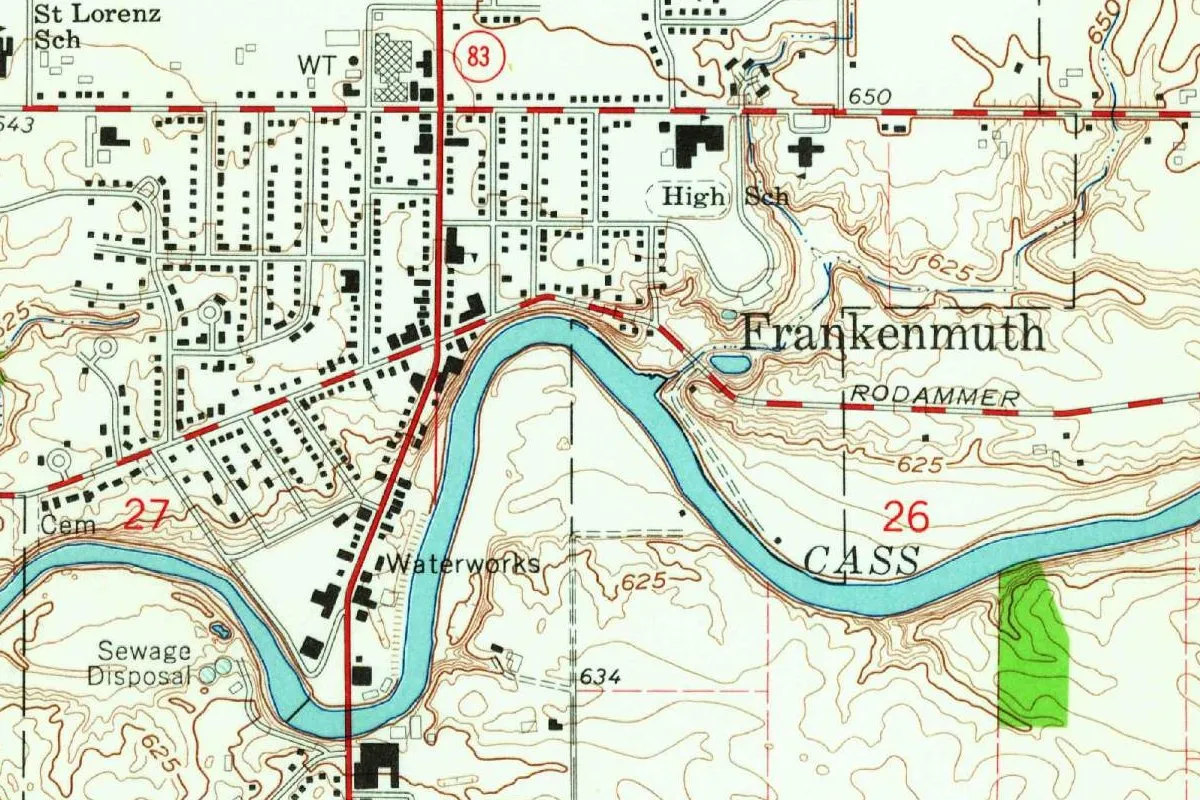
This crop is taken from the Frankenmuth quadrangle, Michigan, a 1:24,000 sheet that says it was “Mapped, edited, and published by the Geological Survey,” from aerial photographs taken in 1959 and planetable surveys in 1963. The copy we used carries a file stamp from September 1964.
In the crop, the name Frankenmuth is printed east of town, beside a pond, with the Cass River looping below the streets. Route 83 runs north and south through the grid, and at the upper left you can read “St Lorenz Sch,” a school carrying the congregation’s name.
Quick answers
What does Frankenmuth mean in English?
The visitors bureau translates it as “courage of the Franconians”: Franken for Franconia, in Bavaria, and muth (mut on the state marker) for courage.
Who founded Frankenmuth?
Fifteen Lutheran immigrants from Franconia led by Pastor August Craemer, sent by Pastor Wilhelm Loehe, in 1845.
Why is the church in Frankenmuth called St. Lorenz?
The church says the settlers brought the name from Germany, where Lutheran churches in three cities carried it, after St. Laurentius, a third-century martyr.
Key dates
- 1840Missionary Frederick Wyneken appeals to Lutherans in Germany for help for German settlers in the Midwest.
- 1845Fifteen colonists sail from Bremen on the Caroline on April 20 and reach the Cass River site on August 18.
- 1846A second, larger group of about 90 emigrants arrives, and a log church is finished.
- 1847A second Franconian colony, Frankentrost, is started some six miles (10 km) to the north.
- 1848Frankenlust is settled.
- 1880The present St. Lorenz church is dedicated.
- 1963The Geological Survey maps the town on its Frankenmuth quadrangle.
Things to do in Frankenmuth, Michigan
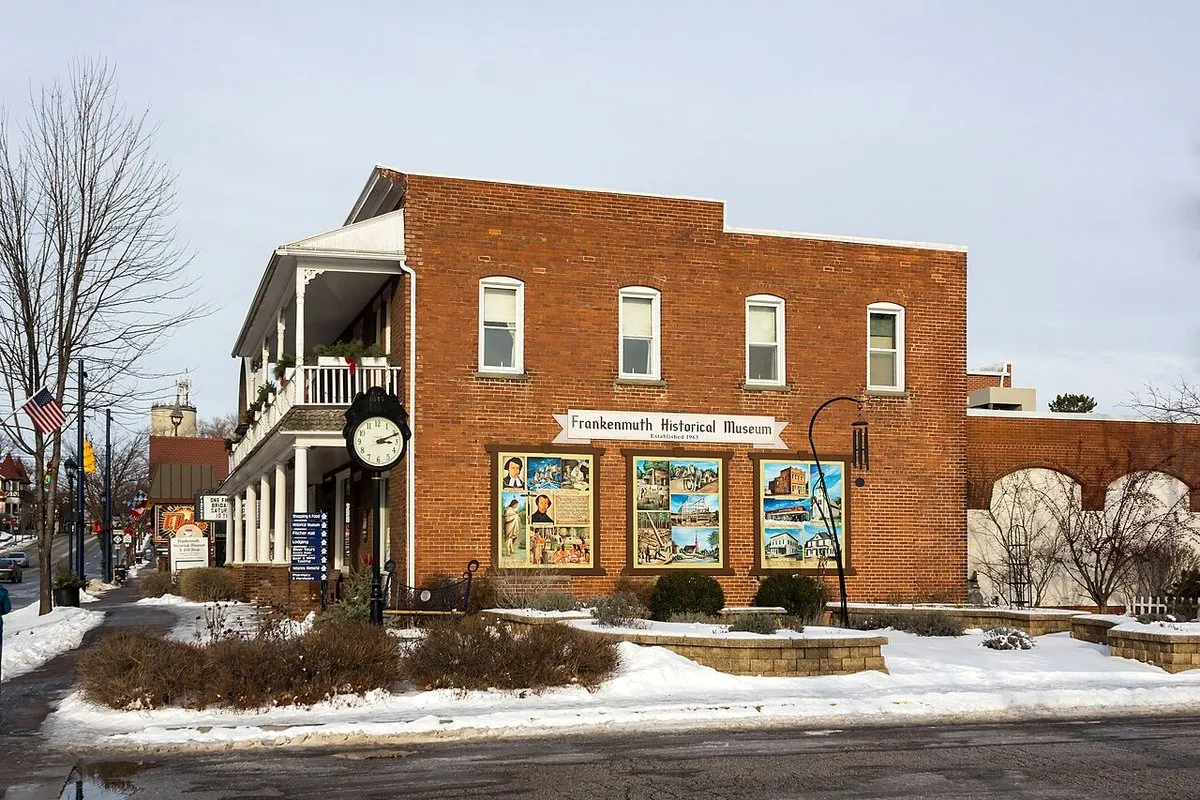
Frankenmuth Historical Museum
The Frankenmuth Historical Association's museum follows the town from the 'First 15' settlers of 1845 to the present, including early businesses, the two world wars and local brewing. Fischer Hall and the Wolkensdörfer Log House are also in the association's care.
St. Lorenz Lutheran Church
The congregation the town grew up with. Its Gothic Revival church, designed by Cleveland architect C. H. Griese, was dedicated in 1880, and the pioneers' names are listed on a plaque set in the lawn on the church's west side.
Frankenmuth Historic Walking Tour
A self-guided tour from the Frankenmuth Historical Association: scan the QR code at each stop to watch a short video about the history of that spot, in any order you like.
Bronner's CHRISTmas Wonderland
Wally Bronner's Christmas store, which calls itself the world's largest, on 27 acres (11 ha). Its authorized replica of Austria's Silent Night Chapel was dedicated in 1992, after his 1976 visit to the original in Oberndorf.
Getting there
Open Frankenmuth in Google Maps
Opens in a new tab. The pin is the center of Frankenmuth in the USGS place-name record.
The closest airports, Amtrak stations and intercity bus stops, measured in a straight line from the center of Frankenmuth.
Airports
- MBS International (MBS) Saginaw 22 mi 36 km
- Bishop International (FNT) Flint 25 mi 41 km
- Detroit Metro Wayne County (DTW) 80 mi 128 km
Amtrak trains
- Flint station (FLN) 22 mi 36 km
- Lapeer station (LPE) 29 mi 47 km
Intercity buses
- Indian Trails Saginaw 12 mi 20 km
- FlixBus Flint (Miller Rd) 24 mi 38 km
- Amtrak Chartered Vehicle Amtrak Connecting Service · Pontiac Amtrak Station 53 mi 86 km
Distances are as the crow flies, not by road. We don't list schedules or fares because they change; check with the airline, Amtrak or the bus company before you go. Official data (FAA commercial service airports (2025), FAA airport locations, Amtrak stations and Intercity Bus Atlas) from the FAA and the U.S. Bureau of Transportation Statistics, checked Nov 18, 2026.
Sponsored
Staying in Frankenmuth?
Compare hotels in Frankenmuth, Michigan, on Expedia.
See hotels in FrankenmuthWe may earn a commission if you buy through this link. It never changes what we write. Read our affiliate disclosure
Historical Sources & References
- Michigan historical marker L1729, “Frankenmuth / Saint Lorenz Evangelical Lutheran Church,” via the Historical Marker Database. Franconia plus mut, Loehe, Craemer “and fourteen other immigrants,” the circuit riders and the 1880 church.
- St. Lorenz Lutheran Church, “History”. Loehe’s choice of the name and why, the Caroline, the 50-day crossing, the 680 acres and August 18, 1845.
- Frankenmuth Convention & Visitors Bureau, “History”. Wyneken’s appeal, “courage of the Franconians,” the 15 settlers, the land purchase, the 1846 group and the other Franconian colonies.
- Frankenmuth Historical Association, its walking tour, and Bronner’s history page. The details in the things-to-do list.
- U.S. Geological Survey, GNIS feature 626405. Frankenmuth in Saginaw County.
- Frankenmuth quadrangle, Michigan, 1963. The sheet the map at the top was cropped from.
Spot something wrong, or know more? Tell us here. You can also email us or use our contact page. Corrections are noted here with their date, never made silently.