Holland, Michigan: Named by Dutch Settlers for Home
Holland is named for the European country its founders came from. Henry Gannett's 1905 catalog of American place-name origins says it was named by early settlers, the Dutch colony led by the Rev. Albertus C. Van Raalte, who arrived in the winter of 1846-47. The Michigan Legislature organized Holland Township on March 16, 1847.
A Dutch name and a Black River post office
Holland, Michigan, was named by Dutch settlers for the country they’d left, yet the first post office there, opened in 1848, was called Black River. In the 1905 edition of Henry Gannett’s Geological Survey bulletin, the Michigan city shares an entry with a village in Indiana: both were “named by early settlers from the country of Europe.”
The post office shared its name with the landscape, not the homeland. The settlement grew up where the Black River runs into Black Lake, the body of water now called Lake Macatawa. G. Van Schelven, a local editor whose history of the colony, read in 1876, was reprinted in an 1882 county book, says the post office was established in 1848 “and named ‘Black River.’” The colony, though, was soon known as Holland, and so was its township.
Hard times in the Netherlands
Van Schelven starts the story in Amsterdam in the winter of 1845-46, when a group of men who favored emigration met to talk about it. Times were “exceedingly hard,” he wrote, especially for working people, with little hope of things getting better.
Their first idea wasn’t America at all. The meeting asked the Dutch government about a colony on the highlands of Java, in the Dutch East Indies. The answer was no; the government said it couldn’t approve a colony on the religious basis they had in mind. They looked at the Cape of Good Hope next, and only then at the United States.
The leader who made it happen was the Rev. Albertus C. Van Raalte, whom the Society of Architectural Historians’ guide describes as being from Rotterdam. He sailed in September 1846 with his family and a shipload of emigrants and reached New York in November.
Choosing the land between two rivers
The group had leaned toward Wisconsin. But with navigation closing for the winter and good information from Detroit, Van Schelven says, they turned toward western Michigan instead. Van Raalte later explained why in a speech for the colony’s 25th anniversary in 1872, printed in translation in the 1882 history. He wanted rich forest soil, good markets and room for many settlements close together:
“I chose this region, with such decision, on account of its great variety, being assured that if the Holland emigration should develop into a power, we ought to remain together for mutual support”
You can hear the name in his own words there. For Van Raalte, the colony was the Holland emigration.
In late December 1846, with Judge Kellogg of Allegan and an Indian guide following an Indian trail, Van Raalte first reached the house of the Rev. George N. Smith, a Presbyterian missionary. He picked a site for the village near the lake, river and harbor, then went back to Detroit, where his family had stayed, to collect his people. The first party reached Smith’s house, as near as Van Schelven could tell, on February 12, 1847, and put up two log sheds with brush roofs while they cut roads through the snow.
Already somebody’s home
The colonists weren’t moving into empty country. The same 1882 history says that near Holland lived a band of about 300 Native people under Wakazoo, who farmed with oxen and plows, had a church built of lumber gathered on the lake shore, and kept log storehouses. Smith was their missionary. Their farms were about three miles (5 km) southeast of the town. In 1848, the year the Black River post office opened, the mission and the Indians were moved north to Grand Traverse.
The Legislature makes it Holland
On March 16, 1847, the Michigan Legislature organized Holland Township, according to the county history. The first town meeting was held at Van Raalte’s house, but only ten men voted, and none of them was Dutch. The reason, the book says, was “that the Hollanders were not naturalized.” At a later election more than 260 people cast ballots.
The history’s verdict on the township is short: “It is essentially a ‘Holland’ township.” The Dutch colonists also spread out into nearby settlements with names from home, among them Zeeland, Vriesland, Drenthe, Graafschap and Overisel, as the architectural historians list them.
A windmill with mixed reviews
The colony had its share of misfires. Back in 1835, eastern capitalists had started a city called Superior near the mouth of Black Lake, with a steam mill and a shipyard, while a “Portsmouth” on the south side never got past paper. Superior died when its leader did. Then, in 1852, W. K. Flietstra built the first windmill at the head of Black Lake to run a sawmill. The county history says it had “tolerable success” but cost too much to repair, and a few paragraphs later, dating it to 1848, calls Flietstra’s mill “the famous wind mill that would not work.”
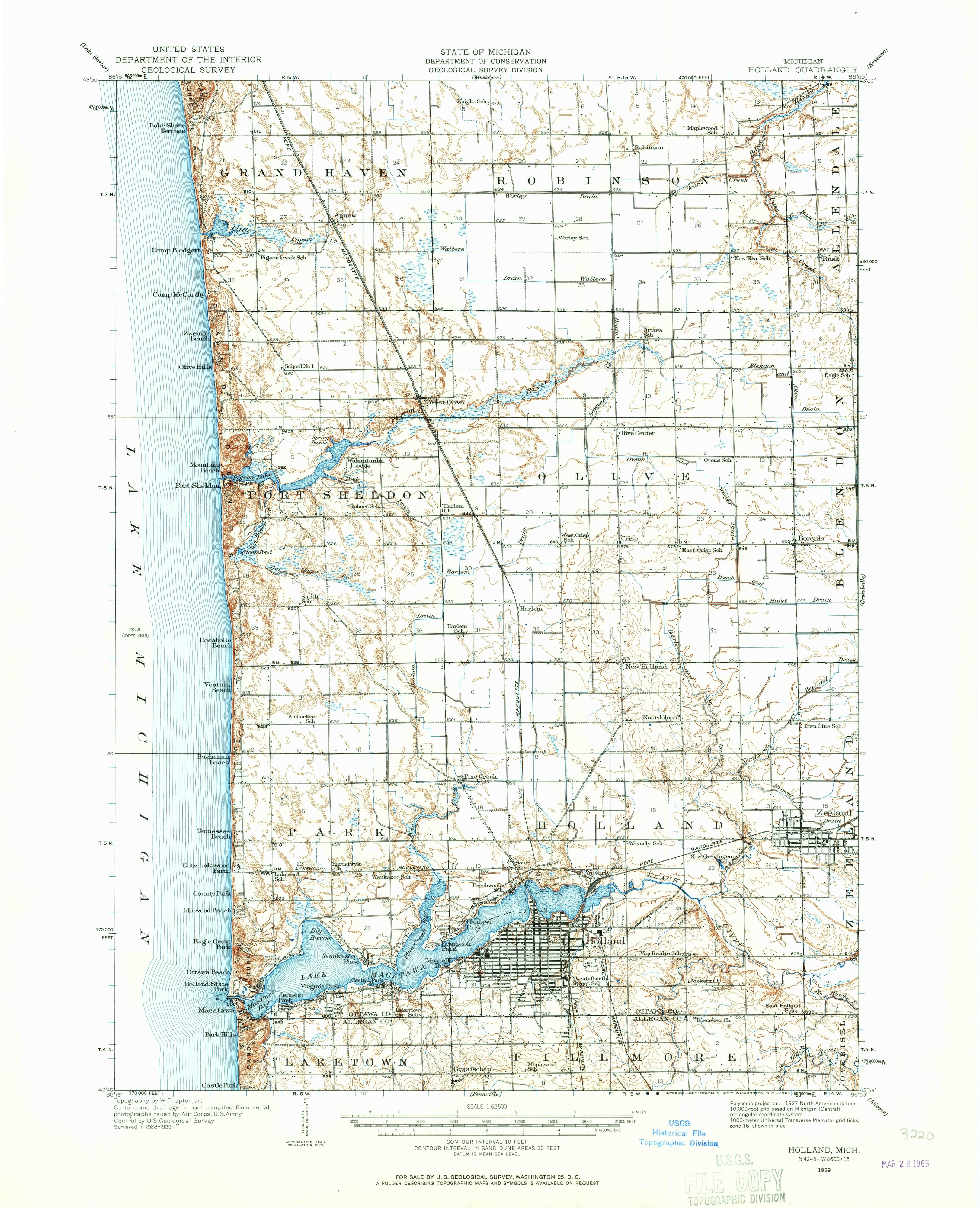
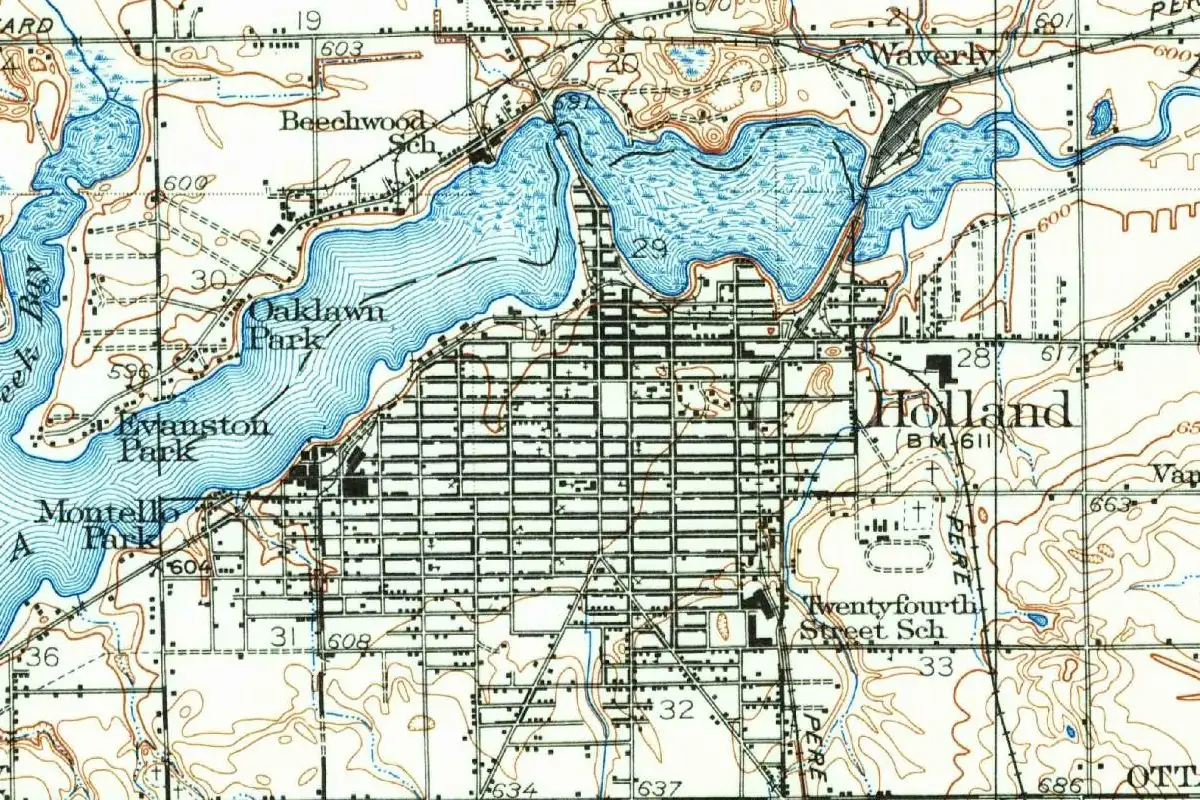
Holland incorporated as a city in 1867, and a fire in 1871 destroyed most of it. The town rebuilt around the same name. On the 1929 map at the top of this page, you can see how far the street grid had spread along the lake by then.
Two Dutch colonies in the Midwest
The same year Van Raalte’s group was carving out roads in Michigan, Van Schelven notes, other Dutch emigrants were weighing colonization plans “in Michigan and in Iowa.” In Iowa, another Dutch minister founded Pella in 1848 and named it for an ancient city of refuge. Other Michigan towns with stories of their own are listed on our Michigan page.
Quick answers
Why is Holland, Michigan, called Holland?
Because its first settlers came from Holland. Gannett’s 1905 volume says the city was “named by early settlers from the country of Europe.”
Who founded Holland, Michigan?
A colony of Dutch emigrants led by the Rev. Albertus C. Van Raalte, who sailed in 1846 and first reached the site in late December of that year.
When did Holland get its name?
By March 16, 1847, when the Michigan Legislature organized Holland Township, according to the 1882 county history.
Was Holland, Michigan, ever called Black River?
Its first post office was. Van Schelven’s sketch, reprinted in the 1882 county history, says that the post office was established in 1848 “and named ‘Black River.’”
Key dates
- 1846Van Raalte sails with a shipload of emigrants in September and, in late December, first reaches the Black Lake country.
- 1847The first party reaches the mission house of the Rev. George N. Smith around February 12; the Legislature organizes Holland Township on March 16.
- 1848A post office opens, named Black River; the Ottawa mission near Holland is moved to Grand Traverse.
- 1852W. K. Flietstra builds the colony's first windmill at the head of Black Lake.
- 1867Holland incorporates as a city.
- 1871A fire destroys most of Holland.
Things to do in Holland, Michigan
Holland Museum
Holland's history museum on the town's past and its Dutch heritage, with history and Dutch galleries, changing exhibitions and objects from its extensive collections.
Cappon House
The 1874 home of Isaac Cappon, Holland's first mayor, restored to show the life of a prominent Holland family around 1900.
Settlers House
A small house built around 1867, one of the few buildings to survive the Great Holland Fire of 1871, restored to tell the story of working-class family life in early Holland.
Holland State Park
A Michigan state park on Lake Michigan and Lake Macatawa, known for its sugar sand beaches, sunsets and views of the red lighthouse known as Big Red.
Getting there
Open Holland in Google Maps
Opens in a new tab. The pin is the center of Holland in the USGS place-name record.
The closest airports, Amtrak stations and intercity bus stops, measured in a straight line from the center of Holland.
Airports
- Gerald R Ford International (GRR) Grand Rapids 30 mi 49 km
- Kalamazoo/Battle Creek International (AZO) 48 mi 77 km
- General Mitchell International (MKE) Milwaukee 91 mi 147 km
Amtrak trains
- Holland station (HOM) under 1 mi 1 km
- Grand Rapids station (GRR) 25 mi 40 km
Intercity buses
- Indian Trails Holland (Bus/Amtrak) under 1 mi 1 km
- FlixBus Holland Bus Stop 3 mi 5 km
- Amtrak Chartered Vehicle Amtrak Connecting Service · Kalamazoo 43 mi 70 km
Distances are as the crow flies, not by road. We don't list schedules or fares because they change; check with the airline, Amtrak or the bus company before you go. Official data (FAA commercial service airports (2025), FAA airport locations, Amtrak stations and Intercity Bus Atlas) from the FAA and the U.S. Bureau of Transportation Statistics, checked Nov 14, 2026.
Sponsored
Staying in Holland?
Compare hotels in Holland, Michigan, on Expedia.
See hotels in HollandWe may earn a commission if you buy through this link. It never changes what we write. Read our affiliate disclosure
Historical Sources & References
- Henry Gannett, The Origin of Certain Place Names in the United States, 2nd ed. (1905), p. 158. Holland, city in Ottawa County, Michigan, “named by early settlers from the country of Europe.”
- G. Van Schelven, “Historical Sketch of Holland City and Colony,” History of Ottawa County, Michigan (1882), pp. 77-78. The Amsterdam meeting of 1845-46 and the hard times; Java, the Cape of Good Hope and America; Van Raalte’s sailing in September 1846; Wisconsin dropped for western Michigan; the quoted passage from Van Raalte’s 1872 speech; his arrival in late December 1846 with Judge Kellogg and an Indian guide; the party at Smith’s house around February 12, 1847, and the log sheds.
- G. Van Schelven, “Historical Sketch of Holland City and Colony” (1882), p. 80. The post office established in 1848 “and named ‘Black River.’”
- History of Ottawa County, Michigan (1882), p. 88. Holland Township organized by act of Legislature, March 16, 1847; the first town meeting at Van Raalte’s, with ten voters because “the Hollanders were not naturalized”; more than 260 votes later; “essentially a ‘Holland’ township”; the paper cities of Portsmouth and Superior; Flietstra’s windmill of 1852, with “tolerable success” but costly repairs, and “the famous wind mill that would not work.”
- History of Ottawa County, Michigan (1882), p. 20. The band of 300 under Wakazoo near Holland, their farms three miles southeast, the Rev. George N. Smith as missionary, and the move to Grand Traverse in 1848.
- Kathryn Bishop Eckert, “Holland and Vicinity,” SAH Archipedia. Van Raalte from Rotterdam; the site at the mouth of the Black River; Black Lake (Lake Macatawa); Overisel, Zeeland, Vriesland, Drenthe and Graafschap; city in 1867; the fire of 1871.
- GNIS feature 628421 (U.S. Geological Survey). The national gazetteer’s entry for Holland, in Ottawa County.
- U.S. Geological Survey, Holland sheet (1929, 1965 reprint). The 1:62,500 quadrangle the map at the top of this page was cropped from.
Sponsored
Put this 1929 map on your wall
The 1929 USGS Holland, Michigan, sheet, in a 1965 reprint, is in the public domain. Download the full-size scan for free, then have it printed on canvas with CanvasOnTheCheap.
Print a map on canvasDownload the full-size mapWe may earn a commission if you buy through this link. It never changes what we write. Read our affiliate disclosure
Spot something wrong, or know more? Tell us here. You can also email us or use our contact page. Corrections are noted here with their date, never made silently.