Grand Rapids, Michigan, and the Rapids That Disappeared
Grand Rapids is named for the rapids of the Grand River, which dropped about 18 feet over a limestone bed in a little more than a mile through what's now downtown. The name went on the first post office in 1832 and the village in 1838. Limestone removal, canals and dams later changed the river, and the rapids are gone.
A mile of fast water over limestone
Grand Rapids, Michigan, is named for the Grand River’s rapids, a mile-long run of water over limestone that the city’s public museum says no longer exists. The Grand Rapids Public Museum puts it bluntly: the city is named after “a hydraulic feature that no longer exists.” So if you go looking downtown for the big rapids, you’ll find what the museum calls “the placid Grand River we know today.”
The rapids were real, though. Albert Baxter opened his 1891 History of the City of Grand Rapids with a section called “The Name,” and he didn’t waste words: “The name Grand Rapids comes from the rapids of Grand River, the largest fall in that stream.” They weren’t a waterfall, he explained, but “a nearly uniform descent for the distance of a little more than a mile, through the central part of the city, amounting to a fall of about eighteen feet, over a limestone bed.” That’s about 18 feet (5.5 m) in a little more than a mile (1.6 km).
The museum describes the same thing in geology terms. Limestone sits just under the riverbed downtown, it says, and over millions of years it cracked into ledges and shelves. The river tumbling over them made the Grand Rapids.
“Grand River Falls,” then “Grand Rapids”
The best way to hear the name being born is in a letter. Joel Guild and his family traveled from Detroit with a party of settlers and landed at the rapids on June 13, 1833. Six months later, he and his wife wrote to her brother, Jesse Vaughan, back in New York State. Baxter printed the letter in 1891 and said the original was “still in existence,” yellowed foolscap with a 25-cent postmark.
Guild wrote that he’d moved “about fifty miles down Grand River to a place called Grand River Falls,” where the only English speaker was a French trader named Campau. He bragged about the water: “here is twenty-five feet fall in one mile of the river at this place.” Then, at the very bottom, came the postscript:
“N. B.—Direct your letters to Grand Rapids, county of Kent, Michigan. We have a post office here by the name of Grand Rapids.”
Guild headed his letter “Grand Rapids, December the 23d, 1833,” but when he described his move in June he still called the spot Grand River Falls. By December the post office name was the one he asked his family to use, and it’s the one that won. Baxter says it was given to “the first postoffice here, in 1832,” and then to the village incorporated in 1838. The Geological Survey’s Henry Gannett agreed in 1905, pairing the Michigan city with a Wisconsin one: both were “named from rapids and falls in the Grand and Wisconsin rivers.”
Guild’s 25 feet (7.6 m) in a mile is more than Baxter’s 18 feet. You’ll see different numbers depending on who’s measuring, but nobody in these sources doubts the rapids themselves.
Kent, the name that didn’t stick
For a few years the place had a rival name. Baxter says the township on the left bank of the river was first called Kent, “in compliment to Chancellor Kent, of New York,” by an act of the territorial legislature on March 7, 1834, which also set the first election at Joel Guild’s house.
Kent stayed the township’s name “till February 26, 1842, when by law it was changed to Grand Rapids,” Baxter writes, and the city that followed the village kept that name. The county, though, never changed. That’s why Guild’s letter says “Grand Rapids, county of Kent,” and why the city still sits in Kent County today.
Older names for the river
The Grand had names long before the post office. Baxter, writing in 1891, gave the river’s Indigenous name as “Ouashtenong (or Washtonnong) Sebee,” and translated it as “far away or long-flowing water.” He added that Andrew J. Blackbird, whom he called “an educated native,” said it meant “overflowing river,” and that the name for the rapids themselves was “Paw-qua-ting,” meaning shallow rapids.
Those are Baxter’s spellings and glosses from more than a century ago, and they don’t fully agree with each other, so we give them as he did. The city’s history page says the Ottawa moved into the valley about 300 years ago and lived in several villages along the river, and that the Hopewell people were there more than 2,000 years ago.
Taming the rapids
Once the settlers came, the rapids became something to use. The city says Louis Campau set up a trading post in 1826 and in 1831 bought what’s now the whole downtown business district from the federal government for $90. The museum says early residents removed hundreds of tons of limestone from the river in a failed attempt to make it navigable, and built canals and dams to harness its flow. The canals have since been filled in.
That may not be the end of the story. On July 1, 2026, the city began removing four low-head dams between the Bridge Street and Fulton Street bridges, the next phase of a Grand River Restoration project that it says “will restore the historic rapids.”
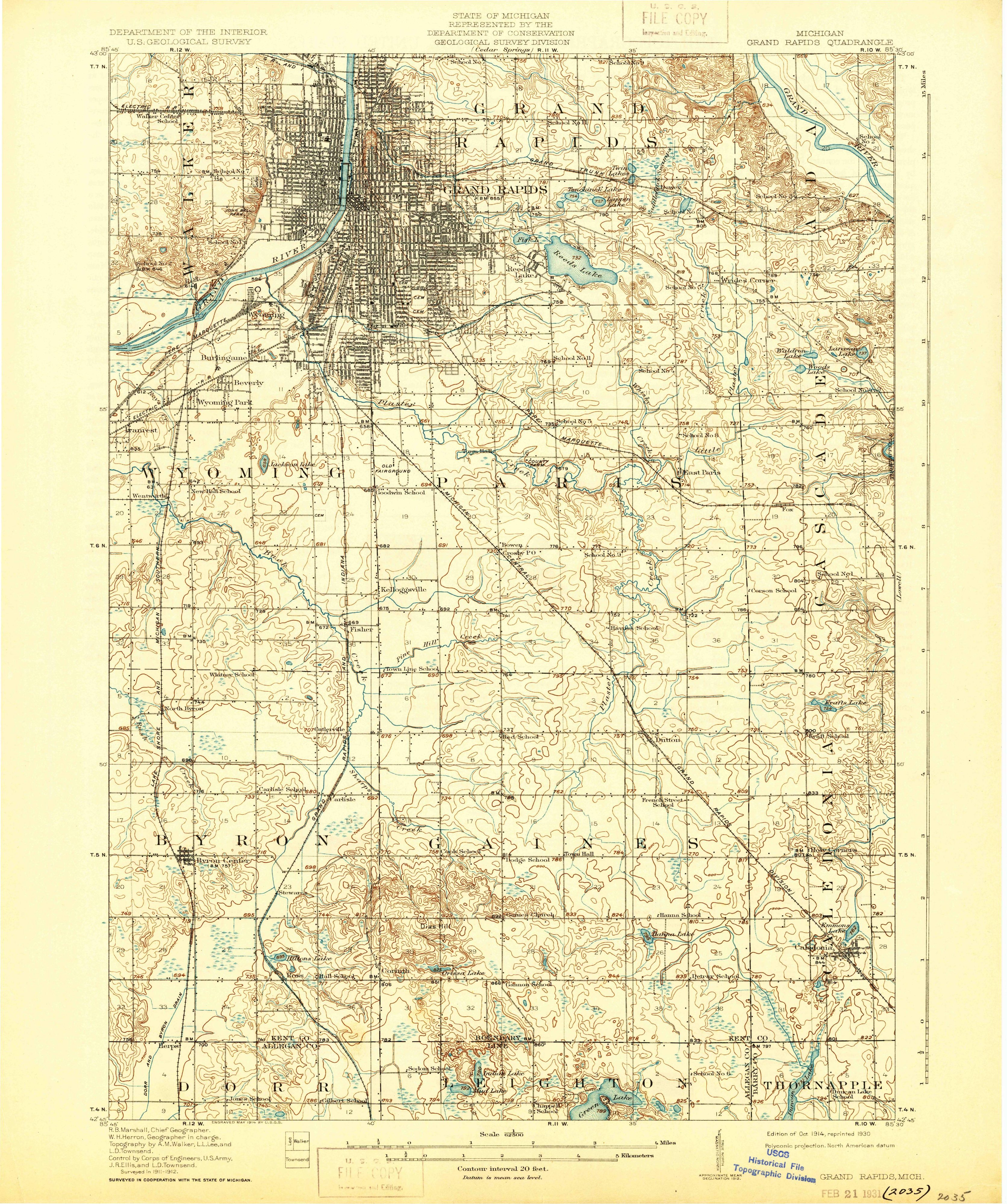
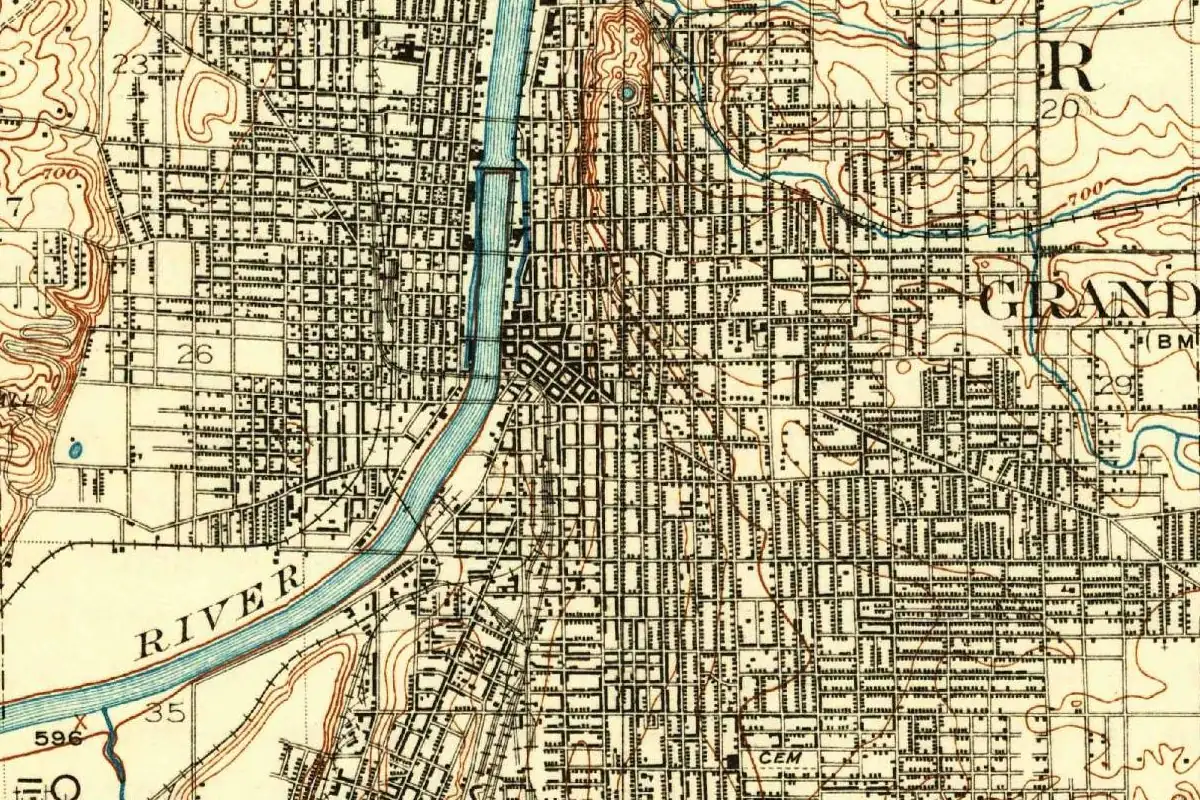
On the 1914 map at the top of this page, you can see the river running through a city that had grown on both banks, with a narrow channel along the east side above downtown.
Rivers that named Michigan towns
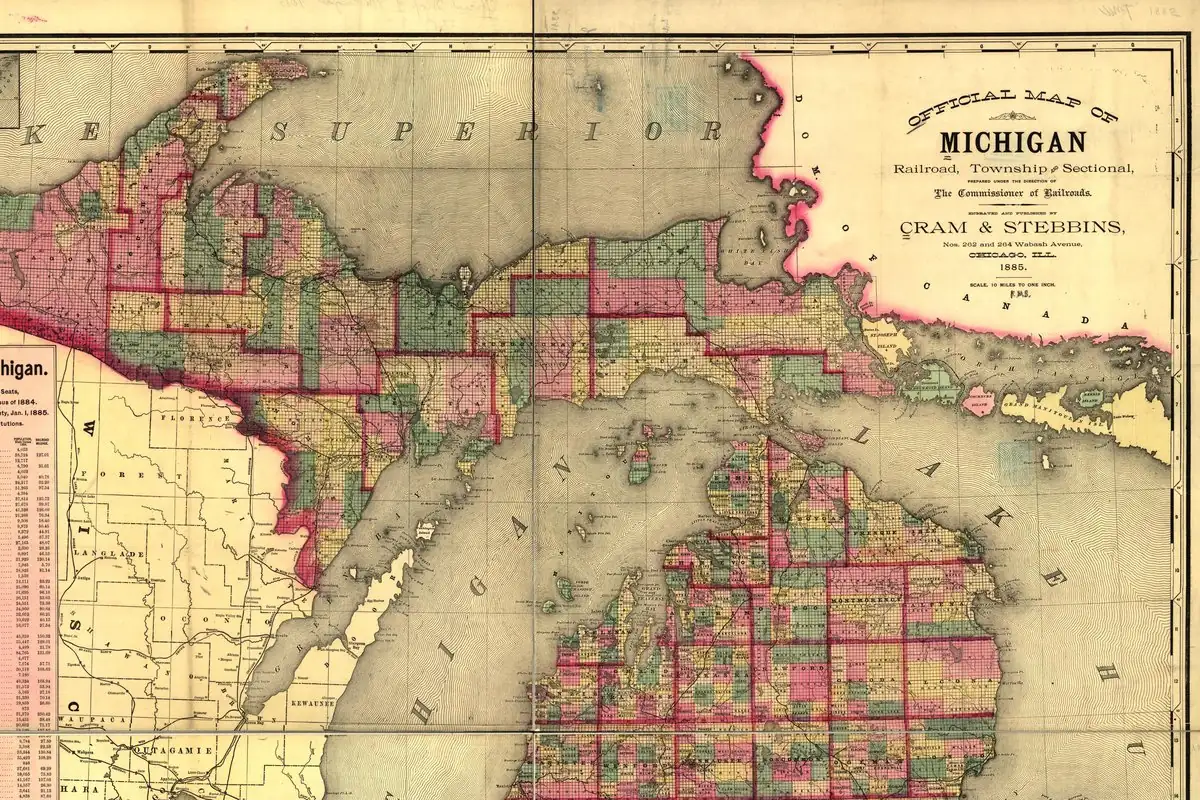
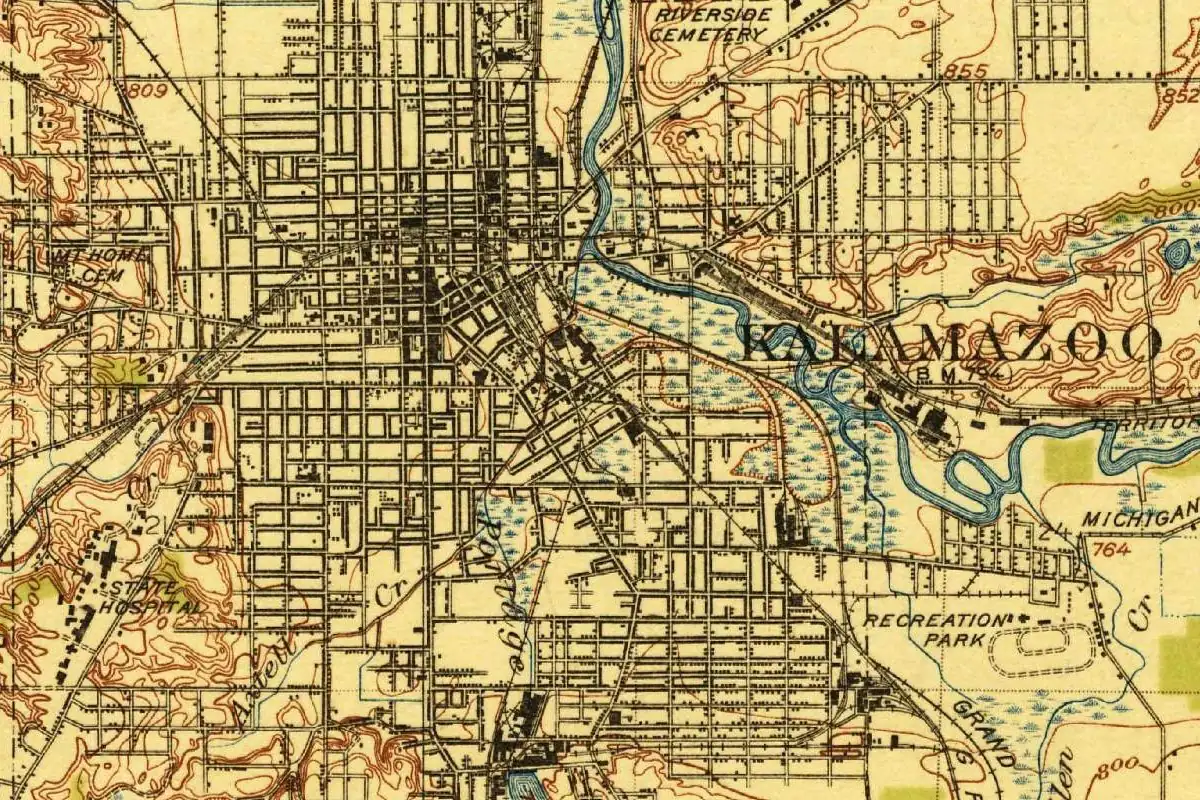
Grand Rapids isn’t alone in taking its name from moving water. Kalamazoo, whose county once took in Kent township, traded its first settler’s name for its river’s in 1836. Out in Iowa, Cedar Rapids started as Rapids City and picked up the name of its river later. There’s more on our Michigan page.
Quick answers
Why is it called Grand Rapids?
Because of the rapids on the Grand River. Baxter’s 1891 history says the name “comes from the rapids of Grand River, the largest fall in that stream,” a drop of about 18 feet in a little more than a mile.
Do the rapids in Grand Rapids still exist?
Not as they were. The Grand Rapids Public Museum says the city is named after “a hydraulic feature that no longer exists.” The museum says settlers removed limestone and built canals and dams; in 2026 the city started removing dams in a project it says will restore the rapids.
Was Grand Rapids ever called something else?
Its township was. The legislature named it Kent in 1834, and Baxter says the name was changed to Grand Rapids in 1842. Settler Joel Guild also wrote “Grand River Falls” in an 1833 letter.
When did Grand Rapids get its name?
By 1832, according to Baxter, when it went on the first post office. The village of Grand Rapids was incorporated in 1838 and the city in 1850.
Key dates
- 1826French trader Louis Campau sets up a trading post at the rapids.
- 1831Campau buys what is now the downtown business district from the federal government for $90.
- 1832The first post office here is named Grand Rapids, according to Albert Baxter.
- 1833Joel Guild dates a letter home "Grand Rapids," recalls arriving at "Grand River Falls" and asks for letters addressed to Grand Rapids.
- 1834The territorial legislature names the township Kent, on March 7.
- 1838The settlement incorporates as the village of Grand Rapids.
- 1842On February 26 the township's name is changed by law from Kent to Grand Rapids.
- 1850Grand Rapids becomes a city, with 2,686 people.
Things to do in Grand Rapids, Michigan
Grand Rapids Public Museum
The city's history and science museum on the Grand River, founded in 1854 as the Grand Rapids Lyceum of Natural History, with exhibits on Grand Rapids and the Roger B. Chaffee Planetarium.
Gerald R. Ford Presidential Museum
The museum of America's 38th president, Gerald R. Ford, and first lady Betty Ford, on Pearl Street NW in downtown Grand Rapids.
Fish Ladder Park
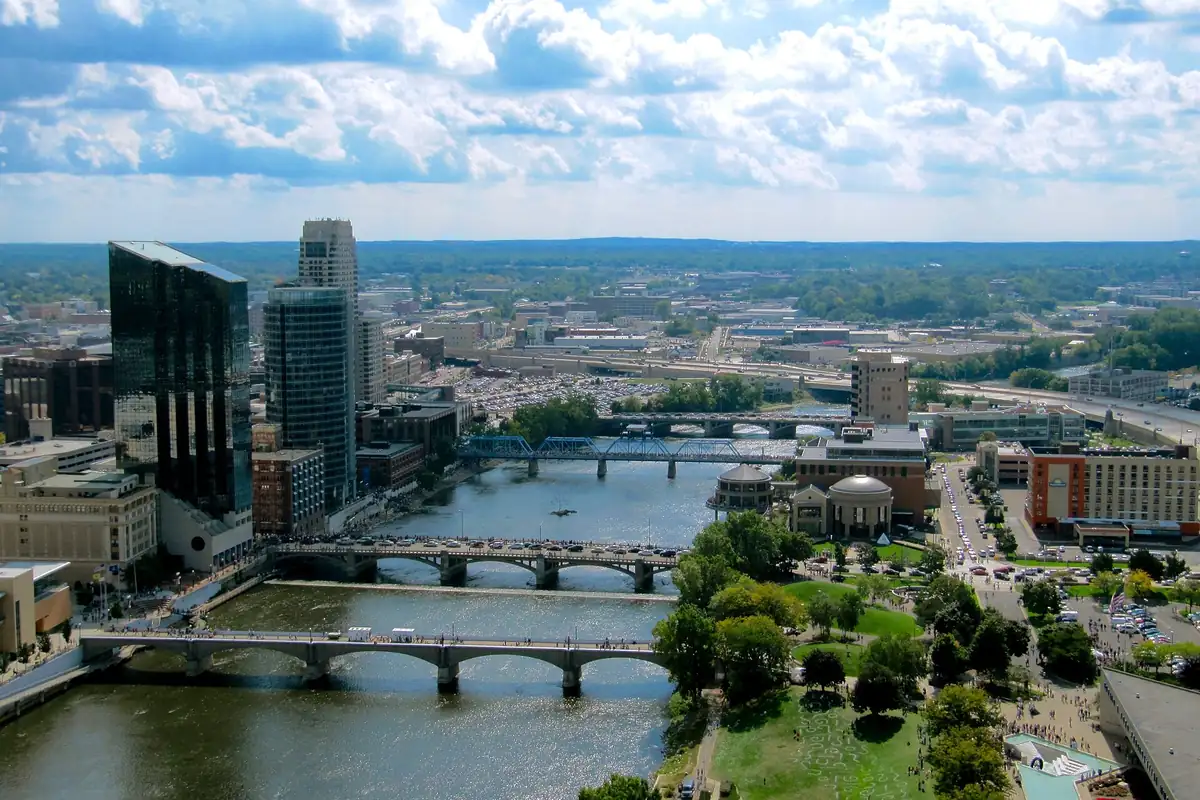
A working piece of public art by Joseph Kinnebrew on the Grand River, built to give migrating fish a way around the powerful flow at the river's man-made rapids. In spring and late summer you can watch them jump up the ladder.
Frederik Meijer Gardens & Sculpture Park
A sculpture park and botanical gardens on the city's East Beltline, with more than 150 acres of gardens and sculpture to explore.
Getting there
Open Grand Rapids in Google Maps
Opens in a new tab. The pin is the center of Grand Rapids in the USGS place-name record.
The closest airports, Amtrak stations and intercity bus stops, measured in a straight line from the center of Grand Rapids.
Airports
- Gerald R Ford International (GRR) Grand Rapids 9 mi 15 km
- Kalamazoo/Battle Creek International (AZO) 51 mi 82 km
- General Mitchell International (MKE) Milwaukee 113 mi 181 km
Amtrak trains
- Grand Rapids station (GRR) under 1 mi 0.9 km
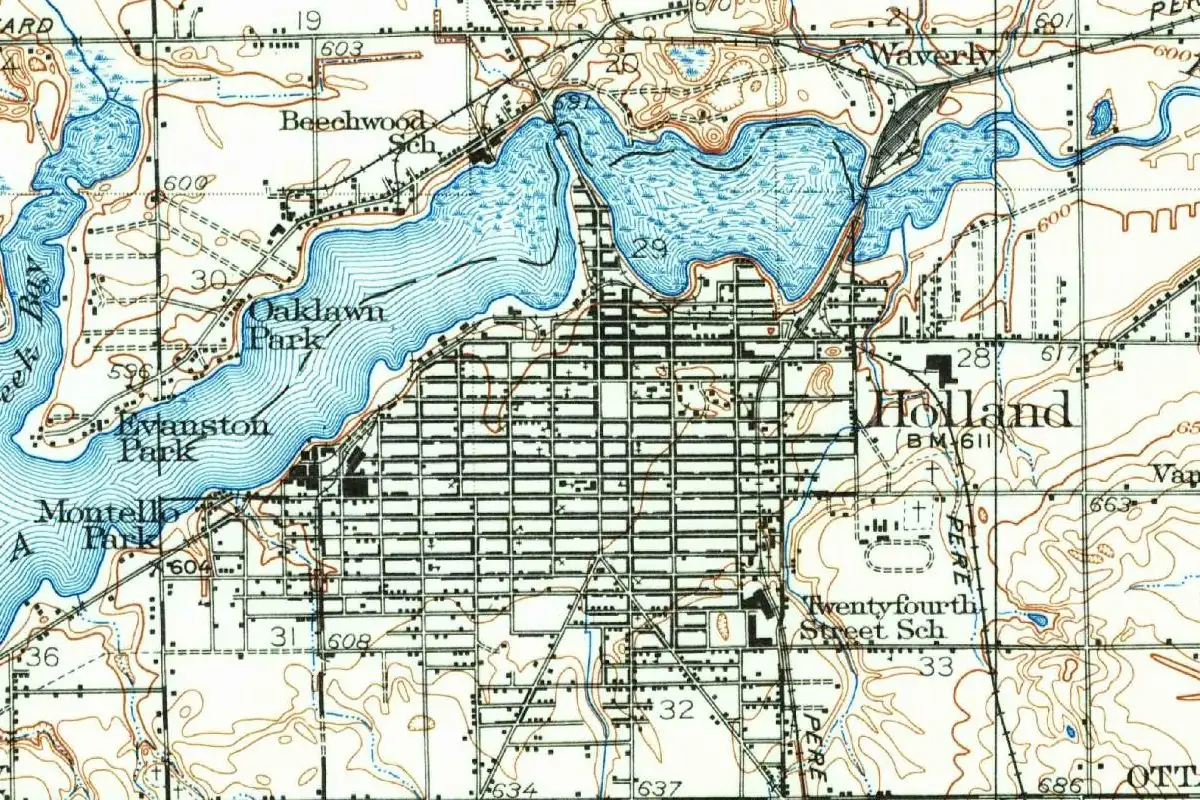
- Holland station (HOM) 25 mi 40 km
Intercity buses
- Indian Trails Grand Rapids (Bus Terminal) under 1 mi 0.8 km
- FlixBus Holland Bus Stop 25 mi 41 km
- Amtrak Chartered Vehicle Amtrak Connecting Service · Kalamazoo 46 mi 75 km
Distances are as the crow flies, not by road. We don't list schedules or fares because they change; check with the airline, Amtrak or the bus company before you go. Official data (FAA commercial service airports (2025), FAA airport locations, Amtrak stations and Intercity Bus Atlas) from the FAA and the U.S. Bureau of Transportation Statistics, checked Nov 14, 2026.
Sponsored
Staying in Grand Rapids?
Compare hotels in Grand Rapids, Michigan, on Expedia.
See hotels in Grand RapidsWe may earn a commission if you buy through this link. It never changes what we write. Read our affiliate disclosure
Sponsored
Want the spooky side of Grand Rapids?
The name has its story above. For the ghost stories, US Ghost Adventures runs walking ghost tours in Grand Rapids.
See ghost tours in Grand RapidsWe may earn a commission if you book through this link. It never changes what we write. Read our affiliate disclosure
Historical Sources & References
- Albert Baxter, History of the City of Grand Rapids, Michigan (1891), p. 1. “The Name”: the rapids “the largest fall in that stream”; the first post office in 1832 and the village in 1838; Kent township in honor of Chancellor Kent, by the act of March 7, 1834, renamed Grand Rapids on February 26, 1842; the descent of about 18 feet in a little more than a mile over limestone.
- Albert Baxter, History of the City of Grand Rapids, Michigan (1891), p. 8. “Ouashtenong (or Washtonnong) Sebee,” with Baxter’s gloss, and Andrew J. Blackbird’s “overflowing river” and “Paw-qua-ting.”
- Albert Baxter, History of the City of Grand Rapids, Michigan (1891), pp. 57-58. Joel Guild’s letter headed “Grand Rapids, December the 23d, 1833” (excerpted by Baxter): “a place called Grand River Falls,” “twenty-five feet fall in one mile,” Campau, and the postscript about the Grand Rapids post office (quoted on p. 58).
- Henry Gannett, The Origin of Certain Place Names in the United States (1905), p. 141. “Named from rapids and falls in the Grand and Wisconsin rivers.”
- Grand Rapids Public Museum, “The Grand River: Past, Present & Future”. The city “named after a hydraulic feature that no longer exists”; the limestone ledges; limestone removal, canals and dams.
- City of Grand Rapids, “History of Grand Rapids”. The Hopewell and the Ottawa; Campau’s trading post in 1826 and his $90 purchase in 1831; the village in 1838 and the city of 2,686 people in 1850.
- City of Grand Rapids, “Grand River Restoration enters the river” (July 1, 2026). In-river work starting July 1, 2026, to remove four low-head dams from just upstream of the Bridge Street Bridge to the Fulton Street Bridge, in a project that “will restore the historic rapids.”
- GNIS feature 627105 (U.S. Geological Survey). The U.S. names file places Grand Rapids in Kent County, as a populated place.
- U.S. Geological Survey, Grand Rapids sheet (1914). The 1:62,500 quadrangle the map at the top of this page was cropped from.
Sponsored
Put this 1914 map on your wall
The 1914 USGS Grand Rapids, Michigan, sheet is in the public domain. Download the full-size scan for free, then have it printed on canvas with CanvasOnTheCheap.
Print a map on canvasDownload the full-size mapWe may earn a commission if you buy through this link. It never changes what we write. Read our affiliate disclosure
Spot something wrong, or know more? Tell us here. You can also email us or use our contact page. Corrections are noted here with their date, never made silently.