Flint, Michigan: A River Name at a Busy Crossing
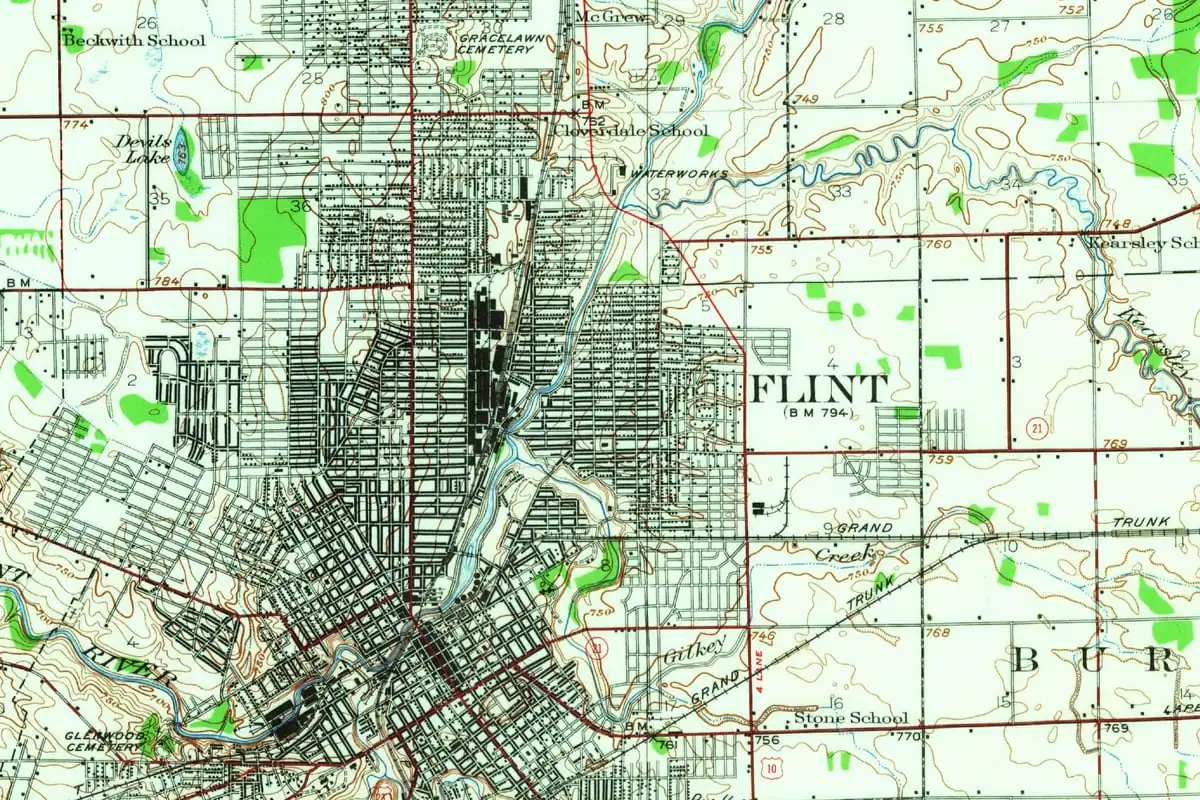
Flint, Michigan, borrowed its river’s name at a crossing once called Grand Traverse and Todd’s Ferry. The city-to-river connection is well documented. The explanation of the river’s own Indigenous name comes with a little more uncertainty.
A crossing before it was a city
The Saginaw Trail, as Michigan’s Department of Natural Resources calls it, crossed the river where Flint grew up. Franklin Ellis’s 1879 History of Genesee County describes it as a route between Detroit and Saginaw, used by Native travelers and French traders. The traders called the crossing Grand Traverse. Jacob Smith made it his permanent trading post after the 1819 treaty, Ellis says; Michigan’s Department of Natural Resources also dates his post to 1819.
Follow the trail and Grand Traverse marks the crossing. Look at the villages Ellis describes and you’ll find Grand Traverse on one bank, facing a village called Flint River on the other.
John Todd arrived in 1830, according to Ellis, and the crossing became Todd’s Ferry. He kept a canoe for travelers, large enough to take wagons and sleighs across. Todd usually handled the ferry himself, with other household members helping when needed. Ellis says there was no charge.
The river had made the stop useful long before a city charter made it official.
The bridge and the Flint River Settlement
Ellis places another turning point in 1834, when the government road from Detroit reached Grand Traverse and a bridge crossed the river. In his account, settlers then moved away from the crossing’s older labels and used Flint River Settlement or the village of Flint.
You can check the shorter name in a book printed much closer to that change. John T. Blois’s 1839 gazetteer lists:
“FLINT, a village, post office, and seat of justice for Genesee county, situated on Flint river.”
The river and the village already shared their name. Blois describes a sawmill, an edge-tool factory and the Saginaw land district’s land office, with the United States road running through town. Water power and that road were central to his description.
Getty’s geographic thesaurus says Flint was named for the river in 1836. Ellis tells the change as a sequence around the road and bridge, without recording a naming vote. These sources establish the connection more securely than they establish one exact day or one person responsible. Flint’s 1855 city charter came later.
What did the river’s name mean?
Henry Gannett’s 1905 Geological Survey bulletin groups the Michigan city and river together. It records the Indigenous name as pawon-nuk-ening and interprets it as “river of the flint.” Ellis gives a similar spelling and explanation. The 2001 DNR assessment uses Pewonigowink and offers river of fire stone or river of flint.
Those are recorded historical interpretations. None of those works supplies a detailed linguistic analysis, and we haven’t independently verified the derivation with an Ojibwe language source. You’ll sometimes see the English gloss presented as a complete translation with no qualification. Here, it remains an attributed explanation of the older river name.
Ellis himself wondered why the river had that name. His 1879 account says its rocky bed offered him no obvious explanation. That uncertainty doesn’t undo the city’s borrowing from the river; it leaves a separate question about how the river acquired its name.
A Flint congressman on another town’s sign
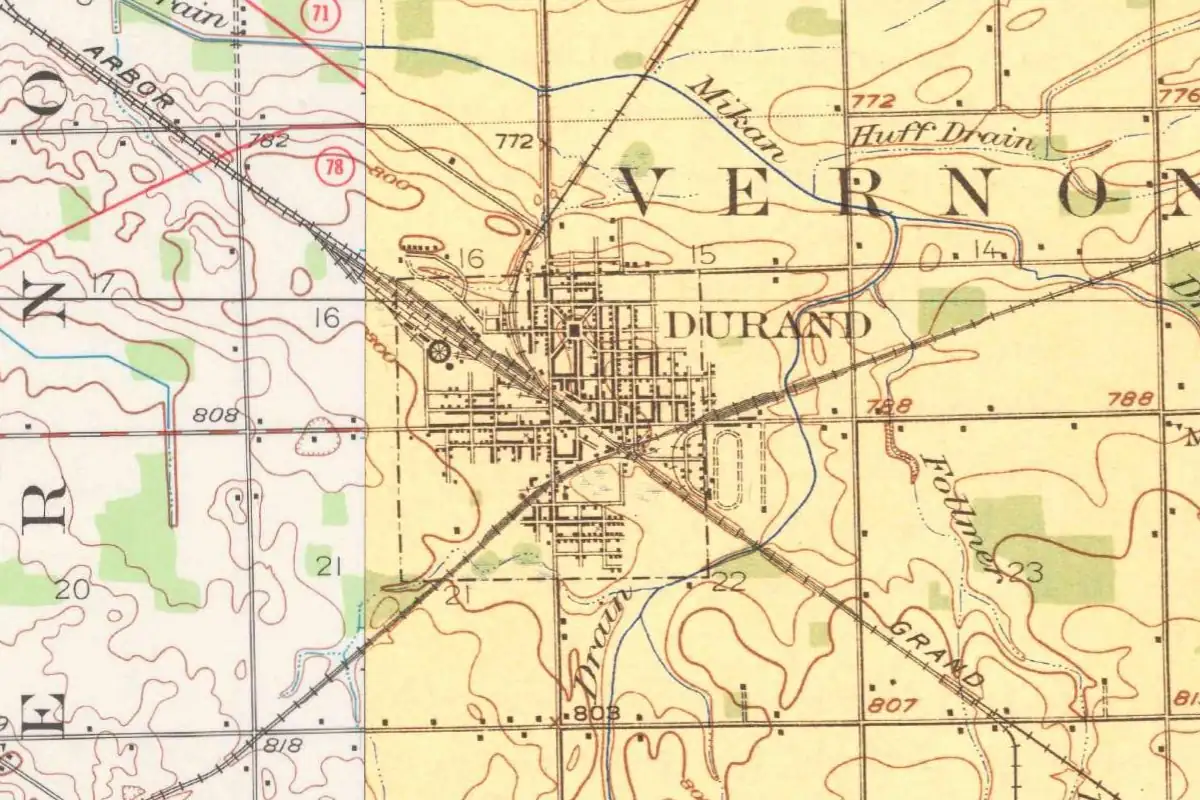
Another Michigan town took its name from a man who lived in Flint. The 1895 county atlas cited in our Durand article says its post office was named for George H. Durand of Flint in 1875. Gannett identifies him as a member of Congress.
At Flint, the river supplied the name. At Durand, a man from Flint did. The connections are still there in names you can read on a map.
Quick answers
Why is Flint, Michigan, called Flint?
The Flint River supplied the name. Ellis’s 1879 county history describes settlers adopting Flint River Settlement or Flint; Getty’s geographic thesaurus explicitly names the river as the source.
What was Grand Traverse in Flint?
A river crossing on the trail from Detroit to Saginaw, according to Ellis. Michigan DNR calls it the Saginaw Trail. It was later called Todd’s Ferry before the settlement adopted Flint’s river name.
Does Flint mean river of fire stone?
Not exactly. Flint is the English river name. Michigan DNR gives two readings of Pewonigowink, river of fire stone and river of flint. The precise derivation remains uncertain.
Was Flint already named before its city charter?
Yes. Blois printed Flint as the name of the village, post office and county seat in 1839; the city charter followed in 1855, according to Michigan DNR.
Key dates
- 1819Jacob Smith establishes a permanent trading post at the river crossing, according to Ellis and Michigan DNR.
- 1834The government road reaches Grand Traverse, with a bridge across the Flint, in Ellis's account.
- 1839Blois lists Flint as a village, post office and county seat on the Flint River.
- 1855Flint receives its city charter, as recorded in Michigan DNR's river assessment.
Getting there
Open Flint in Google Maps
Opens in a new tab. The pin is the center of Flint in the USGS place-name record.
The closest airports, Amtrak stations and intercity bus stops, measured in a straight line from the center of Flint.
Airports
- Bishop International (FNT) Flint 4 mi 7 km
- MBS International (MBS) Saginaw 41 mi 66 km
- Detroit Metro Wayne County (DTW) 58 mi 93 km
Amtrak trains
- Flint station (FLN) 2 mi 3 km
- Durand station (DRD) 17 mi 27 km
Intercity buses
- Indian Trails Flint (Bus/Train) 2 mi 3 km
- FlixBus Flint (Miller Rd) 3 mi 5 km
- Amtrak Chartered Vehicle Amtrak Connecting Service · Pontiac Amtrak Station 33 mi 53 km
Distances are as the crow flies, not by road. We don't list schedules or fares because they change; check with the airline, Amtrak or the bus company before you go. Official data (FAA commercial service airports (2025), FAA airport locations, Amtrak stations and Intercity Bus Atlas) from the FAA and the U.S. Bureau of Transportation Statistics, checked Nov 10, 2026.
Sponsored
Staying in Flint?
Compare hotels in Flint, Michigan, on Expedia.
See hotels in FlintWe may earn a commission if you buy through this link. It never changes what we write. Read our affiliate disclosure
Historical Sources & References
- Franklin Ellis, History of Genesee County, Michigan (1879), pp. 119–122. Grand Traverse, Smith’s trading post, Todd’s Ferry and the adoption of Flint River Settlement or Flint. The river-name interpretation is historical, rather than an independently checked linguistic analysis.
- John T. Blois, Gazetteer of the State of Michigan (1839), p. 287. Flint as a village, post office and county seat, with river power and the United States road.
- Henry Gannett, The Origin of Certain Place Names in the United States (1905), pp. 111, 127. The recorded spelling pawon-nuk-ening and its historical gloss; the separate Durand entry identifies George H. Durand of Flint.
- Joseph M. Leonardi and William J. Gruhn, Flint River Assessment (Michigan DNR, 2001), pp. 22–23. Crossing history, the 1819 post, 1855 charter and the interpretation of Pewonigowink. This historical section draws on earlier works.
- Getty Research Institute, Thesaurus of Geographic Names, Flint. The city named for the river in 1836; a later reference entry rather than a contemporary naming record.
- GNIS feature 626170 (U.S. Geological Survey). The national gazetteer’s identifier for Flint in Genesee County.
Spot something wrong, or know more? Tell us here. You can also email us or use our contact page. Corrections are noted here with their date, never made silently.