Traverse City, Michigan: Why a Clerk Cut "Grand"
Traverse City is named for Grand Traverse Bay, which French voyageurs called "La Grande Traverse" because they crossed it from headland to headland. When Albert T. Lay asked for a post office in the winter of 1852-53, a clerk in Washington suggested dropping "Grand" so it wouldn't be confused with the Grand Traverse office at Old Mission.
Traverse City, Michigan, was nearly Grand Traverse City, until a Washington clerk suggested cutting “Grand” in 1853 to avoid echoing another post office. That other office, at Old Mission on the same bay, was already called Grand Traverse.
Two “traverses” on Lake Michigan
The word itself is French, and it described a trip by water. Alexander Winchell of the University of Michigan opened his 1866 report on the region with a short section called simply “The Name”:
“The early French voyageurs in coasting from Mackinac southward found two considerable indentations of the coast line of Lake Michigan on the east side, which they were accustomed to cross from headland to headland.”
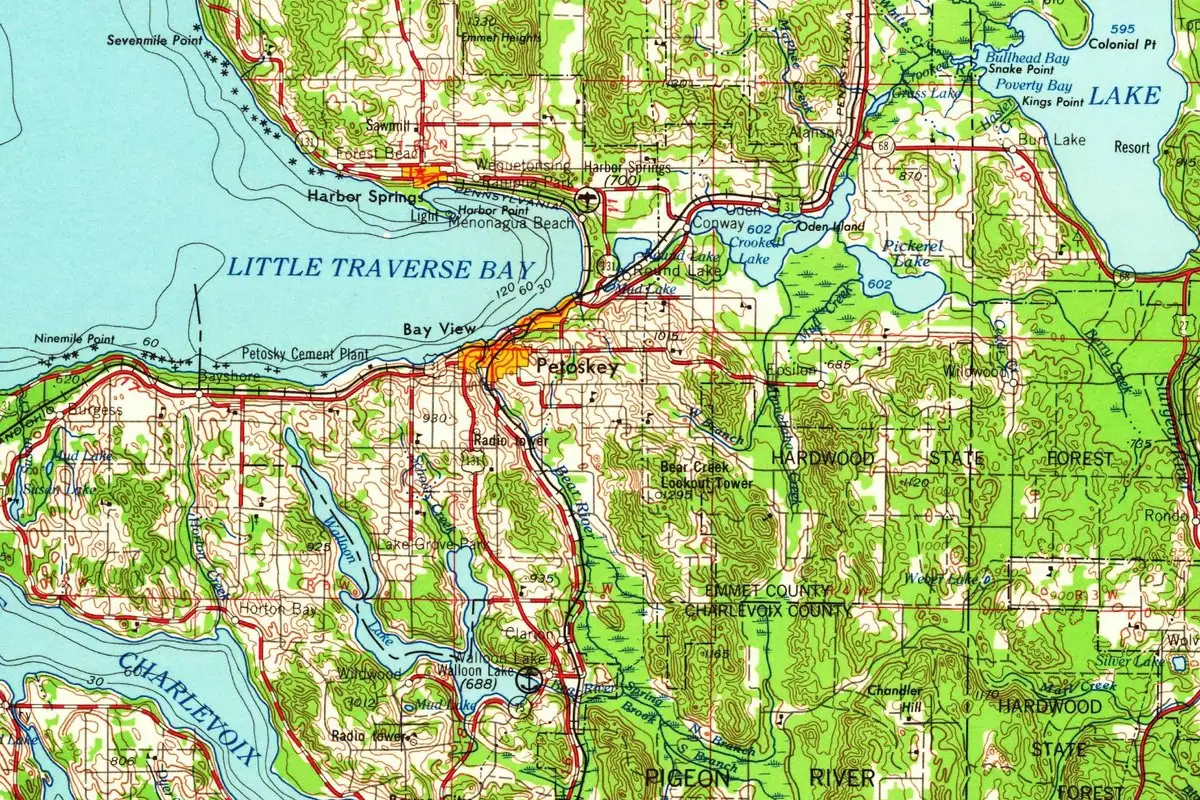
The smaller one, he wrote, they called “La Petite Traverse,” and the bigger one “La Grande Traverse.” Those names passed to the two bays known today as Little Traverse Bay, where Petoskey sits, and Grand Traverse Bay.
Thirty-nine years later, Henry Gannett repeated Winchell’s headland-to-headland line in the Traverse City entry of his 1905 bulletin and added a translation of its own: the name means “lying across.” Winchell doesn’t translate it. He just tells you what the voyageurs did. Gannett’s bulletin also lists Grand Traverse County, “named from Grand Traverse Bay.”
Winchell’s report also gives the bay’s size. On the same page, he put the bay’s length from mouth to head at 34.75 statute miles (55.9 km) in a straight line. A page later he describes it as about 33 miles (53 km) long with an average breadth of about eleven miles (18 km), split at its southern end into east and west arms by a strip of land “known as ‘the Peninsula.’” His list of harbors puts Old Mission harbor on the east side of the Peninsula, near the point. Old Mission matters in a minute.
Michigan has more than one Grand Traverse, by the way. The crossing on the Flint River where Flint began was once called Grand Traverse too.
A post office named Grand Traverse, already
Here’s the problem the settlers ran into. M. L. Leach, in A History of the Grand Traverse Region (1884), says that up to 1853 the post office at Old Mission was the only one in “a vast region of country around the bay.” Its name was Grand Traverse.
Meanwhile a new settlement had grown at the head of the bay, where the firm of Hannah, Lay & Co. was doing business and getting ready to build a steam sawmill. Leach says it “was beginning to be known as Grand Traverse City.”
In the winter of 1852-53, Albert T. Lay was in Washington and got a post office set up for the new settlement. Leach tells what happened next:
“When Mr. Lay proposed the latter name for the new postoffice, the clerk with whom he was transacting the business suggested that ‘Grand’ be dropped, and it be called simply Traverse City, as the name would have less resemblance to that of the office at Old Mission, to which Mr. Lay acceded.”
“Thus originated the name,” Leach adds, “subsequently given to a thriving village.” So the name you see on the map today came from a clerk who wanted it to look less like Old Mission’s, and Lay went along.
The city’s version of the same meeting
The City of Traverse City tells the story a little differently on its page for Lay Park. It credits Lay with naming the city and says that in 1853, “seeking a postal route for the settlement, he presented the name ‘Grand Traverse’ before officials in Washington, D.C., later accepting their suggestion to strike out the ‘Grand.’” In the city’s telling, “City” came later.
The two accounts agree on the important parts: Lay went to Washington, officials there suggested cutting “Grand,” and he agreed. They differ on whether “City” was in the name from the start. Leach, writing about 30 years after the fact in a book published in Traverse City, says it was.
Old Joe and the mail sack
Leach’s page has a few more details about the new office. Mail came once a week from Manistee. Lay was the first contractor, at $400 a year. “At first,” Leach says, “it was carried by an Indian, Old Joe, in a pack upon his shoulders.” Before Lay’s contract ran out, the mail had grown so much that a horse had to be used. Dr. Goodale was appointed postmaster.
Lay’s partner Perry Hannah is remembered across town. The city’s page for Hannah Park says Hannah founded Traverse City’s first general store, Hannah & Lay, and its first bank, the Traverse City State Bank, and helped bring electricity, the railroad and the Northern Michigan Asylum to the region.
Grand on the bay, plain on the city
The clerk’s edit stuck to one name only. The bay kept “Grand,” and so did the county, Grand Traverse County. The bay was the original “Grande Traverse,” and the city’s name is a trimmed copy of it.
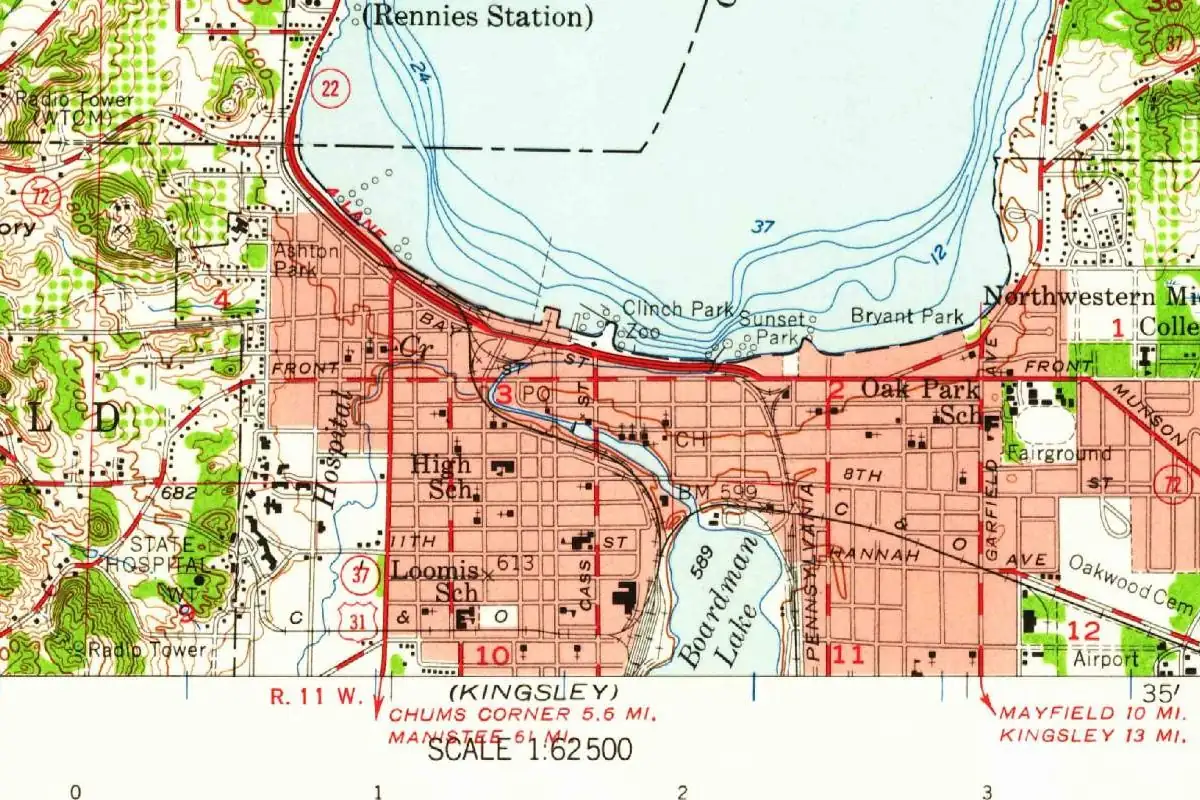
The map at the top of this page, from the Geological Survey’s 1957 Traverse City sheet, catches the city right at the bottom edge of the sheet, where the margin gives the scale and the road distances to Kingsley and Manistee. You can pick out Front Street along the water, Clinch Park and its zoo, Hannah Avenue, Boardman Lake and the State Hospital at left. The city’s own name falls outside this crop.
There’s more on Michigan’s names on our Michigan page.
Quick answers
What does Traverse mean in Traverse City?
It comes from the French name of Grand Traverse Bay, “La Grande Traverse.” Alexander Winchell wrote in 1866 that French voyageurs crossed the bay “from headland to headland,” and Henry Gannett in 1905 translated the name as “lying across.”
Why isn’t it called Grand Traverse City?
Because a post office clerk suggested dropping “Grand.” According to M. L. Leach, the post office at Old Mission was already named Grand Traverse, and the shorter name would be less easily confused with it. Albert T. Lay agreed.
Who named Traverse City?
Albert T. Lay, with an edit from Washington. The city credits Lay with the name, and Leach says it was the clerk handling Lay’s post office request who suggested “Traverse City,” which Lay accepted.
When was Traverse City named?
In the winter of 1852-53, according to Leach, when Lay got the post office established. The city gives the year as 1853.
Key dates
- 1853Albert T. Lay gets a post office for the settlement, and the name Grand Traverse City is shortened to Traverse City (Leach dates it to the winter of 1852-53).
- 1866Alexander Winchell's report explains "La Grande Traverse" and "La Petite Traverse."
- 1884M. L. Leach's history tells the story of the clerk who suggested dropping "Grand."
- 1905Henry Gannett's bulletin translates the name as "lying across."
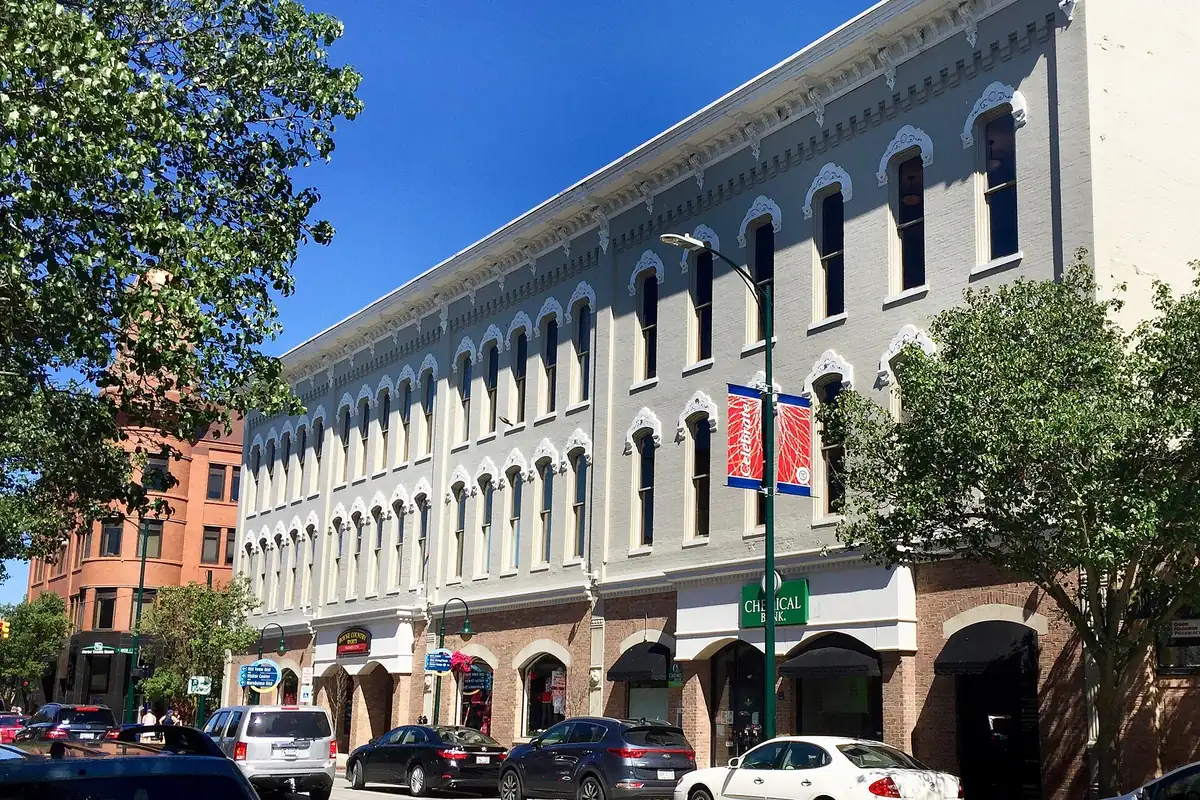
Things to do in Traverse City, Michigan
Lay Park
A park in the Old Town District near the Boardman River, named for Albert T. Lay, whom the city credits with naming Traverse City. It holds Enspire, a weathering-steel sculpture honoring longtime downtown director Bryan Crough.
Hannah Park
A park on the banks of the Boardman River in the historic Central Neighborhood, with fishing platforms and a six-foot (1.8 m) bronze likeness of Perry Hannah, Lay's partner in the city's first general store.
City Opera House
A 680-seat Victorian theater that opened in 1892, one of 48 opera houses built in Michigan in the 19th and early 20th centuries and one of seven still open in the state.
The Village at Grand Traverse Commons
The former Northern Michigan Asylum, designed by Gordon W. Lloyd on the Kirkbride Plan and opened to patients in November 1885, now the site of the renovation of dozens of the old hospital's buildings, one of the largest historic preservation and adaptive reuse projects in the country, the Village says.
Sleeping Bear Dunes National Lakeshore
A national lakeshore with miles of sand beach and bluffs that tower 450 feet (137 m) above Lake Michigan, plus an island lighthouse, U.S. Life-Saving Service stations and old farmsteads.
Getting there
Open Traverse City in Google Maps
Opens in a new tab. The pin is the center of Traverse City in the USGS place-name record.
The closest airports, Amtrak stations and intercity bus stops, measured in a straight line from the center of Traverse City.
Airports
- Cherry Capital (TVC) Traverse City 2 mi 4 km
- Pellston Regional/Emmet County (PLN) 69 mi 111 km
Intercity buses
- Indian Trails Traverse City (B.A.T.A.) under 1 mi 0.6 km
Distances are as the crow flies, not by road. We don't list schedules or fares because they change; check with the airline, Amtrak or the bus company before you go. Official data (FAA commercial service airports (2025), FAA airport locations, Amtrak stations and Intercity Bus Atlas) from the FAA and the U.S. Bureau of Transportation Statistics, checked Nov 14, 2026.
Sponsored
Staying in Traverse City?
Compare hotels in Traverse City, Michigan, on Expedia.
See hotels in Traverse CityWe may earn a commission if you buy through this link. It never changes what we write. Read our affiliate disclosure
Sponsored
Want the spooky side of Traverse City?
The name has its story above. For the ghost stories, US Ghost Adventures runs walking ghost tours in Traverse City.
See ghost tours in Traverse CityWe may earn a commission if you book through this link. It never changes what we write. Read our affiliate disclosure
Historical Sources & References
- Alexander Winchell, The Grand Traverse Region (1866), pp. 5-7. The section “The Name”: French voyageurs crossing two bays “from headland to headland,” “La Petite Traverse” and “La Grande Traverse,” and the bay’s length of 34.75 statute miles (p. 5, which carries no printed number; it’s the one before page 6); the bay’s average breadth and “the Peninsula” (p. 6); Old Mission harbor (p. 7). Checked against the page images.
- Henry Gannett, The Origin of Certain Place Names in the United States, 2nd ed. (1905), p. 303. Traverse City, the name “meaning ‘lying across,’” given by early French voyagers to an indentation of the Lake Michigan shore.
- Gannett (1905), p. 141. Grand Traverse County, “named from Grand Traverse Bay.”
- M. L. Leach, A History of the Grand Traverse Region (1884), p. 19. The Old Mission post office named Grand Traverse, Lay’s trip to Washington in the winter of 1852-53, the clerk’s suggestion, the mail from Manistee, Old Joe and Dr. Goodale. Checked against the page image.
- City of Traverse City, “Lay Park”. Lay credited with naming the city in 1853, the suggestion to strike out “Grand,” and “City” added later.
- City of Traverse City, “Hannah Park”. Perry Hannah, the Hannah & Lay store, the Traverse City State Bank, and the railroad and asylum.
- GNIS feature 1615042 (U.S. Geological Survey). The U.S. gazetteer listing for Traverse City, Grand Traverse County, with its coordinates.
- U.S. Geological Survey, Traverse City sheet (1957). The 1:62,500 map the image at the top of this page was cropped from.
Spot something wrong, or know more? Tell us here. You can also email us or use our contact page. Corrections are noted here with their date, never made silently.