Mackinac Island, Michigan: A Great Turtle or a Lost Tribe?
Mackinac is a shortened form of Michilimackinac, a Native name the French wrote down. Its meaning is disputed. Cadillac wrote 'Island of the Tortoise,' and the island's tourism bureau gives 'place of the great turtle.' Henry Gannett added 'island of the giant fairies' from other dialects, and Andrew J. Blackbird tied the name to a tribe nearly wiped out there.
Mackinac Island, Michigan, carries a shortened Native name, Michilimackinac, which some read as a great turtle and others tie to a tribe nearly wiped out. The short part is settled. The island’s tourism bureau calls Mackinac “a shortened version of the Native American name, Michilimackinac,” and Pure Michigan, the state’s travel site, says the French wrote Michilimackinac and the English cut it down. What the long name meant is where the arguments start.
One name, several places
Before you get to the meaning, it helps to know how much ground the name once covered. Edwin O. Wood, in the first volume of Historic Mackinac (1918), counts the uses: the island itself, which he thought probably came first; the region around it; the Straits country and the eastern Upper Peninsula; the French post at St. Ignace; and the later post on the south shore, near what’s now Mackinaw City. He quotes the Jesuit Claude Dablon calling it “an Island of note in these regions.”
That’s why the name turns up in so many other stories. Julien Dubuque, for one, learned the Indian trade as a clerk “out of Michilimackinac” before he moved down the Mississippi.
Wood also settled the spelling question for his readers. On the island, the name ends in “nac,” and it’s still “correctly pronounced as if ending ‘naw.’” His rule: “In all uses of the word the final ‘c’ is silent, and the pronunciation as if spelled ‘Mackinaw.’” The tourism bureau says the same thing more briefly: it’s MACK-in-awe, “whether it’s spelled Mackinac or Mackinaw.”
The turtle
The oldest reading in these sources comes from a French officer. Wood prints Antoine de la Mothe-Cadillac’s description of the French post at Point St. Ignace, across the water:
“The word Missilimakinak means, ‘Island of the Tortoise.’ The reason why it is so called may be either because it is shaped like a tortoise, or because turtles are found in the vicinity.”
Cadillac knew the place. Wood says Frontenac sent him to the garrison at Michilimackinac in 1694, seven years before Cadillac’s party arrived to build the post at Detroit. He explained another name, too: in 1695 he wrote that Chicago meant “the River of Garlic.”
Henry Gannett kept the turtle in the 1905 edition of The Origin of Certain Place Names in the United States, deriving Mackinac from “the Ojibwa Indian word michilimackinac, meaning ‘island of the great turtle,’ or in other dialects, ‘island of the giant fairies.’” The tourism bureau today says “the Anishinaabek word means place of the great turtle,” and says the people who named it thought the island, with its limestone bluffs, looked like a giant turtle rising out of the water. Pure Michigan hedges it: “It’s been said that Native Americans thought the shape of the island resembled a turtle.”
Andrew Blackbird’s version
Not everyone accepted the turtle. Andrew J. Blackbird, who signed his 1887 History of the Ottawa and Chippewa Indians of Michigan as a former U.S. interpreter from Harbor Springs, wrote that most historians claimed the name meant a large turtle. “But we consider this to be a clear error,” he said.
He told it as Ottawa tradition. A small, independent tribe once lived on the island and was allied with the Ottawas. The Senecas, Iroquois from New York, attacked them in winter and nearly wiped them out; two escaped. The Ottawas and Chippewas named the island after that people “for memorial sake.” His conclusion: “Therefore, we contend, this is properly where the name Michilimackinac is originated.”
So you’ve got a tortoise, a great turtle, giant fairies and a lost tribe, each with someone’s name attached.
The fort on the bluff
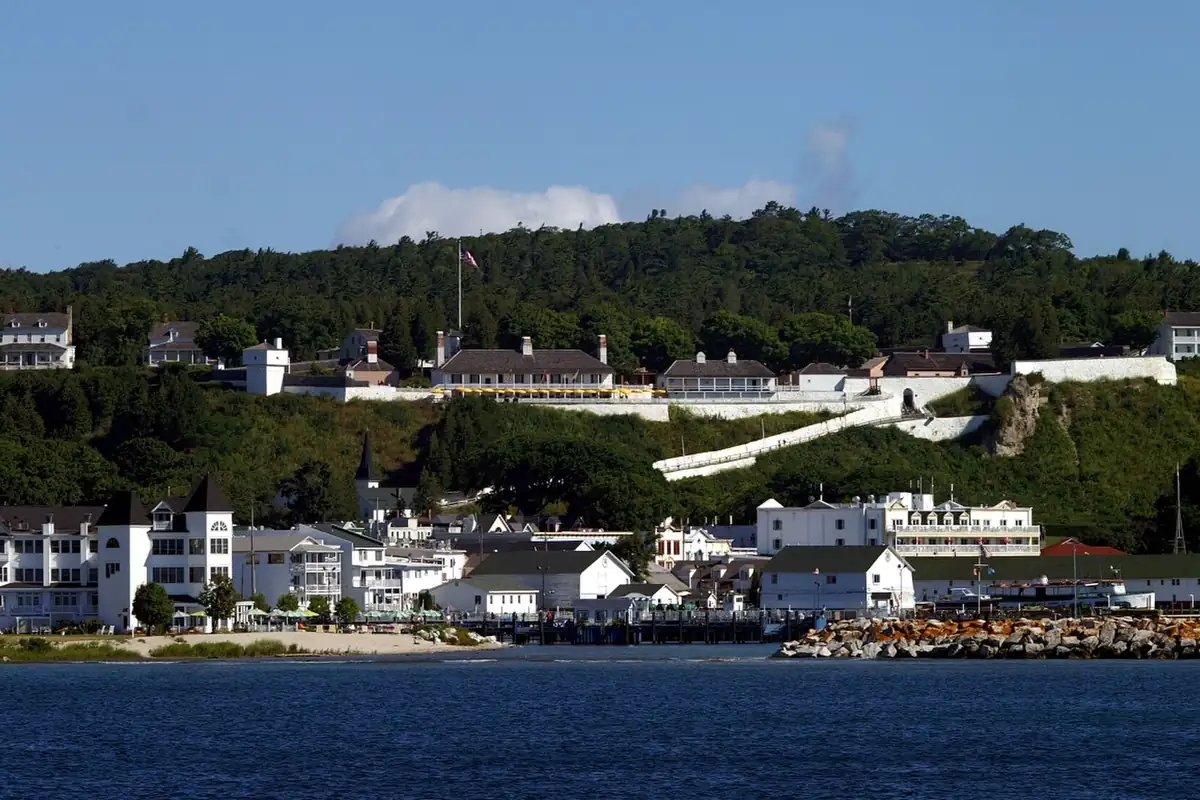
The fort in the photo below came from the mainland. The Mackinaw Area Visitors Bureau says the French fort of Michilimackinac stood on the south shore of the straits until 1781, when it was relocated to Mackinac Island. Mackinac State Historic Parks says Fort Mackinac holds the oldest building in Michigan, and that it later served as headquarters for Mackinac National Park, the country’s second national park. When that ended in 1895, the land became Michigan’s first state park.
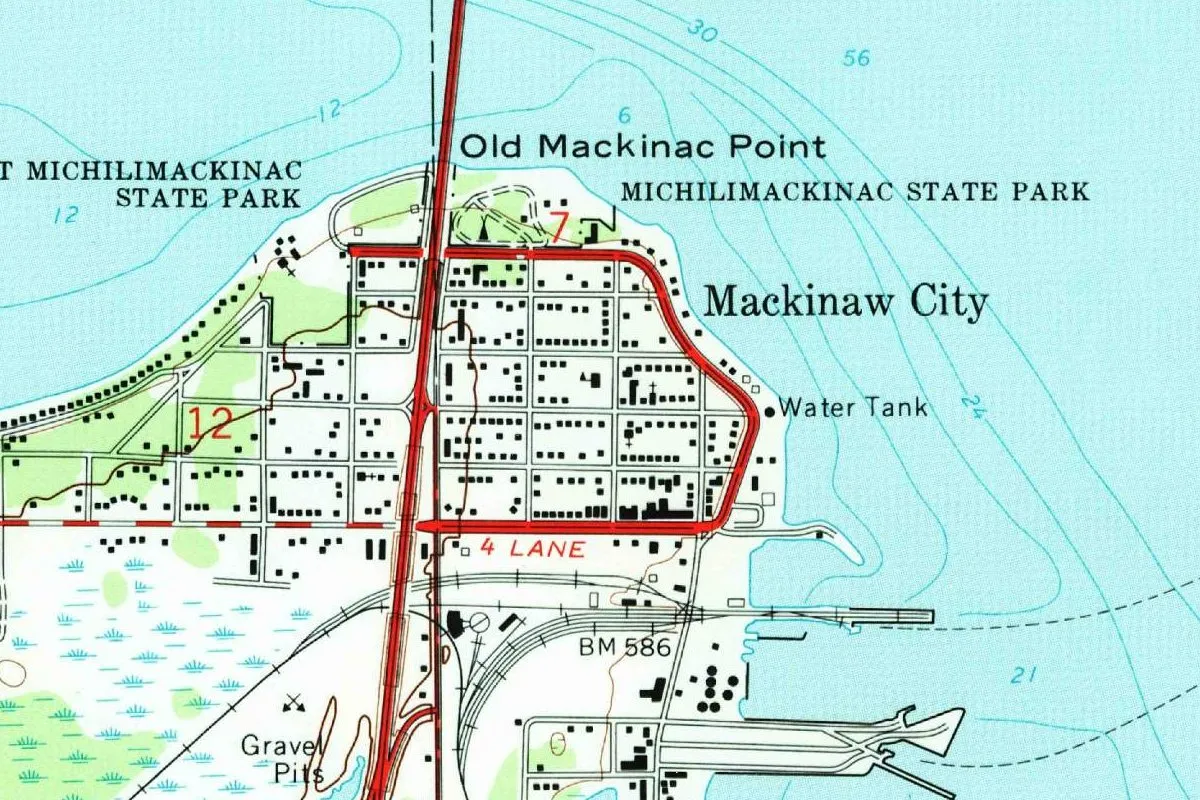
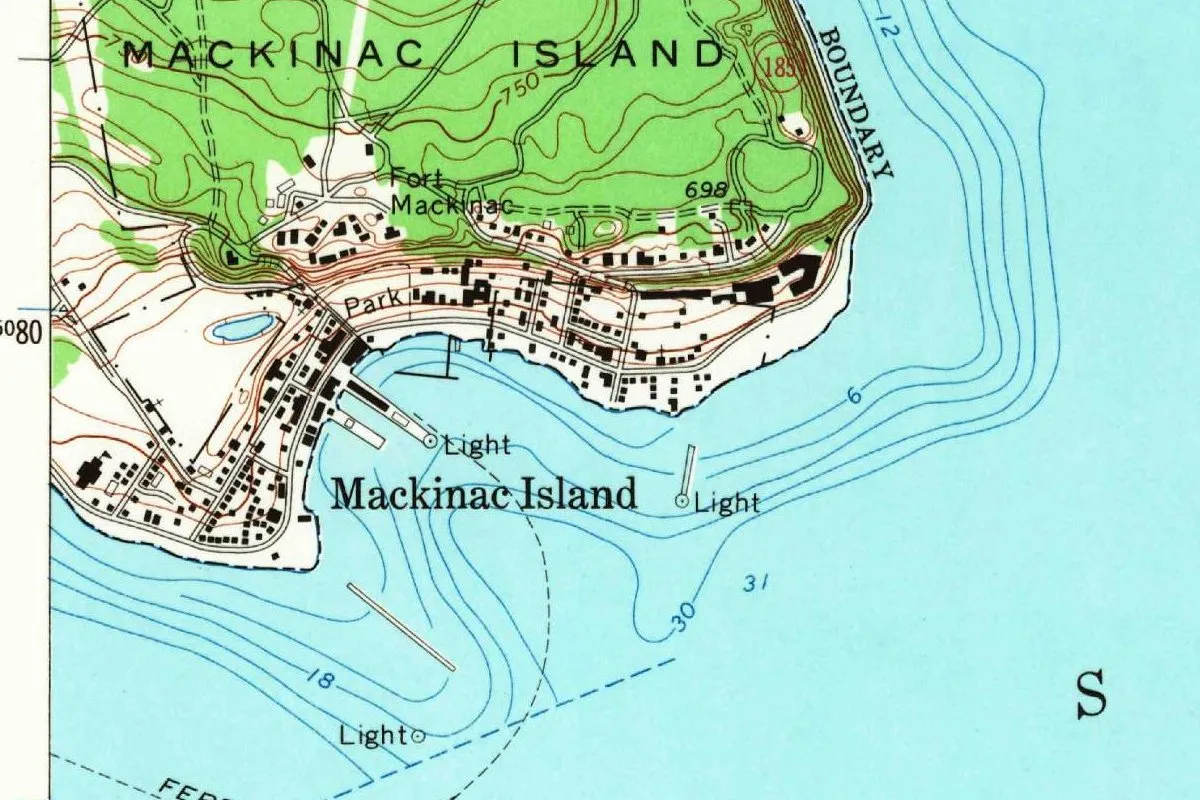
On the 1964 Geological Survey map at the top, in its printing of 1966, you can see the setup: Fort Mackinac on the wooded bluff, the town squeezed along the harbor below it, and lights marking the way in.
Quick answers
What does Mackinac mean?
It’s disputed. Cadillac wrote “Island of the Tortoise,” Gannett gave “island of the great turtle” or “island of the giant fairies,” and the tourism bureau says “place of the great turtle.” Andrew J. Blackbird called the turtle “a clear error” and tied the name to a tribe destroyed on the island.
How do you pronounce Mackinac?
MACK-in-awe, according to the Mackinac Island Tourism Bureau. Edwin O. Wood wrote in 1918 that the final “c” is silent in every use of the name.
Why is Mackinac spelled differently from Mackinaw City?
Wood wrote that the island takes the “nac” spelling and the site on the south side of the straits takes “Mackinaw,” with the same pronunciation for both.
Key dates
- 1694Frontenac sends Antoine de la Mothe-Cadillac to the garrison at Michilimackinac, Wood writes.
- 1781The fort of Michilimackinac moves from the mainland to Mackinac Island.
- 1887Andrew J. Blackbird publishes the Ottawa tradition of the name and rejects the turtle reading.
- 1895Mackinac Island State Park, Michigan's first state park, is established.
- 1905Gannett gives 'island of the great turtle' and, from other dialects, 'island of the giant fairies.'
- 1918Edwin O. Wood's Historic Mackinac sorts out the places the name was used for and its pronunciation.
Things to do in Mackinac Island, Michigan
Mackinac Island State Park
Michigan's first state park, established in 1895 after twenty years as Mackinac National Park. It covers more than 80 percent of the island and takes in Fort Mackinac, Marquette Park, Arch Rock, Sugarloaf Rock, British Landing and Fort Holmes, with no motor vehicles.
Fort Mackinac
The fort on the bluff above the harbor, with the oldest building in Michigan and 13 other historic structures. Its exhibits cover military training, battles, medicine and family life, and it later served as headquarters for Mackinac National Park.
Biddle House and the Mackinac Island Native American Museum
The home of Agatha and Edward Biddle, merchants who moved in around 1830. An exhibit created with tribal partners tells the story of the Anishnaabek of northern Michigan, Agatha among them, and how it still resonates on the island.
Richard & Jane Manoogian Mackinac Art Museum
Art and photography about Mackinac, from hand-beaded Native American garments and 17th- and 18th-century maps of the Great Lakes to photographs from the mid-19th to the mid-20th century, including the work of William H. Gardiner.
Getting there
Open Mackinac Island in Google Maps
Opens in a new tab. The pin is the center of Mackinac Island in the USGS place-name record.
The closest airports, Amtrak stations and intercity bus stops, measured in a straight line from the center of Mackinac Island.
Airports
- Pellston Regional/Emmet County (PLN) 21 mi 34 km
- Chippewa County International (CIU) Sault Ste. Marie 29 mi 46 km
Intercity buses
- Indian Trails St. Ignace (Transportation Center) 5 mi 8 km
Distances are as the crow flies, not by road. We don't list schedules or fares because they change; check with the airline, Amtrak or the bus company before you go. Official data (FAA commercial service airports (2025), FAA airport locations, Amtrak stations and Intercity Bus Atlas) from the FAA and the U.S. Bureau of Transportation Statistics, checked Nov 17, 2026.
Sponsored
Staying in Mackinac Island?
Compare hotels in Mackinac Island, Michigan, on Expedia.
See hotels in Mackinac IslandWe may earn a commission if you buy through this link. It never changes what we write. Read our affiliate disclosure
Historical Sources & References
- Mackinac Island Tourism Bureau, “How to Pronounce Mackinac Island” (2023). MACK-in-awe, the same sound for both spellings, Michilimackinac shortened, “place of the great turtle” and the bluffs.
- Edwin O. Wood, Historic Mackinac, vol. I (1918), pp. 16-17. The places the name covered, Dablon’s line, the spelling and the silent “c.” On p. 74, Cadillac’s “Island of the Tortoise”; on p. 77, his posting in 1694. Checked against the page images.
- Henry Gannett, The Origin of Certain Place Names in the United States, 2nd ed. (1905), p. 195. “Island of the great turtle” and “island of the giant fairies.” Checked against the page image.
- Andrew J. Blackbird, History of the Ottawa and Chippewa Indians of Michigan (1887), pp. 19-20. The Ottawa tradition of the tribe on the island and the rejection of the turtle reading. Checked against the page images.
- Pure Michigan, “How Did Michigan Cities Get Their Names?”. The French Michilimackinac, the English Mackinac, and “It’s been said” about the turtle shape.
- Mackinaw Area Visitors Bureau, “Living History. Making History.”. The fort on the mainland until 1781.
- Mackinac Island State Park; Fort Mackinac; Biddle House; Mackinac Art Museum. The park of 1895, the national park before it, the fort’s buildings and the details in the things-to-do list.
- GNIS feature 1620659 (U.S. Geological Survey). Mackinac Island’s listing as a populated place in Mackinac County and its coordinates.
- Round Island quadrangle, 1964, printed 1966. The sheet the map at the top was cropped from, with Fort Mackinac at 698 feet (213 m).
Spot something wrong, or know more? Tell us here. You can also email us or use our contact page. Corrections are noted here with their date, never made silently.