Petoskey, Michigan: The Man Before the Stone
Petoskey, Michigan, took its name from a Native leader and landowner before the famous fossil became the state stone. The person was Ignatius Petoskey, whose name also appears as Pe-to-se-ga; the familiar English translations of his name are less securely established than the town’s dedication to him.
Ignatius Petoskey at Bear River
Before the name Petoskey took hold, the settlement was called Bear River. The city’s Blueprint Petoskey master plan identifies Ignatius as its namesake and places that earlier community within the homeland of the Little Traverse Bay Bands of Odawa Indians.
He wasn’t just a figure borrowed from a distant past. Harriet Kilborn’s 1960 history describes him as the headman at Bear River when the Little brothers arrived in 1873. He and other Native families held land selected under the Treaty of 1855, and he had also bought land from the federal government. Much of what became the town stood on his property.
That makes the name unusually personal. If you follow it back past the souvenir shops, you reach someone who actually lived where the growing town was taking shape.
A new name in the mail
Kilborn connects the change to Dr. William Little’s application to operate a post office east of the river. She dates his appointment, and the postal change from Bear River to Petoskey, to December 5, 1873. Her account says the official notification didn’t arrive until March.
The timing helps explain why histories can attach different dates to the town’s beginnings. An inspection train had reached the settlement on November 25, 1873, shortly before the postal appointment. A charter followed in 1879, according to the city’s plan.
Little’s application is part of the story, but Kilborn doesn’t establish who first suggested honoring Ignatius. So you can pin down when the mail started carrying the name, but not whose idea it was.
What about the rising sun?
The sunshine explanation needs more care. Henry Gannett’s 1905 federal place-name book identifies the namesake as a Native chief, then adds this cautious description on page 243:
“the name being said to refer to some one of the heavenly bodies.”
Even that early reference stopped short of a firm translation.
A Michigan Geological Survey booklet tells the better-known story of sunlight falling on a newborn’s face. It explicitly introduces the account as legend and offers several English renderings, including rising sun and rays of dawn. Those phrases belong to the legend. Neither account settles what Ignatius’s name meant.
The stone came into the naming story afterward. The same state booklet says the fossil’s common name likely developed because specimens were sold as souvenirs from the Petoskey area. In 1965 Michigan made it the official state stone. The familiar fossil carries a town’s name, and that town carries a man’s.
Quick answers
Who was Petoskey named after?
Ignatius Petoskey, a Native leader and landowner at Bear River. The city master plan and Kilborn’s local history agree on the person honored.
Was Petoskey named after the stone?
No. The town honors Ignatius Petoskey; the Michigan Geological Survey says the fossil’s common name likely came from its sale as a souvenir of the area.
What was Petoskey called before?
Bear River. Kilborn dates the post office’s change to Petoskey to December 5, 1873.
Does Petoskey mean rising sun?
Possibly. Rising sun is one of several English readings. The state booklet presents the birth-and-sunlight story as legend, and Gannett’s earlier wording is cautious.
Key dates
- 1873Kilborn dates the post office's change from Bear River to Petoskey to December 5.
- 1879The community received its charter, according to the city master plan.
- 1965Michigan designated the Petoskey stone its official state stone.
Getting there
Open Petoskey in Google Maps
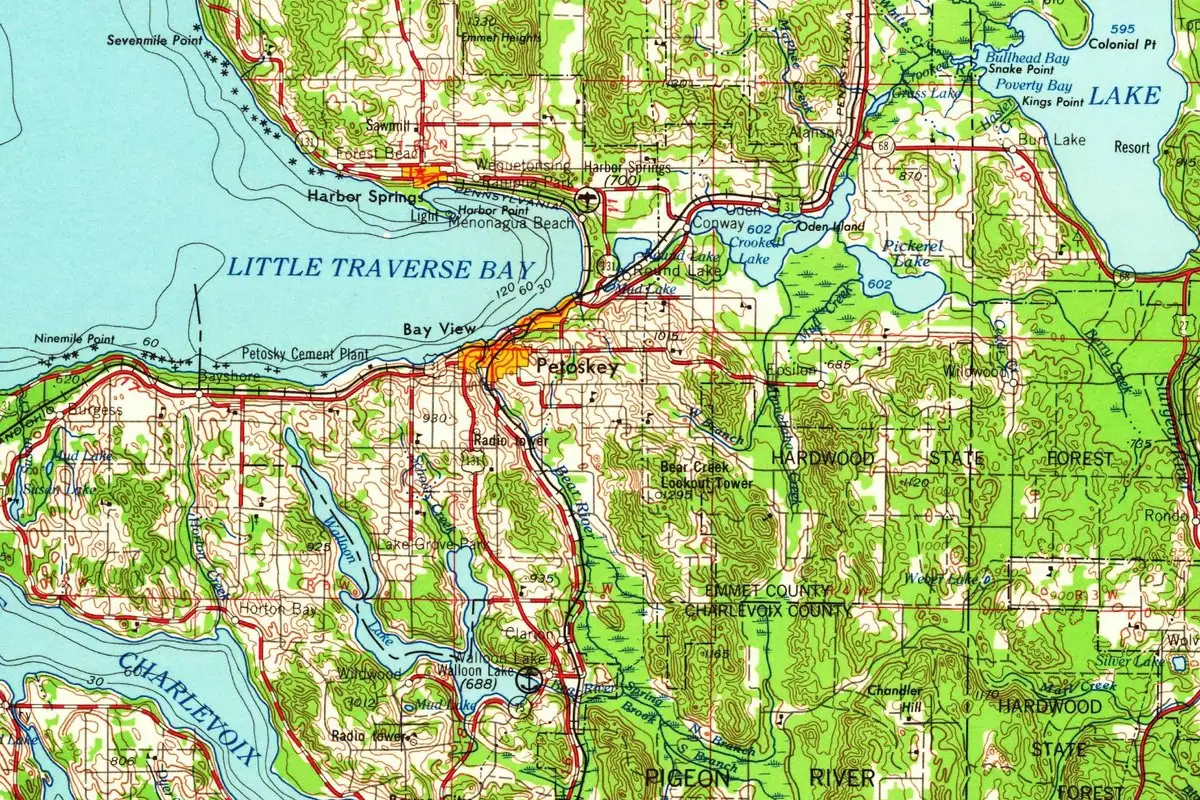
Opens in a new tab. The pin is the center of Petoskey in the USGS place-name record.
The closest airports, Amtrak stations and intercity bus stops, measured in a straight line from the center of Petoskey.
Airports
- Pellston Regional/Emmet County (PLN) 16 mi 25 km
- Cherry Capital (TVC) Traverse City 53 mi 86 km
Intercity buses
- Indian Trails Petoskey 2 mi 3 km
Distances are as the crow flies, not by road. We don't list schedules or fares because they change; check with the airline, Amtrak or the bus company before you go. Official data (FAA commercial service airports (2025), FAA airport locations, Amtrak stations and Intercity Bus Atlas) from the FAA and the U.S. Bureau of Transportation Statistics, checked Nov 10, 2026.
Sponsored
Staying in Petoskey?
Compare hotels in Petoskey, Michigan, on Expedia.
See hotels in PetoskeyWe may earn a commission if you buy through this link. It never changes what we write. Read our affiliate disclosure
Historical Sources & References
- City of Petoskey, Blueprint Petoskey (adopted 2015), pp. 2-1–2-3. Ignatius, the earlier Bear River name, the Odawa homeland and the 1879 charter.
- Harriet Kilborn, The History of the Petoskey Area (1960). Landownership, Little’s postal application, the December 1873 change and the inspection train; transcribed by Emmet County MIGenWeb.
- Henry Gannett, The Origin of Certain Place Names in the United States (1905), p. 243. Early identification of the namesake and the qualified wording quoted above.
- Michigan Geological Survey, The Petoskey Stone, p. 1. The expressly labeled legend, likely souvenir origin of the fossil’s name and 1965 state designation.
- USGS geographic-name entry 634731. Identifies Petoskey in Emmet County; not used as linguistic evidence.
Spot something wrong, or know more? Tell us here. You can also email us or use our contact page. Corrections are noted here with their date, never made silently.