Mackinaw City, Michigan: A 'City' Nobody Lived In
Mackinaw City takes its name from Michilimackinac, the old name of the straits and of the fort that stood here until 1781, in the 'Mackinaw' spelling Edwin O. Wood gave for the south shore. The Mackinaw Area Visitors Bureau says 'City' was added because promoter Edgar Conkling took it for granted that a busy city would soon grow there.
Mackinaw City, Michigan, got the “City” in its name from a Cincinnati investor who took it for granted a metropolis would rise at the Straits of Mackinac. For more than a decade, nobody lived there at all. The Mackinaw Area Visitors Bureau tells it with a straight face: “It was named Mackinaw ‘City’ because Conkling took it for granted that very soon it would be a busy city.”
A metropolis on paper
The idea wasn’t Edgar Conkling’s alone. George Robinson and R. A. Sprague, in their 1873 History of Cheboygan and Mackinac Counties, open a section called “Mackinaw as a Natural Point” with a quote from a writer named Ferris:
“If one were to point out on the map of North America a site for a great central city in the lake region, it would be in the immediate vicinity of the Straits of Michilimackinac. … It would be called the Venice of the lakes.”
Robinson and Sprague say Conkling, “then of Cincinnati,” secured a large tract of land on the south side of the straits in 1853, and surveyed the city site in 1857 and 1858. Then “the financial revulsion at that time and the war which soon followed prevented further operations.” The Visitors Bureau dates the purchase to 1857, by five investors with Conkling as “the main thrust,” and says fliers went out all over the country promising that “soon, very soon, Mackinaw City would be the next Chicago.”
Thirteen years with nobody home
It didn’t happen. The Visitors Bureau blames the lack of a river, and a north too thinly settled for railroads to reach yet. For thirteen years, it says, the platted and recorded “city” had “exactly zero settlers.”
The first one came in January 1870. George Washington Stimpson of Cheboygan bought four lots from Conkling and built a cabin, and his house ended up hosting almost everything: the first church services, in February 1870, and the first school district meeting, in July 1871. By about 1874 there was enough traffic for a hotel, and he added one to his house and called it the Stimpson House.
Mackinaw with a W
The “Mackinaw” part is older than any of this, and it’s the same name as the island across the water, spelled the other way. The long form, Michilimackinac, and the arguments over what it means are on our Mackinac Island page. What matters here is the ending. Edwin O. Wood, in Historic Mackinac (1918), wrote that “when referring to the site on the south side of the Straits, the spelling is ‘Mackinaw,’ with the pronunciation the same as for the Island name.” He called the old post on this shore “Old Mackinaw.” The Mackinac Island Tourism Bureau agrees on the sound: MACK-in-awe, either way you spell it.
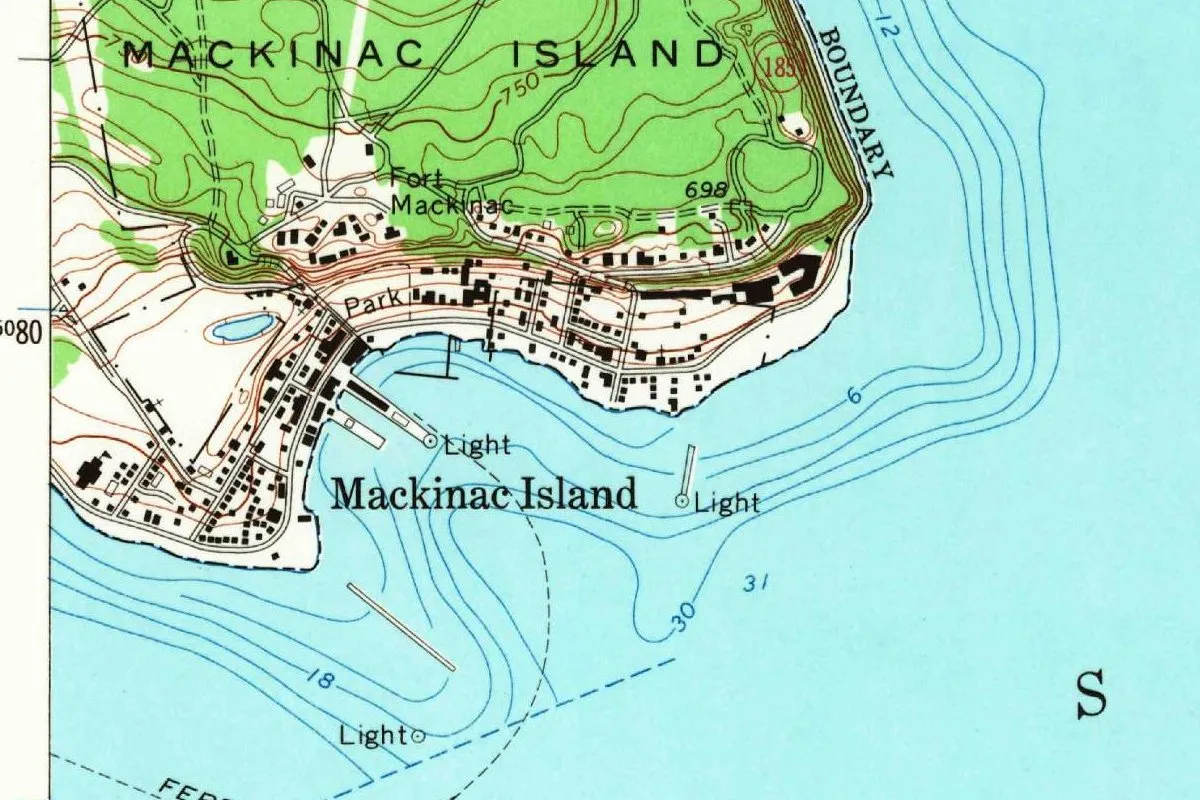
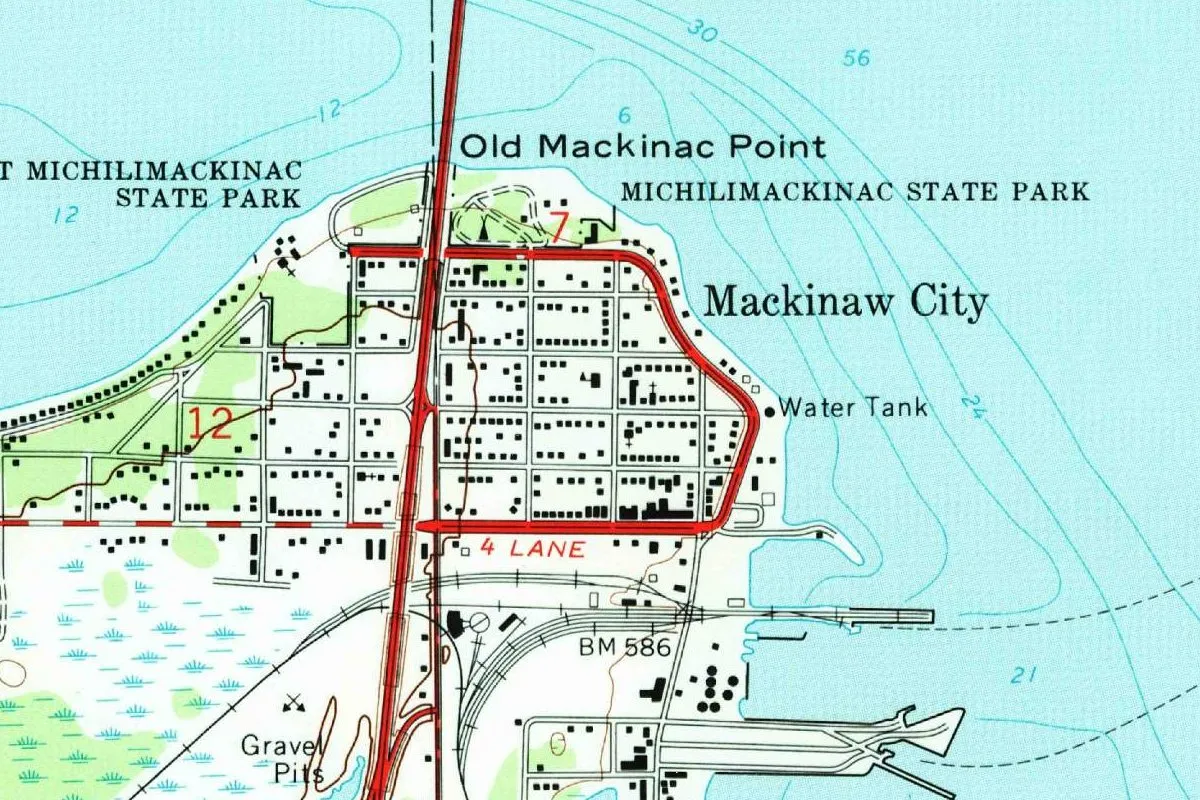
You can see both spellings side by side on the Geological Survey’s 1964 map at the top of this page, in a 1989 printing: Old Mackinac Point with a C, and Mackinaw City with a W, right next to it. The W spelling goes back a long way in what’s now Michigan. Silas Farmer’s history of Detroit, quoted on our Hamtramck page, lists a township named Mackinaw in Wayne County as early as 1798.
The fort the city grew up around
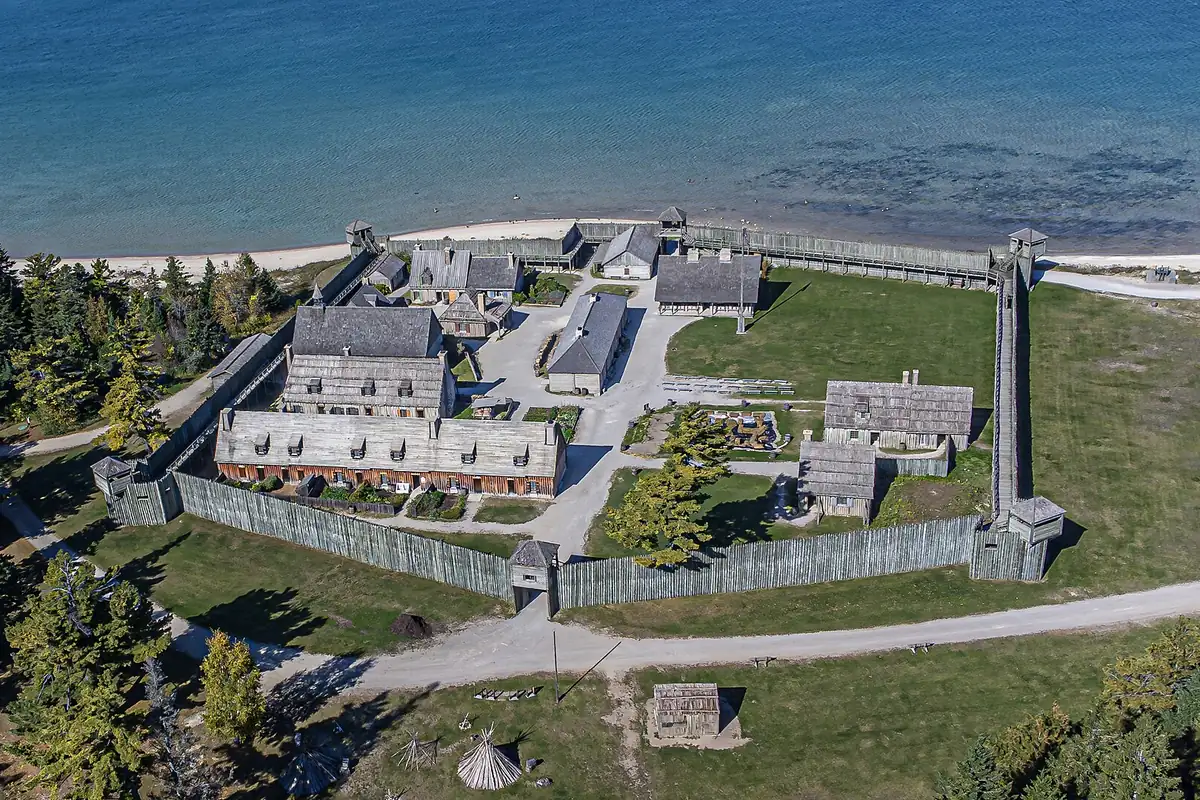
The fort in the photo below is a reconstruction, on the spot where the real one stood. The Visitors Bureau says the French built the fort of Michilimackinac around 1715, and it later passed to the British. Jonathan Carver, at Green Bay in 1766, used it as a yardstick: leave Michilimackinac in spring, before the trees there have budded, he wrote, and two weeks later you’ll find the country around La Bay already green. The fort stayed on the mainland until 1781, when it was moved to Mackinac Island.
The site is now part of Michilimackinac State Park, which Mackinac State Historic Parks calls Michigan’s second state park, established in 1909. The rebuilt fort and village rest on historic maps and more than 60 years of archaeological excavations, the parks say.
Quick answers
Why is it called Mackinaw City?
Mackinaw is the south-shore spelling of the old name Michilimackinac, according to Edwin O. Wood. The Mackinaw Area Visitors Bureau says Edgar Conkling added “City” because he took it for granted that a busy city would soon grow there.
Is Mackinaw pronounced the same as Mackinac?
Yes. The Mackinac Island Tourism Bureau says both are pronounced MACK-in-awe, and Wood wrote in 1918 that the final “c” is always silent.
When was Mackinaw City settled?
In January 1870, when George Washington Stimpson bought four lots, according to the Visitors Bureau. The land had been bought and the city surveyed in the 1850s, but nobody lived there for thirteen years.
Key dates
- 1715The French fort of Michilimackinac is built on the south shore of the straits, around this year.
- 1781The fort is relocated from the mainland to Mackinac Island.
- 1853Edgar Conkling of Cincinnati secures a large tract on the south side of the straits, per Robinson and Sprague.
- 1857Five investors buy the area, the Visitors Bureau says; Conkling surveys the city site in 1857-58.
- 1870January: George Washington Stimpson of Cheboygan buys four lots, the first settler after thirteen empty years.
- 1909Michilimackinac State Park, Michigan's second state park, is established.
Things to do in Mackinaw City, Michigan
Colonial Michilimackinac
The 18th-century fort and fur trading village, reconstructed from historic maps and more than 60 years of archaeological digging. The state parks call the dig one of the longest ongoing archaeological excavations in North America.
Old Mackinac Point Lighthouse
A beacon for ships in the Straits of Mackinac since 1889, nicknamed the Castle of the Straits, with restored quarters, the original lens, the tower and the Straits of Mackinac Shipwreck Museum.
Michilimackinac State Park
Michigan's second state park, established in 1909 at the tip of the Lower Peninsula and split between Cheboygan and Emmet counties, with a walk along the Lake Huron shore and views of the lighthouse, the straits, Mackinac Island and the Mackinac Bridge.
Headlands International Dark Sky Park
An Emmet County park at 15675 Headlands Road, Mackinaw City, with grounds, trails and viewing areas for stargazing and an observatory tower. White lights aren't allowed in the viewing area, red-filtered flashlights are, and camping isn't permitted.
Getting there
Open Mackinaw City in Google Maps
Opens in a new tab. The pin is the center of Mackinaw City in the USGS place-name record.
The closest airports, Amtrak stations and intercity bus stops, measured in a straight line from the center of Mackinaw City.
Airports
- Pellston Regional/Emmet County (PLN) 15 mi 24 km
- Chippewa County International (CIU) Sault Ste. Marie 35 mi 56 km
Intercity buses
- Indian Trails Mackinaw City (Village City Hall) under 1 mi 0.3 km
Distances are as the crow flies, not by road. We don't list schedules or fares because they change; check with the airline, Amtrak or the bus company before you go. Official data (FAA commercial service airports (2025), FAA airport locations, Amtrak stations and Intercity Bus Atlas) from the FAA and the U.S. Bureau of Transportation Statistics, checked Nov 17, 2026.
Sponsored
Staying in Mackinaw City?
Compare hotels in Mackinaw City, Michigan, on Expedia.
See hotels in Mackinaw CityWe may earn a commission if you buy through this link. It never changes what we write. Read our affiliate disclosure
Historical Sources & References
- Mackinaw Area Visitors Bureau, “Living History. Making History.”. The fort around 1715 and its move in 1781, the 1857 purchase, Conkling, the fliers and “the next Chicago,” the thirteen years with no settlers, why it’s called “City,” and George Washington Stimpson.
- George Robinson and R. A. Sprague, History of Cheboygan and Mackinac Counties (1873), pp. 14-15. Ferris’s “great central city” and “Venice of the lakes,” Conkling’s land in 1853 and the survey of 1857-58. Checked against the page images.
- Edwin O. Wood, Historic Mackinac, vol. I (1918), pp. 16-17. The “Mackinaw” spelling for the south side of the straits, “Old Mackinaw,” and the silent “c.” Checked against the page images.
- Mackinac Island Tourism Bureau, “How to Pronounce Mackinac Island”. MACK-in-awe for both spellings.
- Colonial Michilimackinac; Old Mackinac Point Lighthouse; Michilimackinac State Park; Headlands International Dark Sky Park. The park of 1909, the excavations and the details in the things-to-do list.
- GNIS feature 1620662 (U.S. Geological Survey). Mackinaw City’s listing as a populated place in Cheboygan County and its coordinates.
- St. Ignace quadrangle, 1964, printed 1989. The sheet the map at the top was cropped from, with both spellings and a benchmark of 586 feet (179 m).
Spot something wrong, or know more? Tell us here. You can also email us or use our contact page. Corrections are noted here with their date, never made silently.