Hamtramck, Michigan: Named for Detroit's 1796 Commander
Hamtramck is named for Col. John Francis Hamtramck, the first American commandant at Detroit, who took over the post in 1796 and died in 1803. Silas Farmer's 1884 history says a Wayne County township carried his name by November 1, 1798. The village came in 1901 and the city in 1922.
Hamtramck, Michigan, took its name from Detroit’s first American commandant, Col. John Francis Hamtramck, through a township created by 1798. The name was more than a century old by the time the Dodge Brothers plant brought the city its boom, and Merriam-Webster says it’s ham-TRA-mik.
Detroit’s first American commandant
Silas Farmer’s History of Detroit and Michigan, published in 1884, sets the scene in Detroit: “After the evacuation by the English, on July 11, 1796, Colonel Hamtramck, with a garrison of three hundred soldiers, was stationed here.” The Detroit Historical Society’s encyclopedia says he stayed at Detroit until his death in 1803.
Who was he? The sources don’t describe him the same way. The City of Hamtramck calls him “a French Revolutionary War hero, Colonel Jean Francois Hamtramck (1756-1803).” The Detroit Historical Society calls him “a French-Canadian soldier who fought in the American Revolutionary War.” Farmer uses John Francis, or John F.
Two years before Detroit, the colonel had named a fort of his own. In 1794, as our story on Fort Wayne, Indiana tells it, Hamtramck took command of a new fort and gave it the name of Gen. Anthony Wayne. The general’s name also ended up on Wayne, Nebraska, by way of its county.
A township by 1798
The name went onto the map early, in what’s now Michigan. Farmer writes that “as early as November 1, 1798, four townships had been created in Wayne County, namely, Detroit, Mackinaw, Sargent, and Hamtramck.” On the next page he explains it: “Hamtramck was named in honor of Colonel John F. Hamtramck, first United States commander of Detroit.”
The colonel was still alive then. He’d be dead within five years.
The colonel’s grave
Farmer also tells where the colonel lay in 1884. He was “originally buried in the graveyard of St. Anne’s, but in July, 1866,” his remains were moved, “placed in an oaken casket, and deposited in Mount Elliott.” Farmer copied the stone. It gives his death as April 11, 1803, “Aged 45 years, 7 months & 28 days,” and it says: “He was a soldier even before he was a man.” His conduct in the Revolutionary War, the stone adds, “procured him the attention and personal thanks of the immortal Washington.”
Today, though, the city puts his grave somewhere else. Its parks page says the veterans’ memorial in Veterans Park includes “the grave of Hamtramck’s namesake, Col. Jean-Francois Hamtramck.” None of the sources here say when the move happened.
A city (almost) inside Detroit
The township became a village in 1901, the Detroit Historical Society says. The city’s own history describes a German-American farming community of about 500 people in the early 1900s, before Dodge Brothers broke ground for a plant in 1910 and turned out the first car there on November 14, 1914. The plant “attracted Polish laborers in large numbers,” the city says, and the population went from 3,589 in 1910 to 46,615 in 1920.
In 1922 Hamtramck incorporated as a city “to protect itself from becoming annexed by Detroit, which completely surrounds Hamtramck,” the city’s history says. The Detroit Historical Society is more exact, calling it “surrounded almost entirely by the city of Detroit,” except for a small stretch next to Highland Park.
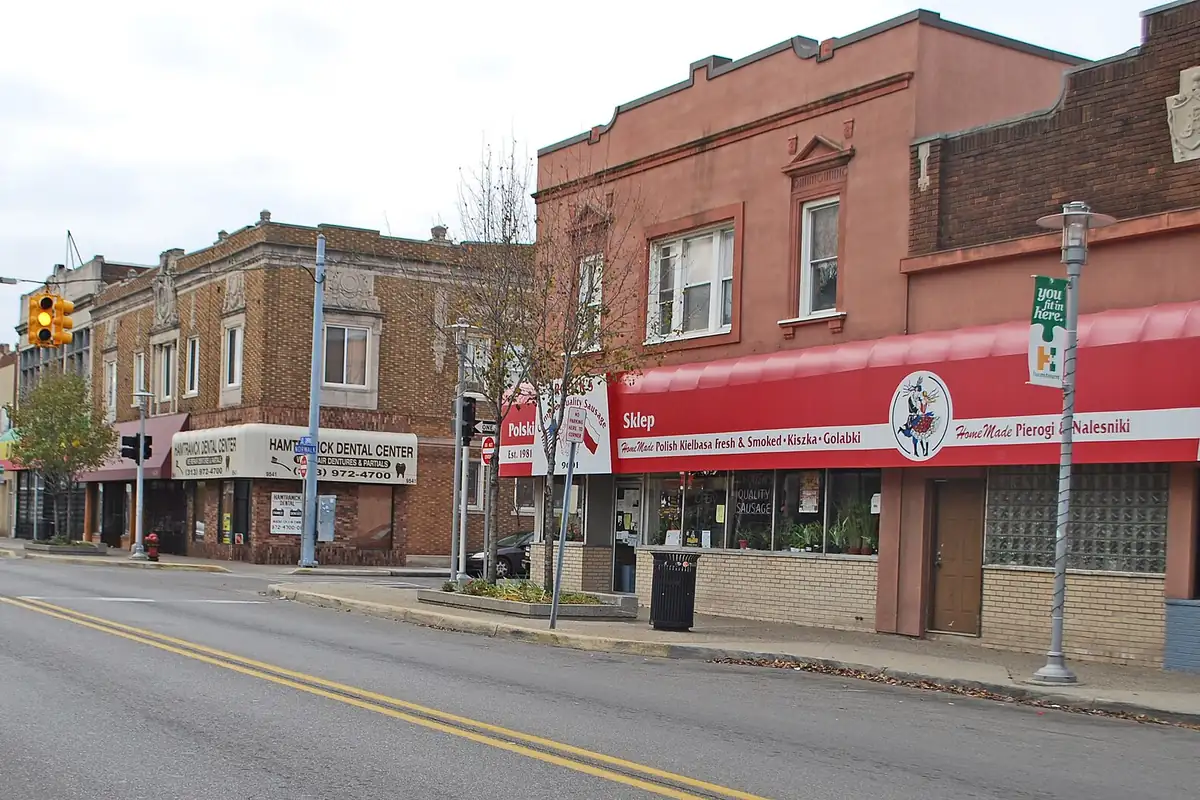
The photo below shows Joseph Campau Avenue, with a Polish sausage shop’s awning on the corner.
The 1924 Army map
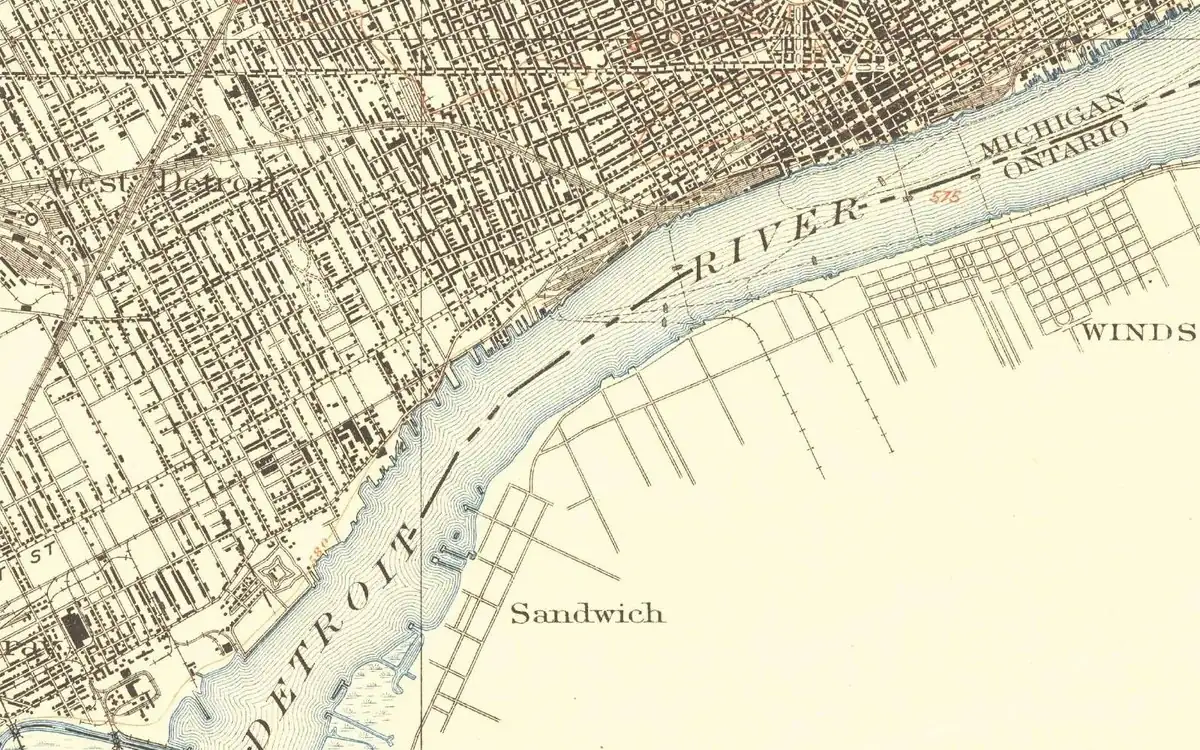
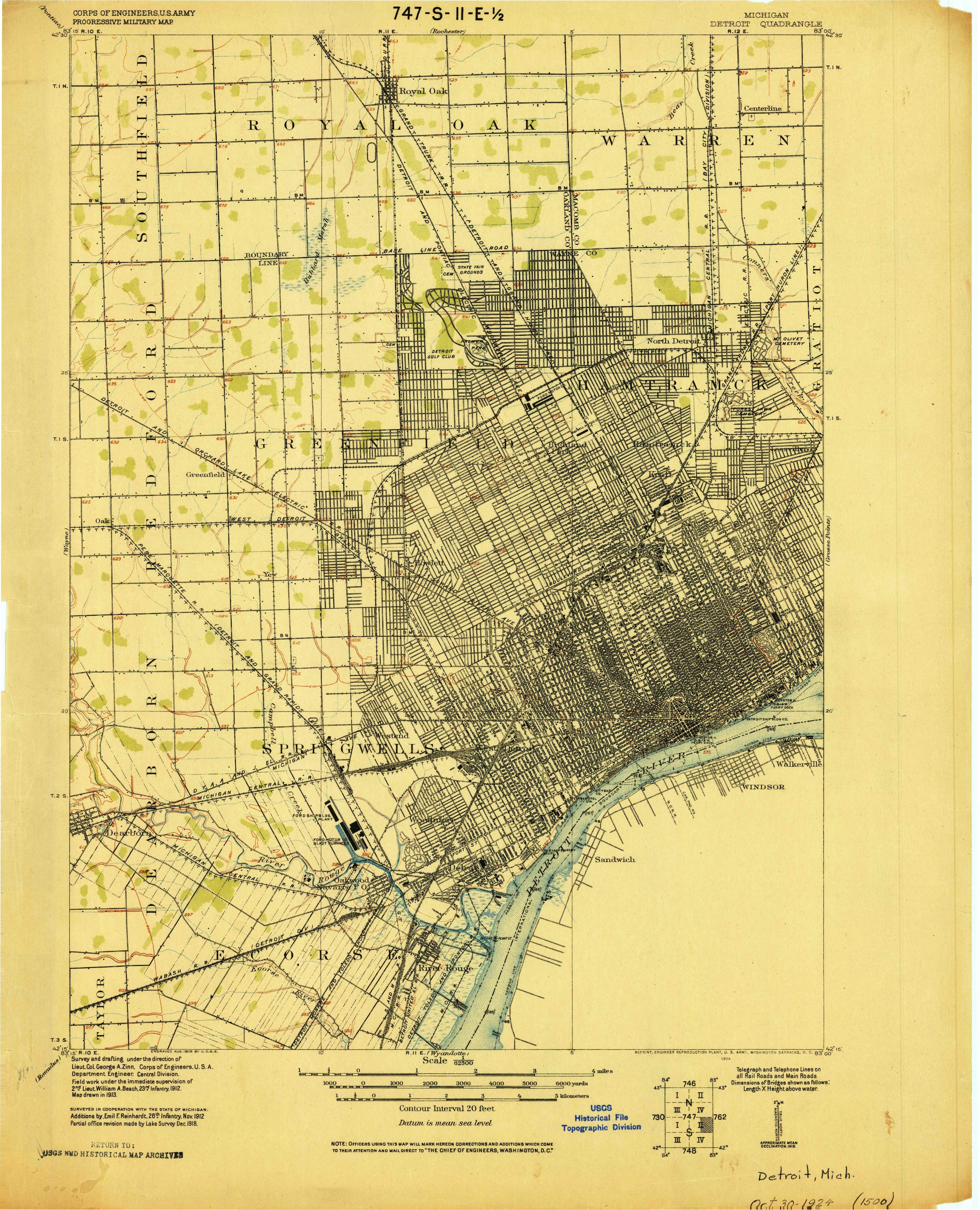
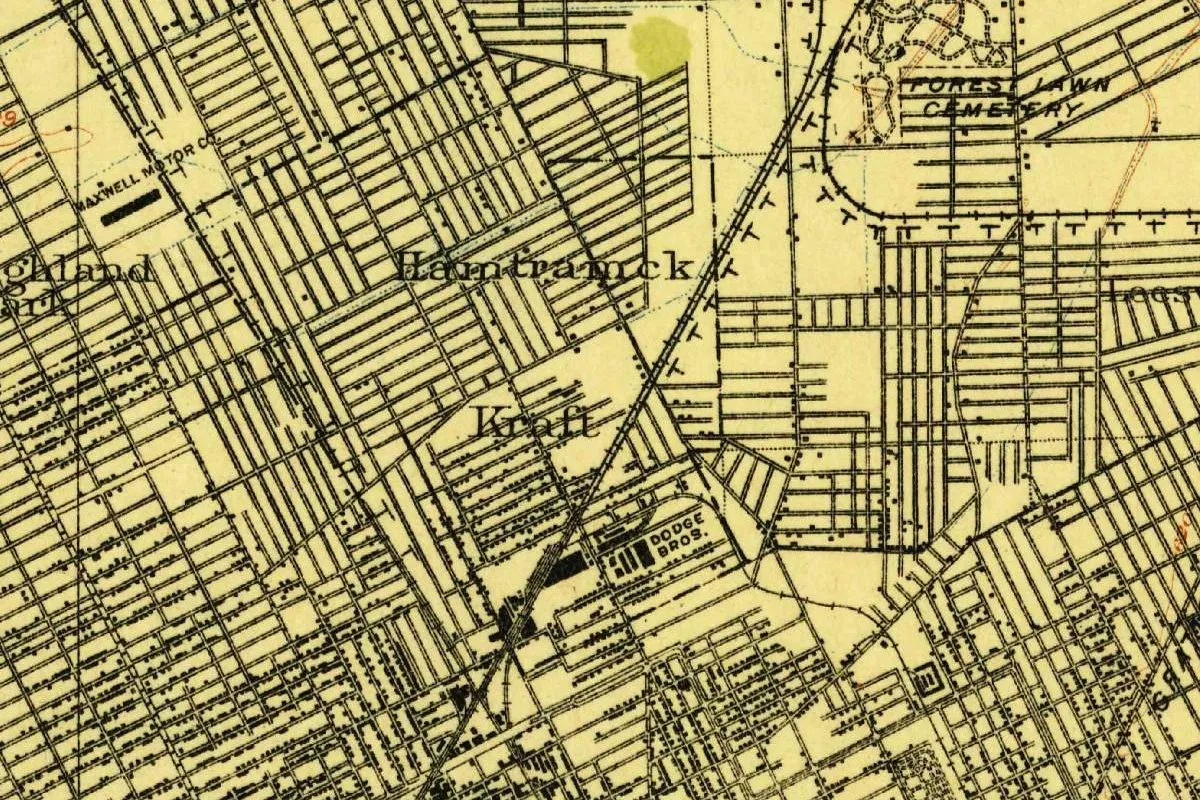
The map at the top of this page comes from a sheet with a long paper trail. It’s the Detroit quadrangle of the Army Corps of Engineers’ Progressive Military Map, engraved by the Geological Survey in August 1905, with field work in 1912, a partial office revision by the Lake Survey in December 1918 and this reprint, made at the Army’s Engineer Reproduction Plant in Washington, in 1924. If you look below the town’s name, you can see “Dodge Bros.” printed across the plant.
Quick answers
Who is Hamtramck named after?
Col. John Francis Hamtramck, whom Silas Farmer (1884) calls the “first United States commander of Detroit.” The city spells his name Jean Francois Hamtramck.
How do you pronounce Hamtramck?
Ham-TRA-mik, Merriam-Webster says, writing it ham-ˈtra-mik.
Was Hamtramck named by Polish immigrants?
No. The township had the colonel’s name by November 1, 1798, Farmer says. The city’s history ties the big Polish arrival to the Dodge plant, which made its first car in 1914.
Is Hamtramck inside Detroit?
Almost. The city’s history says Detroit “completely surrounds” it, while the Detroit Historical Society says it’s surrounded almost entirely, apart from a short border with Highland Park. It’s been its own city since 1922.
Key dates
- 1794Colonel Hamtramck names Fort Wayne, in present-day Indiana.
- 1796On July 11, after the British leave, Hamtramck is stationed at Detroit with a garrison of 300 soldiers.
- 1798By November 1, Wayne County has four townships, one of them Hamtramck.
- 1803Colonel Hamtramck dies on April 11.
- 1866In July his remains are moved from St. Anne's graveyard to Mount Elliott cemetery.
- 1901Hamtramck becomes a village.
- 1914The Dodge Brothers plant produces its first car on November 14.
- 1922Hamtramck incorporates as a city to avoid being annexed by Detroit.
Things to do in Hamtramck, Michigan
Historic Hamtramck Stadium
Home of the Detroit Stars and Detroit Wolves of the Negro Leagues in the 1930s, and one of only five Negro League home ballparks still in existence. The diamond is now Norman 'Turkey' Stearnes Field, and the grandstand reopened in 2022 after a rehabilitation.
Veterans Park
The city's largest park, with a paved exercise trail, several historical markers and a veterans' memorial that includes the grave of the city's namesake, Col. Jean-Francois Hamtramck. Historic Hamtramck Stadium stands in the park.
Pope Park
A park with seating areas, a mural and a statue commemorating the visit of Pope John Paul II to Hamtramck.
Polish Art Center
A shop owned and run by the Bittner family, which calls it one of the country's premier emporiums of Polish cultural and traditional goods.
Getting there
Open Hamtramck in Google Maps
Opens in a new tab. The pin is the center of Hamtramck in the USGS place-name record.
The closest airports, Amtrak stations and intercity bus stops, measured in a straight line from the center of Hamtramck.
Airports
- Detroit Metro Wayne County (DTW) 20 mi 32 km
- Bishop International (FNT) Flint 53 mi 85 km
Amtrak trains
- Detroit station (DET) 2 mi 3 km
- Royal Oak station (ROY) 8 mi 13 km
Intercity buses
- Amtrak Chartered Vehicle Amtrak Connecting Service · Detroit 2 mi 3 km
- Barons Bus Lines Detroit 5 mi 7 km
- Indian Trails Detroit 5 mi 7 km
Distances are as the crow flies, not by road. We don't list schedules or fares because they change; check with the airline, Amtrak or the bus company before you go. Official data (FAA commercial service airports (2025), FAA airport locations, Amtrak stations and Intercity Bus Atlas) from the FAA and the U.S. Bureau of Transportation Statistics, checked Nov 17, 2026.
Sponsored
Staying in Hamtramck?
Compare hotels in Hamtramck, Michigan, on Expedia.
See hotels in HamtramckWe may earn a commission if you buy through this link. It never changes what we write. Read our affiliate disclosure
Historical Sources & References
- Silas Farmer, The History of Detroit and Michigan (1884), p. 54. The grave at Mount Elliott, the move from St. Anne’s in July 1866 and the text of the tombstone. Checked against the page image.
- Farmer (1884), p. 127. The four Wayne County townships, Hamtramck among them, by November 1, 1798. Checked against the page image.
- Farmer (1884), p. 128. The township named for Colonel John F. Hamtramck, “first United States commander of Detroit.” Checked against the page image.
- Farmer (1884), p. 223. Hamtramck stationed at Detroit on July 11, 1796, with 300 soldiers. Checked against the page image.
- City of Hamtramck, “City History”. Jean Francois Hamtramck as “a French Revolutionary War hero,” the Dodge plant, the Polish laborers, the growth from 1910 to 1920 and the city of 1922, surrounded by Detroit.
- Detroit Historical Society, Encyclopedia of Detroit, “Hamtramck”. “A French-Canadian soldier,” his command at Detroit from 1796 to 1803, the township of 1798, the village of 1901 and the border with Highland Park.
- City of Hamtramck, “Parks”. The grave of the city’s namesake in Veterans Park, and the details on Veterans Park and Pope Park in the things-to-do list.
- Merriam-Webster, “Hamtramck”. The pronunciation, ham-ˈtra-mik.
- Friends of Historic Hamtramck Stadium; Polish Art Center. The details in the things-to-do list.
- GNIS feature ID 627707 (U.S. Geological Survey). Hamtramck in the national gazetteer, in Wayne County, with its coordinates.
- Corps of Engineers, Detroit quadrangle (1924). The 1:62,500 Progressive Military Map, engraved in 1905 and reprinted in 1924, that the map at the top of this page was cropped from.
Sponsored
Put this 1924 map on your wall
The 1924 Army reprint of the Detroit sheet, which shows Hamtramck, is in the public domain. Download the full-size scan for free, then have it printed on canvas with CanvasOnTheCheap.
Print a map on canvasDownload the full-size mapWe may earn a commission if you buy through this link. It never changes what we write. Read our affiliate disclosure
Spot something wrong, or know more? Tell us here. You can also email us or use our contact page. Corrections are noted here with their date, never made silently.