Why Is It Called Amelia Island? Oglethorpe's 1736 Name
James Oglethorpe named Amelia Island in April 1736, on a boat trip south from St. Simons. Francis Moore, who wrote up the trip, says he chose the name because the island was beautiful, with myrtle, peach and orange trees. The city and local historians say it honored Princess Amelia, daughter of King George II.
Amelia Island, Florida, got its name in April 1736 from James Oglethorpe, who thought it beautiful; later sources say he meant George II’s daughter Amelia. The one person who wrote down the naming at the time gave a reason, and it wasn’t a princess.
Why is it called Amelia Island?
The founder of Georgia named it from a boat. Francis Moore, who was in Georgia that year, published A Voyage to Georgia in 1744, and he tells how Oglethorpe set out “On the 18th of April” with two scout boats and Tomochichi, with fewer than forty hand-picked warriors. Oglethorpe kept the party small, Moore says, because his job was to avoid a fight with the Spaniards.
On the way, Moore says, the Indians “new named” one island Cumberland, for “his Royal Highness the Duke,” who had given Tomochichi’s nephew a gold watch. They spent the night at Cumberland’s southern tip. The next morning, he writes, they “discovered another island beyond it,” rowing through narrow, shallow passages in the marsh between it and the mainland:
“To this island Mr. Oglethorpe gave the name of Amelia, it being a beautiful island, and the sea shore covered with myrtle, peach-trees, orange trees and vines in the wild woods.”
That’s the whole naming scene. Moore gives Oglethorpe’s reason as the island’s looks, and he doesn’t say whose name Amelia was.
Who was Amelia?
The answer comes from later sources. The City of Fernandina Beach says Oglethorpe renamed the island “in honor of princess Amelia (1710-1786), King George II’s daughter, although the island was still a Spanish possession.” The Amelia Island chapter of the Daughters of the American Revolution and a University of South Florida lesson on the island’s history say the same. In other words, Oglethorpe was naming a piece of Spanish Florida. None of the three cites a document from 1736, so treat the princess as the accepted explanation rather than something Oglethorpe wrote down.
It fits his habits, though. A few months earlier, at the close of 1735 by one historian’s count, Oglethorpe had ordered a town marked out up the Savannah River, and he named it Augusta, for a royal princess. Earlier on this same trip, as Moore tells it, the boats rowed across “Jekyl sound,” off Jekyll Island, which Georgia sources say Oglethorpe named for Sir Joseph Jekyll, one of the colony’s backers in London.
Egmont and the island’s other names
The town at the north end, Fernandina Beach, already tells the island’s oldest names: Napoyca, Ribault’s Isle de Mai of 1562 and the Spanish Santa Maria. One more is worth adding. The DAR chapter says that under British rule, from 1763 to 1783, “The Island became known as ‘Egmont’” after the big indigo plantation the Earl of Egmont ran there. Federal name records keep Egmont Island on the list of variants, along with Santa Maria and two other spellings, Amilia and Amalia.
Fernandina later had an Egmont Hotel. The Amelia Island Museum of History says three identical houses there, known as the Three Sisters, went up using what was salvaged from it.
American Beach and its street names
Down at the island’s southern end there’s a community whose history you can read on the street signs. The National Park Service tells how a Black-owned firm from Jacksonville, the Afro-American Life Insurance Company, known as “the Afro,” bought 33 acres (13 ha) on the shore here in 1935 through its Pension Bureau. A. L. Lewis, the company’s president, invited employees to use the beach, and the bureau offered lots to company executives, shareholders and community leaders. Later purchases brought it to 216 acres (87 ha), and in 1940 the company opened the unsold lots to the wider Black community.
The Park Service lists who the streets honor. Lewis Street is for A. L. Lewis, “founder of American Beach.” Julia Street is for his mother, Julia Brown Lewis, and Mary Street for his first wife. Waldron Street remembers the Rev. J. Milton Waldron, a Jacksonville pastor who “had the original idea for the Afro,” and Burney Road another of the company’s presidents, I. H. Burney II.
Amelia Island on the 1919 map
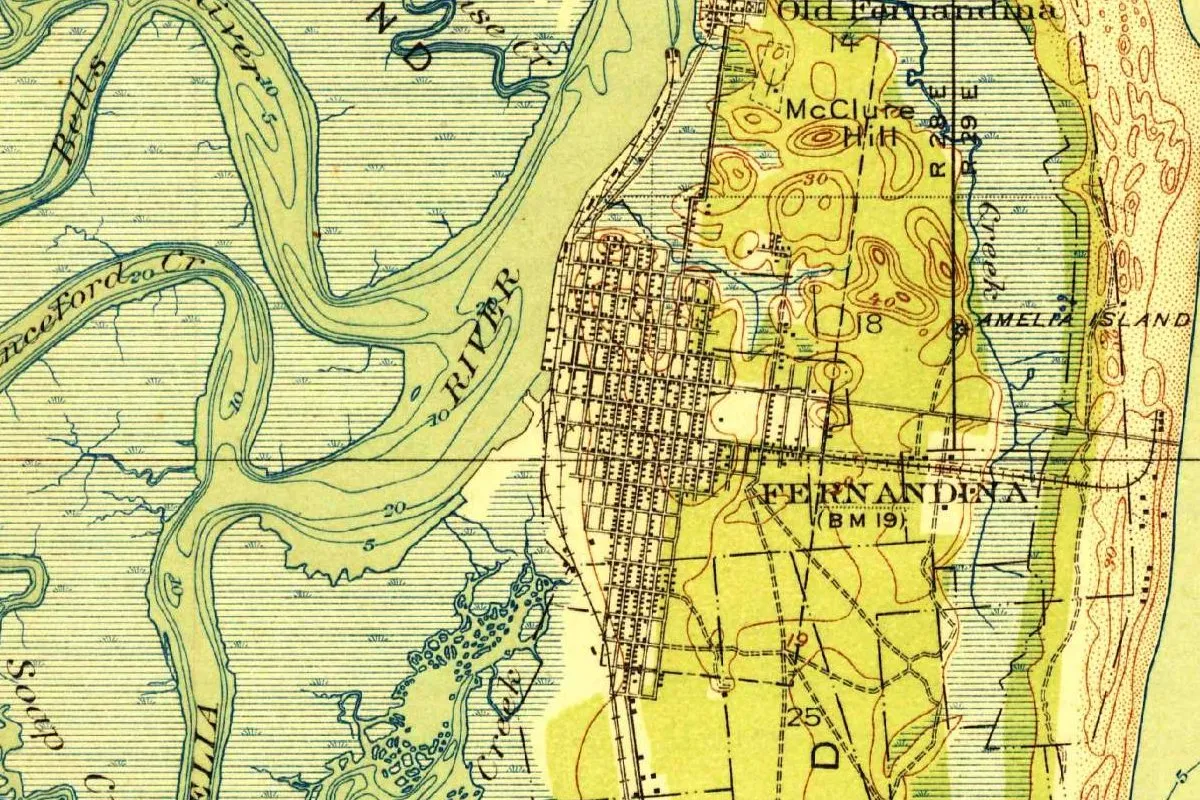
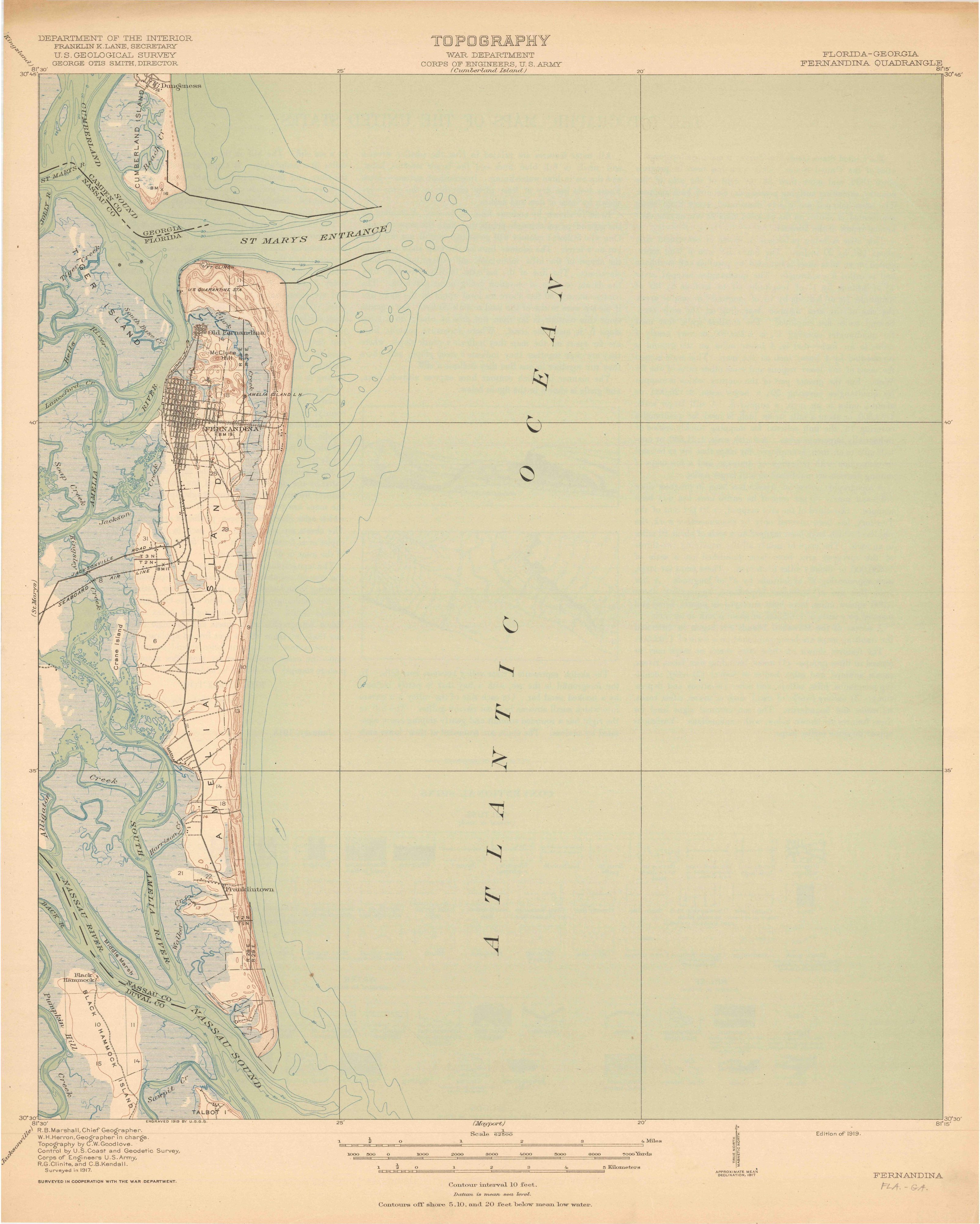
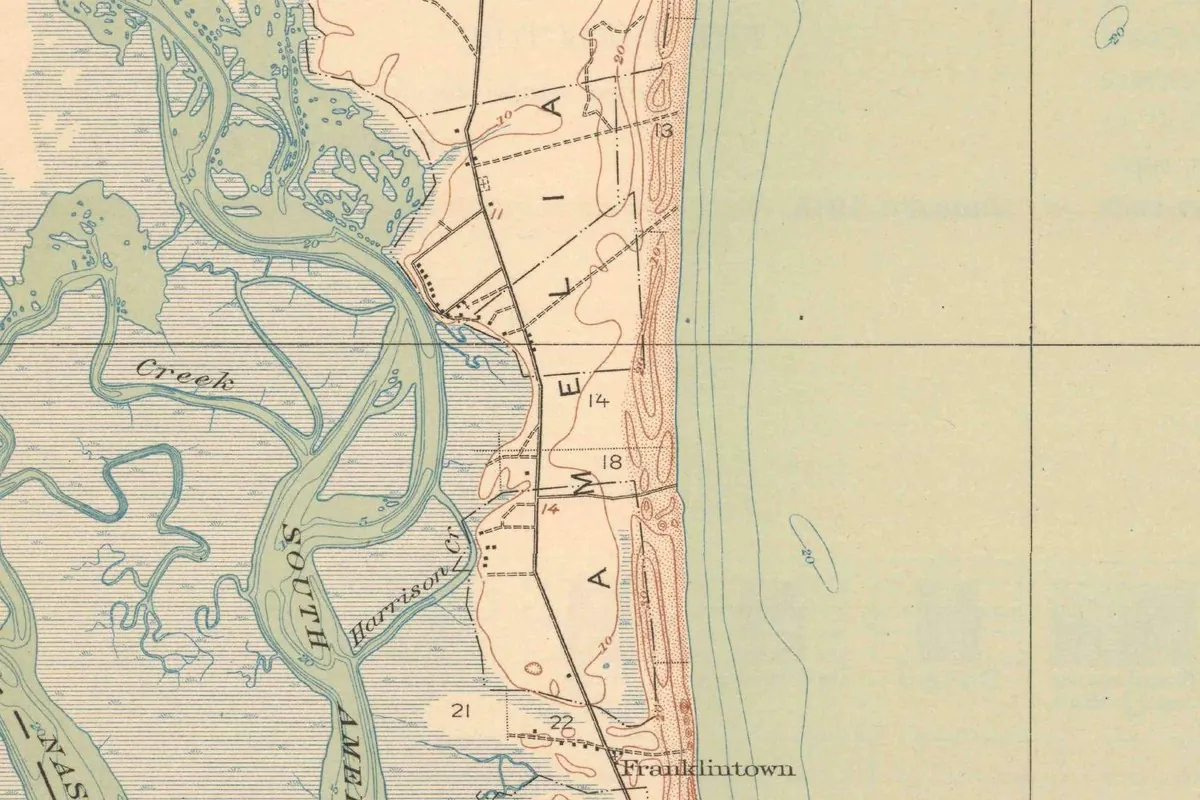
The map at the top was cropped from the Fernandina quadrangle, Florida-Georgia, at 1:62,500, a Geological Survey publication whose margin says it was “SURVEYED IN COOPERATION WITH THE WAR DEPARTMENT.” The bottom margin names C. W. Goodlove as topographer and reads “Surveyed in 1917,” “Engraved 1919 by U.S.G.S.” and “Edition of 1919.”
The crop shows the letters of Amelia spaced out up the middle of the island, reading from bottom to top, with Franklintown near the bottom and Harrison Creek out in the marsh to the west. Take in the whole sheet and you get the rest: Fernandina and Old Fernandina at the north end, the Amelia River, the lighthouse, and Cumberland Island across St. Marys Entrance in Georgia, the island Moore’s party camped on the night before Oglethorpe named this one.
Quick answers
Who named Amelia Island?
James Oglethorpe, Georgia’s founder, in April 1736, according to Francis Moore, who wrote up the trip.
Was Amelia Island named after a princess?
That’s the usual answer. The city and the local DAR chapter say it honors Princess Amelia, George II’s daughter, but Moore’s account only says Oglethorpe found the island beautiful.
What was Amelia Island called before?
Isle de Mai, from Jean Ribault in 1562, then Santa Maria under Spain. Under British rule it was known for a time as Egmont.
Key dates
- 1562Jean Ribault, sailing for France, calls it Isle de Mai, the local DAR chapter says.
- 1736On a boat trip south in April, James Oglethorpe names the island Amelia, Francis Moore writes.
- 1744Moore's account of the trip, A Voyage to Georgia, is published in London.
- 1763British rule begins; the island is known for a time as Egmont, after the Earl of Egmont's indigo plantation.
- 1919The Fernandina quadrangle, surveyed in 1917, letters the island Amelia Island.
- 1935The Afro-American Life Insurance Company's Pension Bureau buys 33 acres of beachfront, the start of American Beach.
- 1940Lots that hadn't sold are offered to Black buyers beyond the company.
Things to do in Amelia Island, Florida
American Beach
The beach community founded in 1935 by a Black-owned Jacksonville insurance company. The National Park Service owns its 8.5-acre (3.4 ha) sand dune, and most of the rest is privately owned, so respect people's property.
A. L. Lewis Museum
A museum at American Beach named for A. L. Lewis, the insurance company president the Park Service calls the founder of American Beach, telling the story of the community.
Egans Creek Greenway
More than 300 acres (121 ha) along Egans Creek, opened in 2000, where grassy old roads make trails for walking and biking, with benches and interpretive displays, and alligators and birds to watch from a distance.
Amelia Island Museum of History walking tours
Guided walks through Fernandina's 52-block historic district. The architecture tour takes in the Three Sisters, identical houses built from what was left of the Egmont Hotel, and the Florida House Inn.
Getting there
Open Amelia Island in Google Maps
Opens in a new tab. The pin is the center of Amelia Island in the USGS place-name record.
The closest airports, Amtrak stations and intercity bus stops, measured in a straight line from the center of Amelia Island.
Airports
- Jacksonville International (JAX) 16 mi 25 km
- Brunswick Golden Isles (BQK) 45 mi 72 km
Amtrak trains
- Jacksonville station (JAX) 23 mi 37 km
- Palatka station (PAK) 67 mi 108 km
Intercity buses
- Greyhound Kingsland Hospitality Ave 17 mi 27 km
- Amtrak Chartered Vehicle Amtrak Connecting Service · Jacksonville 23 mi 37 km
- FlixBus Jacksonville Greyhound Bus Station 23 mi 37 km
Distances are as the crow flies, not by road. We don't list schedules or fares because they change; check with the airline, Amtrak or the bus company before you go. Official data (FAA commercial service airports (2025), FAA airport locations, Amtrak stations and Intercity Bus Atlas) from the FAA and the U.S. Bureau of Transportation Statistics, checked Nov 18, 2026.
Sponsored
Staying in Amelia Island?
Compare hotels in Amelia Island, Florida, on Expedia.
See hotels in Amelia IslandWe may earn a commission if you buy through this link. It never changes what we write. Read our affiliate disclosure
Historical Sources & References
- Francis Moore, A Voyage to Georgia (1744), in Collections of the Georgia Historical Society, vol. 1 (1840), pp. 122-124. The trip that began on April 18, Cumberland and the Duke’s watch, and Oglethorpe naming Amelia. Checked against the page image.
- City of Fernandina Beach, “Isle of Eight Flags”. Oglethorpe renaming the island for Princess Amelia (1710-1786) while it was still Spanish.
- Amelia Island Chapter NSDAR, “Amelia Island History”. Ribault’s Isle de Mai, Santa Maria, the princess, and Egmont under British rule.
- USF Florida Center for Instructional Technology, “Florida’s Historic Places: Fernandina & Amelia Island”. Oglethorpe’s new name and George II’s daughter.
- National Park Service, Timucuan Preserve: American Beach history, street names and visiting. The 1935 purchase, the 216 acres, 1940, the street names and the dune.
- City of Fernandina Beach, Egans Creek Greenway; Amelia Island Museum of History, walking tours. The greenway, the Three Sisters and the Egmont Hotel.
- U.S. Geological Survey, GNIS feature 294302. Amelia Island in Nassau County, with the variants Santa Maria, Egmont Island, Amilia Island and Amalia Island.
- Fernandina quadrangle, surveyed 1917, edition of 1919. The sheet the map at the top was cropped from.
Sponsored
Put this 1919 map on your wall
The Geological Survey's 1919 Fernandina sheet, made with the War Department from a 1917 survey, with Amelia Island between the marshes and the Atlantic, is in the public domain. Download the full-size scan for free, then have it printed on canvas with CanvasOnTheCheap.
Print a map on canvasDownload the full-size mapWe may earn a commission if you buy through this link. It never changes what we write. Read our affiliate disclosure
Spot something wrong, or know more? Tell us here. You can also email us or use our contact page. Corrections are noted here with their date, never made silently.