Livonia, Michigan, and Its Borrowed Baltic Name
Livonia, Michigan, carries the name of Livonia, a Baltic region that was a province of Russia in the 1800s. Silas Farmer's 1890 history of Wayne County says the township was probably named for that province. A history posted by the City of Livonia says the name appears to have come from Livonia Center, New York, instead.
A name from the Baltic
Livonia, Michigan, shares its name with an old Baltic province, but whether the name came straight from there or by way of New York is an open question. A Detroit historian wrote in 1890 that the township was probably named for one of Russia’s western provinces, while a history posted by the City of Livonia says the name appears to have come from Livonia Center, New York, home of some of its first settlers.
The city describes the original Livonia as a region on the Baltic Sea made up of present-day Estonia and Latvia. Its Michigan namesake started as a township. On March 17, 1835, an act of the territorial legislature set the boundaries of Livonia Township, carved from land that had belonged first to Bucklin Township and then to Nankin.
A rule against repeat names
Silas Farmer’s History of Detroit and Wayne County and Early Michigan explains a quirk behind several township names in the county. A territorial law of April 12, 1827, barred any new township from sharing a name with a post office that already existed anywhere in the United States. When the legislative council forgot that rule in 1829 and tried to create townships called Lima and Richland, Governor Cass sent the bill back unapproved. The council swapped in Nankin and Pekin instead.
Farmer figured Livonia came out of the same hunt for something original. He wrote:
“Livonia, as a township name, is doubtless the result of an effort to procure a name not duplicated elsewhere in the United States; it is probably named after one of the western provinces of Russia.”
Notice the two hedges. He’s sure about the motive and only fairly sure about the province. Henry Gannett’s Origin of Certain Place Names in the United States (1905) sounded more certain, listing Livonia townships in Wayne County, Michigan, and Livingston County, New York, both “named from a province of Russia.”
The New York version
There’s a catch in Farmer’s theory, and Gannett’s own entry hints at it. The name wasn’t unique. J. H. French’s 1860 gazetteer of New York says the town of Livonia, in Livingston County, was formed on February 12, 1808, and lists its village of Livonia Center along with a post office called Livonia. That’s a Livonia on the map 27 years before Michigan’s.
That’s where the city’s version comes in. The City of Livonia’s website says pioneers from New England and New York brought “perhaps the very name ‘Livonia’” with them. A typed history of the township’s old villages, which the city posts with the author and date marked unknown, goes a step further: the name “appears to have come from Livonia Center, New York, which was the home of some of the township’s earliest settlers.” Neither one names those settlers or points to a document from 1835.
The two stories don’t cancel each other out. If the name did travel from New York, it still goes back to the Baltic, since Gannett says the New York town was named for the province too. What’s in doubt is the route, and you won’t find a record from 1835 that settles it.
Livonia City, Plank Road and Stark
Once the township had its name, smaller places inside it picked it up, and the village history tracks where it went. It says James Gunning opened a post office called Livonia in 1834, which is a year before the township existed, so treat that date with some care. In 1836 the settlement around it was platted as Livonia City, “in honor of the newly formed township.” The post office became Plank Road in 1851, after the Grand River toll road, and Clarenceville in 1881. The Botsford Inn there went by the 16 Mile House, because it stood 16 miles (26 km) from downtown Detroit.
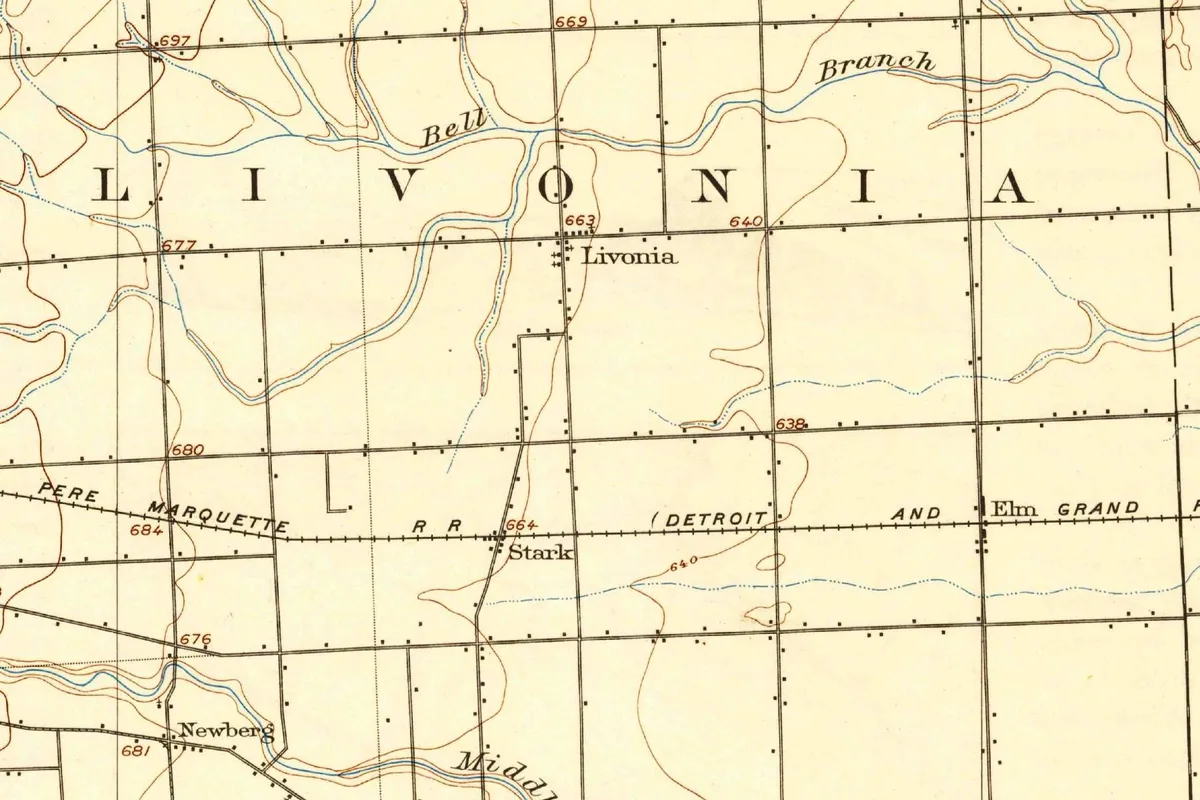
The name also turned up at Livonia Center, the crossroads at the township’s geographic middle, and at the railroad. In 1871 a Livonia Station opened at the Stark Road crossing, and by 1880 the railroad had renamed it Stark. You can see how that looked on the 1905 map at the top of this page: LIVONIA spread across the township, a crossroads labeled Livonia, and Stark down on the tracks.
A township becomes a city
For about a century the name belonged to farmland, with sheep, dairy cattle, vegetables and grain. Then in 1949 the Michigan Racing Association built a racetrack, and the city’s history says the township needed to incorporate so the whole area could share in its revenue. Residents voted to become a city, and on May 23, 1950, the entire township was incorporated as the City of Livonia, with Clarenceville and the other old villages inside it.
So the name that a territorial legislature put on a stretch of Michigan farmland in 1835 outlasted every village that borrowed it. Livonia City turned into Plank Road and Clarenceville, Livonia Station turned into Stark, and the township’s label ended up as the name of the whole city.
Quick answers
Is Livonia, Michigan, named after the Baltic region?
Probably, at least in the end. Silas Farmer’s 1890 history says it’s “probably named after one of the western provinces of Russia,” and the USGS bulletin of 1905 says “named from a province of Russia.” The city’s village history traces it through New York instead.
Was Livonia named after Livonia, New York?
Maybe. A history posted by the city says the name “appears to have come from Livonia Center, New York,” home of some early settlers, but it doesn’t name them, and Farmer’s 1890 passage on the name doesn’t mention New York at all.
When did Livonia become a city?
On May 23, 1950, when the whole of Livonia Township incorporated. The township itself was created on March 17, 1835.
Was Livonia ever called Clarenceville?
No. Clarenceville was one of the township’s villages, platted as Livonia City in 1836. It became part of the city of Livonia in 1950.
Key dates
- 1808February 12: the town of Livonia is formed in what's now Livingston County, New York, according to an 1860 gazetteer.
- 1827April 12: a territorial law bars new Michigan townships from taking the name of any existing U.S. post office.
- 1835March 17: the territorial legislature creates Livonia Township out of land that had been part of Nankin.
- 1836A village in the township is platted as Livonia City, in honor of the new township.
- 1881Livonia City's post office, renamed Plank Road in 1851, becomes Clarenceville.
- 1890Silas Farmer's history of Wayne County calls Livonia 'probably named after one of the western provinces of Russia.'
- 1950May 23: the whole township incorporates as the City of Livonia.
Getting there
Open Livonia in Google Maps
Opens in a new tab. The pin is the center of Livonia in the USGS place-name record.
The closest airports, Amtrak stations and intercity bus stops, measured in a straight line from the center of Livonia.
Airports
- Detroit Metro Wayne County (DTW) 11 mi 17 km
- Bishop International (FNT) Flint 46 mi 74 km
Amtrak trains
- Dearborn station (DER) 7 mi 12 km
- Royal Oak station (ROY) 13 mi 22 km
Intercity buses
- Amtrak Chartered Vehicle Amtrak Connecting Service · Dearborn 7 mi 12 km
- Greyhound Southfield Bus Stop 9 mi 15 km
- Indian Trails Southfield 9 mi 15 km
Distances are as the crow flies, not by road. We don't list schedules or fares because they change; check with the airline, Amtrak or the bus company before you go. Official data (FAA commercial service airports (2025), FAA airport locations, Amtrak stations and Intercity Bus Atlas) from the FAA and the U.S. Bureau of Transportation Statistics, checked Nov 13, 2026.
Sponsored
Staying in Livonia?
Compare hotels in Livonia, Michigan, on Expedia.
See hotels in LivoniaWe may earn a commission if you buy through this link. It never changes what we write. Read our affiliate disclosure
Historical Sources & References
- Silas Farmer, History of Detroit and Wayne County and Early Michigan, 3rd ed., vol. 1 (1890), pp. 127-129. The township’s creation on March 17, 1835, out of land once in Bucklin and Nankin; the law of April 12, 1827, against duplicate names; the Lima and Richland bill of 1829; and the quoted line on Livonia as “probably named after one of the western provinces of Russia.”
- Henry Gannett, The Origin of Certain Place Names in the United States (USGS, 1905), p. 188. Livonia townships in Wayne County, Michigan, and Livingston County, New York, both “named from a province of Russia.”
- J. H. French, Gazetteer of the State of New York (1860), p. 384. The town of Livonia, Livingston County, formed February 12, 1808, and its village of Livonia Center with a post office called Livonia.
- City of Livonia, “History”. The Baltic region of present-day Estonia and Latvia, pioneers from New England and New York who brought “perhaps the very name,” the township boundaries of March 17, 1835, the 1949 racetrack and the incorporation of May 23, 1950.
- City of Livonia, “History of Livonia Villages”. The Livonia Center, New York, explanation; James Gunning’s Livonia post office of 1834; Livonia City in 1836; Plank Road in 1851 and Clarenceville in 1881; the Botsford Inn as the 16 Mile House; Livonia Center; and Livonia Station of 1871, renamed Stark.
- GNIS feature 630841 (U.S. Geological Survey). Where the Wayne County location and the map coordinates come from.
- U.S. Geological Survey, Plymouth sheet (1905). The source of the map at the top of this page.
Spot something wrong, or know more? Tell us here. You can also email us or use our contact page. Corrections are noted here with their date, never made silently.