Why Is Green Bay Called Green Bay? Three Old Answers
Green Bay is named for the bay of Lake Michigan at the mouth of the Fox River, which the French called La Baye or the Baye des Puants. Jonathan Carver, there in 1766, wrote that the English called it Green Bay for its early spring greenery. Later writers credited the water's color or a garbled French La Grande Baie.
French maps called the water at Green Bay, Wisconsin, the Baye des Puants, and three different stories explain how it turned green. The city itself is easy: it took the name of the bay at the mouth of the Fox River, which the English were already calling Green Bay by the 1760s.
The bay before it was green
For the French, the place was simply La Baye, “the bay.” The 1893 book Historic Green Bay, by Ella Hoes Neville, Sarah Greene Martin and Deborah Beaumont Martin, says the whole region from Lake Michigan to the Mississippi “was known as the Country of the Puants or La Baye des Puants. The French called it also La Baye.”
The Puants were a people. The same authors say the French “freely translated” the name they heard for them “into ‘stinkards’ or ‘men of the sea,’” and a footnote explains that the Algonquins gave them a name that “also means Fetid.” The French name stuck to the water. Henry Legler’s 1903 survey of Wisconsin place names lists the variations: Marquette called it the Bay of the Fetid, Hennepin and Membré did the same, St. Cosme wrote Bay of Puants, and de L’Isle’s maps of 1700 and 1718 show “Bay des Puans.” That nation, long called the Winnebago in English, has used its own name, Ho-Chunk, since its constitution of 1994.
What Jonathan Carver saw
The French lost the post when Canada fell to the British. Lieutenant James Gorrell’s journal records a British detachment arriving at La Bay on October 12, 1761, and says the fort was “afterwards called Fort Edward Augustus.” Five years later the traveler Jonathan Carver stopped there on his way west, and his book, published in London in 1778, has the earliest explanation of the new name among the sources we read, and you can still read it today:
“This Fort is situated on the southern extremity of a Bay in Lake Michigan, termed by the French the Bay of Puants; but which since the English have gained possession of all the settlements on this part of the Continent, is called by them the Green Bay.”
His reason comes in the next sentence: it was named “from its appearance.” Leave Michilimackinac in spring, he wrote, when the trees there haven’t budded, and in two weeks you’ll find the country around La Bay “covered with the finest verdure.” He’d arrived on September 18, so the spring greenery wasn’t something he saw on that visit.
The English name caught on fast with traders. Peter Pond, a fur trader who came through in 1773, wrote in his journal, with his own spelling, about the way “to Grean Bay at the Mouth of fox river,” and later of “the Botam of Greane Bay So cald.”
Two other explanations
Carver’s isn’t the only version in print.
Legler’s 1903 list gives two more. One comes from Increase Lapham’s 1846 book Wisconsin: Its Geography and Topography, which says the bay “derives its names from a fancied deeper green color of its waters than usual,” and Legler repeats it almost word for word. The other, in a single line, calls the name “a corruption of La Grande Baie,” the big bay, which Legler notes was another French name for it.
And the authors of Historic Green Bay suggest the French had a green name too. They write that the name Green Bay first appears on a map by Father Hennepin published in 1697. The Baye des Puans is drawn on it, and “the whole of the peninsula extending from the mouth of Fox River to Porte de Mort is included under the general name of Baye Verte,” green bay in French. If that’s right, Carver’s English may have been a translation rather than a fresh coinage. None of these sources settles which came first, so the reason for the color stays disputed.
Navarino, Astor and a borough
The name was on the water long before it was on a town. According to Historic Green Bay, Daniel Whitney laid out the town of Navarino in 1830, “at first merely a town on paper.” In 1835 John Jacob Astor, Ramsay Crooks and Robert Stuart platted a rival town called Astor next door. There was “a fierce jealousy” between them until January 11, 1838, when the two were “united under the name of the Borough of Green Bay,” with Morgan L. Martin as its president.
A legislative act of February 27, 1854, made Green Bay a city, according to Deborah Beaumont Martin’s 1913 History of Brown County. By then the borough had settled on the name everybody already used for the bay. Gorrell’s journal from the same post is also one of the early sources for Milwaukee, the “Milwacky” of his notes. Few names in Wisconsin have older paper behind them, and still nobody can say for sure who saw the green first.
Quick answers
Why is it called Green Bay?
The city is named for the bay, and the bay’s name has three explanations. Carver in 1778 said it came from the early spring greenery; Legler in 1903 recorded a “fancied deeper green” color of the water and a corruption of “La Grande Baie.”
What does Baye des Puants mean?
Bay of the Puants, a French name for the Ho-Chunk people. The 1893 history says the French rendered it as “stinkards,” and Marquette’s version was Bay of the Fetid.
Did the French call it Green Bay?
Possibly. Carver wrote that the English called it Green Bay after they took over, but Historic Green Bay says a 1697 map by Hennepin already used “Baye Verte” for the peninsula beside it.
When did the town take the name Green Bay?
On January 11, 1838, when Navarino and Astor united as the Borough of Green Bay. A legislative act of February 27, 1854, made it a city.
Key dates
- 1697Hennepin's map, according to the 1893 Historic Green Bay, shows the Baye des Puans and labels the peninsula beside it Baye Verte.
- 1761October 12: a British detachment with Lieutenant James Gorrell reaches La Bay, soon renamed Fort Edward Augustus.
- 1766September 18: Jonathan Carver reaches Fort La Bay and writes that the English call the bay the Green Bay.
- 1773Trader Peter Pond's journal mentions "Grean Bay at the Mouth of fox river."
- 1830Daniel Whitney lays out the town of Navarino on the river.
- 1838January 11: Navarino and the rival town of Astor unite as the Borough of Green Bay.
- 1854February 27: a legislative act incorporates Green Bay as a city.
Getting there
Open Green Bay in Google Maps
Opens in a new tab. The pin is the center of Green Bay in the USGS place-name record.
The closest airports, Amtrak stations and intercity bus stops, measured in a straight line from the center of Green Bay.
Airports
- Green Bay/Austin Straubel International (GRB) 6 mi 10 km
- Appleton International (ATW) 31 mi 49 km
- General Mitchell International (MKE) Milwaukee 109 mi 175 km
Amtrak trains
- Columbus station (CBS) 95 mi 153 km
- Portage station (POG) 98 mi 158 km
Intercity buses
- Greyhound Green Bay WI - Transportation Center (GBY) under 1 mi 1 km
- Indian Trails Green Bay under 1 mi 1 km
- FlixBus Appleton WI (APP) 26 mi 42 km
Distances are as the crow flies, not by road. We don't list schedules or fares because they change; check with the airline, Amtrak or the bus company before you go. Official data (FAA commercial service airports (2025), FAA airport locations, Amtrak stations and Intercity Bus Atlas) from the FAA and the U.S. Bureau of Transportation Statistics, checked Nov 13, 2026.
Sponsored
Staying in Green Bay?
Compare hotels in Green Bay, Wisconsin, on Expedia.
See hotels in Green BayWe may earn a commission if you buy through this link. It never changes what we write. Read our affiliate disclosure
Sponsored
Want the spooky side of Green Bay?
The name has its story above. For the ghost stories, US Ghost Adventures runs walking ghost tours in Green Bay.
See ghost tours in Green BayWe may earn a commission if you book through this link. It never changes what we write. Read our affiliate disclosure
Historical Sources & References
- Jonathan Carver, Travels Through the Interior Parts of North-America (1778), p. 21. Arrival at Fort La Bay on September 18 (1766), the bay “termed by the French the Bay of Puants” and “called by them the Green Bay,” named “from its appearance” and “covered with the finest verdure” in spring.
- Ella Hoes Neville, Sarah Greene Martin and Deborah Beaumont Martin, Historic Green Bay, 1634-1840 (1893), pp. 4, 178-179, 237, 259-260. The Country of the Puants and La Baye, “stinkards” and “Fetid” (p. 4); Hennepin’s 1697 map, where the name Green Bay “first appears,” and the peninsula “under the general name of Baye Verte” (pp. 178-179); Whitney’s town of Navarino in 1830 (p. 237); Astor platted in 1835 and the Borough of Green Bay of January 11, 1838 (pp. 259-260).
- Henry E. Legler, “Origin and Meaning of Wisconsin Place-Names” (1903), p. 27. The “fancied deeper green” of the water, the French names from Marquette, Hennepin, Membré, St. Cosme and de L’Isle’s maps, Le Grand Baie, and “a corruption of La Grande Baie.”
- Increase A. Lapham, Wisconsin: Its Geography and Topography (1846), p. 97. Green Bay “derives its names from a fancied deeper green color of its waters than usual.”
- Lieut. James Gorrell’s Journal, in Collections of the State Historical Society of Wisconsin, vol. 1, p. 25. The British arrival at La Bay on October 12, 1761, and the post “afterwards called Fort Edward Augustus.”
- The Journal of Peter Pond, in Collections of the State Historical Society of Wisconsin, vol. 18 (1908), pp. 329, 344. “Grean Bay at the Mouth of fox river” and “the Botam of Greane Bay So cald,” from his journal of 1773-74. Also online: p. 344.
- Ho-Chunk Nation, “Wisconsin Winnebago fades into history…”. The nation’s account of its 1994 constitution and the change of name to Ho-Chunk.
- Deborah Beaumont Martin, History of Brown County, Wisconsin, vol. 1 (1913), p. 167. “By legislative enactment of February 27, 1854, Green Bay was incorporated as a city.” Also online: Advisory Council on Historic Preservation, “Green Bay, Wisconsin”, which says the city was “reincorporated” in 1854.
- GNIS feature 1565801 (U.S. Geological Survey). The name record for the city, number 1565801, assigned to Brown County.
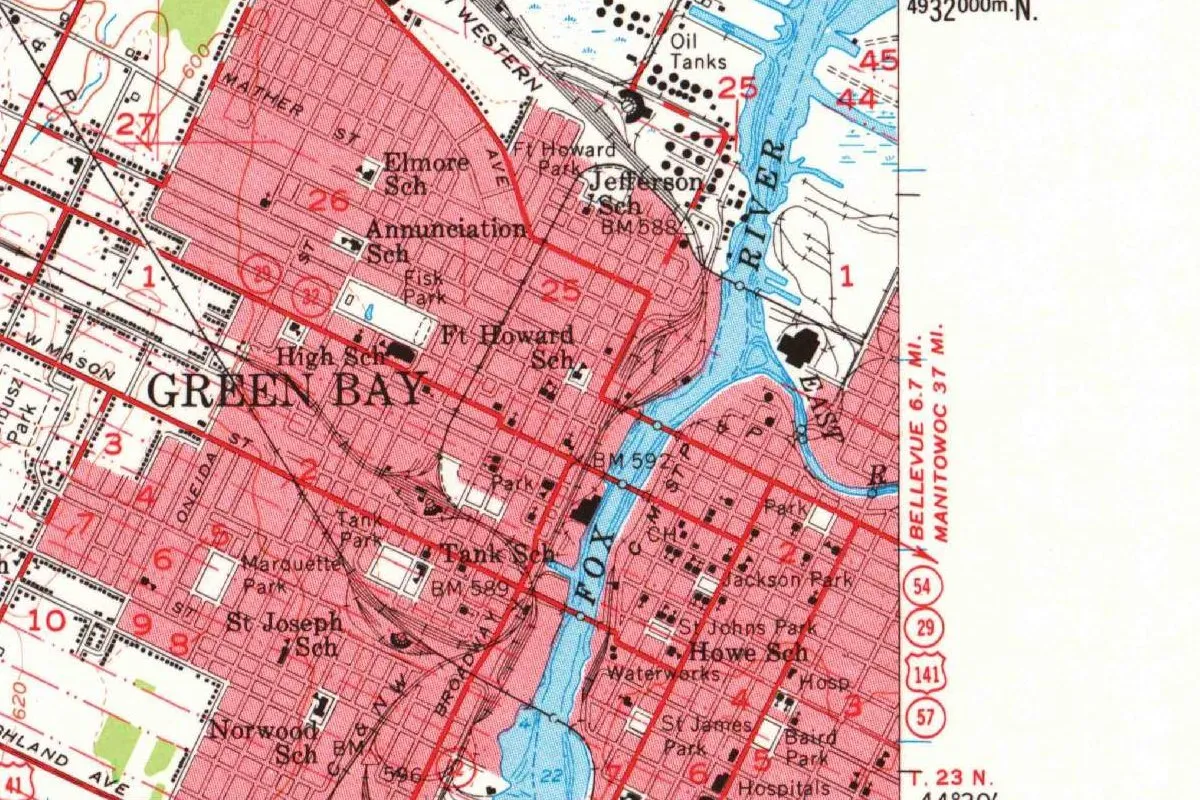
- U.S. Geological Survey, Green Bay sheet (1954). The 1954 Green Bay quadrangle at 1:62,500, the oldest sheet in the USGS historical collection that covers the city’s center.
Spot something wrong, or know more? Tell us here. You can also email us or use our contact page. Corrections are noted here with their date, never made silently.