Appleton, Wisconsin: Named for Samuel, Sarah, or Both?
Appleton is named for the Boston Appletons, relatives of Amos A. Lawrence, whose $10,000 pledge started Lawrence University there. Which Appleton is disputed. Gannett (1905) and the 1911 Britannica name Samuel Appleton; Lawrence University's archives name Sarah Appleton Lawrence, Amos's wife; Appleton's public library names both.
One family, three answers
Appleton, Wisconsin, carries a Boston family name, but the sources split on whether it honors Samuel Appleton, Sarah Appleton Lawrence or both of them. Everyone agrees on the family. The arguments start when you ask which Appleton.
What ties them together is a college. Appleton grew up around a school that a Boston merchant paid to start, and the name came from his side of the family tree, or his wife’s.
A Boston merchant’s college on the Fox
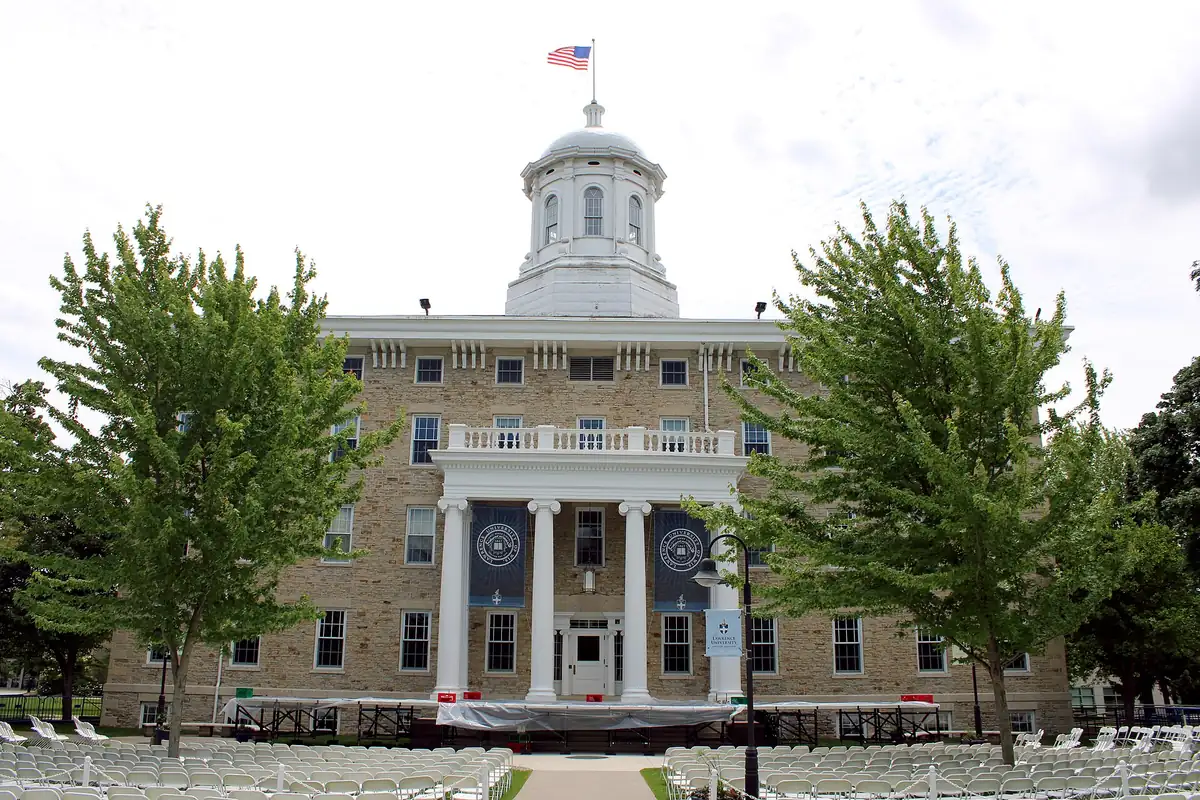
That merchant was Amos Adams Lawrence. According to Lawrence University’s archives, he had picked up nearly 5,000 acres on the Fox River, and in late 1845 or early 1846 he wrote to his agent in Green Bay about “the establishment of an institution of learning or college on the land.”
He backed it with money. Lawrence pledged $10,000 to endow the school, as long as Methodists in Wisconsin matched it, and the territorial legislature chartered the Lawrence Institute in January 1847. The Appleton Public Library’s timeline says church leaders raised the matching $10,000 in 1848.
That August, the library says, the Reverend Reeder Smith, the Reverend William H. Sampson, a surveyor named Joel S. Wright and a volunteer named Henry Blood moved onto the Lawrence Institute land and started laying out lots for the school and a village. The John F. Johnston family moved into a half-finished cabin and became the first family to settle there. And, the library notes, “the name ‘Appleton’ was first used for the tiny village that was growing around the Lawrence Institute.”
So the school took Lawrence’s name. The town took a different one.
Samuel Appleton’s version
The oldest accounts in this story credit a man. Henry Gannett’s 1905 survey bulletin on the origins of place names says Appleton was “named for Samuel Appleton, one of the founders of Lawrence University, located at that place.”
The 1911 Encyclopaedia Britannica agreed on the name but gave a different reason. Its entry says the city “was named in honour of Samuel Appleton of Massachusetts, who owned part of the original town plot.” Founder of the college, or owner of the land: the two books pick the same man for slightly different jobs.
The same Britannica entry is clear about the other half of the pair. The college, it says, was “named in honour of Amos Adams Lawrence (1814-1886) of Boston, son of Amos Lawrence, and giver of $10,000 for the founding of the Institute.” It also dates the first permanent settlement at Appleton to 1833, well before the surveyors of 1848, which shows how differently even old reference books could tell the start of this town.
The library’s timeline adds one more fact about him. Samuel Appleton died at his home in Boston on July 12, 1853, the same year the village of Appleton was incorporated.
Sarah Appleton Lawrence’s version
Lawrence University’s own archive tells it another way. Among its digital collections is a letter from Amos Lawrence to his wife, Sarah Appleton Lawrence, dated May 16, 1857. The archivists’ description is short and direct: “The city of Appleton was named in honor of Sarah Appleton Lawrence.”
In that reading, the town is a nod to the founder’s wife, whose maiden name was Appleton. The school got his name and the village got hers. It’s a tidy story, and you can see why it appeals to a college that grew up alongside the city.
Keep in mind what that source is. It’s a catalog note attached to a letter, not a record from 1848. The description doesn’t say who chose the name or when.
The library’s answer: both
The Appleton Public Library splits the difference. Its timeline says the village “was named to honor Sarah Appleton, the wife of Amos Lawrence, and Samuel Appleton, her father’s cousin, who donated money to the Lawrence Institute.”
That version makes room for both stories. It also explains how two careful sources could land on different people: Sarah and Samuel were relatives, both Appletons and both tied to the money behind the school.
None of these sources cites a paper from 1848 that settles it, like a letter saying “we’ve named the village for…” Until one turns up, the fair summary is the library’s: it was the Appleton family, and you can pick your Appleton.
The city that grew around the school
The village didn’t stay tiny. The library says classes began at what was by then called Lawrence University on November 12, 1849, with 35 students. Appleton was incorporated as a village in 1853, pulling in the neighboring villages of Lawesburg and Grand Chute, and it became a city on May 2, 1857.
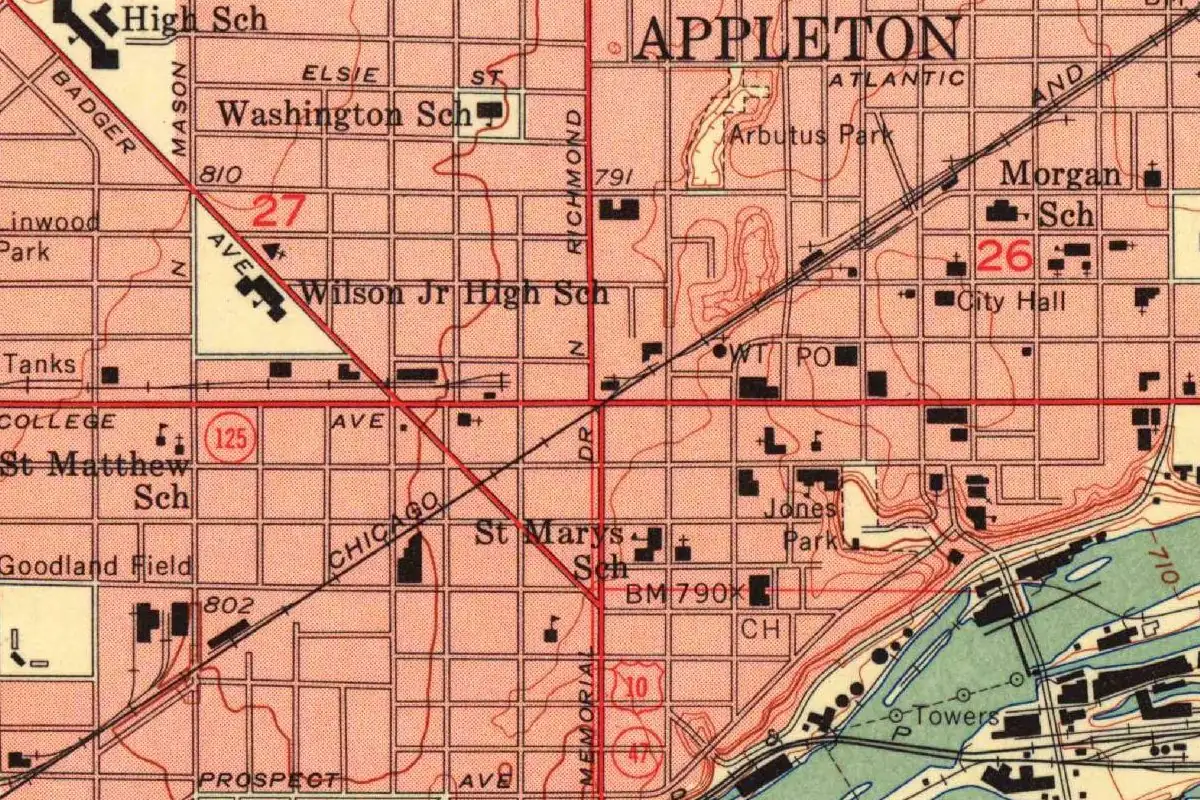
That same year, the library says, Amos A. Lawrence visited Appleton for the first time and inspected the school named for him. The town had been carrying his wife’s family name for nearly nine years by then. On the 1955 U.S. Geological Survey map, you can see the result: College Avenue running straight across the middle of a city that started as a college’s backyard. In 1856, the library adds, the steamboat Aquila passed through Appleton on its first complete trip from Milwaukee to Green Bay, and the town held a celebration.
So whichever Appleton you credit, the name points back to the same place: a Boston family’s money, a Methodist school and a few surveyors staking lots in the woods above the Fox.
Quick answers
Who is Appleton, Wisconsin, named after?
Sources differ. Gannett (1905) and the 1911 Britannica say Samuel Appleton; Lawrence University’s archives say Sarah Appleton Lawrence, wife of founder Amos A. Lawrence; the Appleton Public Library says both.
Is Appleton named after an apple?
No. None of the sources connects the name to apples. They all trace it to the Appleton family of Boston and Massachusetts.
How are Lawrence University and Appleton connected?
They started together. Amos A. Lawrence pledged $10,000 for the Lawrence Institute, chartered in 1847, and the village of Appleton was laid out beside the school’s land in 1848.
Key dates
- 1847The territorial legislature charters the Lawrence Institute, after Amos A. Lawrence pledges $10,000.
- 1848Surveyors lay out the school grounds and a village beside them, and the name Appleton is first used.
- 1849Classes begin on November 12 under the name Lawrence University.
- 1853The village of Appleton is incorporated. Samuel Appleton dies in Boston on July 12.
- 1857Appleton becomes a city on May 2. Amos A. Lawrence visits for the first time, and a letter to his wife is dated May 16.
Things to do in Appleton, Wisconsin
Hearthstone Historic House Museum
An 1882 Victorian house that was the first home in the world lit by a hydroelectric central station using Thomas Edison's system, now a museum with a hands-on hydro discovery center.
History Museum at the Castle
A museum of Appleton and Fox Cities history in a former Masonic Temple, with three floors of exhibits and a featured exhibit on Harry Houdini's Appleton roots.
Trout Museum of Art
A downtown art museum with changing exhibitions, art classes and a cafe.
Fox River Locks
The historic lock system on the Fox River, where 16 of the 17 locks have been restored to full working order for boaters and visitors.
Getting there
Open Appleton in Google Maps
Opens in a new tab. The pin is the center of Appleton in the USGS place-name record.
The closest airports, Amtrak stations and intercity bus stops, measured in a straight line from the center of Appleton.
Airports
- Appleton International (ATW) 5 mi 8 km
- Green Bay/Austin Straubel International (GRB) 21 mi 34 km
- General Mitchell International (MKE) Milwaukee 94 mi 152 km
Amtrak trains
- Columbus station (CBS) 70 mi 113 km
- Portage station (POG) 72 mi 116 km
Intercity buses
- FlixBus Appleton WI (APP) under 1 mi 0.8 km
- Greyhound Green Bay WI - Transportation Center (GBY) 27 mi 43 km
- Indian Trails Green Bay 27 mi 43 km
Distances are as the crow flies, not by road. We don't list schedules or fares because they change; check with the airline, Amtrak or the bus company before you go. Official data (FAA commercial service airports (2025), FAA airport locations, Amtrak stations and Intercity Bus Atlas) from the FAA and the U.S. Bureau of Transportation Statistics, checked Nov 13, 2026.
Sponsored
Staying in Appleton?
Compare hotels in Appleton, Wisconsin, on Expedia.
See hotels in AppletonWe may earn a commission if you buy through this link. It never changes what we write. Read our affiliate disclosure
Historical Sources & References
- Appleton Public Library, “City of Appleton Notable Events”. The matching funds and the 1848 survey of the school land and village; the first settlers; the name “first used for the tiny village”; the village named for Sarah Appleton and Samuel Appleton, “her father’s cousin”; classes in 1849; incorporation as a village in 1853 and Samuel Appleton’s death that year; city status on May 2, 1857; Amos A. Lawrence’s first visit; the Aquila in 1856.
- Lawrence University Archives, “Amos Lawrence letter to his wife Sarah Appleton Lawrence” (1857). The letter’s date, May 16, 1857, and the archive’s description: “The city of Appleton was named in honor of Sarah Appleton Lawrence.”
- Lawrence University Archives, “University Dates & Milestones”. Amos Adams Lawrence’s 5,000 acres on the Fox, his letter to his Green Bay agent, the $10,000 pledge, the January 1847 charter and the first classes on November 12, 1849.
- Henry Gannett, The Origin of Certain Place Names in the United States (USGS, 1905), p. 27. Appleton “named for Samuel Appleton, one of the founders of Lawrence University.”
- “Appleton,” Encyclopaedia Britannica, 11th ed. (1911). The city “named in honour of Samuel Appleton of Massachusetts, who owned part of the original town plot”; the college named for Amos Adams Lawrence, giver of $10,000; first permanent settlement dated to 1833.
- GNIS feature 1560914 (U.S. Geological Survey). Appleton’s entry in the federal place-name database, filed under Outagamie County.
- U.S. Geological Survey, Appleton sheet (1955). The 1:24,000 map the view of College Avenue and the Fox River was cut from.
Spot something wrong, or know more? Tell us here. You can also email us or use our contact page. Corrections are noted here with their date, never made silently.