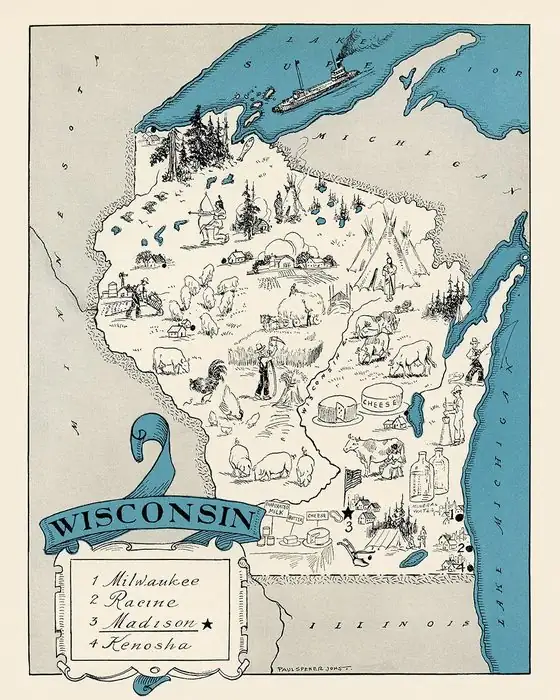
Sheboygan, Wisconsin: The River Behind the Name
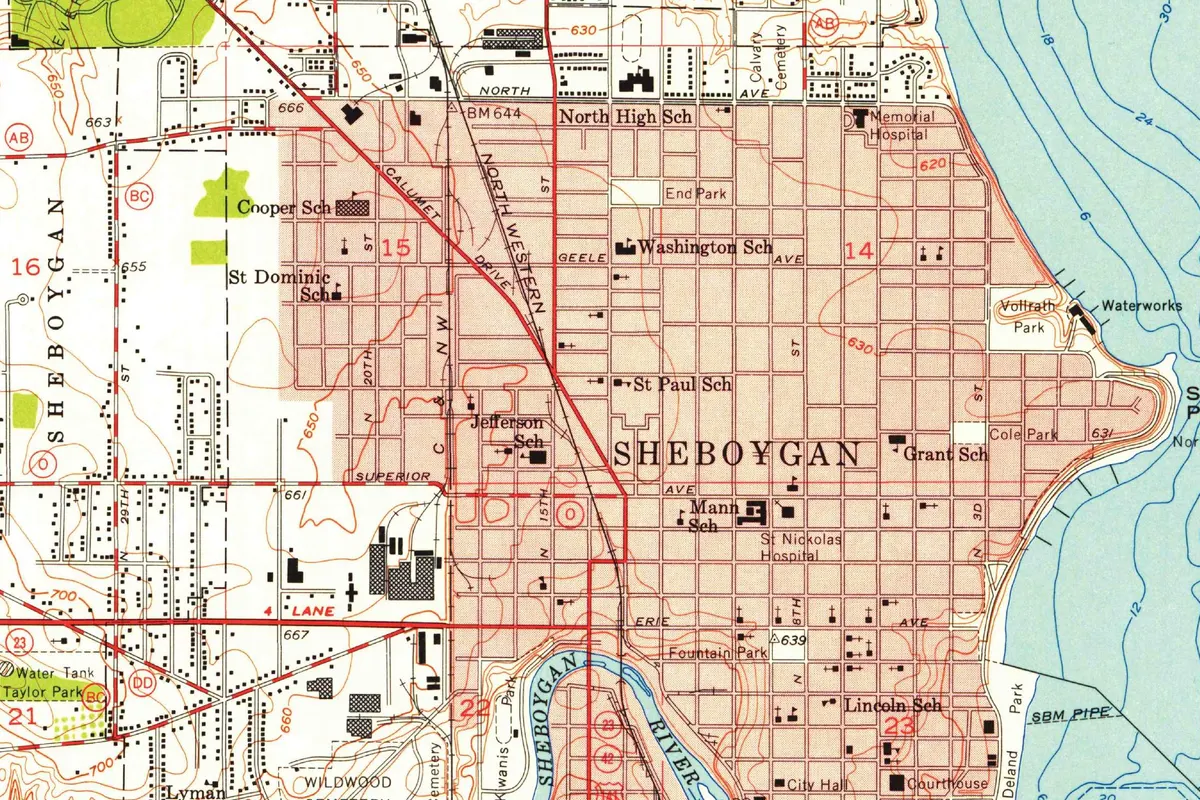
Sheboygan, Wisconsin, took its name from the Sheboygan River, whose name, most likely Ojibwe, writers traced to a pipe stem or to a sound underground. You can see where the river meets Lake Michigan on an 1836 survey, seventeen years before the city incorporated.
What the surveyors needed to know
In 1836, a surveyor approaching this stretch of western Lake Michigan had a practical question: where was the entrance to the river? A survey preserved by the Wisconsin Historical Society maps its mouth and calls it the Sheboygan River. The map dates the use of the name; it doesn’t tell us who first spoke it.
In January 1897, Army engineer George A. Zinn placed the harbor this way:
“at the mouth of the river of the same name, on the western shore of Lake Michigan.”
Soundings between the piers told him how much room a ship had beneath its keel. He drew on work at Kenosha when proposing how to deepen the entrance. For a navigator, the connection between city and river needed no further explanation. For someone trying to translate the name, it was only a start.
A pipe stem, a needle and a noise underground
In July 1849, Joshua Hathaway sent the Wisconsin Historical Society an account of a noise that traveled underground from the Lake Superior region and could be heard at this river. A month earlier Alfred Brunson had explained how the county got its name from its principal river. Brunson’s entry left the meaning an open question. Hathaway offered a tradition, the earliest explanation in these records.
In 1892 the Franciscan missionary Chrysostom Verwyst put Sheboygan in his list of names of Ojibwe origin. He traced it to jibaigan, something with a hole through it, and gave a pipe stem as his example. Verwyst credited Vincent Roy, an Ojibwe merchant, Antoine Gaudin and M. Gurnoe for help with the list as a whole. In the 1920 city directory, interpreter Louis M. Moran offered “a hollow bone, or perforated object.” The directory called that reading generally accepted. It has the strongest support in these sources, though none identifies the person who named the river.
The Rev. E. P. Wheeler understood the word differently. Think of the eye of a needle and then of its point. In Verwyst’s account you’re looking for the hole. In Wheeler’s, you’re looking for the tool that makes it.
Other stories followed the sound. Robert Gard’s 1968 collection adds drums carried between Sheboygan Falls and Sheboygan, a chief who tied the name to the sound you’d hear with an ear to the ground near the river mouth, and a river disappearing underground. A survey for the city credits Jerome Francis Hesslink with a different source of the rumble: waterfalls on the Sheboygan River itself. Janice Hildebrand proposed a water route between lakes. The same survey preserves an English pun about a newborn, “She be a boy again.” It works when you say it in English. It supplies no evidence for what the river’s name meant.
Quick answers
Which had the name first, the river or the city?
The river. The 1836 survey already uses the name for the stream; the local history collected by Mead Public Library explicitly identifies it as the source of both the city and county names.
Does Sheboygan mean “hollow bone”?
Not for certain. Interpreter Louis M. Moran said it meant “a hollow bone, or perforated object,” and the 1920 city directory called that the generally accepted meaning. There’s no agreement, though: other accounts point to a needle, a noise underground or the river’s falls.
Did Sheboygan get its name in 1853?
No. March 19, 1853, marks city incorporation. It doesn’t mark the naming of the river or establish the day the settlement adopted its name.
Key dates
- 1836A survey maps the mouth of the Sheboygan River under that name.
- 1853Sheboygan incorporates as a city on March 19.
- 1920The city directory records rival explanations for the river name.
Getting there
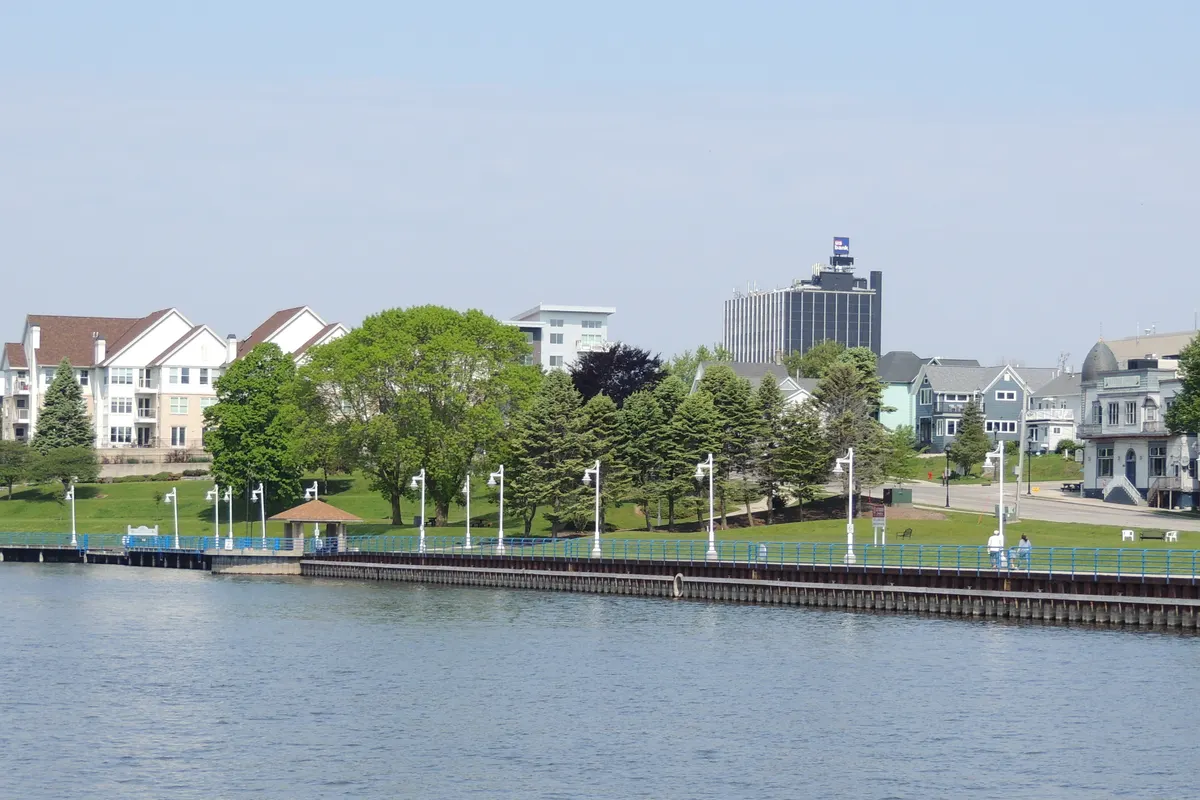
Open Sheboygan in Google Maps
Opens in a new tab. The pin is the center of Sheboygan in the USGS place-name record.
The closest airports, Amtrak stations and intercity bus stops, measured in a straight line from the center of Sheboygan.
Airports
- Appleton International (ATW) 53 mi 86 km
- Green Bay/Austin Straubel International (GRB) 55 mi 88 km
- General Mitchell International (MKE) Milwaukee 56 mi 91 km
Amtrak trains
- Milwaukee-Downtown station (MKE) 51 mi 81 km
- Milwaukee Airport-Trains station (MKA) 57 mi 92 km
Intercity buses
- Greyhound Sheboygan Sheboygan Transit under 1 mi 0 km
- Indian Trails Sheboygan under 1 mi 0.1 km
- FlixBus Fond Du Lac WisDOT Park&Ride 20-20 38 mi 61 km
Distances are as the crow flies, not by road. We don't list schedules or fares because they change; check with the airline, Amtrak or the bus company before you go. Official data (FAA commercial service airports (2025), FAA airport locations, Amtrak stations and Intercity Bus Atlas) from the FAA and the U.S. Bureau of Transportation Statistics, checked Nov 10, 2026.
Sponsored
Staying in Sheboygan?
Compare hotels in Sheboygan, Wisconsin, on Expedia.
See hotels in SheboyganWe may earn a commission if you buy through this link. It never changes what we write. Read our affiliate disclosure
Historical Sources & References
- Wisconsin Historical Society, Survey of the Mouth of the Sheboygan River (1836). A dated record of the river name.
- Mead Public Library, Sheboygan FAQs. Distinguishes the 1920 directory’s accounts from Robert Gard’s 1968 discussion and gives the incorporation date.
- George A. Zinn, Survey of Harbor at Sheboygan (1897), p. 2. The engineer’s description of the river mouth and channel.
- City of Sheboygan, architectural and historical intensive survey. Records the falls tradition and identifies the researcher who proposed it.
- Wisconsin Historical Collections, vol. I. Brunson on the county (p. 113) and Hathaway on the underground noise (pp. 116–117), both writing in 1849.
- Chrysostom Verwyst, Wisconsin Historical Collections, vol. XII (1892). The list credits its contributors on p. 390 and gives the pipe-stem reading on p. 397.
- USGS Geographic Names Information System. Federal record for the city in Sheboygan County.
Spot something wrong, or know more? Tell us here. You can also email us or use our contact page. Corrections are noted here with their date, never made silently.