Dubuque, Iowa: The Lead Miner's Name That Beat Washington
Dubuque is named for Julien Dubuque, a French-Canadian trader who got the Meskwaki's permission to work their lead mines in 1788 and died there in 1810. American miners who arrived after 1833 kept his name by common consent, a 1911 county history says, and voted down an 1834 idea to rename the town Washington.
The trader the Meskwaki called Little Cloud
Dubuque, Iowa, is named for Julien Dubuque, a French-Canadian lead miner, and in 1834 its settlers held a meeting about renaming it Washington. They decided the old name had too much of a head start. By then, the man himself had been dead for 24 years.
Henry Gannett’s 1905 book on the origins of American place names, a government survey bulletin, gives it a single line: the county and the city are “named for a French trader, Julien Dubuque.” That’s the whole answer to the naming question, and the other sources here agree with it. The better story is how a dead trader’s name held on through a change of countries, a flood of new settlers and one attempt to swap it out.
Who was Julien Dubuque?
The Biographical Dictionary of Iowa, published by the University of Iowa Press, says he was born in St.-Pierre-de-Bequet, on the St. Lawrence River in Quebec, and learned the Indian trade as a clerk out of Michilimackinac. Around 1783 he joined his brother Augustin at Prairie du Chien, then moved farther down the Mississippi and settled among the Meskwaki, whom older records call the Fox. The City of Dubuque dates his arrival to 1785.
The lead was the reason he stayed. The city says the Meskwaki, sometimes written Mesquakie, kept the locations of the mines secret, because they knew how much Europeans wanted lead, and only told Dubuque after he’d gained their trust as a fur trader. The dictionary adds that Meskwaki women and old men did most of the actual mining.
A deal at Prairie du Chien, 1788
On September 22, 1788, at Prairie du Chien, the Meskwaki gave him permission to work the mines. The original was in French. Decades later, when his heirs’ claim ended up before the U.S. Supreme Court in Chouteau v. Molony (1853), an English translation went into the record, and the justices quoted it in their opinion:
“The Foxes permit Mr. Julien Dubuque, called by them the Little Cloud, to work at the mine as long as he shall please …”
That nickname is a small puzzle. The Biographical Dictionary of Iowa, which describes him as short and stocky with a dark complexion, says the Meskwaki knew him as “Little Night,” la petite nuit. The court’s translation says Little Cloud. You’ll see both, and we can’t tell you which one the Meskwaki actually said.
The Supreme Court wasn’t interested in nicknames. It was deciding whether the agreement, plus a grant Dubuque got in 1796 from the Spanish governor of Louisiana, the Baron de Carondelet, made the land his private property. Dubuque had named his holdings the Mines of Spain. The court ruled against the claim.
A town that kept a dead man’s name
Julien Dubuque died in March 1810, the city says, and the Meskwaki buried him with tribal honors on the bluff above Catfish Creek. Twenty-three years later, the city says, the U.S. government opened the land to settlement on June 1, 1833, under the Black Hawk Purchase Treaty.
The miners who poured in didn’t hold a naming ceremony. They called the place what everyone already called it. Franklin T. Oldt’s 1911 History of Dubuque County says that in the summer of 1834 “a public meeting was held and attempts were made to change the name of Dubuque to that of Washington.” It didn’t take. On page 48, Oldt explains why:
“The former had been adopted by common consent and not by any formal act of the inhabitants or the authorities. However, it was not thought wise to change the name, as the place had already become widely known as Dubuque.”
So, by Oldt’s account, nobody formally chose the name Dubuque. It was just already there, and it was too late to stop it. Oldt says the post office, in 1836, went by “Dubuque’s Mines.” The city was chartered in 1837, and the city government today calls it Iowa’s oldest city.
How the man spelled himself
Oldt has one more small surprise. Citing the local Herald of 1866, he says Dubuque “wrote his name as it is now written; he did not use a capital B.” In French, Oldt adds, the name is written Debuc. So the spelling on every sign in town today is the one the miner used himself.
Oldt was skeptical of other stories, too. A Meskwaki wife named Potosa often turns up in tellings of his life, and the city’s monument page repeats it. Oldt, citing a local judge, writes that “not the slightest trace” of a wife or children turned up, and that “Pesota” seems to be a distortion of Peosta, the name of a Fox chief. The Biographical Dictionary of Iowa is just as careful: there are “a few references” to a wife, but none in his estate.
A tower on the bluff
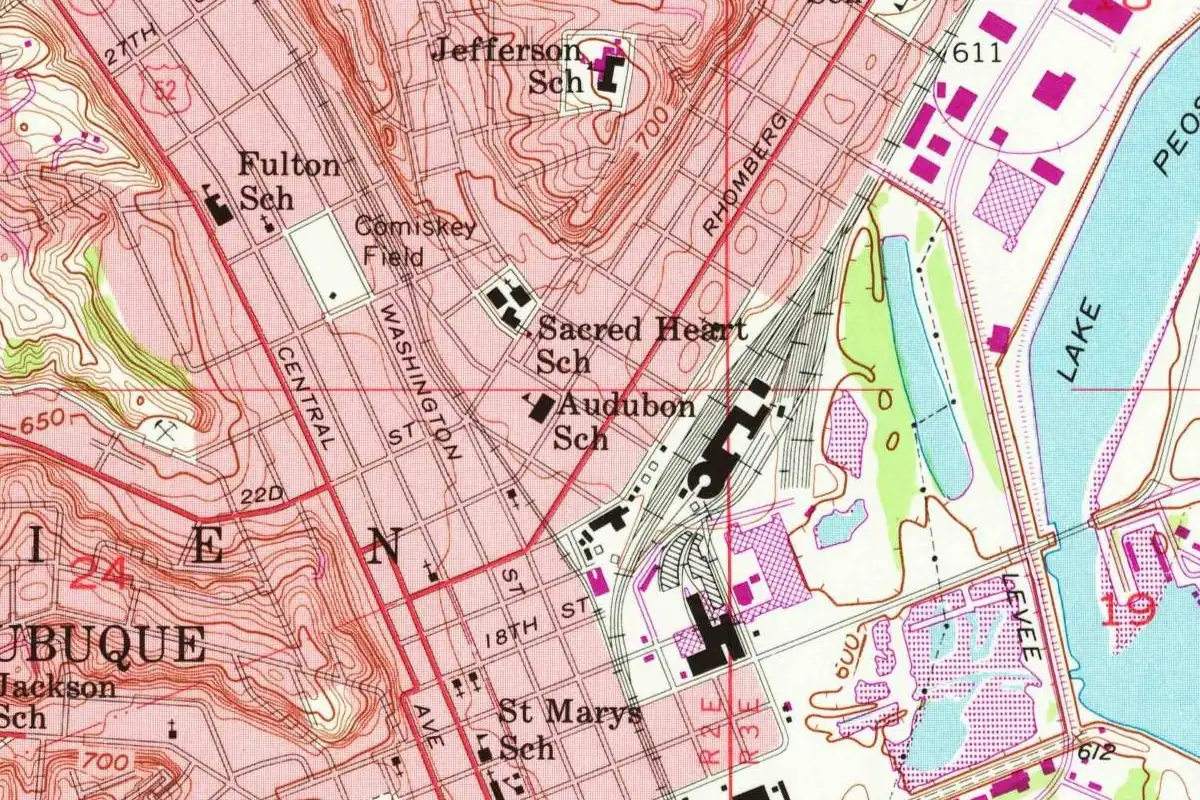
In 1897, the Early Settlers’ Association put up a limestone tower over his grave, the dictionary says, near the spot where the city says he first settled by the village of Kettle Chief. The town on the flats below spread up the bluffs, and the old map at the top of this page catches it in 1956, squeezed between the hills and the Mississippi River.
Dubuque isn’t the only Iowa river city named for a trader who did business with the Meskwaki. Downriver, our story of Davenport follows George Davenport from Rock Island to the town that took his name. For more Hawkeye State names, start at our Iowa page.
Quick answers
Who is Dubuque, Iowa, named after?
Julien Dubuque, a French-Canadian trader and lead miner from Quebec. The Meskwaki gave him permission to work their lead mines in 1788, and he lived and mined there until he died in 1810.
Is Dubuque the oldest city in Iowa?
By its own account, yes. The City of Dubuque calls itself Iowa’s oldest city. Julien Dubuque’s mining goes back to 1788, but the land opened to American settlement on June 1, 1833, and the city was chartered in 1837.
Was Dubuque almost named Washington?
Yes. A 1911 county history says a public meeting in the summer of 1834 tried to change the name to Washington, but the settlers decided against it because the place “had already become widely known as Dubuque.”
What are the Mines of Spain?
The name Julien Dubuque gave to the land around his lead mines after the Spanish governor of Louisiana granted his petition in 1796. Today the Mines of Spain Recreation Area holds his grave and monument.
Key dates
- 1788On September 22, at Prairie du Chien, the Meskwaki give Julien Dubuque permission to work the lead mines.
- 1796The Spanish governor grants Dubuque's petition for the land he calls the Mines of Spain.
- 1810Julien Dubuque dies, and the Meskwaki bury him on the bluff above Catfish Creek.
- 1833On June 1, the U.S. government opens the land to settlement under the Black Hawk Purchase.
- 1834A public meeting considers renaming Dubuque as Washington and decides against it.
- 1837Dubuque is chartered as a city.
- 1897The limestone tower over Julien Dubuque's grave is built.

Things to do in Dubuque, Iowa
Julien Dubuque Monument
A limestone tower built in 1897 over Julien Dubuque's grave, on the edge of the bluff above Catfish Creek in the Mines of Spain Recreation Area, near where he first settled by the village of Kettle Chief.
National Mississippi River Museum & Aquarium
Run by the Dubuque County Historical Society on the historic Ice Harbor, its campus of three buildings tells the story of Dubuque and the region alongside the history and wildlife of the Mississippi and other rivers.
Fenelon Place Elevator
Also known as the Fourth Street Elevator, this historic funicular is 296 feet (90 m) long and lifts passengers 189 feet (58 m) up the bluff to Fenelon Place, with a view over downtown, the Mississippi River and three states.
Mathias Ham Historic Site
In the Eagle Point Park neighborhood: the Italianate mansion of early Dubuque leader Mathias Ham, lead-mining badger holes, the Arriandeaux log cabin and the one-room Humke Schoolhouse.
Getting there
Open Dubuque in Google Maps
Opens in a new tab. The pin is the center of Dubuque in the USGS place-name record.
The closest airports, Amtrak stations and intercity bus stops, measured in a straight line from the center of Dubuque.
Airports
- The Eastern Iowa (CID) Cedar Rapids 68 mi 110 km
- Quad Cities International (MLI) Moline 73 mi 118 km
- General Mitchell International (MKE) Milwaukee 144 mi 231 km
Amtrak trains
- Cedar Rapids station (CRI) 59 mi 95 km
- Iowa City station (IAC) 73 mi 118 km
Intercity buses
- Jefferson Lines Dubuque under 1 mi 0.5 km
- Greyhound Lindale Mall Bus Stop 59 mi 95 km
Distances are as the crow flies, not by road. We don't list schedules or fares because they change; check with the airline, Amtrak or the bus company before you go. Official data (FAA commercial service airports (2025), FAA airport locations, Amtrak stations and Intercity Bus Atlas) from the FAA and the U.S. Bureau of Transportation Statistics, checked Nov 14, 2026.
Sponsored
Staying in Dubuque?
Compare hotels in Dubuque, Iowa, on Expedia.
See hotels in DubuqueWe may earn a commission if you buy through this link. It never changes what we write. Read our affiliate disclosure
Historical Sources & References
- Henry Gannett, The Origin of Certain Place Names in the United States (USGS, 1905), p. 109. Dubuque County and the city of Dubuque “named for a French trader, Julien Dubuque.”
- Franklin T. Oldt and P. J. Quigley, History of Dubuque County, Iowa (1911), pp. 42, 48 and 56. The 1834 meeting to rename the town Washington and the name “adopted by common consent” (p. 48; the link opens this page); the post office called “Dubuque’s Mines” in 1836 (p. 56); Dubuque’s own spelling with a small b, the French form Debuc and the doubts about “Pesota” (p. 42).
- Chouteau v. Molony, 57 U.S. 203 (1853), Library of Congress. The English translation of the agreement of September 22, 1788, filed as Exhibit B (p. 223) and quoted in the opinion (p. 227), with the name “the Little Cloud”; Carondelet’s grant of 1796 and the court’s ruling against the claim.
- The Biographical Dictionary of Iowa, “Dubuque, Julien”. His birth in Quebec, the move to Prairie du Chien around 1783, the 1788 agreement with Aquoqua (Kettle Chief), the Mines of Spain, the nickname “Little Night,” the Meskwaki women and old men who did most of the mining, the doubts about a wife and the 1897 tower.
- City of Dubuque, “History”. Iowa’s oldest city; Julien Dubuque’s arrival in 1785; the secret mines; the opening of the land on June 1, 1833, under the Black Hawk Purchase; the charter of 1837.
- City of Dubuque, “Julien Dubuque Monument”. The rights of 1788, the petition granted in 1796, his first settlement near Kettle Chief’s village, his death in March 1810 and burial with tribal honors, and the 1897 monument above Catfish Creek.
- GNIS feature 456040 (U.S. Geological Survey). Dubuque’s record in the federal place-names system: a populated place in Dubuque County.
- U.S. Geological Survey, Dubuque North sheet (1956). The 1:24,000 quadrangle the map at the top of this page was cropped from.
Spot something wrong, or know more? Tell us here. You can also email us or use our contact page. Corrections are noted here with their date, never made silently.