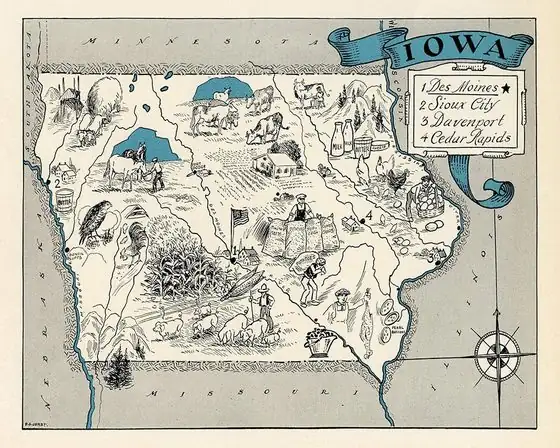
Davenport, Iowa: Which Colonel Davenport Got the Name?
The town was named for George Davenport, an English-born trader living on Rock Island, one of eight partners who laid it out on Antoine LeClaire's land in 1835-36. LeClaire's nephew swore in 1905 that LeClaire insisted on the name. A 1905 study found no early evidence for a rival claim naming Colonel William Davenport, the fort's commander.
A trader on Rock Island
George Davenport, an English-born trader on Rock Island, gave his name to Davenport, Iowa, when he and his partners laid out the town in 1835 and 1836. That’s how Franc B. Wilkie told it in 1858. Decades later, though, some people argued it was named for another Colonel Davenport entirely, and the town’s old papers came out to settle it.
George Davenport had a long road to the Mississippi. The Biographical Dictionary of Iowa says he was born in Lincolnshire, England, in 1783, went to sea at 18, and ended up in New York harbor in 1804 after an injury kept him from sailing home. He joined the U.S. Army, fought at Lundy’s Lane in the War of 1812, and after his discharge in 1815 went to work hauling supplies from St. Louis to Fort Armstrong, the new post on Rock Island in the Mississippi. He built a home on the island in 1816 and became a trader with the Winnebago, Sauk and Meskwaki. In the Black Hawk War he was made quartermaster with the rank of colonel in the Illinois militia. You’ll want to keep that title in mind.
He’d already had one near miss: the dictionary says a bid to name the Illinois town across from the island for him was blocked, and it became Rock Island instead.
Eight partners and a claim
The Iowa side had its own landowner, Antoine LeClaire, who held a claim on the west bank. Franc B. Wilkie, writing Davenport Past and Present in 1858, only 13 years after George Davenport’s death, puts the deal on page 161:
“In the Fall of 1835, Mr. Davenport, Maj. Smith, Maj. Gordon, Mr. Hambaugh, Mr. McGregor, Mr. Colton, and Capt. May, purchased a claim of Mr. LeClaire (he retaining an eighth part,) upon which to lay out a town. The proprietors agreed to name it Davenport, in honor of their friend, Mr. Davenport.”
Major William Gordon, who was in the area surveying LeClaire’s land for the government, laid out the town with a Mr. Bennett. A year later, Wilkie says, Davenport and others bought into another LeClaire tract at the head of the rapids and named that town LeClaire, “in honor of Mr. LeClaire.” So both men got a town, about the same time, from the same group.
The other Colonel Davenport
This is the tangled part. From 1833, Fort Armstrong was commanded by a regular Army officer, Colonel William Davenport. Same last name, same island, same title. By the early 1900s some people were saying the town had really been named for him.
Maria Purdy Peck took that on in a 1905 article for the Half Century Democrat, which Harry E. Downer reprinted in his 1910 History of Davenport and Scott County, Iowa under the heading “How Davenport Got Its Name.” She’d looked into the question years earlier and found “not one atom of evidence of any kind belonging to the early period” for William Davenport.
The LeClaire family still had the original articles of agreement, dated February 23, 1836. They set out “a town to be laid out on said land” but, she noted, gave it no name. By May 18, 1836, a record of one partner selling his share to another mentions “the above named town of Davenport.” Somewhere in between, the name stuck. That’s a little at odds with Wilkie, who has the partners agreeing on the name in the fall of 1835, but both point at the same man.
Peck went through the partners one by one. The case for William Davenport, she wrote, rested on Captain James May, a steamboat man said to have pushed for his friend at the fort. But May had left the river for Pittsburgh in 1834, and his name on the agreement was signed “by George Davenport, Agent.” She also pointed out that the fort was being evacuated that spring and William Davenport had left before the last entry on the agreement, May 4.
She had a witness, too. Elnathan C. Gavit, whose signature is on the May 1836 record, wrote in his memoir that “Colonel Davenport bought an interest in Mr. LeClaire’s claim and the town was named after Davenport,” and later said he’d been there when the name was accepted and it was George.
LeClaire’s nephew under oath
The last word went to J. A. LeClaire, Antoine’s nephew and longtime secretary. On September 22, 1905, he swore that his uncle had told the story many times and “always made the point very clear that it was named for his friend, George Davenport.” He added a detail you won’t find in Wilkie: George Davenport and the other partners had actually wanted to call the town LeClaire. Antoine said no. As the nephew put it, Davenport “was the older man, had been here longer and that it was more fitting that the town should bear his name.” They compromised by putting LeClaire’s name on the other town, up at the head of the rapids.
The nephew also said Antoine LeClaire had personally given Wilkie the early history for his 1858 book. So Wilkie’s account and the affidavit come from the same source, LeClaire himself. That makes them consistent, though not independent.
The bulletin Henry Gannett put out in 1905 didn’t take sides in so many words. It says Davenport was “named for Colonel Davenport, an early settler,” and that Le Claire was named for Antoine Le Clair, “the French founder of Davenport.” “Early settler” describes George, who had lived on the island since 1816, better than a fort commander who left in 1836.
Davenport’s money and men went west, too. Fred Hedde, one of the settlers, wrote that a company of “gentlemen in Davenport, Iowa” backed a colony that left the city in the spring of 1857 and founded Grand Island, Nebraska, on July 4 of that year. Back in Iowa, the town on LeClaire’s claim kept George Davenport’s name.
Quick answers
Who is Davenport, Iowa, named after?
George Davenport, an English-born trader and former soldier who lived on Rock Island. Wilkie’s 1858 history says the proprietors named the town “in honor of their friend, Mr. Davenport.”
Was Davenport named for Colonel William Davenport?
No early record supports it. Maria Purdy Peck’s 1905 article found “not one atom of evidence” for the fort commander, and Antoine LeClaire’s nephew swore that same year that the town was named for George Davenport.
Why isn’t the city named LeClaire?
According to J. A. LeClaire’s 1905 affidavit, the partners wanted to name it LeClaire, but Antoine insisted on Davenport. His name went to the town of LeClaire, laid out in 1836 at the head of the rapids.
When was Davenport named?
Between the fall of 1835, when Wilkie says the partners agreed on it, and May 18, 1836, when the name first shows up on the town’s own papers. The articles of agreement of February 23, 1836, don’t name it.
Key dates
- 1833June 8: Colonel William Davenport takes command of Fort Armstrong on Rock Island, relieving Captain Thomas F. Smith.
- 1835Fall: George Davenport and six partners buy into Antoine LeClaire's claim to lay out a town, which they agree to call Davenport, Wilkie writes.
- 1836February 23: the partners sign articles of agreement to lay out a town on LeClaire's claim; the paper gives it no name.
- 1836May 18: a transfer of one partner's share refers to "the above named town of Davenport."
- 1836Fall: George Davenport and others lay out a town at the head of the rapids and name it LeClaire.
- 1905September 22: J. A. LeClaire swears that his uncle Antoine always said the town was named for his friend George Davenport.
Getting there
Open Davenport in Google Maps
Opens in a new tab. The pin is the center of Davenport in the USGS place-name record.
The closest airports, Amtrak stations and intercity bus stops, measured in a straight line from the center of Davenport.
Airports
- Quad Cities International (MLI) Moline 6 mi 10 km
- The Eastern Iowa (CID) Cedar Rapids 64 mi 102 km
- Chicago O'Hare International (ORD) 141 mi 227 km
Amtrak trains
- Kewanee station (KEE) 39 mi 62 km
- Galesburg station (GBB) 42 mi 67 km
Intercity buses
- Greyhound Davenport IA (DVP) under 1 mi 0.3 km
- Jefferson Lines Davenport (Ground Transportation) under 1 mi 0.4 km
- Executive Transportation Amtrak Connecting Service · Galesburg Amtrak Station 42 mi 67 km
Distances are as the crow flies, not by road. We don't list schedules or fares because they change; check with the airline, Amtrak or the bus company before you go. Official data (FAA commercial service airports (2025), FAA airport locations, Amtrak stations and Intercity Bus Atlas) from the FAA and the U.S. Bureau of Transportation Statistics, checked Nov 13, 2026.
Sponsored
Staying in Davenport?
Compare hotels in Davenport, Iowa, on Expedia.
See hotels in DavenportWe may earn a commission if you buy through this link. It never changes what we write. Read our affiliate disclosure
Historical Sources & References
- Franc B. Wilkie, Davenport Past and Present (1858), pp. 161-162. The fall 1835 purchase of LeClaire’s claim, the list of proprietors and the naming “in honor of their friend, Mr. Davenport” (p. 161); Gordon and Bennett’s survey and the town of LeClaire in the fall of 1836 (p. 162).
- Harry E. Downer, History of Davenport and Scott County, Iowa, vol. 1 (1910), pp. 851-854. “How Davenport Got Its Name”: Maria Purdy Peck’s 1905 article on the “double claimants,” the articles of agreement of February 23, 1836, the May 18, 1836, transfer, Gavit’s memoir, James May and Fort Armstrong, and J. A. LeClaire’s affidavit of September 22, 1905 (affidavit on pp. 853-854, also online).
- Henry Gannett, The Origin of Certain Place Names in the United States (USGS, 1905), pp. 100, 183. Davenport, “named for Colonel Davenport, an early settler” (p. 100), and Le Claire (p. 183, also online).
- Mel Prewitt, “Davenport, George,” The Biographical Dictionary of Iowa. George Davenport’s birth, Army service, Fort Armstrong, trade, militia rank of colonel, the blocked naming of the Illinois town and the 1835 meeting at his house.
- A. F. Buechler, R. J. Barr and Dale P. Stough, eds., History of Hall County, Nebraska (1920), pp. 10-12. Fred Hedde’s narrative of 1897: the company of “gentlemen in Davenport, Iowa,” the party leaving Davenport in the spring of 1857 and the Grand Island settlement of July 4, 1857.
- GNIS feature 455799 (U.S. Geological Survey). Davenport’s federal feature record, Scott County.
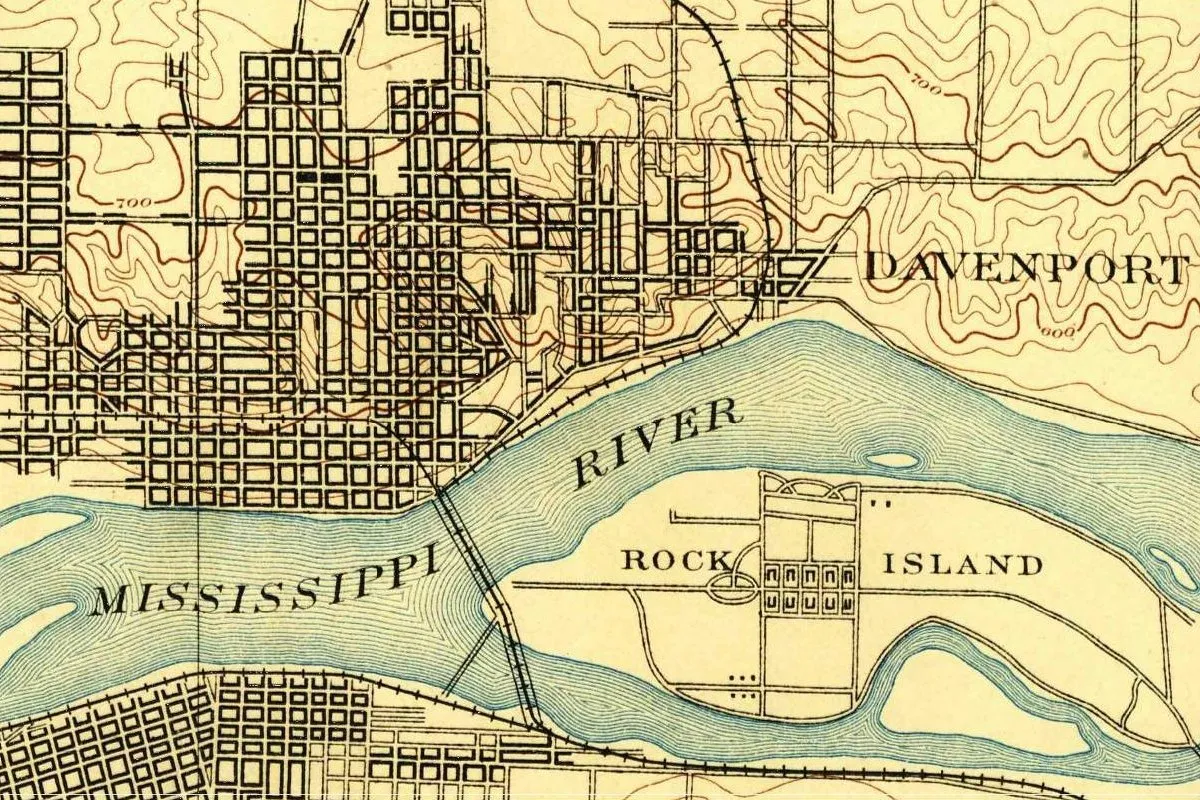
- U.S. Geological Survey, Davenport sheet (1891). Where the 1891 map image on this page was taken from.
Spot something wrong, or know more? Tell us here. You can also email us or use our contact page. Corrections are noted here with their date, never made silently.