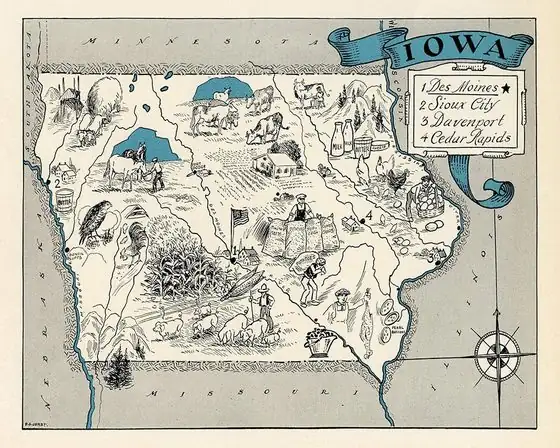
Cedar Falls, Iowa: How Sturgis Falls Got a New Name
Cedar Falls is named for the falls of the Cedar River, where the town's first mill was built. Settlers first called the spot Sturgis Falls, after William Sturgis, who claimed it in 1845. After he sold out to the Overman brothers and John T. Barrick, the name changed to Cedar Falls, in 1849, 1850 or 1851, depending on the source.
Two families at the falls
Cedar Falls, Iowa, started out as Sturgis Falls, after the settler who claimed the waterfall in 1845, and took the river’s name a few years later. The falls stayed put. What changed was who owned them.
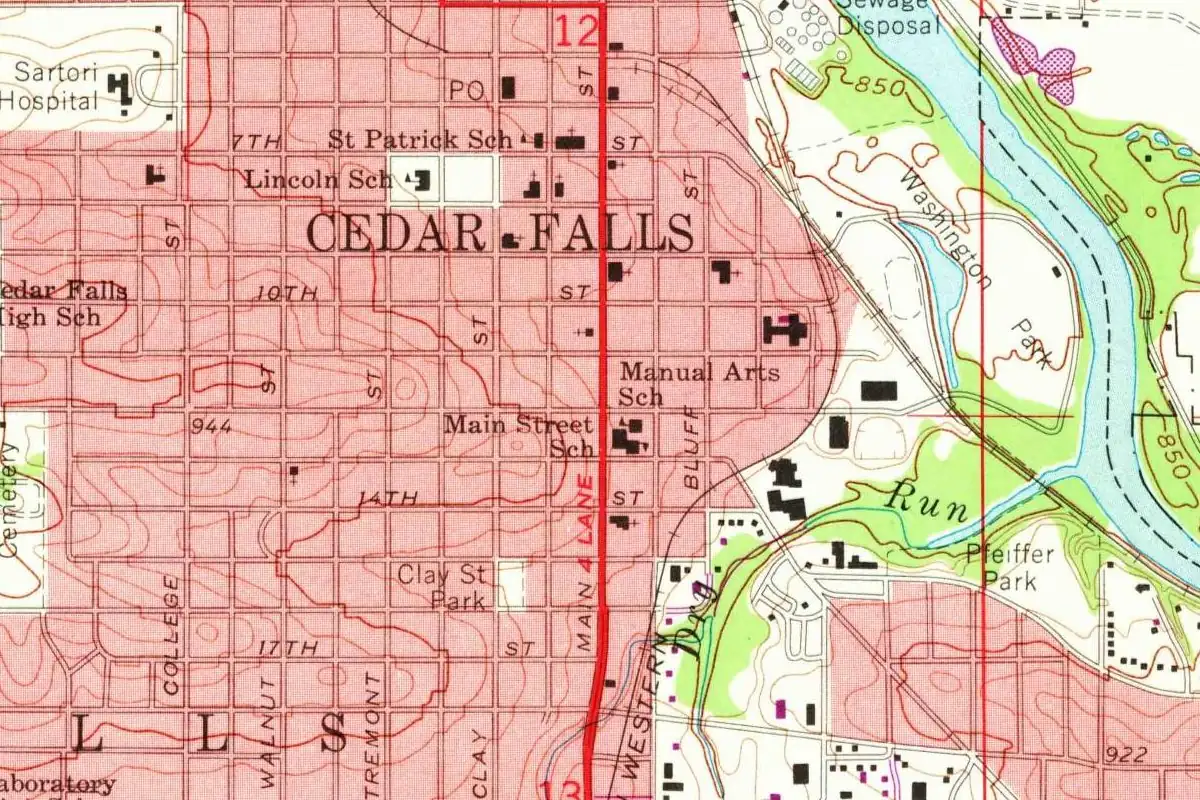
The county’s 1878 history tells how it started. In March 1845, William Sturgis, a farmer from Michigan, and his wife, along with Erasmus D. Adams, a cabinet maker from Ohio, came up the valley of the Red Cedar looking for homes and “a desirable water-power.” They liked what they saw, both “the romantic beauty of the spot” and its promise as a town site. Sturgis claimed the north part of what’s now Cedar Falls, mill site included. Adams took land farther south, near a creek called Dry Run, and you can still find Dry Run winding toward the river on the 1963 map at the top of this page.
A later county history, edited by John C. Hartman in 1915, puts the naming in one line: “They named the spot where they settled Sturgis Falls.” In its chapter on the city, it explains the name came from “the natural waterfall and the name of the first settler.”
A dam that wouldn’t finish
Sturgis had big plans and not much money. The 1878 history says he worked on a dam through 1846 “but did not succeed in completing it.” It also passes along a strange little story. An earlier settler’s empty cabin stood on the riverbank when Sturgis arrived, and soon after, it “tumbled into the river.” It is said Sturgis had a theory about how that happened, the book adds, “but he never, so far as is known, made the explanation.”
In February 1847, John W. Overman, Dempsey C. Overman and John T. Barrick showed up. That fall Sturgis sold them his 280 acres, mill site and improvements for $2,200, with Barrick borrowing $500 from James Newell to cover part of his share. The new owners had the county’s first sawmill running early in 1848. Then, in 1850, they added a run of millstones cut from a granite boulder found nearby, and settlers came from a hundred miles (160 km) north and west to use the county’s first gristmill.
Sturgis Falls becomes Cedar Falls
So when did the name change? That depends on which book you open.
The 1915 county history says the village was called Sturgis Falls “until the year 1849, when it was given the present title of Cedar Falls.” The Cedar Falls Historical Society’s timeline agrees on 1849: “Sturgis Falls is re-christened Cedar Falls.” The city’s own history page says that in 1850 the Overmans and Barrick “bought out the Sturgis family and renamed the community ‘Cedar Falls.’”
The 1878 history points to 1851. That’s when Barrick sold his share to the Overmans, Edwin Brown and Dr. H. H. Meredith, and the new partners put real money into the water power. They widened the race, rebuilt the dam with logs and plank, and then, “A town plat was surveyed, and the little settlement for the first time received the name of Cedar Falls.” There were nine log cabins and forty people.
There’s one catch with 1851, though. The very same book says a post office opened on January 3, 1850, with Dempsey C. Overman as “Postmaster at Cedar Falls.” So the name was clearly on the mail a year before that plat. You don’t need to pick a winner. Every one of these sources agrees on the who and the why. They just disagree on the paperwork.
The postmaster’s hat
That first post office is a story in itself. The 1878 history says the mail was so small at first that Overman “used to carry the letters in his hat,” handing them out whenever he ran into the person they were addressed to. The book goes so far as to call him “the Pioneer Letter Carrier of Iowa.”
The Cedar Falls post office even helped name its neighbor. In 1851, Charles Mullan brought a petition for a post office at Prairie Rapids to be endorsed by the postmaster at Cedar Falls. The petitioners had left the name up to him, so Mullan looked through the list of post offices in the United States, found Waterloo and picked it. That’s how Waterloo got its name, inside the Cedar Falls post office.
The two towns didn’t stay friendly for long. The city’s history says county commissioners met in Cedar Falls in 1853 and made it the county seat. Two years later Waterloo got the legislature to allow a referendum, and in April 1855, after what the city calls “a bitter referendum battle,” the seat moved to Waterloo.
Why “Cedar”
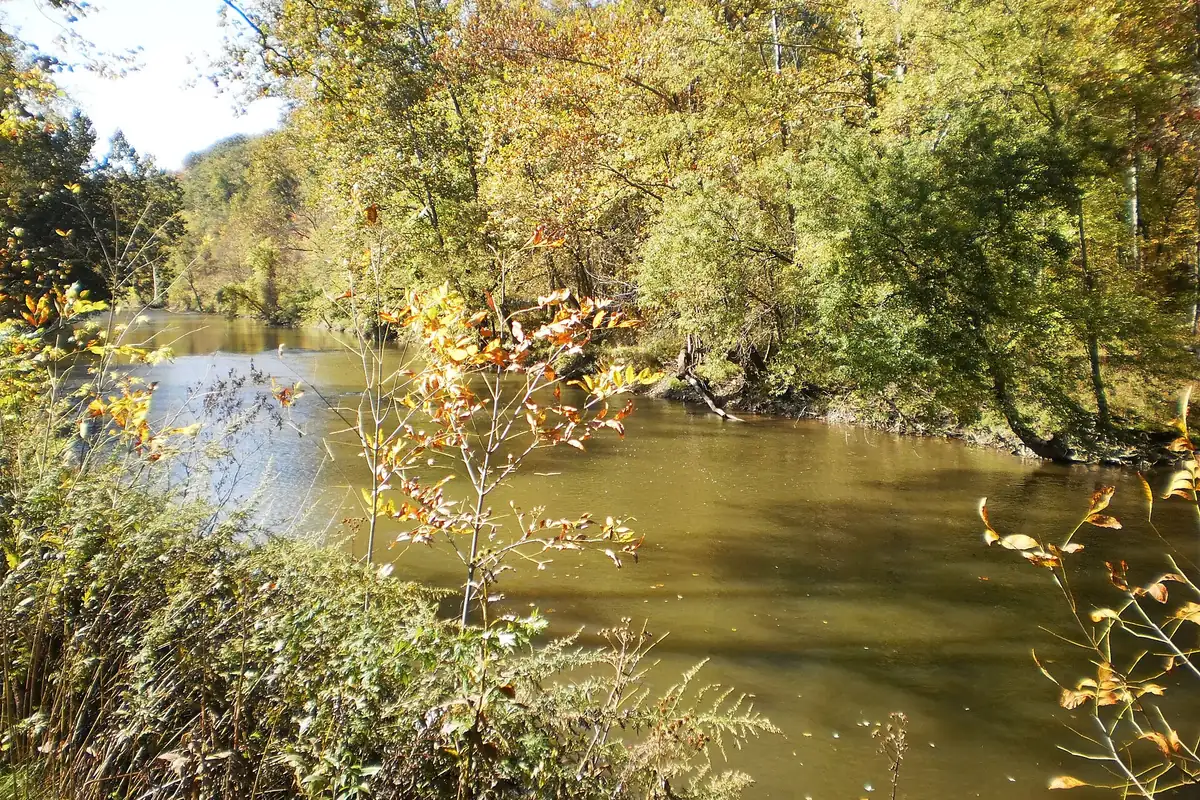
The second word of the name is easy: the falls. The first comes from the river, which the 1878 history still calls the Red Cedar. The city’s own short description says the town was “later renamed after the river that flows through the city.”
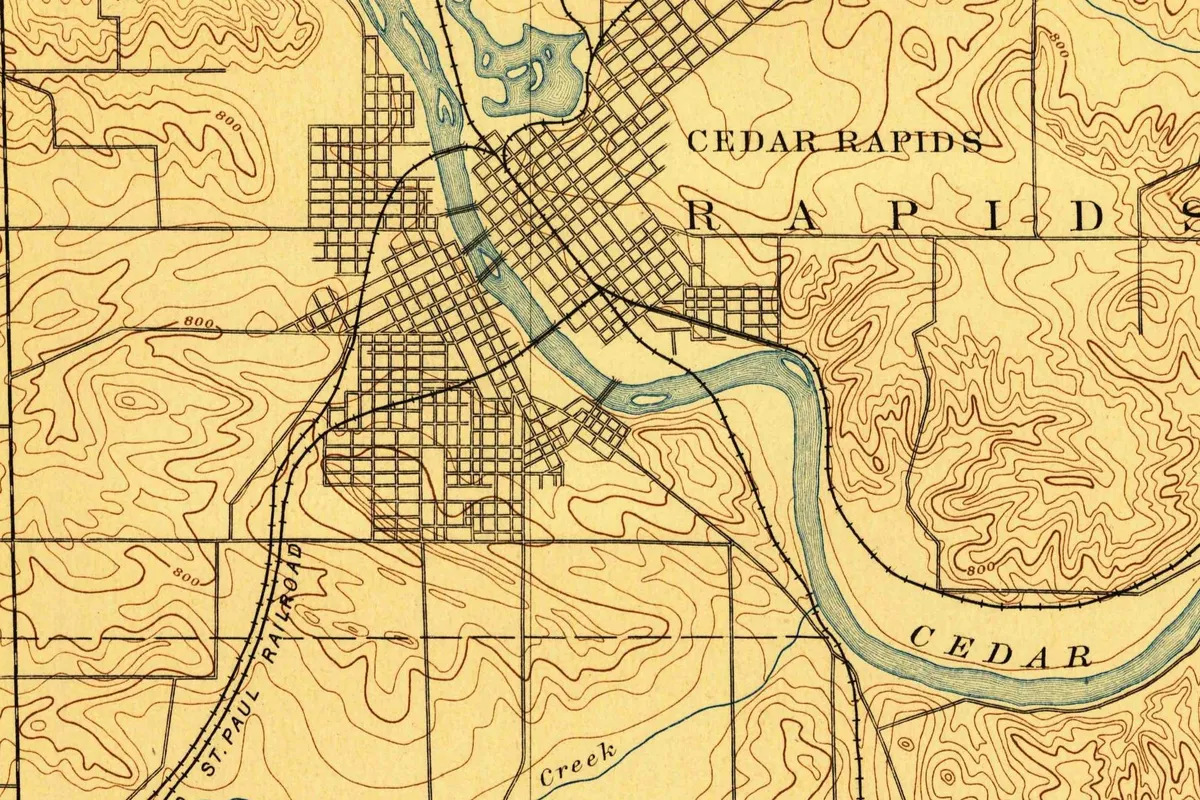
When Henry Gannett compiled his 1905 list of where American place names came from, he gave the river its own line: the Red Cedar of Iowa was “so named from the abundance of cedar trees which formerly grew along its banks.” He also notes that “cedar” turns up in the names of counties, many post offices and “numerous rivers, creeks, etc.,” all “referring to the presence of the tree in the vicinity.” Farther down the same river, Cedar Rapids got its name the same way, with rapids instead of falls. Sturgis’s name didn’t stick. The water he came for did. More stories from the state are on our Iowa page.
Quick answers
What was Cedar Falls, Iowa, originally called?
Sturgis Falls, for William Sturgis, who claimed the land at the falls in 1845. The 1915 county history says the name came from the waterfall and the first settler.
When did Sturgis Falls become Cedar Falls?
Sources disagree. The 1915 county history and the historical society say 1849, the city says 1850, and the 1878 county history says 1851, when the town was platted.
Who renamed Cedar Falls?
The city’s history credits the new mill owners, the Overman brothers and John T. Barrick, who bought out Sturgis. The county histories link the new name to the Overmans’ town plat but don’t say who picked it.
Key dates
- 1845In March, William Sturgis and Erasmus D. Adams make claims at the falls of the Cedar River.
- 1847Sturgis sells his 280-acre claim and mill site to John W. Overman, Dempsey C. Overman and John T. Barrick.
- 1849The year Sturgis Falls became Cedar Falls, according to the 1915 county history and the historical society.
- 1850On January 3, Dempsey C. Overman is appointed postmaster at Cedar Falls.
- 1851A town plat is surveyed, and the 1878 county history says the settlement received the name Cedar Falls for the first time.
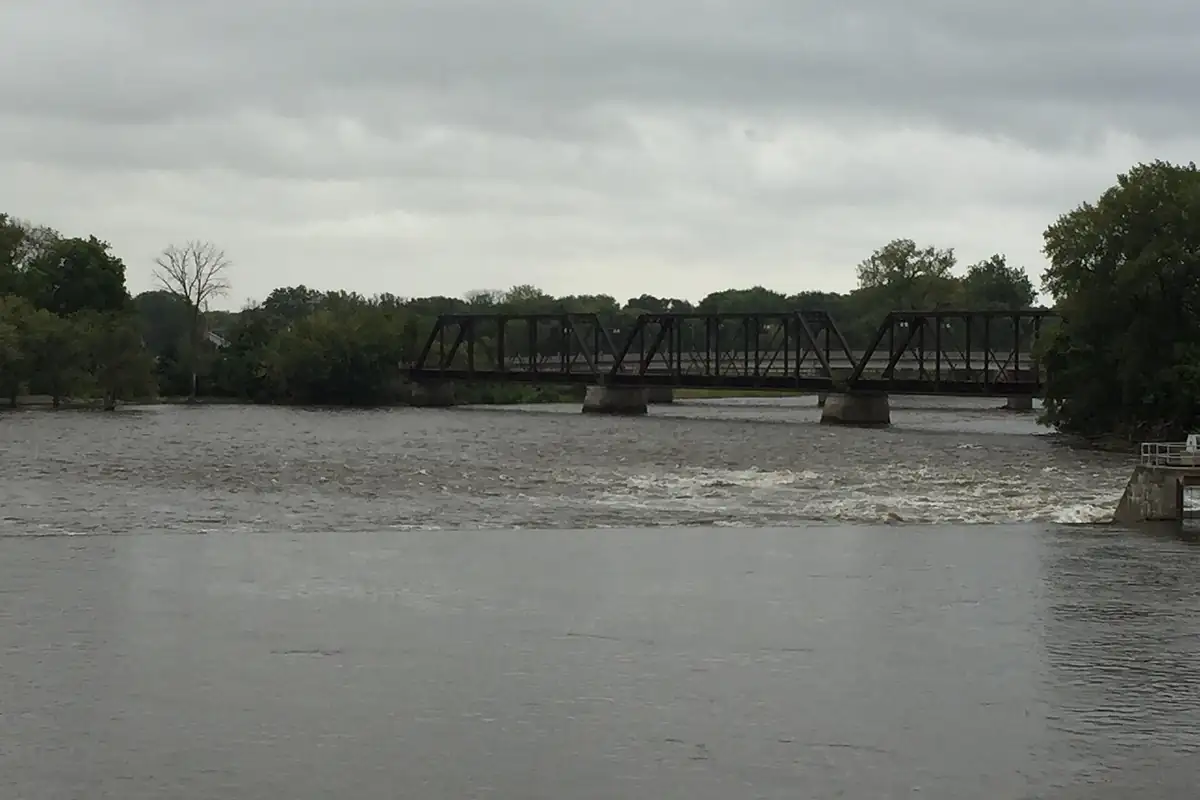
Things to do in Cedar Falls, Iowa
Ice House Museum
A round ice house built in 1921 to hold 16 million pounds of ice, now a museum of the ice once cut from the Cedar River nearby. It's a Silos & Smokestacks National Heritage Area site.
Victorian House Museum
An Italianate home built by Azel D. Barnum in 1863 and filled with furnishings, photographs and everyday objects from the 1880s to the 1900s. Its cupola has looked out over the Cedar River for generations.
George Wyth State Park
A wooded "urban sanctuary" between Waterloo and Cedar Falls, named in 1956 for a Cedar Falls businessman, with paved trails, several lakes and Fisher Lake, a natural oxbow of the Cedar River.
Hearst Center for the Arts
The city's James and Meryl Hearst Center for the Arts on West Seerley Boulevard puts on rotating gallery exhibitions, classes, workshops and public art programs.
Cedar Falls Downtown District
The downtown district looked after by Community Main Street, with local shops, restaurants and events in the heart of Cedar Falls.
Getting there
Open Cedar Falls in Google Maps
Opens in a new tab. The pin is the center of Cedar Falls in the USGS place-name record.
The closest airports, Amtrak stations and intercity bus stops, measured in a straight line from the center of Cedar Falls.
Airports
- Waterloo Regional (ALO) 3 mi 5 km
- The Eastern Iowa (CID) Cedar Rapids 58 mi 94 km
Amtrak trains
- Marshalltown station (MAN) 43 mi 70 km
- Cedar Rapids station (CRI) 54 mi 88 km
Intercity buses
- Jefferson Lines Cedar Falls-Waterloo 2 mi 3 km
- Greyhound Waterloo Union Bus Depot 6 mi 9 km
Distances are as the crow flies, not by road. We don't list schedules or fares because they change; check with the airline, Amtrak or the bus company before you go. Official data (FAA commercial service airports (2025), FAA airport locations, Amtrak stations and Intercity Bus Atlas) from the FAA and the U.S. Bureau of Transportation Statistics, checked Nov 14, 2026.
Sponsored
Staying in Cedar Falls?
Compare hotels in Cedar Falls, Iowa, on Expedia.
See hotels in Cedar FallsWe may earn a commission if you buy through this link. It never changes what we write. Read our affiliate disclosure
Historical Sources & References
- The History of Black Hawk County, Iowa (Western Historical Company, 1878), pp. 310-311. Sturgis and Adams coming up the Red Cedar in March 1845 for “a desirable water-power,” their claims, Adams near Dry Run, and the cabin that “tumbled into the river.”
- The History of Black Hawk County (1878), pp. 313-314. Sturgis’s unfinished dam (p. 313), the Overmans and Barrick arriving in February 1847, the sale of 280 acres for $2,200, the first sawmill in 1848 and the gristmill of 1850 (p. 314). Also online: p. 314.
- The History of Black Hawk County (1878), pp. 316-317. The post office of January 3, 1850, the letters carried in Overman’s hat, Charles Mullan choosing the name Waterloo, and the 1851 plat when the settlement “for the first time received the name of Cedar Falls.” Also online: p. 317.
- John C. Hartman, ed., History of Black Hawk County, Iowa, and Its People (1915), vol. 1, p. 273. Sturgis Falls, “a name derived from the natural waterfall and the name of the first settler,” used “until the year 1849.”
- Hartman (1915), vol. 1, pp. 75-76. “They named the spot where they settled Sturgis Falls,” and the Overmans platting the Town of Cedar Falls in April 1850.
- City of Cedar Falls, “History”. Sturgis and Adams in 1845 and the 1850 purchase by the Overmans and Barrick, who “renamed the community ‘Cedar Falls.’”
- City of Cedar Falls, “About Cedar Falls”. Originally Sturgis Falls, “later renamed after the river,” and the city’s Hearst Center for the Arts.
- Cedar Falls Historical Society, A Historical Timeline of Cedar Falls (2024). “1849: Sturgis Falls is re-christened Cedar Falls,” and the post office opening in 1850.
- Henry Gannett, The Origin of Certain Place Names in the United States (USGS, 1905), p. 73. The word “cedar” in many American place names, “referring to the presence of the tree in the vicinity.”
- Henry Gannett, The Origin of Certain Place Names in the United States (USGS, 1905), p. 259. The Red Cedar, “river in Iowa, so named from the abundance of cedar trees which formerly grew along its banks.”
- GNIS feature 455240 (U.S. Geological Survey). Record 455240 in the federal names register: Cedar Falls, a populated place in Black Hawk County.
- U.S. Geological Survey, Cedar Falls sheet (1963). The 1:24,000 quadrangle the map at the top of this page was cut from.
Spot something wrong, or know more? Tell us here. You can also email us or use our contact page. Corrections are noted here with their date, never made silently.