Decorah, Iowa: Which Ho-Chunk Chief Gave It Its Name?
Decorah is named for a Winnebago (Ho-Chunk) chief of the Decorah family. County histories of 1882 and 1913 and the Wisconsin Historical Society name Waukon Decorah, who died about 1868. Henry Gannett wrote in 1905 that the chief was Dehere, which he said meant 'spoon,' and a 1903 article pointed to Little Decorah.
Decorah, Iowa, carries the name of a family of Ho-Chunk chiefs, though the men who wrote its history never fully settled which Decorah it honors. The name was on the books by 1851, and the town’s own historians then spent decades arguing over the man behind it, and over a box of bones.
The chief in the 1882 history
W. E. Alexander’s History of Winneshiek and Allamakee Counties, printed in Sioux City in 1882, starts the topic with confidence:
Decorah, our beautiful inland city, and county seat of Winneshiek County, was named after Waukon-Decorah, one of the prominent chiefs of the Winnebagoes.
He adds that the neighboring town of Waukon “gained its name from the first half of the hyphenated name of the aforesaid chieftain.” So one man would have given his name to two towns in northeast Iowa.
Alexander’s chief had lost an eye. He says the man was “familiarly known by the whites as ‘one-eyed Decorah.’” Keep that detail in mind, because it comes back.
Winnebago was the name most white writers used then. The people themselves use Ho-Chunk, and the nation adopted that name with a new constitution signed on November 25, 1994, a change the Green Bay story also covers, since that city’s bay once carried a French name for the same people.
A census taker’s suggestion
Thirty-one years later, Edwin C. Bailey’s Past and Present of Winneshiek County (1913) went back over the question in a chapter compiled by Charles Philip Hexom. Hexom says the name itself “is a corruption of the French surname De Carrie.”
He also says who picked it. “Eliphalet Price took the census of 1850 and is credited by the Day family (who were some of the first white settlers in Winneshiek county) with suggesting Decorah as a very proper name for the town site that they had in mind to plat,” the chapter reads. The name was on paper before the town was. “In the act of organizing the county (1851) Decorah is herein first named, two and a half years before the town plat was recorded.”
Later in the book, the county chapter fills in those dates. Decorah was chosen as county seat on April 7, 1851. William Day recorded the plat of the “east half of Decorah” on August 17, 1853, and William Painter the west half on September 7.
Which Decorah?
Here’s where it gets tangled. There wasn’t just one Decorah. Hexom’s chapter lists the family. The eldest son of Sabrevoir De Carrie and Hopokoekau was “Spoon Decorah, sometimes called the Ladle.” Then there’s the Buzzard Decorah, who “settled at La Crosse in 1787, with a band of Winnebagoes,” and two of the Buzzard’s sons: Big Canoe, also called One-eyed Decorah, and a son the chapter calls Snake Skin, “known as Waukon Decorah.” That’s the same spot on the Mississippi whose French name, Prairie de la Crosse, became La Crosse, Wisconsin.
In Hexom’s list, then, One-eyed Decorah is Big Canoe, a brother of Waukon Decorah. Hexom’s criticism goes to an earlier writer, Price himself, whose 1866 account in the Annals of Iowa he says “contains numerous errors.” John Day remembered the chief as “a small Indian about five feet in height.” Hexom’s verdict is that “Mr. Price and Mr. Day were probably mislead in their identification of this chief, as there were other Winnebagoes whose names began with Waukon.” They knew the name Waukon Decorah, he thinks, and had it in mind when they chose a name for the town.
He rejects another candidate, too. Col. C. A. Clark had written in the Annals of Iowa in 1903 that “The name of the city of Decorah evidently comes from Little Decorah.” Hexom calls that “very improbable” and closes: “It is evident, therefore, that our county seat is named in honor of the venerable Waukon Decorah.”
The same 1913 book isn’t fully consistent, though. Its county chapter calls Waukon Decorah “a lesser chief,” where Alexander had called him one of the prominent ones, and says the name “is believed to have come from the French and Sioux.”
Henry Gannett took yet another line in 1905. His entry reads: “Decorah; city in Winneshiek County, Iowa, named for Dehere, meaning ‘spoon,’ a Winnebago chief. Another authority gives the orthography as Decorie.” The translation is his. If you’re keeping score, that’s three candidates: Waukon Decorah, Little Decorah and Gannett’s Dehere.
The bones by the courthouse
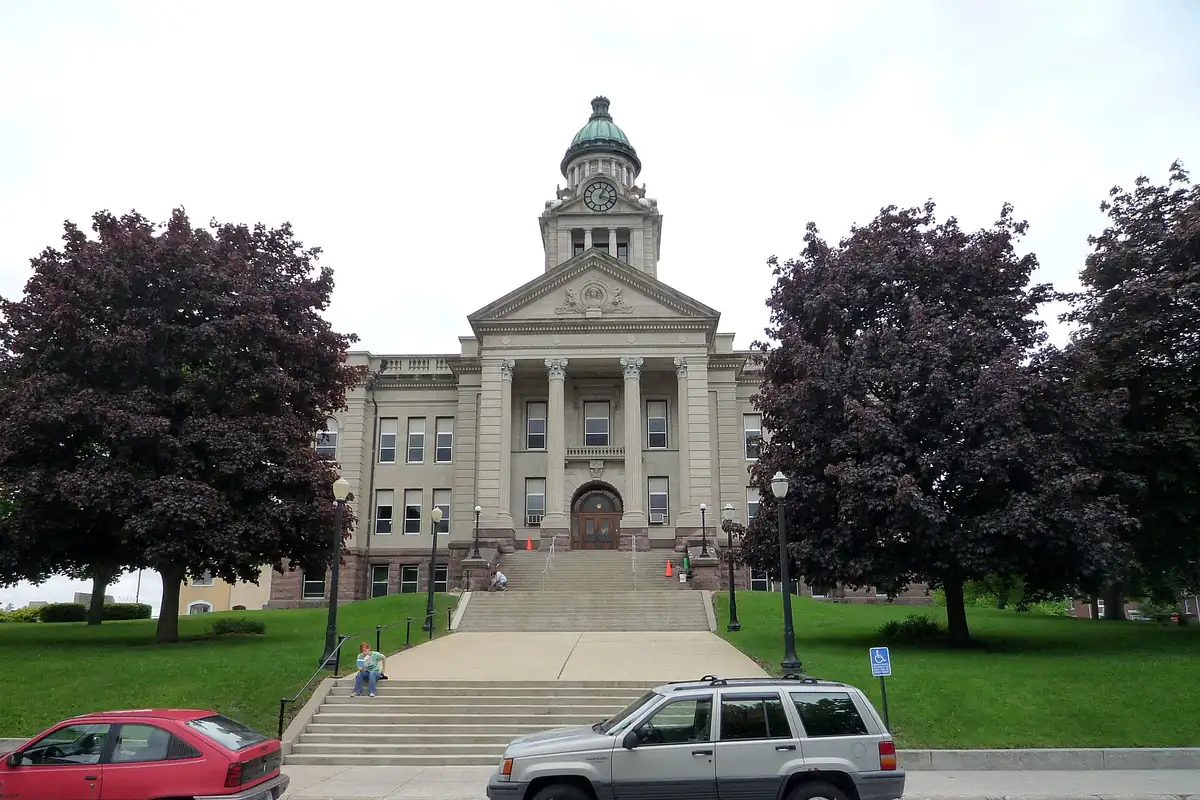
Decorah has a grave that’s tied to the name, and the town’s two historians didn’t agree on who’s in it. Alexander writes that “What are said to be the remains of Decorah, having been twice re-interred, now repose in the Court House grounds, near the northeast corner.” The first grave was near Winnebago and Main streets. A citizens’ meeting on August 4, 1859, took the matter up, and the remains were dug up and reburied on the courthouse grounds. Grading work turned them up again in 1876, and they were buried a second time.
Alexander also passes along the doubts. There were rumors “that Decorah was still living” when the town claimed his bones. The Rev. Ephraim Adams, in a sermon he called “First Things of Decorah,” said word came back that Decorah was an old man, bent, with one eye put out, and he allowed that the town might have “his bones, or those of some other poor Indian, safely deposited in a rough box.” Hexom starts with the same careful wording in 1913, “What are said to be the remains of Waukon Decorah,” and then goes further: “These are, however, the bones of some other Indian.” Waukon Decorah, he writes, was living in Minnesota at the time.
The man himself
The Wisconsin Historical Society gives Waukon Decorah’s dates as about 1780 to 1868 and calls him the youngest son of the Buzzard and the tribe’s orator. His village stood about 60 miles (97 km) north of Prairie du Chien. He helped the army during the Black Hawk War, the society says, then moved to northeast Iowa, later to Long Prairie, Minnesota, and after 1855 lived in Blue Earth County, Minnesota. “Two Iowa cities, Decorah and Waukon, bear his name,” its page says.
Another Wisconsin town, Oshkosh, carries the name of a Menominee chief.
The 1906 map
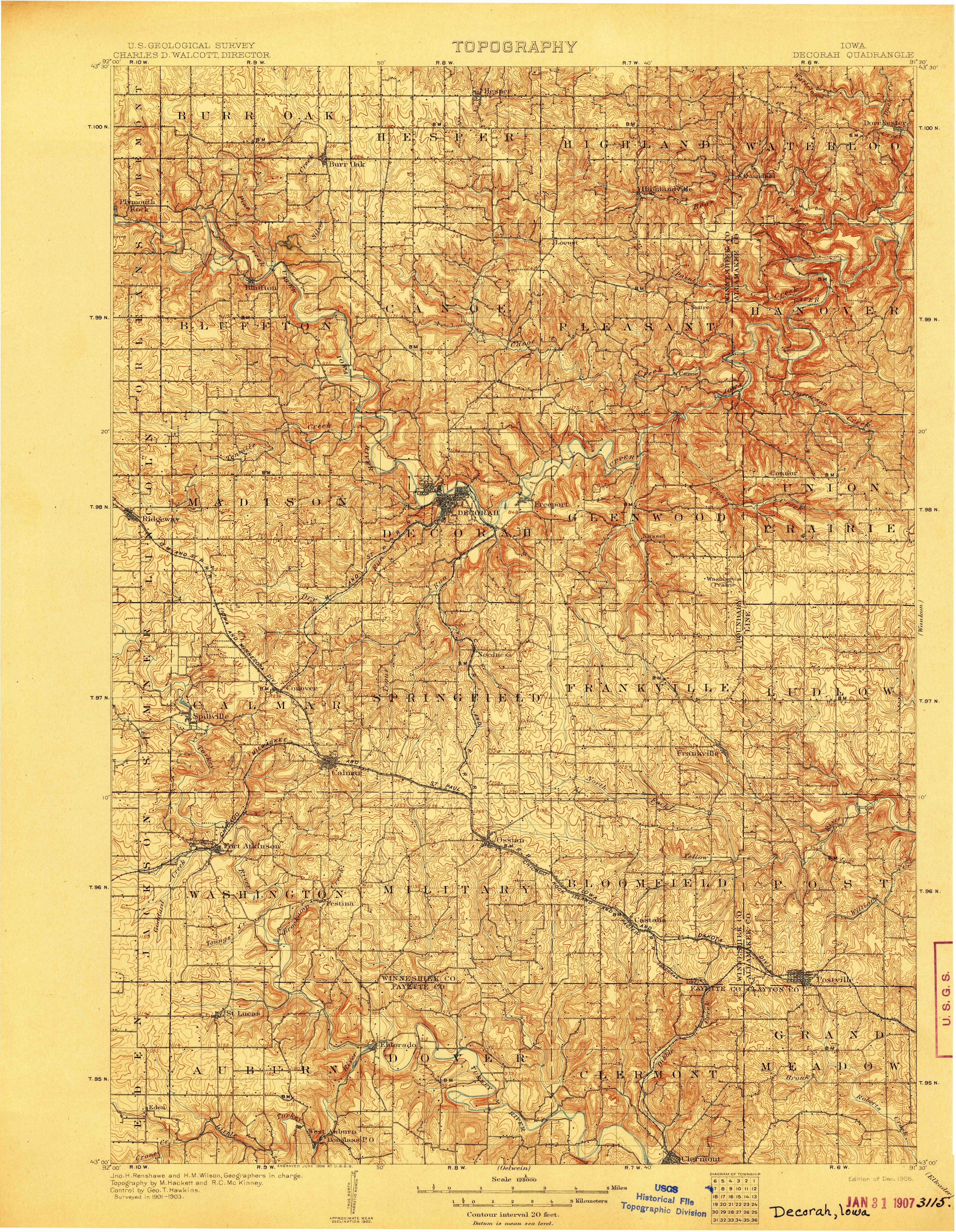
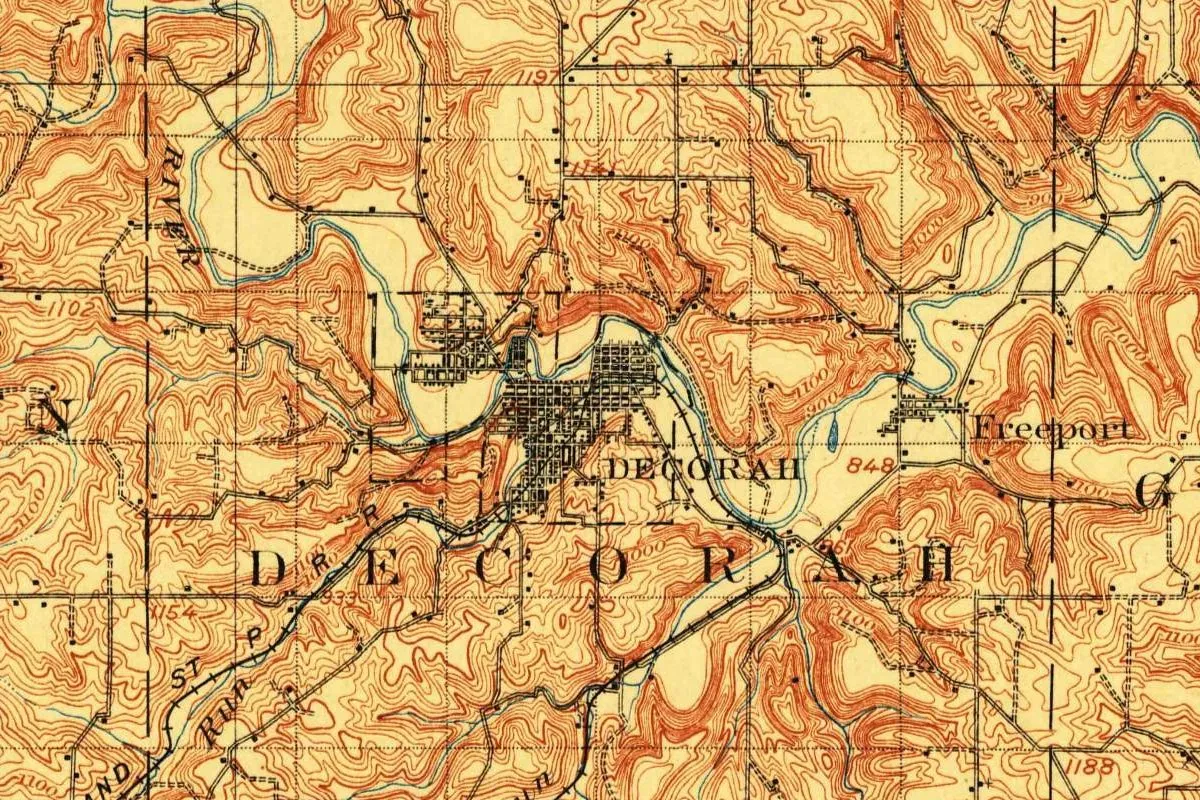
The map at the top of this page comes from the Geological Survey’s Decorah sheet, surveyed from 1901 to 1903 and issued in December 1906. The town sits on a loop of the river with Freeport to the east, and if you look below the town, you’ll see the name Decorah spelled out a second time in big spaced letters across the township. The photo below shows the Winneshiek County Courthouse, whose grounds, both county histories say, hold the remains said to be the chief’s.
Quick answers
Who is Decorah, Iowa, named after?
A Ho-Chunk chief of the Decorah family. Alexander (1882), Bailey’s 1913 history and the Wisconsin Historical Society name Waukon Decorah. Gannett (1905) names a chief called Dehere, and Col. C. A. Clark, in 1903, Little Decorah.
Where does the name Decorah come from?
French, by way of the family. The 1913 county history calls it “a corruption of the French surname De Carrie,” after Sabrevoir De Carrie. Gannett says Dehere meant “spoon.”
Who chose the name Decorah?
Eliphalet Price, the 1850 census taker, by the Day family’s account in the 1913 history. The name appears in the 1851 act organizing the county.
Is Waukon Decorah buried in Decorah?
Probably not. Both county histories describe remains “said to be” his near the courthouse, reburied in 1876, but Hexom’s 1913 chapter says they’re “the bones of some other Indian,” and Alexander reports rumors that Decorah was still alive.
Key dates
- 1787The Buzzard Decorah, father of Waukon Decorah, settles at La Crosse with a band of Winnebago, Bailey's history says.
- 1851The act organizing Winneshiek County names Decorah, and on April 7 the place is chosen as county seat.
- 1853William Day records a plat of the east half of Decorah on August 17.
- 1853William Painter records the west half of Decorah on September 7.
- 1859A citizens' meeting on August 4 deals with the remains said to be the chief's, which are dug up from their first grave and reburied on the courthouse grounds.
- 1868Waukon Decorah dies about this year, by the Wisconsin Historical Society's dates.
- 1876The remains are buried again, near the courthouse, Alexander reports.
Things to do in Decorah, Iowa
Vesterheim
A museum building of four floors, drawn from a collection of over 33,000 artifacts, plus a Heritage Park of 12 buildings. Among its pieces is the TradeWind, a 25-foot (7.6 m) sailboat the museum calls the smallest known to have crossed the Atlantic Ocean without assistance.
Fort Atkinson State Preserve
A frontier army post built from 1840 to 1842 and occupied until 1849, which the state says featured prominently in the removal of the Winnebago (Ho-Chunk) people. The North Barracks, cannon houses and powder magazine still stand.
Dunning's Spring Park
A waterfall surrounded by limestone cliffs, with a walking path, a scenic overlook and a bridge built by stone mason Ted Wilson.
Trout Run Trail
An 11-mile (18 km) asphalt loop through and around Decorah, with views of limestone bluffs and the Upper Iowa River. It passes the Decorah Fish Hatchery, home to Siewers Springs, which the page calls the second largest natural spring in Iowa, and to the Decorah eagles.
Seed Savers Exchange Heritage Farm
An 890-acre (360 ha) farm just outside Decorah where Seed Savers Exchange grows nearly 1,000 varieties of seed each year, with display gardens and a Historic Orchard of hundreds of apple varieties.
Getting there
Open Decorah in Google Maps
Opens in a new tab. The pin is the center of Decorah in the USGS place-name record.
The closest airports, Amtrak stations and intercity bus stops, measured in a straight line from the center of Decorah.
Airports
- La Crosse Regional (LSE) 48 mi 77 km
- Rochester International (RST) 55 mi 89 km
- Minneapolis-St Paul International/Wold-Chamberlain (MSP) 130 mi 210 km
Amtrak trains
- La Crosse station (LSE) 45 mi 73 km
- Winona station (WIN) 52 mi 83 km
Intercity buses
- Jefferson Lines La Crosse 44 mi 71 km
- Land to Air Express Rochester (Airport - RST) 55 mi 88 km
Distances are as the crow flies, not by road. We don't list schedules or fares because they change; check with the airline, Amtrak or the bus company before you go. Official data (FAA commercial service airports (2025), FAA airport locations, Amtrak stations and Intercity Bus Atlas) from the FAA and the U.S. Bureau of Transportation Statistics, checked Nov 17, 2026.
Sponsored
Staying in Decorah?
Compare hotels in Decorah, Iowa, on Expedia.
See hotels in DecorahWe may earn a commission if you buy through this link. It never changes what we write. Read our affiliate disclosure
Historical Sources & References
- W. E. Alexander, History of Winneshiek and Allamakee Counties, Iowa (1882), p. 141. The town named for Waukon-Decorah, and Waukon for the first half of his name. Checked against the page image.
- Alexander (1882), p. 142. “One-eyed Decorah,” the remains near the courthouse, the first grave and the meeting of August 4, 1859. Checked against the page image.
- Alexander (1882), p. 143. The reburial on the courthouse grounds and the second burial of 1876. Checked against the page image.
- Alexander (1882), p. 144. The rumors that Decorah was alive and the Rev. Ephraim Adams’s sermon. Checked against the page image.
- Edwin C. Bailey, Past and Present of Winneshiek County, Iowa, vol. 1 (1913), p. 20. The Decorah family, the Buzzard at La Crosse in 1787, his sons and Spoon Decorah, in Hexom’s chapter. Checked against the page image.
- Bailey (1913), p. 27. De Carrie, Price’s suggestion, the 1851 act, John Day’s memory and Hexom’s doubts about Price and Day. Checked against the page image.
- Bailey (1913), p. 28. Clark’s Little Decorah, Hexom’s conclusion, the remains in the courthouse square and Hexom’s view that they’re another man’s bones. Checked against the page image.
- Bailey (1913), p. 190. The county seat in 1851, the plats of 1853, “a lesser chief” and “the French and Sioux.” Checked against the page image.
- Henry Gannett, The Origin of Certain Place Names in the United States (1905), p. 102. Dehere, “spoon,” and Decorie. Checked against the page image.
- Wisconsin Historical Society, “Decorah family”. Waukon Decorah’s dates, his village about 60 miles (97 km) north of Prairie du Chien, his moves, and the two Iowa towns named for him.
- Ho-Chunk Nation, “Wisconsin Winnebago fades into history…”. The constitution of November 25, 1994, and the name Ho-Chunk.
- Vesterheim; Fort Atkinson State Preserve; Dunning’s Spring Park; Trout Run Trail; Seed Savers Exchange. The details in the things-to-do list.
- GNIS feature ID 455839 (U.S. Geological Survey). Decorah in the national gazetteer, in Winneshiek County, with its coordinates.
- U.S. Geological Survey, Decorah sheet (1906). The 1:125,000 map that the image at the top of this page was cropped from.
Sponsored
Put this 1906 map on your wall
The 1906 USGS Decorah, Iowa, sheet is in the public domain. Download the full-size scan for free, then have it printed on canvas with CanvasOnTheCheap.
Print a map on canvasDownload the full-size mapWe may earn a commission if you buy through this link. It never changes what we write. Read our affiliate disclosure
Spot something wrong, or know more? Tell us here. You can also email us or use our contact page. Corrections are noted here with their date, never made silently.