Battle Creek, Michigan: The Fight Behind the Name
Battle Creek, Michigan, took a stream’s name and a story about a fight between surveyors and Potawatomi men, with conflicting details. The link to the surveyors is old: it was already in print in 1839. Exactly what happened, and how the name caught on, takes more care.
The story was in print by 1839
John T. Blois’s Gazetteer of the State of Michigan puts the village at the meeting of Battle Creek and the Kalamazoo River. On the same page, he explains the stream’s name through a confrontation between government land surveyors and Native people.
His opening words matter:
“It is understood that the name of Battle creek took its origin from an adventure…”
Blois was reporting an explanation in circulation. He didn’t name an eyewitness or reproduce a survey record. His next lines say two Native men were killed, a detail that clashes with a later account.
You can see how early the story had attached itself to the creek without accepting every part of it. The printed explanation and the event it describes are separate pieces of evidence.
A letter, copied almost sixty years later
In 1883, Orrin Poppleton tried to straighten out the story for Michigan’s State Pioneer Society. His paper, available in a modern transcription, includes a copy of a March 1825 letter from John Mullett to territorial governor Lewis Cass. Poppleton said Mullett’s son supplied the copy.
The letter places the confrontation on March 14. Mullett had left Taylor and Baldwin at camp while he continued surveying. It describes gunfire, a struggle and the two Native men being restrained. Mullett returned that evening and heard the particulars from his men; he hadn’t witnessed the fight himself.
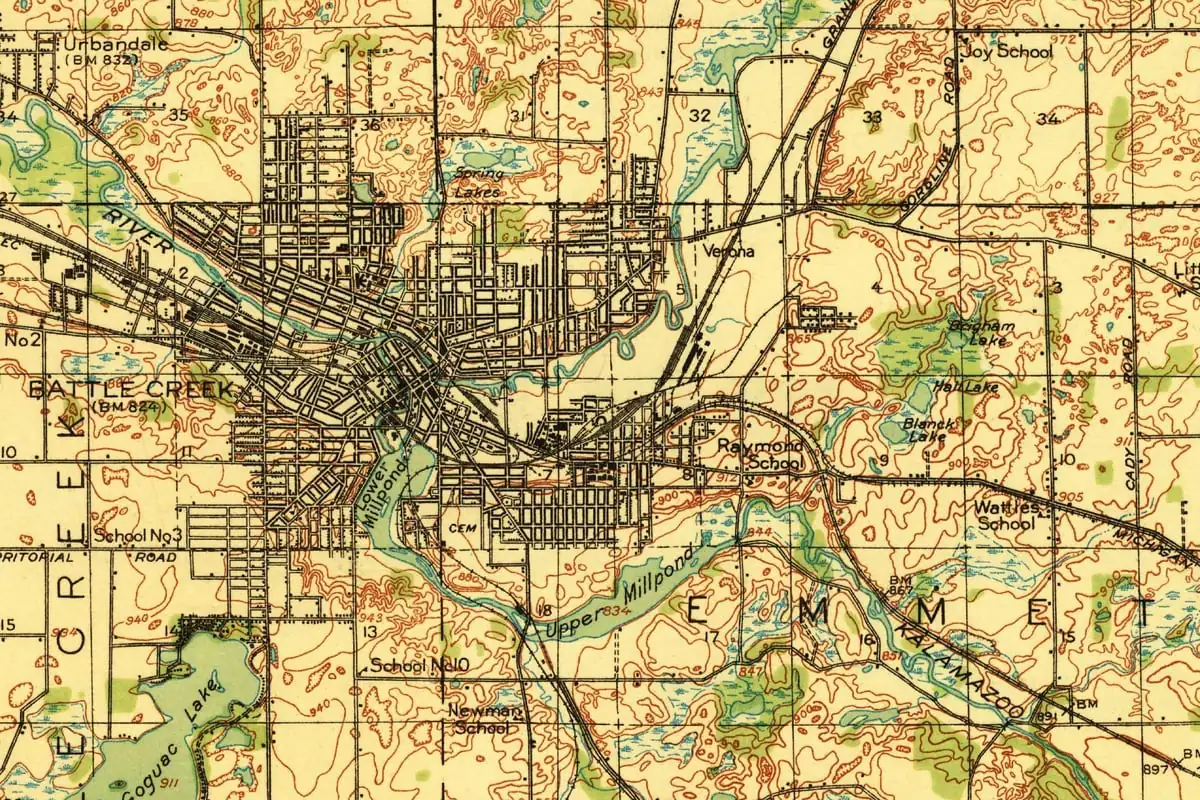
The camp was on the survey baseline, in the western part of range six west. Edwin Baldwin placed it about a mile east of the Penfield–Convis corner. From his description, Poppleton worked out two possible sections near the Convis–Bellevue boundary, upstream from the city. The city’s river junction and the reported campsite weren’t the same location.
This is useful evidence, with a clear limitation: we’re reading an 1825 letter through a copy presented in 1883 and a modern transcription. It preserves the survey party’s account. It doesn’t give the Potawatomi participants’ own testimony.
Why the details stay disputed
Poppleton also collected recollections from Edwin Baldwin, brother of participant Edward Baldwin. Those recollections say the Native men survived the immediate encounter. The following year, Edwin Baldwin met one of the two men, Simo, on a trail. Simo lived about another year in poor health before he died. Edwin couldn’t remember the other man’s name, but knew of his whereabouts for years afterward. That account only partly fits what Blois wrote. Even the modern page carrying Poppleton’s paper opens with an 1824 date, while the letter it reproduces says March 1825.
If you’re looking for a single tidy version, the surviving accounts won’t give you one. The sources support a confrontation behind the stream’s English name; they don’t agree on every detail or identify a securely documented moment when someone first spoke the name.
Milton, Garnsey, then the creek’s name
A 1937 history published by the J. L. Hudson Company describes the settlement as first called Milton, then Garnsey after a landholder, before becoming Battle Creek. Its account dates the Garnsey post office to 1832 but doesn’t establish the exact subsequent change date.
By 1839, Blois plainly lists the village as Battle Creek, with sawmills and flour mills at the river junction. The waterways supplied both a location and a name. Nearby Kalamazoo also borrowed its river’s name, replacing Bronson in 1836.
Battle Creek kept a small stretch of survey history in everyday use. The name survived more neatly than the accounts explaining it.
Quick answers
What battle was Battle Creek named after?
A confrontation involving members of John Mullett’s surveying party and Potawatomi men, according to the historical accounts. Blois reported the connection in 1839; Poppleton’s later paper transcribes a letter dated March 1825.
Did the fight happen in downtown Battle Creek?
Upstream, judging by the location Poppleton reconstructed from Edwin Baldwin’s description. He placed the camp around the Convis–Bellevue township boundary, rather than at the city’s river junction.
Is the date 1824 or 1825?
1825 is the date in the letter Poppleton reproduced. The modern transcription introduces the incident as taking place in 1824, but the letter itself is dated March 1825.
What was Battle Creek called before?
Milton and Garnsey, according to Michigan Pioneers (1937). Battle Creek was already the village’s printed name in Blois’s 1839 gazetteer.
Key dates
- 1825A March letter attributed to surveyor John Mullett places the confrontation on March 14; Poppleton read a copy to the State Pioneer Society in 1883.
- 1839Blois lists Battle Creek as both a village and a stream, explaining the latter's name through a surveyors' dispute.
- 1883Orrin Poppleton presents his attempt to correct conflicting accounts of the confrontation.
Getting there
Open Battle Creek in Google Maps
Opens in a new tab. The pin is the center of Battle Creek in the USGS place-name record.
The closest airports, Amtrak stations and intercity bus stops, measured in a straight line from the center of Battle Creek.
Airports
- Kalamazoo/Battle Creek International (AZO) 20 mi 32 km
- Gerald R Ford International (GRR) Grand Rapids 42 mi 68 km
- Detroit Metro Wayne County (DTW) 94 mi 151 km
Amtrak trains
- Battle Creek station (BTL) under 1 mi 0.7 km
- Kalamazoo station (KAL) 21 mi 33 km
Intercity buses
- Greyhound Battle Creek Bus Stop under 1 mi 0.7 km
- Amtrak Chartered Vehicle Amtrak Connecting Service · Battle Creek under 1 mi 0.7 km
- Indian Trails Kalamazoo 21 mi 33 km
Distances are as the crow flies, not by road. We don't list schedules or fares because they change; check with the airline, Amtrak or the bus company before you go. Official data (FAA commercial service airports (2025), FAA airport locations, Amtrak stations and Intercity Bus Atlas) from the FAA and the U.S. Bureau of Transportation Statistics, checked Nov 10, 2026.
Sponsored
Staying in Battle Creek?
Compare hotels in Battle Creek, Michigan, on Expedia.
See hotels in Battle CreekWe may earn a commission if you buy through this link. It never changes what we write. Read our affiliate disclosure
Historical Sources & References
- John T. Blois, Gazetteer of the State of Michigan (1839), p. 251. A contemporary listing of the village and creek; an early printed explanation connecting the name with a surveyors’ dispute. Its death claim conflicts with later recollections.
- Orrin Poppleton, “How Battle Creek Received Its Name” (1883), pp. 248–251, transcription. A copied March 1825 letter attributed to Mullett, campsite research and later Baldwin family recollections. The original manuscript wasn’t examined for this article.
- J. L. Hudson Company, Michigan Pioneers (1937), pp. 31–33, transcription. The settlement names Milton and Garnsey, the 1832 postal date and the later adoption of Battle Creek.
- GNIS feature 620755 (U.S. Geological Survey). Battle Creek’s official geographic identifier in Calhoun County.
Spot something wrong, or know more? Tell us here. You can also email us or use our contact page. Corrections are noted here with their date, never made silently.