New Braunfels, Texas: Named for a Prince's Home on the Lahn
New Braunfels is named for Braunfels, on the Lahn River in Germany, home of the Solms family. Prince Carl of Solms-Braunfels, who led the German emigration society in Texas, picked the townsite, and the settlers arrived on March 21, 1845. The Handbook of Texas calls Braunfels his estate; another entry calls it the family's ancestral castle.
New Braunfels, Texas, carries the name of Braunfels, the Solms family seat on Germany’s Lahn River, brought in 1845 by Prince Carl’s German settlers. Which Braunfels you picture, a castle, an estate or a town, depends on the source you read.
What is New Braunfels named after?
Braunfels, in Germany. The sources agree on that much. They split over what Braunfels was, and even the two Handbook of Texas entries don’t match.
Writing on the city for the Handbook, Daniel P. Greene says that by the summer of 1845 the settlement “had been incorporated under the name of Prince Solms’s estate on the Lahn River in western Germany, Braunfels.” The Handbook’s entry on the prince, by Glen E. Lich and Günter Moltmann, says the settlers founded New Braunfels, “named for the Solms ancestral castle on the Lahn River, southwest of Wetzlar.”
Henry Gannett, the Geological Survey man who published a bulletin on the sources of American names in 1905, saw it a third way. His entry reads, in full: “New Braunfels; city in Comal County, Texas, named from the town in Prussia.”
That’s an estate, a castle and a town, one for each writer. None of them says who actually proposed “New Braunfels.” Prince Carl chose the site, but the sources we checked stop short of saying he chose the name.
Who was Prince Carl of Solms-Braunfels?
His full name, as Lich and Moltmann give it, is a long one, starting “Friedrich Wilhelm Carl Ludwig Georg Alfred Alexander, Prince of Solms, Lord of Braunfels” and going on through several more places. He was born July 27, 1812, at Neustrelitz, and was raised to be both a soldier and a courtier.
In 1844 the Adelsverein, a society of German noblemen organizing emigration to Texas, made him commissioner-general of its first colony. He landed at Galveston on July 1, 1844. Lich and Moltmann say he bought land on Matagorda Bay for a landing port, Carlshafen, or Indianola, and traveled widely in Texas.
They call him a visionary and quote one of his reports: “The eyes of all Germany, no, the eyes of all Europe are fixed on us and our undertaking.”
The 1845 wagon train to the Comal
Greene’s entry gives the founding date as March 21, 1845. Nicolaus Zink led a wagon train of German immigrants up the Guadalupe River to where the San Antonio-Nacogdoches road crossed it, and they camped on Comal Creek, today’s Dry Comal Creek, at a spot Prince Carl had picked. Lich and Moltmann note that it was Good Friday.
Zink laid out town and farm lots and put up a rough stockade called the Zinkenburg. Within weeks the prince laid the cornerstone of a sturdier fort and headquarters on a hill, which he called the Sophienburg. On May 15, 1845, he started home, and John O. Meusebach took over the colony. Greene counts 300 to 400 settlers on hand that summer.
Sophie’s castle
The fort’s name is its own small naming story. The Sophienburg Museum says the original Sophienburg, “Sophie’s Castle,” was “named in honor of his fiancée, Princess Sophie.” Lich and Moltmann say Carl married Sophie, a princess of Salm-Salm whose first husband had died, at Bendorf on December 3, 1845, less than seven months after he left New Braunfels.
The museum was founded in 1933 on that same hill. In Cedarburg, Wisconsin, a town history reads the burg ending as the German word for a fortress, and New Braunfels has two of those in its first months alone: the Zinkenburg and the Sophienburg.
New Braunfels history: a German town in Texas
The town grew fast. “It is reported,” Greene writes, “that in 1850 New Braunfels was the fourth largest town in Texas.” Comal Springs gave it water power, and its place on the Austin-San Antonio road brought customers, so mills, stores and workshops followed. The Neu Braunfelser Zeitung first came out in 1852, he says, and kept printing in German until 1957.
German names didn’t stop at New Braunfels, either. Henry Gannett, in the same 1905 book, says the immigrants who founded New Ulm, Minnesota, named it, in his words, for “their native city of Ulm, Germany.”
Inside today’s city there’s another name you’ll see a lot: Gruene. The Handbook’s entry on Gruene says the area was first known as Goodwin, that H. D. Gruene built a store there in 1878, and that the community eventually “took the name of its leading citizen.” It’s now within New Braunfels.
Landa Park, around Comal Springs, has its own family name on it. The city says Harry and Joseph Landa owned the property from 1847 to 1927. Greene says it began in 1899 as a privately run resort, and the city says the public was let in starting in 1936.
New Braunfels on the 1925 map
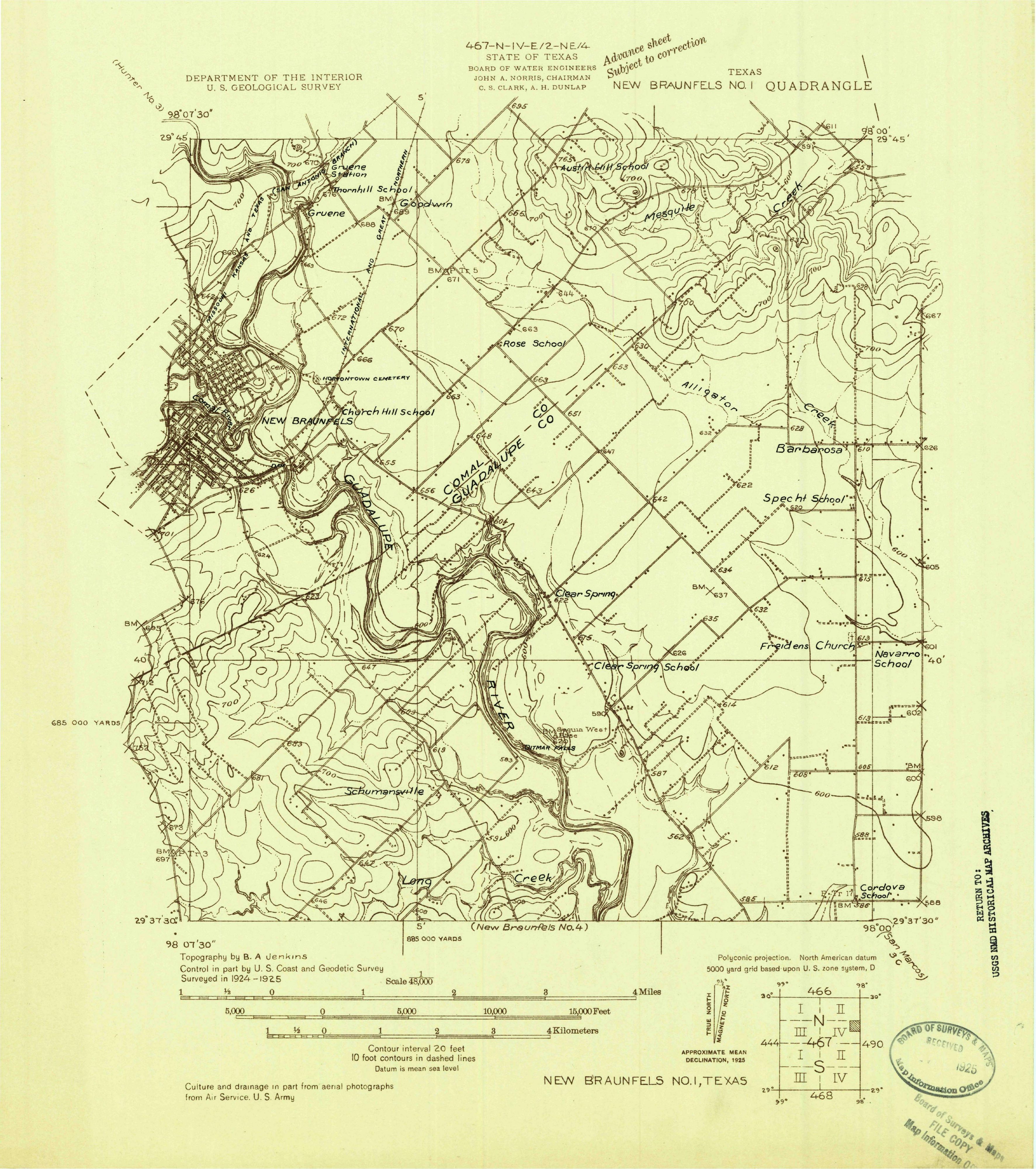
Up top is the New Braunfels No. 1 quadrangle, drawn at 1:48,000. Its top margin pairs the Interior Department’s Geological Survey with the Board of Water Engineers of the State of Texas, under chairman John A. Norris with C. S. Clark and A. H. Dunlap. Beside the title, a slanted line in script reads “Advance sheet, subject to correction,” so this is a preliminary printing. Two years later, in 1927, the Survey issued a larger New Braunfels quadrangle that takes in this ground. At the bottom, B. A. Jenkins gets the topography credit, the Coast and Geodetic Survey gets partial credit for control, and the sheet gives “Surveyed in 1924-1925.” A note adds that some of the culture and drainage came from aerial photos by the Army’s Air Service. The declination diagram is dated 1925, and so is the Board of Surveys and Maps stamp in the corner.
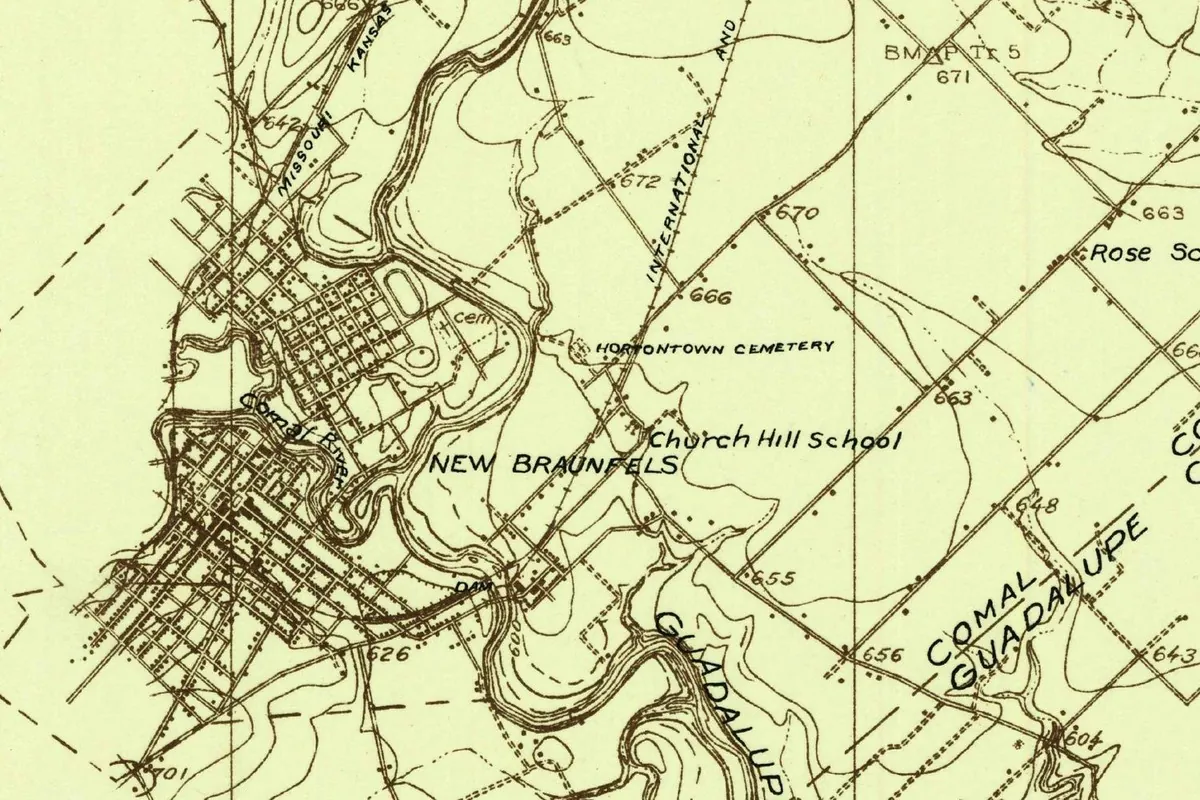
The town is drawn right at the west border of the sheet, and some of its streets spill over the neatline into the margin. The crop shows its street grid on both sides of the Comal River, a dam marked “DAM” near where the Comal reaches the Guadalupe, a cemetery marked “cem,” Hortontown Cemetery, Church Hill School, the International railroad and the Comal-Guadalupe county line. Farther north on the same sheet, you can find Gruene, Gruene Station and Goodwin.
Quick answers
What is New Braunfels named after?
Braunfels, on the Lahn River in Germany, home of the Solms family. One Handbook of Texas entry calls it Prince Carl’s estate, and another calls it the family’s ancestral castle; Gannett called it a town in Prussia.
Who founded New Braunfels?
German immigrants of the Adelsverein, led by Nicolaus Zink, on March 21, 1845, at a site Prince Carl of Solms-Braunfels had chosen, according to the Handbook.
What does Sophienburg mean?
Sophie’s Castle. The museum says Prince Carl named his fort for his fiancée, Princess Sophie.
Where is the original Braunfels?
On the Lahn, southwest of the town of Wetzlar, according to Lich and Moltmann. Gannett, in 1905, placed it in Prussia.
Key dates
- 1844Prince Carl of Solms-Braunfels lands at Galveston on July 1 as commissioner-general of the Adelsverein.
- 1845Nicolaus Zink leads the German settlers to the Comal on March 21; by summer the community is incorporated as New Braunfels.
- 1850By one report, New Braunfels ranks fourth in size among Texas towns.
- 1852The Neu Braunfelser Zeitung prints its first issue.
- 1878H. D. Gruene builds his store in what becomes Gruene, now inside the city.
- 1905Henry Gannett traces the name to a town in Prussia.
- 1925The Geological Survey puts out an advance sheet of the New Braunfels No. 1 quadrangle, surveyed in 1924 and 1925.
- 1933The Sophienburg Museum is founded on the hill where Prince Carl laid his fort's cornerstone.
- 1936Landa Park opens to the public as a city park.
Things to do in New Braunfels, Texas
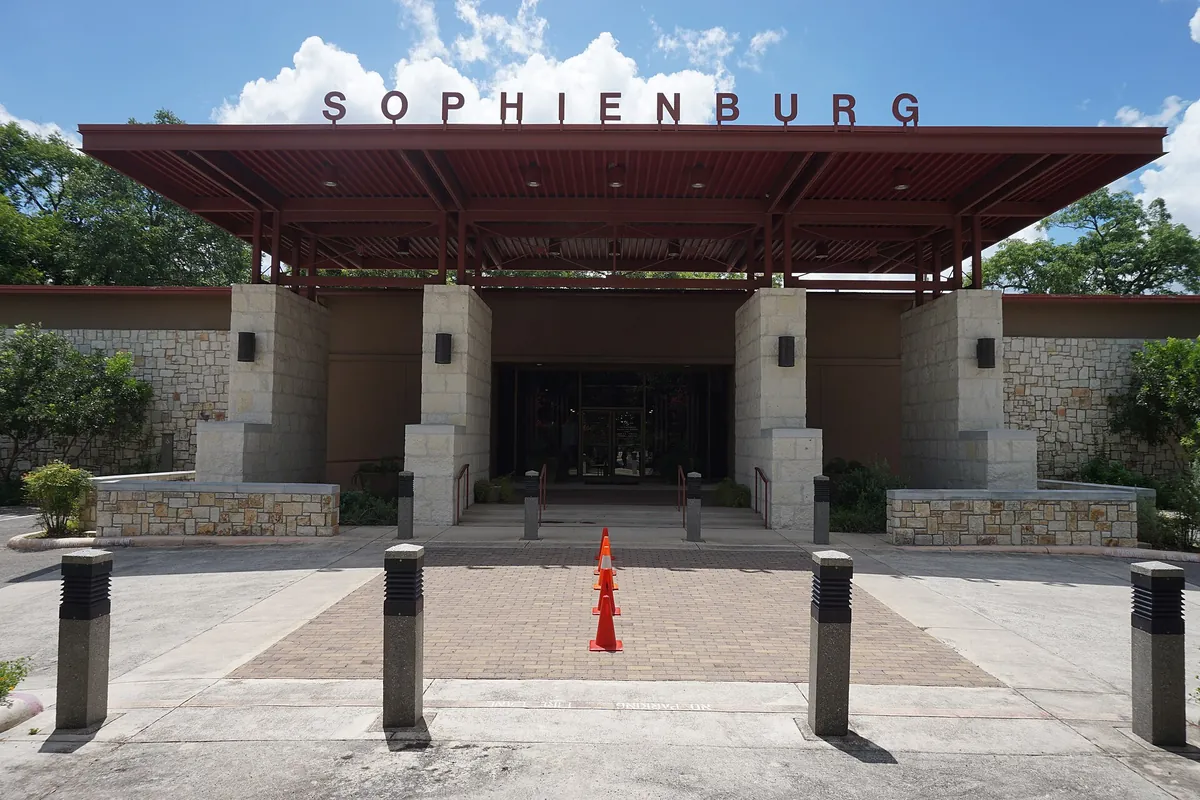
Sophienburg Museum and Archives
A museum founded in 1933 on the spot where Prince Carl laid the cornerstone of the first Sophienburg in 1845. Exhibits follow the German immigrants, and the archives hold more than a million images and records, newspapers back to 1852 included.
Landa Park
A 51-acre (21 ha) city park built around Comal Springs, which the city calls "the largest springs in Texas and the North American Southwest." The Landa family owned it from 1847 to 1927, and the public got in starting in 1936.
Panther Canyon Nature Trail
About 1.8 miles (2.9 km) of trails on 49 acres (20 ha), starting in Landa Park near the head of Comal Springs and climbing the Balcones Escarpment under oaks and Ashe juniper.
Gruene Historic District
A cotton town on the Guadalupe that's now part of New Braunfels, with H. D. Gruene's 1878 store and Gruene Hall, a 6,000-square-foot (557 m²) open-air dance hall. The Handbook of Texas says "the entire town is on the National Register of Historic Places."
Getting there
Open New Braunfels in Google Maps
Opens in a new tab. The pin is the center of New Braunfels in the USGS place-name record.
The closest airports, Amtrak stations and intercity bus stops, measured in a straight line from the center of New Braunfels.
Airports
- San Antonio International (SAT) 24 mi 38 km
- Austin-Bergstrom International (AUS) 44 mi 70 km
Amtrak trains
- San Marcos station (SMC) 16 mi 26 km
- San Antonio station (SAS) 29 mi 47 km
Intercity buses
- FlixBus San Marcos CARTS 16 mi 26 km
- Greyhound Comfort (Chevron) 51 mi 81 km
Distances are as the crow flies, not by road. We don't list schedules or fares because they change; check with the airline, Amtrak or the bus company before you go. Official data (FAA commercial service airports (2025), FAA airport locations, Amtrak stations and Intercity Bus Atlas) from the FAA and the U.S. Bureau of Transportation Statistics, checked Nov 18, 2026.
Sponsored
Staying in New Braunfels?
Compare hotels in New Braunfels, Texas, on Expedia.
See hotels in New BraunfelsWe may earn a commission if you buy through this link. It never changes what we write. Read our affiliate disclosure
Historical Sources & References
- Daniel P. Greene, “New Braunfels, TX,” Handbook of Texas Online. March 21, 1845, Zink, Comal Creek, the Zinkenburg and Sophienburg, Meusebach, incorporation “under the name of Prince Solms’s estate on the Lahn River,” 1850, the Zeitung and Landa Park.
- Glen E. Lich and Günter Moltmann, “Solms-Braunfels, Prince Carl of,” Handbook of Texas Online. His names and birth, the Adelsverein, Galveston in 1844, Carlshafen, Good Friday 1845, “the Solms ancestral castle on the Lahn River, southwest of Wetzlar,” May 15, 1845, and the marriage of December 3, 1845.
- Henry Gannett, The Origin of Certain Place Names in the United States (1905), p. 223. “Named from the town in Prussia.” Checked against the page image.
- Sophienburg Museum and Archives, “About”. The museum of 1933, “Sophie’s Castle” and Princess Sophie.
- Handbook of Texas Online, “Gruene, TX”. Goodwin, H. D. Gruene’s store of 1878 and the change of name.
- City of New Braunfels, Landa Park and Panther Canyon Nature Trail; Gruene Historic District, “History”. The details in the things-to-do list.
- U.S. Geological Survey, GNIS feature 1342440. New Braunfels in Comal County.
- New Braunfels No. 1 quadrangle, surveyed 1924-25, advance sheet of 1925. The sheet the map at the top was cropped from.
Sponsored
Put this 1925 map on your wall
The Geological Survey's 1925 advance sheet for New Braunfels, surveyed in 1924-25 with the Texas Board of Water Engineers, with Gruene to the north, is in the public domain. Download the full-size scan for free, then have it printed on canvas with CanvasOnTheCheap.
Print a map on canvasDownload the full-size mapWe may earn a commission if you buy through this link. It never changes what we write. Read our affiliate disclosure
Spot something wrong, or know more? Tell us here. You can also email us or use our contact page. Corrections are noted here with their date, never made silently.