New Ulm, Minnesota: Named for Ulm by Its German Settlers
New Ulm is named for Ulm, a city on the Danube in Württemberg, Germany. Henry Gannett wrote in 1905 that immigrants named it for their native city, and Warren Upham's 1920 state gazetteer says 20 of the first 32 settlers, who arrived in 1854, came from the village of Erbach, near Ulm.
New Ulm, Minnesota, is named for Ulm, a Danube city in Württemberg, by German settlers who reached the Minnesota River by way of Chicago and Cincinnati. Most of the first company, Upham wrote, came from one village near Ulm. He also noted another town with almost the same name, right across the Danube from Ulm.
Twenty of thirty-two from near Ulm
The fullest account of the name comes from Warren Upham’s Minnesota Geographic Names, published by the Minnesota Historical Society in 1920. New Ulm, he wrote, “was named for Ulm in Germany, near the village of Erbach, which was, according to the late Hon. William Pfaender, the place of emigration of twenty in thirty-two of the first company of pioneer settlers, who came in the autumn of 1854.”
Henry Gannett’s one-liner from 1905 is simpler: the city was “named by immigrants from their native city of Ulm, Germany.” The Minnesota Historical Society says the town was named for Ulm in Württemberg, “the home region of many of the immigrants.” The Advisory Council on Historic Preservation agrees that many of the original settlers came from Ulm.
Upham also describes the old city: an important city of Württemberg on the northwest side of the Danube, at the head of navigation. Then he adds, “On the opposite Bavarian side of the Danube is Neu Ulm,” which had 9,215 people in 1900. He doesn’t say whether the Minnesota settlers had it in mind.
From Chicago and Cincinnati
The settlers didn’t come straight from Germany. Upham says the town was “founded in 1854-55 by German colonists, coming from Chicago and Cincinnati.” The Minnesota Historical Society fills in the order. In 1854, a German colonization association from Chicago picked a spot on the south bank of the Minnesota River near the mouth of the Cottonwood River for “their planned model town.” In 1856 it was joined by a society from Cincinnati that was affiliated with the Turner movement. The Advisory Council calls the Chicago group the Chicago Land Society.
The land had been Dakota homeland until the treaties of Traverse des Sioux and Mendota in 1851, the society notes, and the site was nine miles (14 km) from the edge of the strip set aside as a reservation for the Dakota. Upham says the legislature of Minnesota incorporated New Ulm as a town on March 6, 1857. It became a borough in 1870 and a city in 1876, and it’s the county seat of Brown County.
The town kept its German character in print. In January 1858, a German-language weekly called the Neu-Ulm Pionier, or “New Ulm Pioneer,” started publishing. The Advisory Council says that by the 1870s the town’s economy rested on four industries: flour, beer, cigars and bricks.
The attacks of August 1862
In August 1862, war broke out between the United States and the Dakota along the Minnesota River valley. The Minnesota Historical Society says a group of New Ulm residents had petitioned the governor on August 14, warning that payments owed to the Dakota had been delayed and that war was likely.
Dakota forces attacked New Ulm on August 19 and again on August 23. The first attack left five settlers dead, according to the society. The town elected Judge Charles Flandrau of St. Peter as its military commander, and more than 1,000 refugees crowded in, bringing the population to about 2,000, with only 300 able to fight. In the second battle, more than 600 Dakota soldiers fought under Chiefs Waƞbdiṭanka, Wabaṡa and Makato. The society calls it “the largest battle over a US town since 1776.”
At the end of the second day, the society says, the defenders “intentionally burned down most of what remained of the town.” On August 25, Flandrau led the evacuation of about 2,000 people to Mankato, St. Peter and St. Paul. The Pionier didn’t restart, and New Ulm went without a newspaper until 1864.
Hermann on the hill
A generation later, the town put its German heritage on the bluff. MNopedia says the statue there reflects the pride the early German American immigrants felt in their cultural background, and that Julius Berndt, “one of the founders of New Ulm,” persuaded the Sons of Hermann to fund a statue of Hermann, the Germanic chieftain who defeated three Roman legions in 9 CE. The cornerstone was laid on June 24, 1888. The Sons of Hermann dedicated the monument on September 25, 1897, and it rises 102 feet (31 m) with its base.
Other towns took European names for their own reasons. Solvang, California, got a Danish name in 1911 from the Danish Americans who started the colony. Bismarck, North Dakota, got a German one in 1873 because the railroad wanted German investors to notice.
New Ulm on the 1964 map
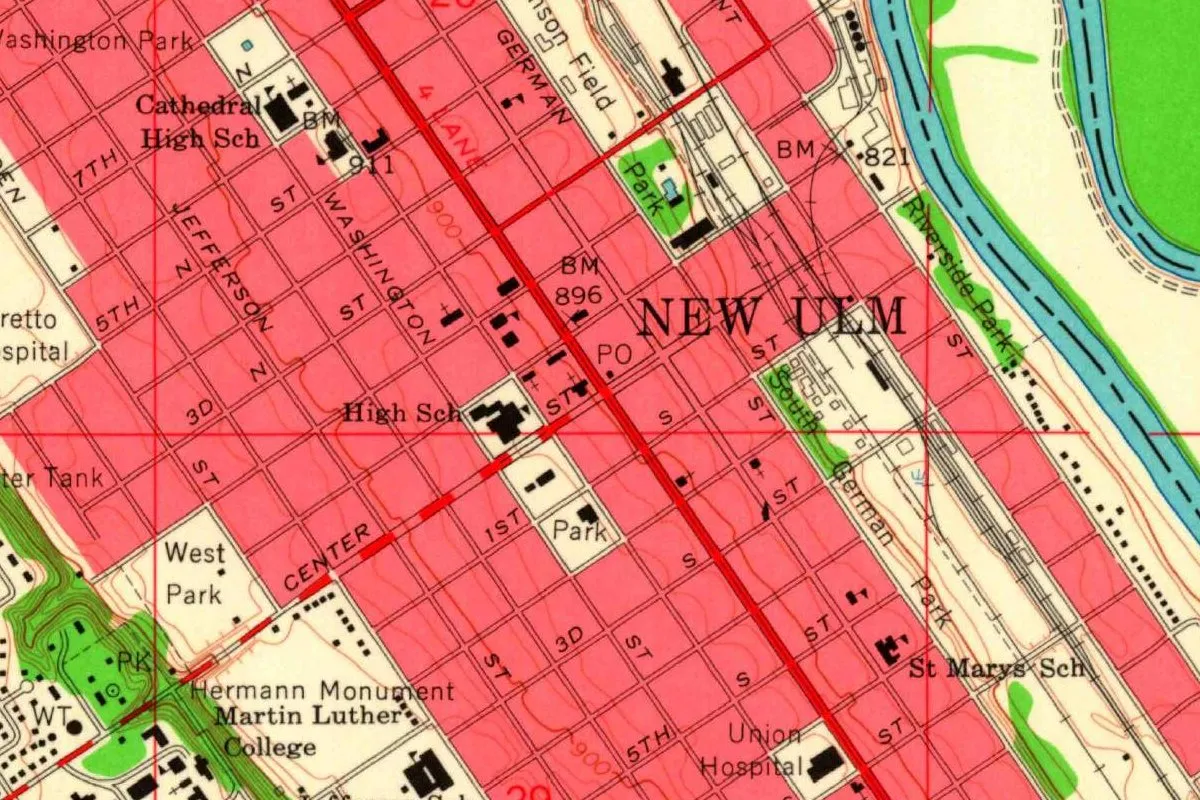
The map at the top of this page is a detail of the Geological Survey’s New Ulm quadrangle, made from aerial photographs taken in 1963 and field checked in 1964. This copy was printed in 1965, as the printer’s line in the margin shows. On the full sheet, you’ll find New Ulm on the west side of the Minnesota River, left of center, with the Cottonwood River coming in from the southwest below the town.
In this detail you can see the red-shaded grid of streets, with Martin Luther College and the Hermann Monument at the lower left and the strip of South German Park beside the rail yards, with a blue river at the right edge. The contour interval on the sheet is 10 feet (3 m).
Quick answers
Why is it called New Ulm?
For Ulm, a city on the Danube in Württemberg, Germany. Henry Gannett wrote that immigrants named it for their native city, and Warren Upham wrote that 20 of the first 32 settlers came from the village of Erbach, near Ulm.
Who founded New Ulm, Minnesota?
German colonists from Chicago and Cincinnati, according to Warren Upham. The Minnesota Historical Society says a Chicago colonization association chose the site in 1854 and a Cincinnati society tied to the Turner movement joined it in 1856.
Is there a Neu Ulm in Germany?
Yes. Upham wrote in 1920 that Neu Ulm lies on the Bavarian side of the Danube, opposite Ulm.
Key dates
- 1854A German colonization society from Chicago picks a site near the mouth of the Cottonwood River, and the first company of settlers arrives in the autumn.
- 1856A society from Cincinnati, tied to the Turner movement, joins the Chicago group.
- 1857The legislature incorporates New Ulm as a town on March 6.
- 1858The German-language weekly Neu-Ulm Pionier is founded in January.
- 1862Dakota forces attack New Ulm on August 19 and 23, and the town is evacuated on August 25.
- 1888The cornerstone of the Hermann Monument is laid on June 24.
- 1897The Sons of Hermann dedicate the monument on September 25.

Things to do in New Ulm, Minnesota
Hermann Monument
A copper-sheet statue of Hermann, the first-century Germanic chieftain who defeated Roman legions, on the bluffs above town. Designed by town founder Julius Berndt and dedicated in 1897, it reaches 102 feet (31 m) with its base, according to MNopedia.
Glockenspiel
A 45-foot (14 m) freestanding carillon with 37 bells weighing more than two tons, where figurines depicting important people, industries and traditions of New Ulm appear while the bells play.
Wanda Gág House
The restored Queen Anne-style house, built in 1894, where artist and author Wanda Gág grew up. She wrote and illustrated the children's classic Millions of Cats.
Brown County Historical Society Museum
The county museum and research library, housed in New Ulm's 1910 federal post office building, a German Renaissance-style building with its original slate roof that was placed on the National Register of Historic Places in 1976.
Getting there
Open New Ulm in Google Maps
Opens in a new tab. The pin is the center of New Ulm in the USGS place-name record.
The closest airports, Amtrak stations and intercity bus stops, measured in a straight line from the center of New Ulm.
Airports
- Minneapolis-St Paul International/Wold-Chamberlain (MSP) 73 mi 117 km
- St Cloud Sky Central (STC) St. Cloud 87 mi 141 km
Amtrak trains
- St. Paul-Minneapolis station (MSP) 81 mi 130 km
- St. Cloud station (SCD) 88 mi 142 km
Intercity buses
- Land to Air Express Madelia 18 mi 29 km
- Jefferson Lines Fairmont 44 mi 71 km
Distances are as the crow flies, not by road. We don't list schedules or fares because they change; check with the airline, Amtrak or the bus company before you go. Official data (FAA commercial service airports (2025), FAA airport locations, Amtrak stations and Intercity Bus Atlas) from the FAA and the U.S. Bureau of Transportation Statistics, checked Nov 18, 2026.
Sponsored
Staying in New Ulm?
Compare hotels in New Ulm, Minnesota, on Expedia.
See hotels in New UlmWe may earn a commission if you buy through this link. It never changes what we write. Read our affiliate disclosure
Historical Sources & References
- Warren Upham, Minnesota Geographic Names (1920), p. 70. Ulm, Erbach and William Pfaender’s twenty of thirty-two, the colonists from Chicago and Cincinnati, the dates of incorporation, and Neu Ulm across the Danube. Checked against the page image.
- Henry Gannett, The Origin of Certain Place Names in the United States (1905), p. 224. “Named by immigrants from their native city of Ulm, Germany.”
- Minnesota Historical Society, “Neu-Ulm Pionier”. The Chicago association of 1854, the Cincinnati Turners of 1856, the treaties of 1851, the newspaper of 1858, and the burning of the town in 1862.
- Minnesota Historical Society, “Attacks on New Ulm”. The petition of August 14, the attacks of August 19 and 23, 1862, and the evacuation of August 25.
- Advisory Council on Historic Preservation, New Ulm, Minnesota. The Chicago Land Society, the settlers from Ulm, the four industries, and the 1910 post office.
- MNopedia, “‘Hermann the German’ Monument”. Julius Berndt, the cornerstone of 1888 and the dedication of 1897.
- City of New Ulm, Glockenspiel and Wanda Gág House. The carillon and the house of 1894.
- New Ulm in GNIS, feature 648523 (U.S. Geological Survey). The city’s listing as a populated place in Brown County, with its coordinates.
- U.S. Geological Survey, New Ulm quadrangle (1964, printed 1965). The 1:24,000 sheet the map at the top was cropped from.
Spot something wrong, or know more? Tell us here. You can also email us or use our contact page. Corrections are noted here with their date, never made silently.