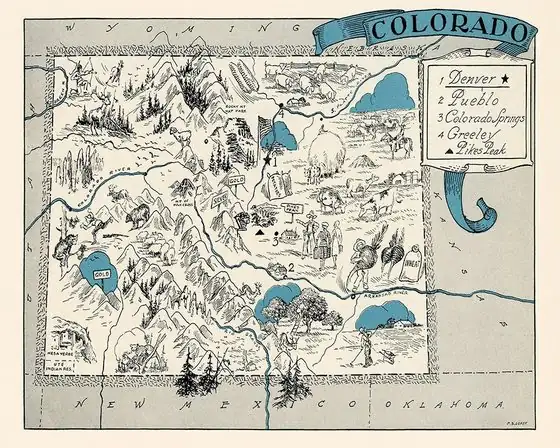
Grand Junction, Colorado: Named for a River That Was Renamed
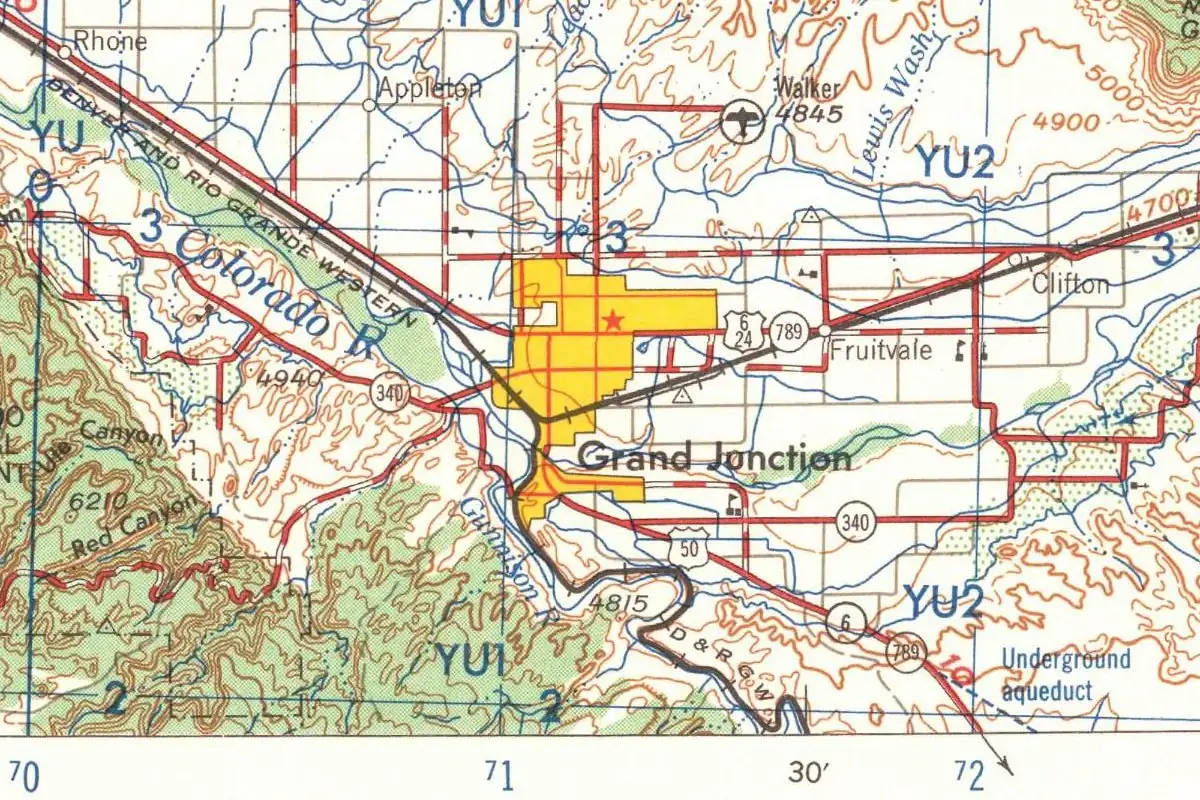
Grand Junction, Colorado, is named for a meeting of two rivers, and one of those rivers hasn’t been called the Grand since 1921. The town kept the old name after the river lost it.
A townsite staked in a hurry
The Grand Valley was Ute country until 1881. The Federal Writers’ Project’s 1941 guide to the state is blunt about it. The Utes gave up their claims in 1880, it says, and “the next year were removed forcibly to Utah so that the valley might be opened to settlement.” Settlers came in so fast “when the opening gun was fired on September 4, 1881, that they caught sight of the rear guard of the retreating Ute.”
Among them was “a party of five men from Gunnison, headed by George A. Crawford,” a former governor of Kansas who had a reputation, the guide says, for founding a new town “every decade or so.” They staked a townsite where two rivers meet.
Ute, West Denver, then Grand Junction
The town went through two names first. “The settlement was first called Ute, then West Denver,” the guide goes on, “and was finally named for its site at the junction of the Gunnison and the Colorado (formerly the Grand) Rivers.” J. Frank Dawson’s 1954 book of Colorado place names agrees: “So named because of its location at the junction of the Colorado and Gunnison Rivers. Once called UTE, also WEST DENVER.” Henry Gannett, the government geographer, had said it in 1905 with the old river name: the town was “so named because of its location at the junction of the Gunnison and Grand rivers.”
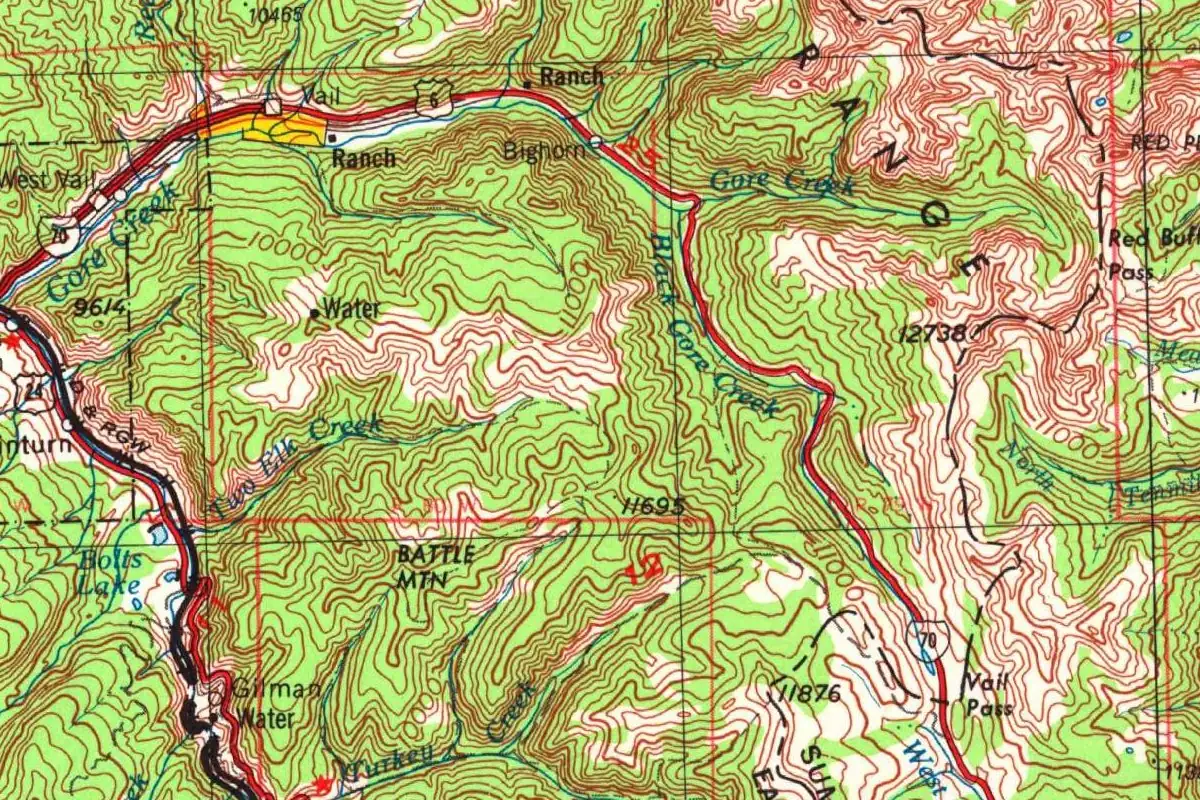
You’ll notice neither source says who picked “Grand Junction” or exactly when Ute and West Denver were dropped. The guide does say the town incorporated in December 1881, so the new name was settled quickly. On the Geological Survey’s 1959 sheet you can pick out the meeting point itself, with the Gunnison coming in from the south.
When the Grand became the Colorado
Here’s the twist. In 1881 the river coming down from the east wasn’t the Colorado. Upstream of the junction it was the Grand River, which is the “Grand” in the town’s name. The government’s own record for the state of Colorado explains what happened next: “In 1921, Congress changed the name of the Grand River, a tributary of the Colorado River, so that part of the Colorado River would flow through the State.”
So the state got a Colorado River of its own, and Grand Junction lost its namesake. If you want the longer version of why the state’s name and the river didn’t match, it’s in the story of Colorado itself. Grand Junction’s own entry, with the government’s official spelling and location, has no history note.
Rails to go with the rivers
The junction of rivers became a junction of rails, too. The guide says the narrow-gauge Denver & Rio Grande “from Gunnison in 1882 gave the town its first rail outlet.” In 1883 Mesa County was created, with Grand Junction as its seat, and the town “boomed with the coming of the main line of the Denver & Rio Grande Railroad in 1887.” By 1941 it was “primarily a railroad and manufacturing city,” and the Denver & Rio Grande Western shops there were “the largest on the Western Slope,” with the biggest payroll in town.
The rivers still meet where Crawford’s party staked its claim, but only one of them still has the name it had then.
Quick answers
Why is it called Grand Junction?
Because it sits at the junction of the Gunnison and Grand rivers, as Henry Gannett put it in 1905. The 1941 state guide and Dawson (1954) give the same reason, using the river’s newer name, the Colorado.
What was Grand Junction called before?
Ute, then West Denver. Both the 1941 guide and Dawson (1954) list those two names.
When did the Grand River become the Colorado River?
In 1921, when Congress changed the name, according to the federal record for the state of Colorado.
Key dates
- 1881September 4: the Grand Valley opens to settlement after the Utes are forced out. Crawford's party stakes a townsite, incorporated in December.
- 1882The narrow-gauge Denver & Rio Grande arrives from Gunnison.
- 1883Mesa County is created, with Grand Junction as its seat.
- 1887The Denver & Rio Grande's main line reaches town.
- 1921Congress renames the Grand River the Colorado.
Getting there
Open Grand Junction in Google Maps
Opens in a new tab. The pin is the center of Grand Junction in the USGS place-name record.
The closest airports, Amtrak stations and intercity bus stops, measured in a straight line from the center of Grand Junction.
Airports
- Grand Junction Regional (GJT) 4 mi 7 km
- Montrose Regional (MTJ) 52 mi 84 km
Amtrak trains
- Grand Junction station (GJT) 1 mi 2 km
- Glenwood Springs station (GSC) 74 mi 119 km
Intercity buses
- Colorado Department of Transportation Bustang · Grand Junction Downtown Transfer Facility under 1 mi 1 km
- Bustang Outrider Bustang · Grand Valley Downtown Transfer Facility under 1 mi 1 km
- Greyhound Town of Parachute - Parachute, CO 38 mi 62 km
Distances are as the crow flies, not by road. We don't list schedules or fares because they change; check with the airline, Amtrak or the bus company before you go. Official data (FAA commercial service airports (2025), FAA airport locations, Amtrak stations and Intercity Bus Atlas) from the FAA and the U.S. Bureau of Transportation Statistics, checked Nov 6, 2026.
Sponsored
Staying in Grand Junction?
Compare hotels in Grand Junction, Colorado, on Expedia.
See hotels in Grand JunctionWe may earn a commission if you buy through this link. It never changes what we write. Read our affiliate disclosure
Historical Sources & References
- Federal Writers’ Project, Colorado: A Guide to the Highest State (1941), pp. 158-160. The opening of September 4, 1881, George A. Crawford’s party from Gunnison, “first called Ute, then West Denver,” the “(formerly the Grand)” river, incorporation in December 1881 and the Denver & Rio Grande lines of 1882 and 1887.
- J. Frank Dawson, Place Names in Colorado (1954). “So named because of its location at the junction of the Colorado and Gunnison Rivers. Once called UTE, also WEST DENVER.”
- Henry Gannett, The Origin of Certain Place Names in the United States (1905), p. 141. “So named because of its location at the junction of the Gunnison and Grand rivers.”
- GNIS feature 1779779, Colorado (U.S. Geological Survey). The state’s record: “In 1921, Congress changed the name of the Grand River.”
- GNIS feature 204662 (U.S. Geological Survey). Grand Junction’s entry, with the government’s official spelling and location in Mesa County.
Spot something wrong, or know more? Tell us here. You can also email us or use our contact page. Corrections are noted here with their date, never made silently.