Stamford, Connecticut: Rippowams Renamed in 1642
Stamford was named in 1642, when the General Court of the New Haven jurisdiction recorded that "the plantatio of Rippowams is named Stamforde." The settlers had asked to change the name. Connecticut's state register says it came from Stamford in Lincolnshire, England, though Stamford's 1868 historian couldn't prove which English Stamford was meant.
Stamford, Connecticut, got its name from one line in a 1642 court record, “The plantatio of Rippowams is named Stamforde,” which doesn’t say why. Stamford’s 1868 historian couldn’t even settle which English Stamford the settlers had in mind.
Seven words in the New Haven records
The line sits on page 69 of the printed Records of the Colony and Plantation of New-Haven, under the heading for a General Court held on “the 6th of the 2d Moneth, 1642.” The Stamford Historical Society gives that date as April 6, 1642. The court admitted new freemen, two of them “of Rippowams,” chose deputies for the next half year, and then got to it:
“The plantatiō of Rippowams is named Stamforde.”
That’s all the record says about the name. The very next entry already uses the new name, when “the Deputyes for Stamforde” complained that their plantation was “att some difference” with the Indians and asked the court for advice.
Why did New Haven get to decide? Because Rippowams belonged to it. The Historical Society says Stamford was set up as a settlement of the New Haven Colony, and one of the society’s mural texts says the Puritans of Rippowam “appealed to the New Haven jurisdiction for permission to change the name of their plantation.” In 1642, it adds, they got permission to use the name Stamford.
Rippowams, before the new name
The land deal came first. In 1640, the Historical Society says, Theophilus Eaton and the Rev. John Davenport of New Haven sent Captain Nathaniel Turner west “to the lands then called Rippowams or Toquams.” In exchange for 12 coats, 12 hoes, 12 hatchets, 12 looking glasses, 12 knives, 2 kettles and 4 fathoms of white wampum, Ponus, “Sagamore of Toquams,” and Wascusse, “Sagamore of Shippan,” “sold” the area, keeping some planting lands. The society puts that word in quotation marks itself, and says, “It is unlikely that the native Siwanoy … understood what was intended by this exchange.” Later treaties in 1655, 1662 and 1701 added payments to Ponus and his descendants.
The settlers came from Wethersfield, where the church had split. On October 19, 1640, twenty men formed the Rippowam Company to buy the land from New Haven, and nine more joined. The price was 33 pounds, paid in corn. The Rev. Richard Denton led the way, and by the spring of 1641, 29 men and their families had arrived.
None of the sources here translates Rippowam, so we won’t either. The word didn’t vanish, though. The mural text says the settlers’ gristmill stood at “Mill River, now the Rippowam River.”
Which Stamford?
England has more than one Stamford, and the 1642 record doesn’t pick. Connecticut’s official list of its towns does. It says Stamford was “settled in 1641; named 1642 from Stamford in Lincolnshire,” and gives the Indian name as “Rippowam.” The Historical Society agrees, more carefully: “It is believed” the English town was Stamford, Lincolnshire.
The oldest explanation on record is vaguer. In his centennial address of 1841, the Rev. Mr. Alvord said, “Our fathers in changing the name,” from Rippowams, “called the town after Stamford in England, which place was doubtless the former residence of some of them.” E. B. Huntington quoted that in his 1868 History of Stamford and called it “a most natural conclusion, and one which we shall be able, neither to prove or disprove.”
Huntington laid out three candidates and admitted he couldn’t settle it:
- Stamford Bridge, in Yorkshire. He noted that the spelling of that name, “as reported by Hume is precisely that which we find on our earlier records.”
- “That other Stamford of England, on the extreme western borders of Worcestershire,” which he thought matched the Connecticut town’s spot at the far western edge of New England.
- Stamford in Lincolnshire, “as has been generally supposed,” another town on the southwestern edge of its county.
He also checked the settlers. “Our utmost diligence has failed to trace a single family to the Lincolnshire Stamford,” he wrote. His own guess leaned on Denton, who he said “had his nativity” not far from the Lincolnshire Stamford, “on the borders of Leicestershire.” It was “not improbable,” Huntington thought, that the minister picked a name he remembered from boyhood. That’s his conjecture, and he presented it that way.
The name and the date are documented. The English town is Lincolnshire according to the state, with Stamford’s own 19th-century historian on record saying he couldn’t prove it.
A New Haven town that ended up in Connecticut
Stamford didn’t stay under New Haven. The Historical Society says the town “chafed” under New Haven’s rule, and that when Charles II granted Connecticut its charter in 1662, the New Haven Colony’s towns were folded into Connecticut. The Connecticut State Library dates Stamford’s submission to Connecticut to October 1662.
The name never changed again, but the government did. In 1893, the State Library says, a City of Stamford was incorporated inside the Town of Stamford, leaving two governments side by side. They were consolidated on April 15, 1949, as the City of Stamford. Pieces of the old town went to new ones along the way, too. The state list says Norwalk and Stamford both gave land to New Canaan in 1801, and Darien was formed from Stamford in 1820.
Gannett’s name on the 1892 map
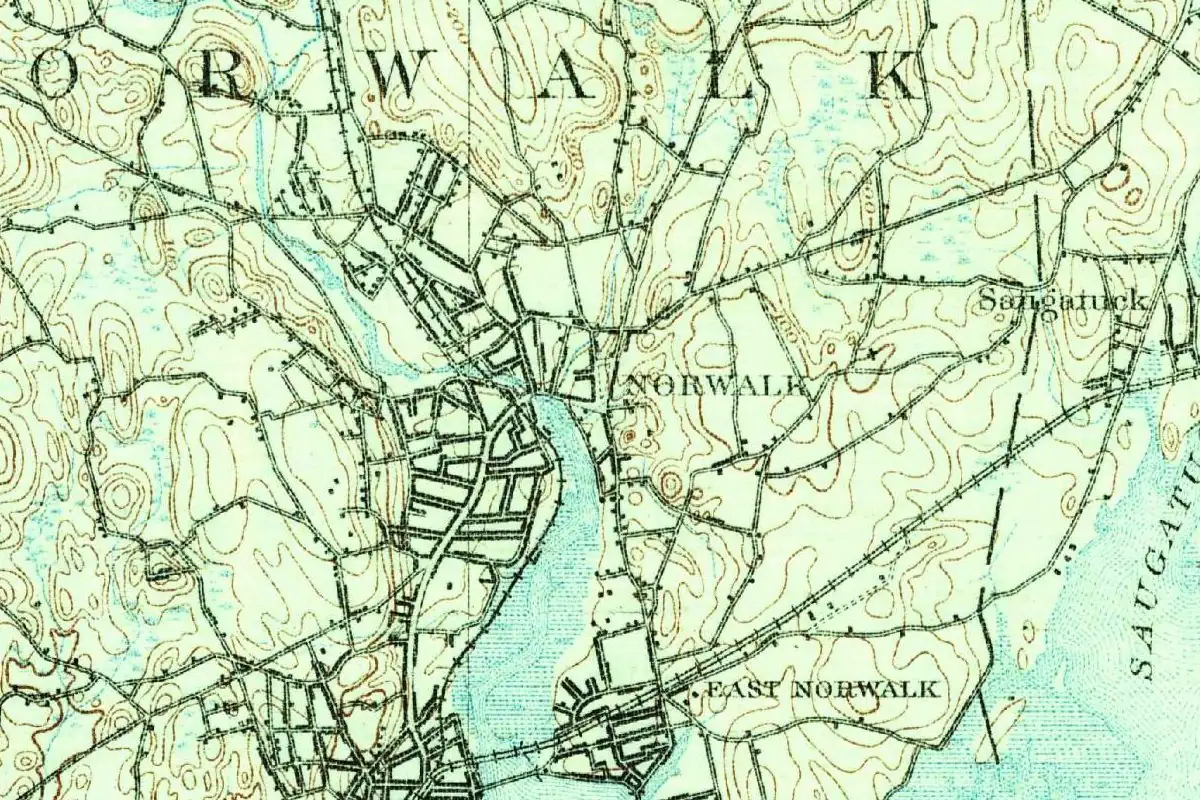
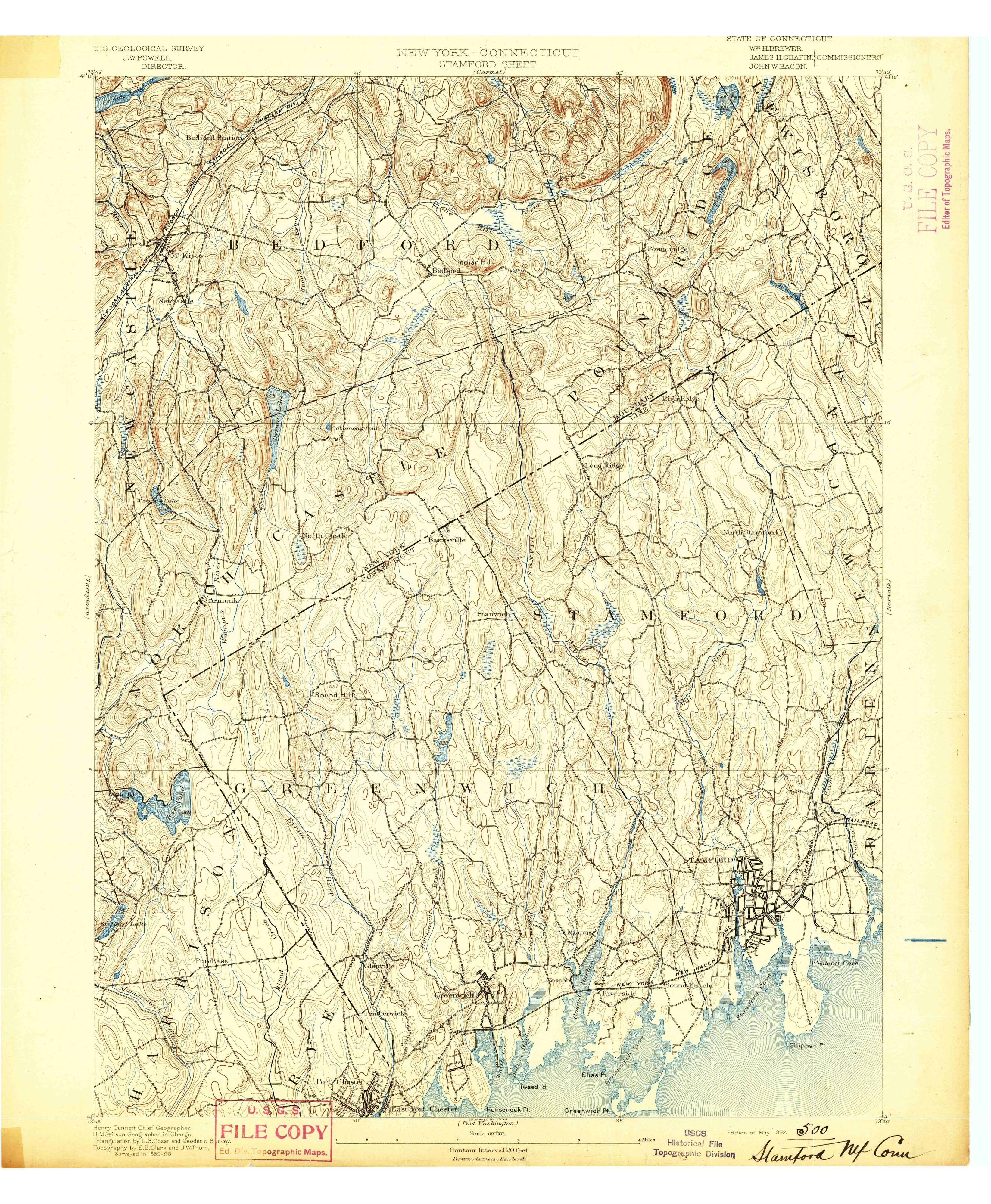
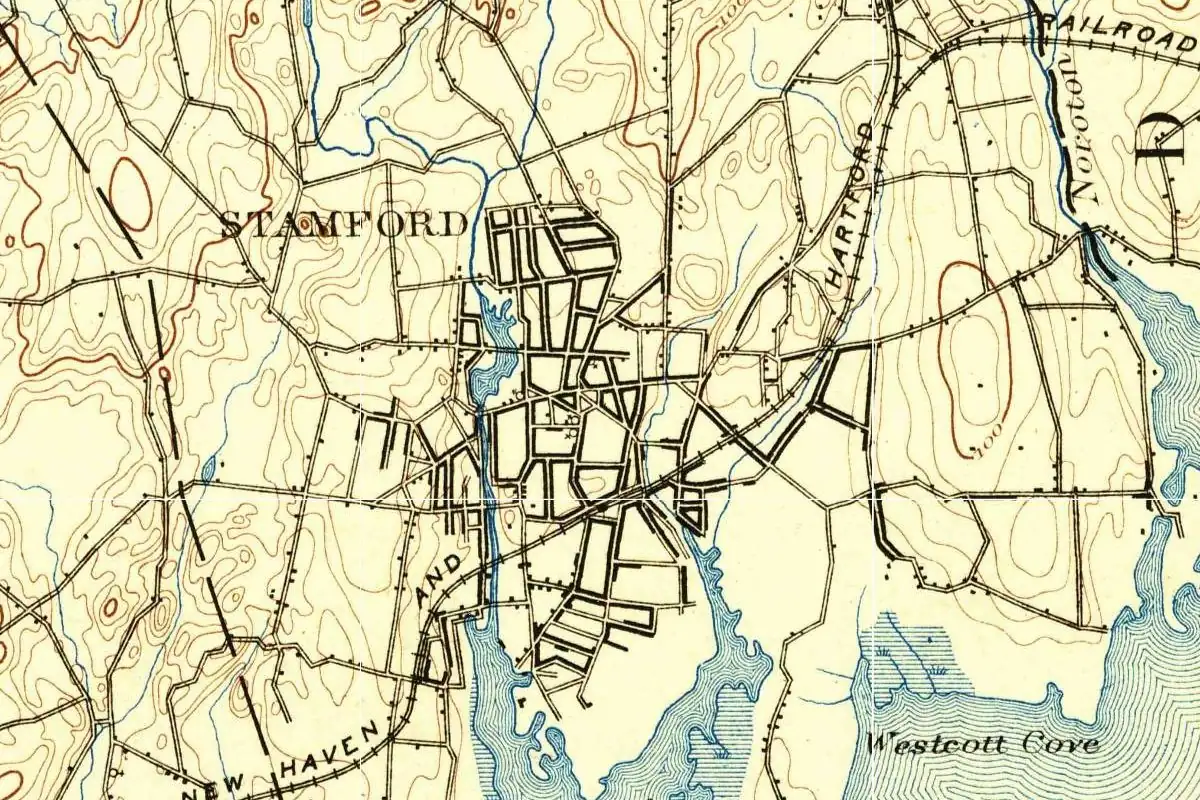
The map at the top of this page comes from the Geological Survey’s “Stamford Sheet,” which covered both New York and Connecticut. Its margin says the area was surveyed in 1889-90 and that this is the edition of May 1892. In the bottom left corner is a credit line you might not expect: “Henry Gannett, Chief Geographer.”
That’s the Henry Gannett who signed the Geological Survey’s 1905 bulletin The Origin of Certain Place Names in the United States as its geographer. The bulletin has no entry for Stamford, Connecticut, so the town’s name story doesn’t get his help, only his signature on the map.
If you want more towns that took the names of English places, Connecticut’s list has plenty, New London among them. Our Connecticut page has the rest.
Quick answers
Why is it called Stamford, Connecticut?
Because the General Court of the New Haven jurisdiction renamed the plantation of Rippowams in 1642: “The plantatio of Rippowams is named Stamforde.” The record doesn’t explain the choice.
Is Stamford, CT, named after Stamford, England?
Yes, after an English Stamford. Connecticut’s state register says Stamford in Lincolnshire. E. B. Huntington wrote in 1868 that Lincolnshire was “generally supposed,” but he couldn’t prove it and also considered Stamford Bridge in Yorkshire and a Stamford in Worcestershire.
What was Stamford, CT, called before?
Rippowams, or Rippowam. The Historical Society says the land was also called Toquams when New Haven bought it in 1640.
When was Stamford founded?
Settlers from Wethersfield arrived in 1641, and the name Stamford was adopted in 1642. The Connecticut State Library lists 1641 as the settlement date.
Key dates
- 1640Captain Nathaniel Turner buys the lands called Rippowams or Toquams for the New Haven Colony; that October, Wethersfield men form the Rippowam Company.
- 1641By spring, 29 men and their families from Wethersfield have arrived at Rippowams.
- 1642New Haven's General Court records that "the plantatio of Rippowams is named Stamforde."
- 1662Stamford submits to Connecticut.
- 1841The Rev. Mr. Alvord's centennial address says the town was called after Stamford in England.
- 1868E. B. Huntington's History of Stamford weighs three English Stamfords and can't prove any of them.
- 1893The City of Stamford is incorporated inside the Town of Stamford.
- 1949Town and city are consolidated on April 15 as the City of Stamford.
Things to do in Stamford, Connecticut
Stamford Museum & Nature Center
A museum of art, history and natural science where you can walk more than 80 acres (32 ha) of nature trails, picnic on the Meadow, visit the farm animals and see the galleries.
Heckscher Farm
A 10-acre (4 ha) working farm at the Stamford Museum & Nature Center, opened in 1955, with barns including the Cheshire Barn built in 1750, an organic vegetable garden and a maple sugar house.
Mill River Park
Stamford's central park, along the Mill River in the heart of downtown. A nonprofit collaborative created in 2003 runs it with the city, carrying on a plan begun in 1997 to restore the river and reclaim green space.
First Presbyterian Church (the Fish Church)
A church known locally as the Fish Church, with a mid-century modern landmark sanctuary on a 10-acre (4 ha) campus.
Getting there
Open Stamford in Google Maps
Opens in a new tab. The pin is the center of Stamford in the USGS place-name record.
The closest airports, Amtrak stations and intercity bus stops, measured in a straight line from the center of Stamford.
Airports
- Westchester County (HPN) White Plains 9 mi 14 km
- Laguardia (LGA) New York 26 mi 42 km
Amtrak trains
- Stamford station (STM) under 1 mi 0.8 km
- New Rochelle station (NRO) 16 mi 26 km
Intercity buses
- OurBus Stamford, CT (Tresser Blvd & Elm Street. Bus stop on Tresser Blvd, across from 4 Stamford Plaza. (note please do not wait in the apartment parking lot)) under 1 mi 0.5 km
- Greyhound Stamford Station Pl under 1 mi 0.8 km
- Orange Westchester Link Westchester Ave & Kenilworth Rd 9 mi 15 km
Distances are as the crow flies, not by road. We don't list schedules or fares because they change; check with the airline, Amtrak or the bus company before you go. Official data (FAA commercial service airports (2025), FAA airport locations, Amtrak stations and Intercity Bus Atlas) from the FAA and the U.S. Bureau of Transportation Statistics, checked Nov 14, 2026.
Sponsored
Staying in Stamford?
Compare hotels in Stamford, Connecticut, on Expedia.
See hotels in StamfordWe may earn a commission if you buy through this link. It never changes what we write. Read our affiliate disclosure
Historical Sources & References
- Records of the Colony and Plantation of New-Haven, from 1638 to 1649 (1857), p. 69. The General Court of “the 6th of the 2d Moneth, 1642” and the line “The plantatiō of Rippowams is named Stamforde,” followed by the complaint of “the Deputyes for Stamforde.” Checked against the page image. In the summary and Quick answers, the abbreviation mark over “plantatiō” is dropped.
- E. B. Huntington, History of Stamford, Connecticut (1868), pp. 8-10. Alvord’s 1841 explanation (p. 8), the three English candidates and the failure to trace any family to Lincolnshire (pp. 8-9), and the conjecture about Denton (p. 10). Checked against the page images.
- Connecticut Secretary of the State, “Connecticut Towns in the Order of their Establishment”. Stamford “named 1642 from Stamford in Lincolnshire,” the Indian name “Rippowam,” and the later towns of New Canaan (1801) and Darien (1820).
- Connecticut State Library, “Connecticut Towns and Counties”. Settlement in 1641 under New Haven, the name in 1642, submission to Connecticut in October 1662, the city of 1893 and the consolidation of April 15, 1949.
- Stamford Historical Society, “Stamford’s Colonial Period 1641-1783”. The 1640 purchase and the society’s caution about it, the Rippowam Company, Denton and the 29 families, April 6, 1642, and the belief that the English town was in Lincolnshire.
- Stamford Historical Society, “Settlers observe the Sabbath”. The settlers’ appeal to New Haven for permission to change the name, and the gristmill at “Mill River, now the Rippowam River.”
- Henry Gannett, The Origin of Certain Place Names in the United States, 2nd ed. (1905), p. 5. The letter of transmittal signed “Henry Gannett, Geographer.” The bulletin’s alphabetical list has no entry for Stamford, Connecticut.
- GNIS feature 211129 (U.S. Geological Survey). The GNIS entry for Stamford, with its coordinates.
- U.S. Geological Survey, Stamford sheet (1892). The 1:62,500 New York-Connecticut sheet, surveyed in 1889-90, with “Henry Gannett, Chief Geographer” in its margin; the image at the top of this page was cropped from it.
Sponsored
Put this 1892 map on your wall
The 1892 USGS Stamford sheet is in the public domain. Download the full-size scan for free, then have it printed on canvas with CanvasOnTheCheap.
Print a map on canvasDownload the full-size mapWe may earn a commission if you buy through this link. It never changes what we write. Read our affiliate disclosure
Spot something wrong, or know more? Tell us here. You can also email us or use our contact page. Corrections are noted here with their date, never made silently.