Litchfield, Connecticut: An English Name With an Extra T
Litchfield is named for Lichfield in Staffordshire, England, according to Connecticut's State Register, Payne Kenyon Kilbourne's 1859 town history and the National Park Service. The General Assembly gave the name when it incorporated the town in May 1719. Kilbourne wrote that the 't' was added, 'probably by the legislative clerk.' Before that, the place was called Bantam.
Litchfield, Connecticut, took its name in 1719 from Lichfield, a cathedral city in Staffordshire, England, and picked up a letter on the way. Connecticut’s own list of towns puts it in one line: “Litchfield, named and incorporated May, 1719, from Lichfield, a town of Staffordshire. Indian name, ‘Bantam.’” That entry, in the Secretary of the State’s Register and Manual, gives you both halves of the story: the English city, and the older name that came before it.
Where the T came from
Look at the two spellings side by side and you’ll see the problem. The English city has no T. Payne Kenyon Kilbourne, who published Sketches and Chronicles of the Town of Litchfield in 1859, had an explanation, and he hedged it:
“The Town, as we have seen, was first called Litchfield in the act of incorporation, passed during the May Session, 1719, and was so named from the ancient city of Lichfield, Staffordshire, England—the t being added, probably by the legislative clerk, and has ever since been retained.”
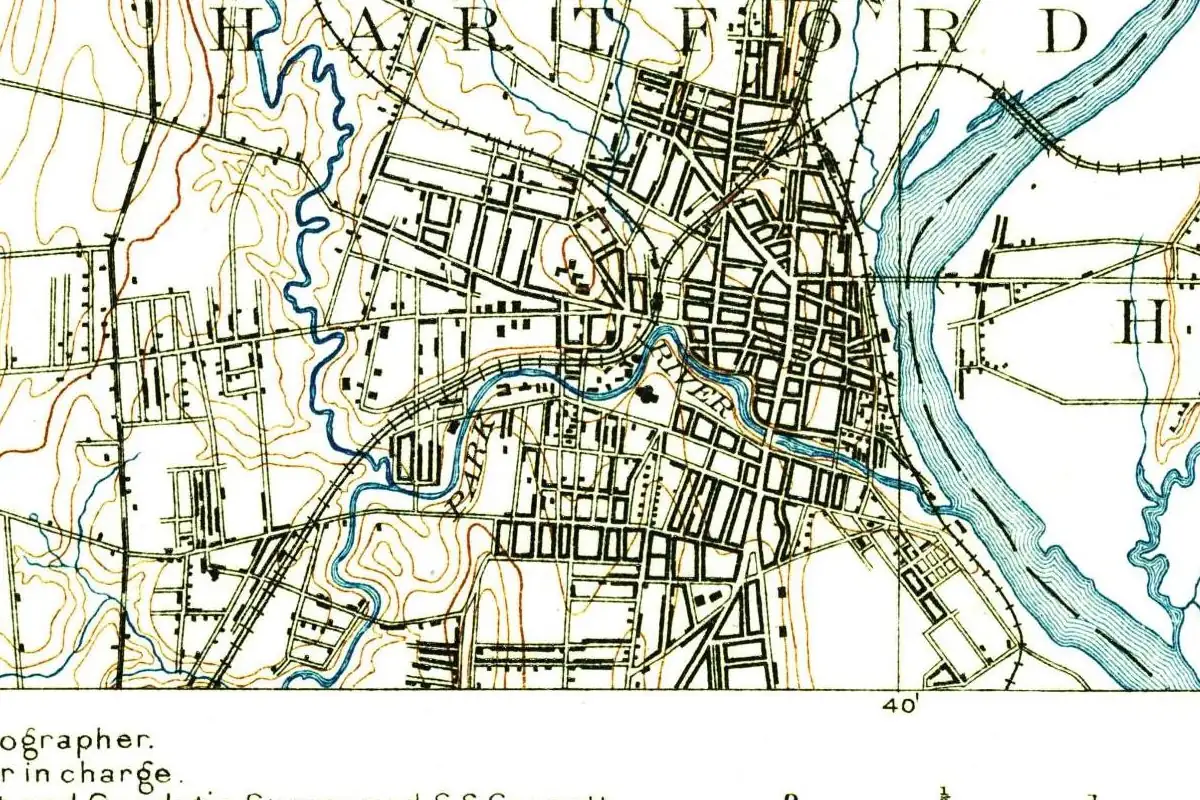
Kilbourne had been to Lichfield himself, in July 1855. He wrote “probably,” and he didn’t go further than that. Hartford is another Connecticut town that doesn’t spell its English namesake the same way: the town in England is Hertford. And if Kilbourne’s guess is right, Litchfield has company in Ravenswood, West Virginia, where the engravers of the first map got the family name wrong and nobody ever fixed it.
What the 1719 act says
George C. Woodruff’s History of the Town of Litchfield, printed in Litchfield in 1845, quotes the Assembly’s records. In May 1719, Lieutenant John Marsh of Hartford and Deacon John Buel of Lebanon petitioned to settle a town west of Farmington, “at a place called Bantam.” The Assembly agreed, and Woodruff gives the order: the “said town to be known by the name of Litchfield, and to have the following figure for a brand for their horse kind.” So the town got its name and a mark for its horses in the same breath.
Nobody lived there yet. Woodruff says a few people started the settlement in 1720, and in 1721 “a considerable number, chiefly from the towns of Hartford, Windsor and Lebanon, moved on to the tract.” The National Park Service’s 1967 survey of the Litchfield Historic District, written by historian Charles W. Snell, tells it from the settlers’ side: “In 1720-21, the first settlers arrived and named the town Litchfield, after the old cathedral city Lichfield in Staffordshire, England.” The legislature’s act came first, though, and that’s the date the state uses.
Bantam before Litchfield
The place had a name before 1719, and it’s still on the map: Bantam is a village in the town, and the name went on to a lake and a river. Woodruff quotes an early statistical account that says it plainly: “The Indian name of this Town, was Bantam. It took the name of Litchfield, when it was incorporated.”
What Bantam means is another question. J. Hammond Trumbull, in his 1881 Indian Names of Places in Connecticut, wrote that the first deed in the town records, from May 1719, calls the plantation “Bantaham,” and that if the name is of Indian origin, “which is nearly certain,” it must be a corruption of a word meaning “‘he prays’ or ‘praying,’” used for a Christian Indian. Dartmouth’s Occom Circle project gives the same reading, “‘he prays’ in Algonquian,” and says the land was Potatuck country, bought in 1715 by John Mitchell, Joseph Minor and John Minor: 44,800 acres for fifteen pounds.
Kilbourne wasn’t so sure. He reported a professor, W. G. Peck, who thought the name came from Bantam on the island of Java and was “not of Connecticut origin.” Kilbourne’s own verdict: “Why it was transferred to this locality, must remain a matter of conjecture.”
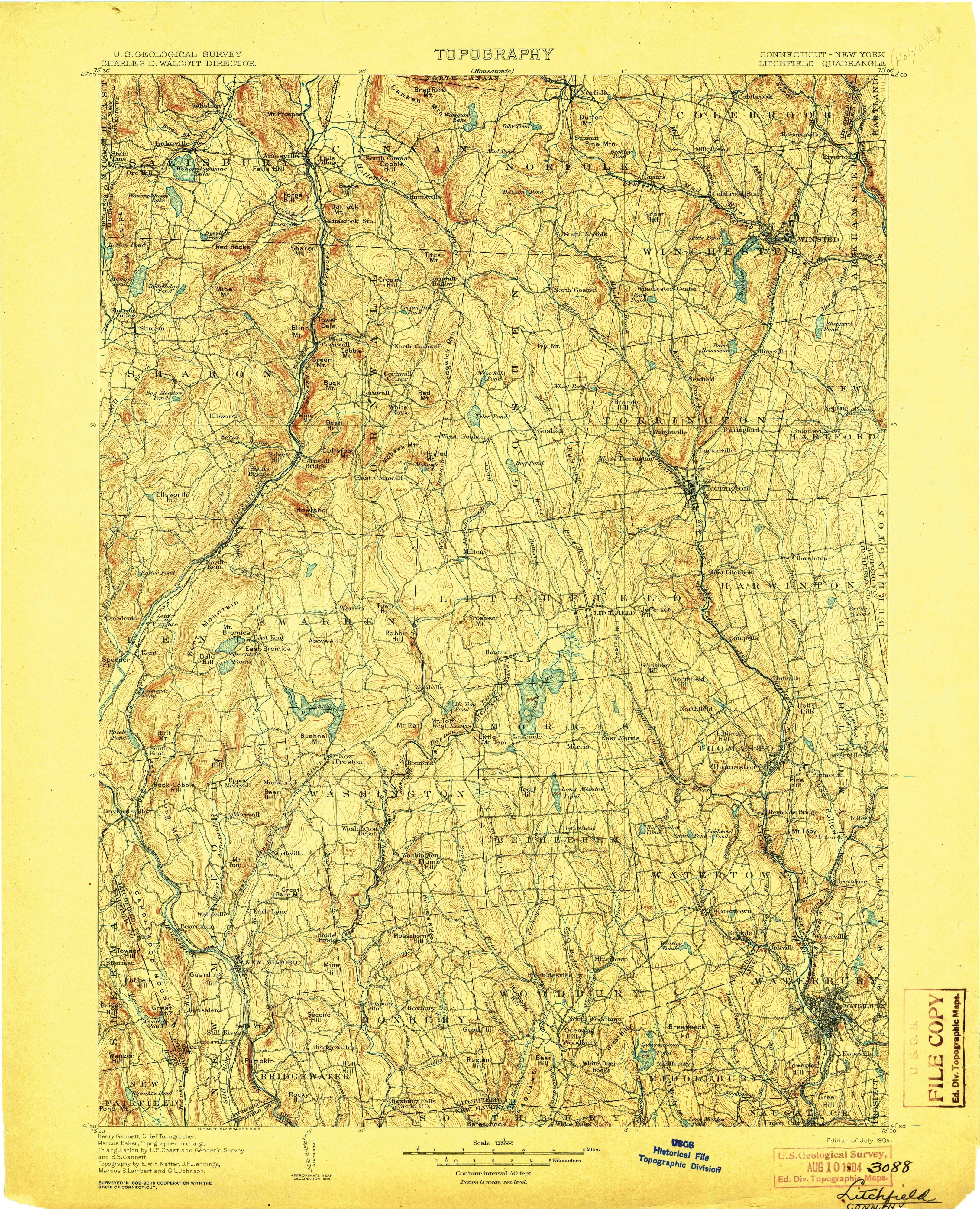
The town on the 1904 map
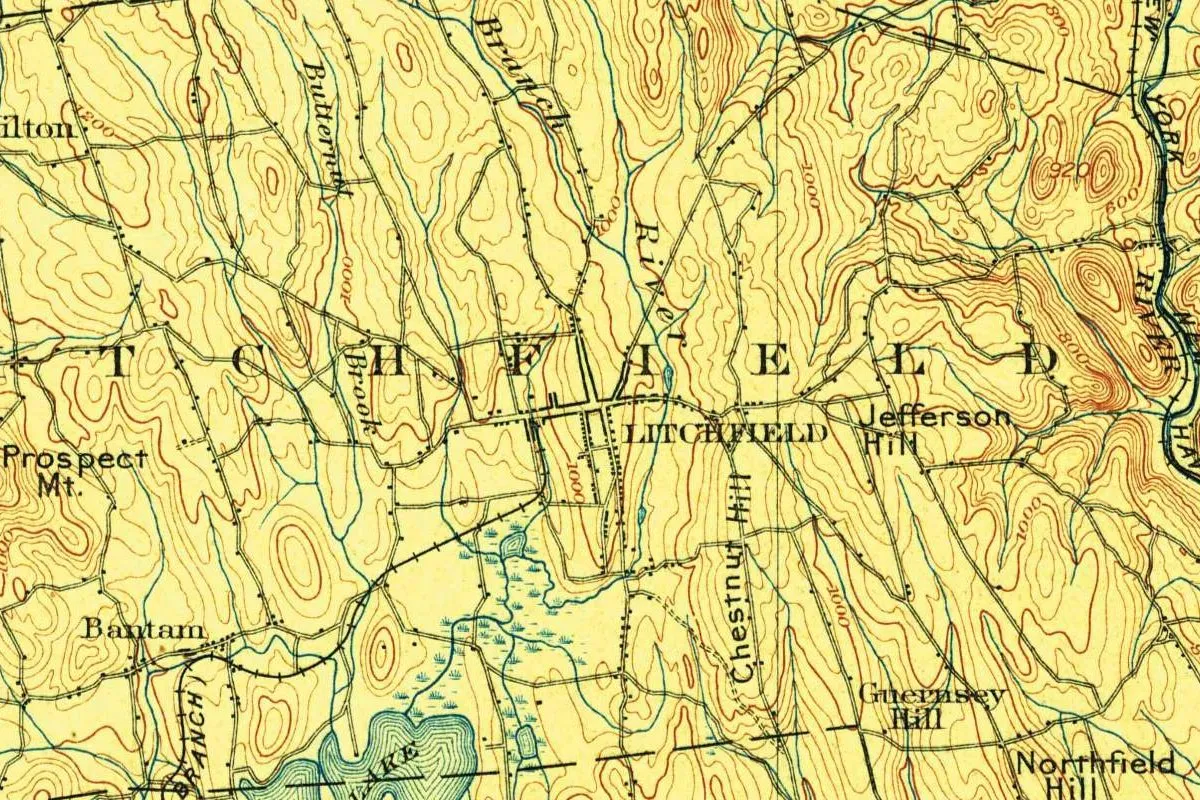
The Park Service survey describes a town laid out with four main streets running toward the points of the compass and a green in the middle, with palisades around five of the first houses. You can see that crossroads on the Geological Survey’s Litchfield quadrangle at the top of this page, with LITCHFIELD printed beside it and the spaced-out letters of the township name stretched across the sheet. Bantam sits on the railroad at the lower left, near the edge of a lake. The margin of the full sheet says it was surveyed in 1889-90 in cooperation with the State of Connecticut, engraved in May 1904, and issued as the edition of July 1904.
The town was bigger once. The state’s list records that Morris was incorporated “from Litchfield” in June 1859, and the Litchfield History Museum still covers Morris before the 1850s along with Bantam, Milton and Northfield. If you’re working through the older towns of Connecticut, there’s another English name passed along twice in Torrington, Wyoming, which took its name from Torrington, Connecticut, which took its own from a town in England.
Quick answers
Who is Litchfield, Connecticut, named after?
Nobody: it’s named for a place, Lichfield in Staffordshire, England, according to Connecticut’s State Register, Kilbourne’s 1859 history and the National Park Service.
Why is Litchfield spelled with a T?
Kilbourne wrote in 1859 that the T was added “probably by the legislative clerk” when the town was incorporated, and the spelling was kept ever since. He didn’t claim to know for sure.
What was Litchfield called before?
Bantam. The State Register gives Bantam as the Indian name, and the 1719 petition describes “a place called Bantam.” Trumbull thought the name came from a Native word for “praying”; a professor quoted by Kilbourne thought it came from Bantam in Java.
Key dates
- 1715John Mitchell, Joseph Minor and John Minor buy 44,800 acres from the Potatucks, according to Dartmouth's Occom Circle.
- 1719May: the General Assembly incorporates the town at a place called Bantam and names it Litchfield.
- 1720A few people start the settlement, Woodruff writes.
- 1721Many more settlers arrive, chiefly from Hartford, Windsor and Lebanon.
- 1859June: Morris is incorporated from part of Litchfield.
- 1904July: the Geological Survey issues its Litchfield quadrangle.
Things to do in Litchfield, Connecticut
Litchfield History Museum
The Litchfield Historical Society's museum at 7 South Street, with exhibits on how the town grew from its settlement in 1719 to today, including the center village, Bantam, East Litchfield, Milton, Northfield and Morris before the 1850s.
Tapping Reeve House and Litchfield Law School
The house and law school where Tapping Reeve and his partner James Gould taught more than 1,000 young men from 1774 to 1833. The society counts two vice presidents, 101 congressmen, 28 senators, three Supreme Court justices and 14 governors among the students.
White Memorial Conservation Center
40 miles (64 km) of trails open to the public for hiking, cross-country skiing and snowshoeing, with more than 50 entrances in Litchfield and Morris, the Little Pond Boardwalk, and a museum at 80 Whitehall Road.
Topsmead State Forest
Edith Morton Chase's summer estate on Jefferson Hill, where she received about 16 acres from her father in 1917. Her English Tudor style house, designed by Richard Henry Dana Jr., was finished in 1925.
Mount Tom State Park
One of Connecticut's oldest state parks, established in 1915, off Route 202. A trail of about 1 mile (1.6 km) climbs to a 34-foot (10 m) stone tower on the 1,325-foot (404 m) summit.
Getting there
Open Litchfield in Google Maps
Opens in a new tab. The pin is the center of Litchfield in the USGS place-name record.
The closest airports, Amtrak stations and intercity bus stops, measured in a straight line from the center of Litchfield.
Airports
- Bradley International (BDL) Windsor Locks 29 mi 47 km
- Tweed/New Haven (HVN) 37 mi 59 km
Amtrak trains
- Berlin station (BER) 23 mi 37 km
- Meriden station (MDN) 25 mi 40 km
Intercity buses
- OurBus Waterbury, CT (Park & Ride lot at 709 Chase Pkwy) 15 mi 24 km
- Greyhound New Britain Jimmy'S Food Mart #1 22 mi 35 km
- Peter Pan Bus Lines Hartford 26 mi 42 km
Distances are as the crow flies, not by road. We don't list schedules or fares because they change; check with the airline, Amtrak or the bus company before you go. Official data (FAA commercial service airports (2025), FAA airport locations, Amtrak stations and Intercity Bus Atlas) from the FAA and the U.S. Bureau of Transportation Statistics, checked Nov 17, 2026.
Sponsored
Staying in Litchfield?
Compare hotels in Litchfield, Connecticut, on Expedia.
See hotels in LitchfieldWe may earn a commission if you buy through this link. It never changes what we write. Read our affiliate disclosure
Historical Sources & References
- Connecticut Secretary of the State, “Connecticut Towns in the Order of their Establishment”. Litchfield “named and incorporated May, 1719, from Lichfield, a town of Staffordshire,” the Indian name Bantam, and Morris incorporated from Litchfield in June 1859.
- George C. Woodruff, History of the Town of Litchfield, Connecticut (1845), pp. 17-18. The 1719 petition of John Marsh and John Buel, “a place called Bantam,” the order naming the town and its horse brand, the first settlers of 1720 and 1721, and (p. 23) the line “The Indian name of this Town, was Bantam.” Checked against the page images.
- Payne Kenyon Kilbourne, Sketches and Chronicles of the Town of Litchfield (1859), pp. 24-25. The ancient city of Lichfield, the T “probably” added by the legislative clerk, his 1855 visit, and W. G. Peck’s Java theory for Bantam. Checked against the page images.
- J. Hammond Trumbull, Indian Names of Places, etc., in and on the Borders of Connecticut (1881), pp. 7-8. Bantam and Bantaham, the deed of May 1719, and the reading “he prays” or “praying.” Checked against the page images.
- Dartmouth College, The Occom Circle, “Litchfield”. The Potatucks, the 1715 purchase of 44,800 acres and the reading of Bantam as “he prays.”
- Charles W. Snell, National Park Service, Litchfield Historic District (1967). The settlers of 1720-21, the “old cathedral city Lichfield,” the palisades, the four streets and the green.
- Litchfield History Museum; Tapping Reeve House and Law School; White Memorial Conservation Center; Topsmead State Forest; Mount Tom State Park. The details in the things-to-do list, including the 40 miles (64 km) of trails at White Memorial and the 1,325-foot (404 m) summit of Mount Tom.
- GNIS feature 208497 (U.S. Geological Survey). Litchfield’s listing as a populated place in Litchfield County and its coordinates.
- Litchfield quadrangle, edition of July 1904. The sheet the map at the top was cropped from, surveyed in 1889-90 with contour lines every 40 feet (12 m).
Sponsored
Put this 1904 map on your wall
The Geological Survey's 1904 Litchfield sheet is in the public domain. Download the full-size scan for free, then have it printed on canvas with CanvasOnTheCheap.
Print a map on canvasDownload the full-size mapWe may earn a commission if you buy through this link. It never changes what we write. Read our affiliate disclosure
Spot something wrong, or know more? Tell us here. You can also email us or use our contact page. Corrections are noted here with their date, never made silently.