Apalachicola, Florida: The Name and Its Disputed Meanings
Apalachicola is a Native name, first used by the Spanish for the Lower Creeks and later for one of their towns. The Florida town, once Cottonton and then West Point, took it in 1831. Gannett and Read translate it as "people on the other side"; another account ties it to a ridge of swept earth.
Apalachicola, Florida, took its Native name in 1831, and what that name means is still argued: “people on the other side” or a ridge of swept earth. The town had already gone through two other names before that, and the word it settled on had been traveling for almost two centuries.
Cottonton, West Point, Apalachicola
The town at the mouth of the Apalachicola River didn’t start out with the river’s name. The City of Apalachicola’s history page puts it in one sentence: “In 1828 the town which was originally named Cottonton was incorporated as West Point and later renamed Apalachicola in 1831.”
The Florida Natural Areas Inventory gives the same sequence in its regional timeline for the Apalachicola River: “1831 · The town council changes the name of the town from West Point to Apalachicola. Before ‘Westpoint,’ the town was known as Cottonton.”
Neither source says why the council made the change. What’s clear is where the new name came from. By then it already belonged to the river, which William A. Read, writing in 1934, describes as the name of the Chattahoochee below its meeting with the Flint, and to the bay at its mouth. Read also notes the town of his day, with 3,150 people, “on the Apalachicola Northern Railway.”
A name the Spanish stretched
The name is older than the town by almost two hundred years, and it didn’t start on this coast. John R. Swanton, an ethnologist at the Smithsonian’s Bureau of American Ethnology, traced it in his 1922 Early History of the Creek Indians and Their Neighbors. The Spanish, he writes, used it for the Lower Creeks in general, and the first time he found it was in a letter dated August 22, 1639. In a letter of 1686, “Apalachicoli” was also applied to a single town.
That town, Swanton says, was known in the Creek language as “Tålwa łåko, ‘Big Town,’” and he cites the naturalist William Bartram’s statement that it was “the leading White or Peace town.” The Creeks counted it among their towns that spoke Hitchiti, which is Swanton’s word for the language.
Even the spelling is a blend, according to Swanton. In a footnote he lists two old forms, “Apalachicoli and Apachicolo, the first of which is evidently in the Hitchiti dialect, the second in Muskogee.” Then: “Apalachicola is a compromise term.”
Read tells the same story in his Florida Place-Names of Indian Origin and Seminole Personal Names. The name “was first applied by the Spaniards to the Lower Creeks,” who lived on the Chattahoochee and Flint rivers, and later to a particular town, “now called in Creek tàlwa làko, ‘big town.’”
“People on the other side”
The most repeated translation comes in two versions, one firm and one careful. Henry Gannett put it plainly in 1905: Apalachicola is “A Hichiti Indian word, signifying ‘people on the other side.’” That’s his spelling of Hitchiti. On the same page, he takes nearby Apalachee from a word meaning “on the other side” (of a stream), or from apalatchiokli, “people on the other side.”
Read, a professor of English at Louisiana State University, gave the same reading with a hedge you shouldn’t skip:
“Apalachicola is composed, probably, of Hitchiti apalahchi, ‘on the other side,’ and okli, ‘people’; hence ‘those people residing on the other side, shore, or river.’”
He sends readers to Swanton for it. Swanton himself goes only as far as a resemblance: “The ending of the name resembles okli, the Hitchiti word for ‘people.’” So the people part has some support, and among the scholars, the “other side” part rests on Read’s “probably.”
A ridge of swept earth
Swanton passes on a second explanation in the very next sentence. “Judge G. W. Stidham told Dr. Gatschet that he had heard the name was derived from the ridge of earth around the edge of the square ground made in sweeping it.” Albert S. Gatschet wrote the 1884 study of the Creek people that our Tallahassee article leans on. Notice how many steps that takes: Stidham heard it, told Gatschet, and Swanton wrote it down.
The City of Apalachicola picks up this reading first. Its history page calls the name “an Indian word interpreted as a ridge of earth produced by sweeping the ground in preparation for a council or peace fire.”
“Friendly people,” a later reading
The city’s page then goes further than any of the older books. “Over time, the term has been translated as an area of peaceful people or people on the other side,” it says. “‘Land of the friendly people’ is a common interpretation of the word.”
The city presents these as translations and interpretations, and it doesn’t name a source for them. Neither Gannett, Swanton nor Read uses “peaceful” or “friendly” as a meaning. The “Peace town” that Swanton draws from Bartram is a description of the town’s role, not a translation of its name, and nothing in the sources links the two. So of the three readings, “land of the friendly people” is the one with the least written behind it.
Read worked through other Florida names the same way, including Kissimmee and Hialeah.
The 1943 map
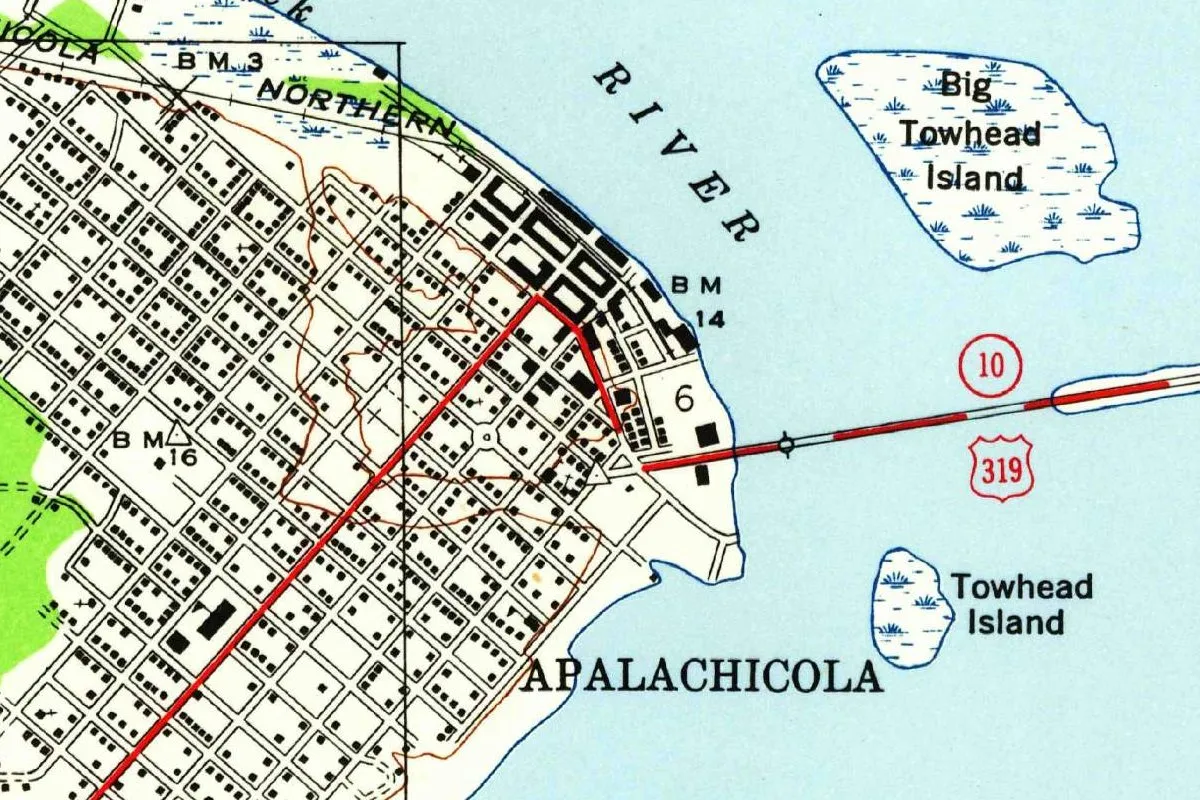
The map at the top of this page comes from the U.S. Geological Survey’s Apalachicola sheet of 1943, printed in 1960. The town’s grid fills the point of land, the river curves past it with two islands named Big Towhead and Towhead, and a red highway marked 10 and US 319 heads out across the water to the east. Along the top runs the railroad Read named, the Apalachicola Northern, cut off by the edge of the crop so you can read only “Northern.”
The name on that map once covered a whole people. Here it covers a town, a river, a bay and a railroad.
Quick answers
What does Apalachicola mean?
It’s disputed. Gannett (1905) says “people on the other side,” and Read (1934) says the same but with “probably.” Swanton (1922) records Judge Stidham’s account of a ridge of swept earth, and the city adds “land of the friendly people” as a common interpretation.
What was Apalachicola called before?
Cottonton first, then West Point, the name under which it was incorporated in 1828. The town council changed it to Apalachicola in 1831, according to the city and the Florida Natural Areas Inventory.
What language does the name come from?
Swanton calls one old form, “Apalachicoli,” Hitchiti and another, “Apachicolo,” Muskogee, and says “Apalachicola is a compromise term.” Gannett and Read call the word Hitchiti.
Who first used the name?
The Spanish, according to Swanton and Read. They applied it to the Lower Creeks generally, first in a letter of 1639, and later to one town.
Key dates
- 1639A Spanish letter dated August 22 uses the name Apalachicola for the Lower Creeks, the earliest use Swanton found.
- 1686A Spanish letter also applies "Apalachicoli" to a single town.
- 1828The town, first called Cottonton, is incorporated as West Point.
- 1831The town council renames West Point as Apalachicola.
Things to do in Apalachicola, Florida
Orman House Historic State Park
Thomas Orman, a cotton merchant who traded in Apalachicola from 1834 into the 1880s, built this house in 1838. The state park service describes it as a blend of Federal and Greek revival styles.
John Gorrie Museum State Park
A museum for the doctor who came to Apalachicola in the early 1830s and served as postmaster and city treasurer. By 1841 he was working on ways to cool the rooms of yellow fever patients, and in 1851 he received the first U.S. patent for mechanical refrigeration.
ANERR Nature Center
The nature center of the Apalachicola National Estuarine Research Reserve covers 18,000 square feet (about 1,700 m²). Three tanks of more than 1,000 gallons each show river, bay and Gulf habitats, and an oyster boat greets you at the entrance.
Apalachicola River Wildlife and Environmental Area
The state wildlife commission calls this the largest expanse of floodplain forest in Florida. You can paddle its creeks and rivers, and more than 280 bird species have been recorded there.
Getting there
Open Apalachicola in Google Maps
Opens in a new tab. The pin is the center of Apalachicola in the USGS place-name record.
The closest airports, Amtrak stations and intercity bus stops, measured in a straight line from the center of Apalachicola.
Airports
- Tallahassee International (TLH) 60 mi 96 km
- Northwest Florida Beaches International (ECP) Panama City 65 mi 105 km
Intercity buses
- Greyhound Panama City Beach Bus Station 57 mi 92 km
Distances are as the crow flies, not by road. We don't list schedules or fares because they change; check with the airline, Amtrak or the bus company before you go. Official data (FAA commercial service airports (2025), FAA airport locations, Amtrak stations and Intercity Bus Atlas) from the FAA and the U.S. Bureau of Transportation Statistics, checked Nov 15, 2026.
Sponsored
Staying in Apalachicola?
Compare hotels in Apalachicola, Florida, on Expedia.
See hotels in ApalachicolaWe may earn a commission if you buy through this link. It never changes what we write. Read our affiliate disclosure
Historical Sources & References
- City of Apalachicola, “Apalachicola History”. Cottonton, West Point and the 1831 renaming; the ridge-of-earth reading, and “peaceful people,” “people on the other side” and “land of the friendly people” as interpretations.
- Florida Natural Areas Inventory, ARROW, “History Regional Timeline”. The council’s 1831 change from West Point to Apalachicola, and Cottonton before it.
- Henry Gannett, The Origin of Certain Place Names in the United States, 2nd ed. (1905), p. 26. Apalachicola as “A Hichiti Indian word, signifying ‘people on the other side,’” and the Apalachee entry on the same page. Checked against the page image.
- John R. Swanton, Early History of the Creek Indians and Their Neighbors, Bureau of American Ethnology Bulletin 73 (1922), pp. 129-130. The Spanish use for the Lower Creeks from 1639, the town in 1686, Tålwa łåko, Bartram’s statement about the “Peace town” as Swanton reports it, the footnote on Apalachicoli and Apachicolo (p. 129), and the okli resemblance and Stidham’s account (p. 130). Checked against the page images.
- William A. Read, Florida Place-Names of Indian Origin and Seminole Personal Names (1934), p. 2. The town, river and bay, the Apalachicola Northern Railway, the Spanish use, and “probably” Hitchiti apalahchi and okli. Checked against the page image.
- Orman House Historic State Park; John Gorrie Museum State Park; ANERR Nature Center; Apalachicola River WEA. The details in the things-to-do list.
- GNIS feature 277920 (U.S. Geological Survey). The national gazetteer’s entry for Apalachicola, Franklin County, with its coordinates.
- U.S. Geological Survey, Apalachicola sheet (1943). The 1:24,000 map, printed in 1960, that the image at the top of this page was cropped from.
Spot something wrong, or know more? Tell us here. You can also email us or use our contact page. Corrections are noted here with their date, never made silently.