What Does Boca Raton Mean? A Sailor's Name That Moved North
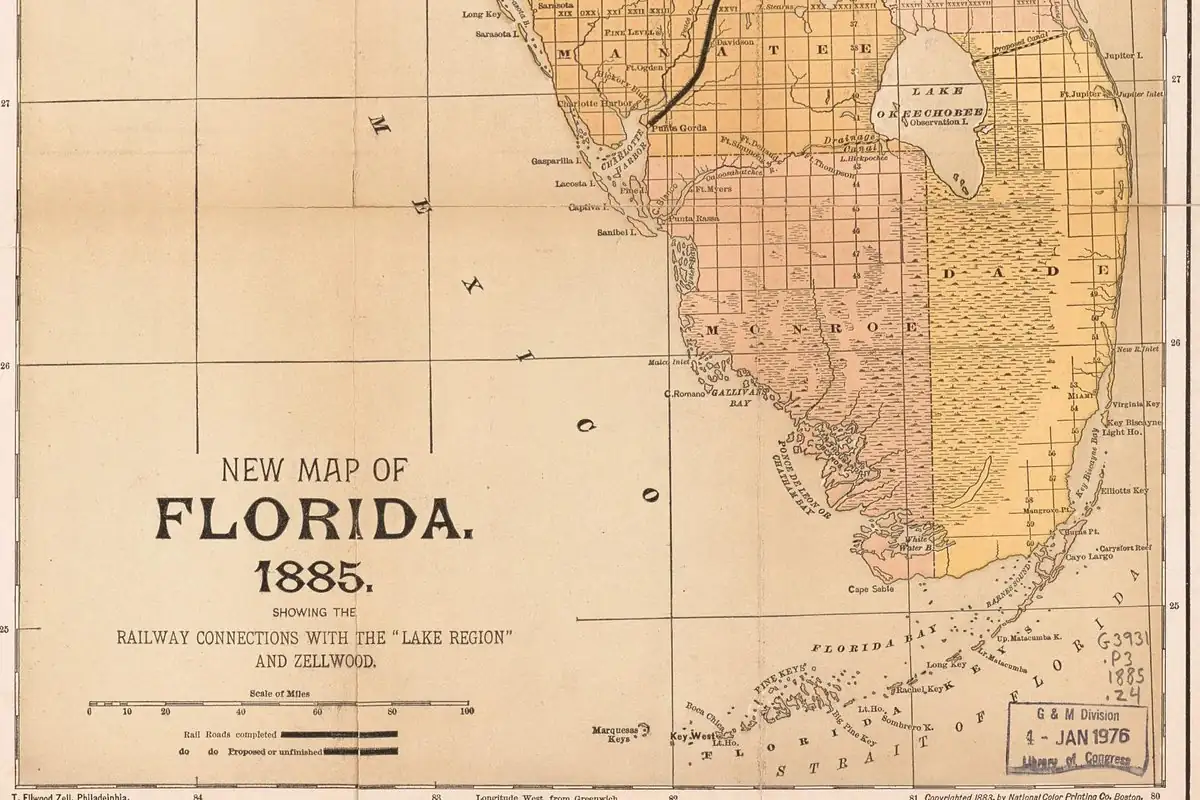
Boca Raton comes from Boca de Ratones, a Spanish navigational name for a rocky inlet that 18th-century maps placed on Biscayne Bay, near today's Miami Beach. Old Spanish dictionaries defined ratones as seabed rocks that chafe cables, a 2012 study reports. By the early 1800s mapmakers had moved the name, by mistake, to today's Lake Boca Raton.
A label from Biscayne Bay
Boca Raton, Florida, took its name from Boca de Ratones, a label that 18th-century maps put on Biscayne Bay, near today’s Miami Beach, not on Boca Raton. Sometime around the turn of the 1800s, mapmakers moved it up the coast, and it stuck to the place where the city stands now.
That’s how the Boca Raton Historical Society tells it, and the society starts with a warning. “Many people wrongly assume the name is simply Rat’s Mouth,” its history says. In Spanish, boca means mouth and often describes an inlet, while raton literally means mouse. Put together, the society explains, Boca de Ratones or Boca Ratones “was a navigational term referring to a rocky or jagged inlet.” In other words, it was a sailor’s word for a dangerous opening in the coast, not a description of rodents.
Rocks that chafe a cable
Why would a mouse word mean rocks? Two local researchers, Humberto E. Ruiz and Manley F. Cobia, went looking for the answer in Spain, in a study dated February 14, 2012. They report that the Royal Spanish Academy’s 1803 dictionary gave ratón two senses: a cowardly thief, and “the sharp-pointed and cutting rock that is at the bottom of the seas and scrapes the cables.” A Spanish maritime dictionary of 1831, they write, defined ratones as “rugged rocks or stony ground on the bottom of some ports and coastal outlets, where the cables rub against.” Those English versions are theirs; we haven’t read the old dictionaries ourselves. They also quote the geographer Roland E. Chardon, who wrote in 1975 that Boca Ratones was named “not for rats as is commonly supposed, but for the sharp, submerged rocks” off its Atlantic entrance.
That reading hasn’t always carried the day. In 1981 the society’s own journal, the Spanish River Papers, ran an article by Daniel F. Austin and David M. McJunkin that found “No etymological source” for the rocks idea and leaned, on evidence they called “highly circumstantial,” toward “thieves’ inlet.” The 2012 study was written to answer them, and the society’s current history sides with the navigational meaning.
So the meaning has a paper trail. How the name got from Biscayne Bay to Boca Raton is a separate question, and that one has a weaker trail.
The society’s timeline points to Captain Bernard Romans, whose 1774 map shows Boca Ratones on Biscayne Bay. Romans’s book on the Floridas, printed in New York in 1776, puts the name in the same corner of the coast. Describing the shore near Cape Florida, at the tip of Key Biscayne, he writes that just west of it is “the river Rattones,” a good-sized stream with rich soil on its banks. That’s down by today’s Miami. Miami Beach sits about 40 miles (64 km) south of Boca Raton as the crow flies.
Where the name landed
By 1823 the name had a second home. The society dates the first known appearance of “Boca Raton” on a map of its present location to that year. The same year, Charles Vignoles, who signed himself a “civil and topographical engineer,” published Observations upon the Floridas, and his description of the coast catches the name in both places at once.
On one page he follows a stream he calls the Rio Seco, Spanish for “dry river,” which ran through marsh and mangrove islands toward a mouth that sand had shut:
“…its mouth, which is closed at present like that of Jupiter; the place where the outlet was is also called Boca Ratone and Dry inlet…”
A page later he mentions “Boca Ratone sound,” and a few lines after that he’s back down south, noting that “The Ratones discharge into the head of the Bay of Key Biscayne.” So in a single 1823 book you’ve got Ratones near Key Biscayne and a Boca Ratone at a closed inlet far to the north, the spot that matches today’s Lake Boca Raton.
The society calls the transfer a mistake, and it adds that the inlet at Lake Boca Raton was closed through most of the 18th and 19th centuries. A boca is an opening, so the name for a rough, rocky passage ended up on a mouth that, for long stretches, wasn’t open at all. Neither Romans, Vignoles nor the society says which mapmaker made the switch, or why. The 1981 article comes closest: it says the northern inlet became known as Boca Ratone only in the 1820s, cites Vignoles and a Tanner map, both from 1823, and credits Vignoles with starting the name Boca Ratone Sound. It doesn’t say why.
From Boca Ratones to Boca Raton
The spelling kept moving after that. The Florida East Coast Railway reached the area in 1895, the society says, and pioneers followed, many of them farmers growing pineapples. A group of Japanese farmers led by Joseph Sakai settled along today’s Yamato Road in 1904.
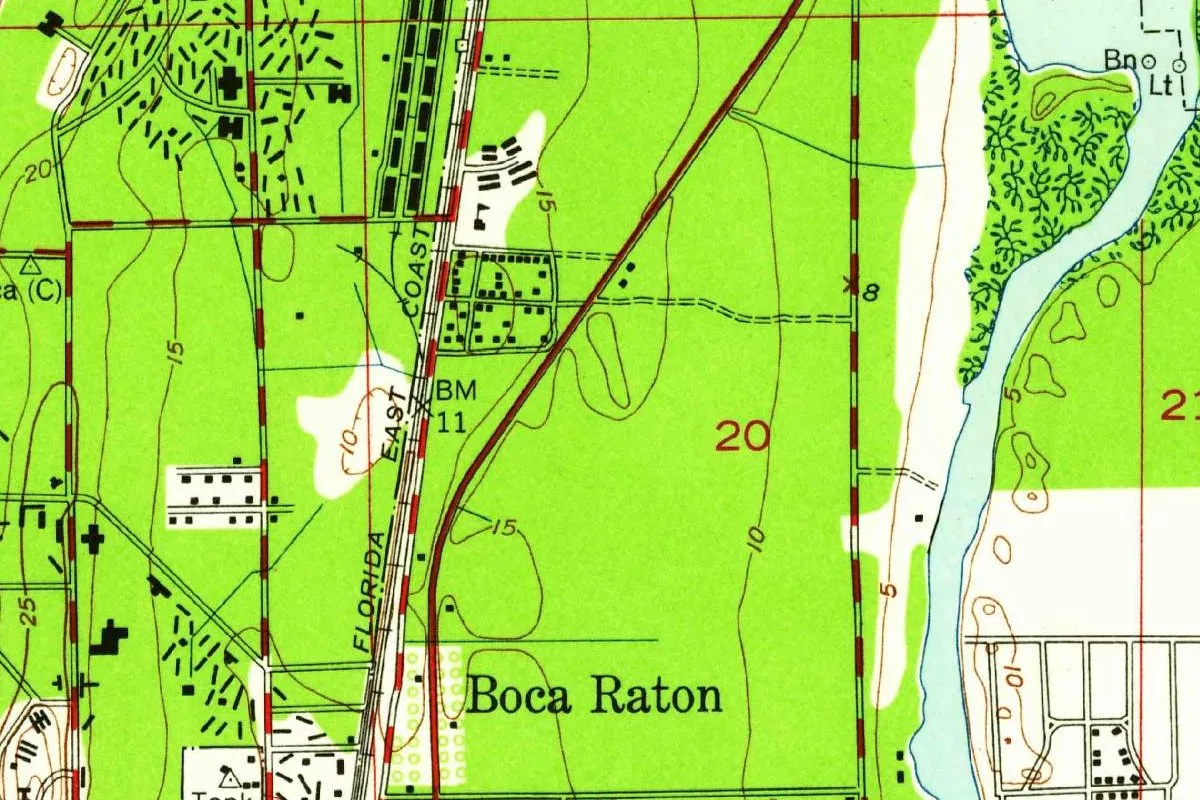
When the place first incorporated, in 1924, it did so as “Boca Ratone,” with the extra e that Vignoles had used a century earlier. The Town of Boca Raton was incorporated in 1925, at the height of the Florida land boom, and the society says the “s” and later the “e” had been dropped by the 1920s. You can still see the result on the 1946 federal map at the top of this page: plain “Boca Raton” beside the railroad and the inland waterway.
What survived the trimming is the pronunciation. The society says “the correct pronunciation remains Rah-tone,” which keeps a little of the old Spanish in a name that’s spent more than two centuries on the wrong inlet. If you’ve been reading it as “rat,” you’re not alone, but the town’s own historians would like a word.
Quick answers
Does Boca Raton mean “rat’s mouth”?
No. The Boca Raton Historical Society says that’s a common mistake: boca means mouth, raton literally means mouse, and Boca de Ratones was a navigational term for a rocky or jagged inlet. A 2012 study by Ruiz and Cobia ties ratones to old Spanish dictionary entries for seabed rocks that rub ships’ cables.
Where was the original Boca de Ratones?
On Biscayne Bay, near today’s Miami Beach, according to 18th-century maps cited by the society. Romans’s 1776 book also puts “the river Rattones” by Cape Florida.
How do you pronounce Boca Raton?
The society says the correct pronunciation of Raton “remains Rah-tone.”
Was Boca Raton ever spelled Boca Ratone?
Yes. Vignoles wrote “Boca Ratone” in 1823, and the town first incorporated as Boca Ratone in 1924 before becoming the Town of Boca Raton in 1925.
Key dates
- 1774Bernard Romans's map shows Boca Ratones on Biscayne Bay, in what is now Miami Beach, according to the Boca Raton Historical Society.
- 1776Romans's printed Florida book places the river Rattones just west of Cape Florida.
- 1823Boca Raton first appears on a map at its present location, and Charles Vignoles calls the closed outlet of the Rio Seco Boca Ratone.
- 1895The Florida East Coast Railway is completed through Boca Raton.
- 1924The town is first incorporated under the spelling Boca Ratone.
- 1925The Town of Boca Raton is incorporated at the height of the Florida land boom.
Getting there
Open Boca Raton in Google Maps
Opens in a new tab. The pin is the center of Boca Raton in the USGS place-name record.
The closest airports, Amtrak stations and intercity bus stops, measured in a straight line from the center of Boca Raton.
Airports
- Fort Lauderdale/Hollywood International (FLL) 20 mi 33 km
- President Donald J Trump International (DJT) West Palm Beach 22 mi 36 km
Amtrak trains
- Deerfield Beach station (DFB) 4 mi 6 km
- Delray Beach station (DLB) 7 mi 11 km
Intercity buses
- Greyhound Boca Raton Trirail Station 3 mi 4 km
- FlixBus Ft Lauderdale Broward Park & Ride 17 mi 28 km
Distances are as the crow flies, not by road. We don't list schedules or fares because they change; check with the airline, Amtrak or the bus company before you go. Official data (FAA commercial service airports (2025), FAA airport locations, Amtrak stations and Intercity Bus Atlas) from the FAA and the U.S. Bureau of Transportation Statistics, checked Nov 13, 2026.
Sponsored
Staying in Boca Raton?
Compare hotels in Boca Raton, Florida, on Expedia.
See hotels in Boca RatonWe may earn a commission if you buy through this link. It never changes what we write. Read our affiliate disclosure
Historical Sources & References
- Charles Vignoles, Observations upon the Floridas (1823), pp. 48–49. The Rio Seco and its closed outlet, “also called Boca Ratone and Dry inlet,” “Boca Ratone sound,” and the Ratones that “discharge into the head of the Bay of Key Biscayne.”
- Bernard Romans, A Concise Natural History of East and West Florida (1776), p. 288. “The river Rattones,” just west of Cape Florida.
- Humberto E. Ruiz and Manley F. Cobia, “Boca de Ratones: An Etymological Reassessment” (2012). The definitions they report from the Royal Spanish Academy’s 1803 dictionary and the Spanish maritime dictionary of 1831, in their translation (pp. 5-6); Roland E. Chardon’s 1975 statement on “sharp, submerged rocks,” as they quote it (p. 4); their reply to Austin and McJunkin (pp. 2-3, 8).
- Daniel F. Austin and David M. McJunkin, “The Legends of Boca Ratones,” Spanish River Papers (May 1981). “No etymological source has been found to support these interpretations,” the case for “thieves’ inlet,” and the northern inlet known as “Boca Ratone” only from the 1820s (Vignoles and Tanner, 1823), with Vignoles starting “Boca Ratone Sound.”
- Boca Raton Historical Society, “A Brief History”. The meaning of boca and raton, Boca de Ratones as a navigational term for a rocky or jagged inlet, its original place on Biscayne Bay, its mistaken transfer to Lake Boca Raton, the dropped letters, the pronunciation “Rah-tone,” the Yamato colony and the 1925 incorporation.
- Boca Raton Historical Society, “Timeline”. Romans’s map of 1774, the first map of Boca Raton at its present location in 1823, the railway in 1895, and the incorporations of 1924 as “Boca Ratone” and 1925 as Boca Raton.
- GNIS feature 279123 (U.S. Geological Survey). Lists the city under Palm Beach County and supplies the map coordinates.
- U.S. Geological Survey, Boca Raton sheet (1946). The source of the map at the top of this page.
Spot something wrong, or know more? Tell us here. You can also email us or use our contact page. Corrections are noted here with their date, never made silently.