New Orleans Street Names: Tchoupitoulas, Tremé and More
New Orleans street names come from French princes, Creole landowners and old plans that never got built, and a few, like Tchoupitoulas, have two stories. Bourbon Street is named for a French prince, Tremé is named for the man who owned the land, and Vieux Carré just means “old square.”
Planning a trip? Here’s where the names on your map came from. In the French Quarter, the old books mostly agree: the streets carry the names of French royals and saints. Outside the Quarter it gets more colorful: Greek muses, Napoleon’s battles, a young lady of the de Clouet family and one street named for a game of chance.
Where New Orleans got its name
The city is named for the Duke of Orleans, who was regent of France. Gayarré says the name was given “in compliment to the Duke of Orleans, Regent of France.” Our New Orleans page tells that story.
The French Quarter
Vieux Carré
Vieux Carré is French for “old square.” The Picayune’s 1904 guide to the city explains the term as “the ‘Vieux Carre,’ or ‘old square,’” and says it’s the part of the French Quarter laid out by Bienville, the city’s founder, in 1718. It ran from Esplanade to Canal Street and from the river to Rampart Street. The 1885 Historical Sketch Book, published by Will Coleman, uses the two names side by side: “le vieux carre, or the old French quarter.”
Chartres, Toulouse and Dumaine
These three streets are named for French royals. Charles Gayarré, a Louisiana historian, wrote this in 1854:
“Chartres-street was called after the Duke of Chartres, son of the Regent:—Maine, Conde, Conti, Toulouse, and Bourbon streets were also named after the princes of the royal blood…”
In the next lines Gayarré names them: the Prince of Conti, the Duke of Maine, the Prince of Condé, the Count of Toulouse and the Duke of Bourbon. John Kendall’s 1922 history of the city says it a little differently. He says the streets got names in 1724, that Chartres honored “the oldest of the Orleans princes,” and that “Dumaine and Toulouse immortalize the two illegitimate sons of Madame de Montespan and Louis XIV.”
Bourbon Street
Bourbon Street is named for a French prince, the Duke of Bourbon. Gayarré lists Bourbon among the streets “named after the princes of the royal blood,” and puts the Duke of Bourbon on his list.
St. Louis, St. Peter, St. Ann and St. Philip
The saints’ streets have royal ties too. Kendall says St. Louis “received the name of the patron saint of France,” and that St. Peter, St. Ann and St. Philip “were so called for the baptismal names frequently bestowed upon members of the royal family.”
Bienville and Decatur
Bienville Street is named for the man who founded the city. Kendall says it had that name as early as 1726, “because the founder of the city had his residence on that street.” Decatur Street used to have a plainer name. Kendall says “What is now called Decatur Street was then the Rue du Quay.”
Barracks, Hospital and Ursulines
These streets are named for what stood on them. The 1904 guide says the soldiers’ barracks gave Barracks Street its name, the military hospital next to it gave the name to Hospital Street, and Ursulines Street took its name from the convent of the Ursuline nuns. Kendall says Ursulines was first called the Rue de l’Arsenal.
Rampart Street
Rampart Street was the edge of the old walled town. The 1904 guide says it was “so-called because being the city limit on the west, ramparts were erected all along the line.” The walls are long gone. Kendall says the Americans began to tear down the forts in 1804.
Beyond the Quarter
Canal Street
Canal Street is named for a waterway. Kendall says that by 1838 “the waterway from which it derives its name and which, it is said, was intended to unite the Mississippi with Lake Pontchartrain, had been partially filled in.” In its place was what he calls a “neutral ground,” or embankment, which ran from the river all the way to Claiborne Street. Note the “it is said”: Kendall wasn’t sure what the canal was meant for.
Tchoupitoulas Street
Tchoupitoulas Street started as a road, and the old books give two meanings for its name. Kendall says it was “the Chemin de Tchoupitoulas, or ‘fish hole’ road,” which led up the river to Bayou Tchoupitoulas and was “originally an Indian path.” The 1904 guide says instead that “Indian herb doctors once lived in Tchoupitoulas Street and sold the ‘millet seed,’ for which the street is named.” Neither book says which language the word comes from, so we can’t tell you which one is right.
If you’re wondering how to say it, the 1885 Historical Sketch Book spells it out: “Tchoupitoulas—pronounced Chopitoulas.” The book adds that it was one of the names locals used to spot outsiders.
Gravier and Poydras
Both are named for men who owned land or did business in the city. Kendall says Gravier Street recalls Bernard Gravier, who owned a great land grant above Canal Street. Poydras Street is named for Julien Poydras, who wrote the first poem known to have been printed in Louisiana and was the first president of the Bank of Louisiana.
Camp Street
Camp Street is named for a camp. The 1904 guide says Camp Street was once the “Campo de Negros,” the ground set aside for free Black people who came to New Orleans after the revolution in Haiti (then Saint-Domingue).
Desire Street
Desire Street was probably named for a woman. Kendall says it “should properly be Désirée — a girl’s name probably bestowed out of compliment to one of the young ladies of the de Clouet family.”
The muses, Napoleon and Prytania
Uptown, a whole group of streets is named for the Greek muses, like Calliope, Terpsichore and Melpomene. Kendall says they “show that a taste for the classics existed in New Orleans in the late ’40s.” Napoleon Avenue and the streets named for his battles, like Austerlitz, came from General Burthe, a landowner who admired the emperor. Prytania Street comes from a plan for “a sort of people’s university” called the Prytanium, which, Kendall says, “needless to say, was never built.”
Elysian Fields Avenue
Elysian Fields is the English version of the Champs-Élysées, the famous avenue in Paris. The 1904 guide says Marigny laid out the wide avenue when he cut his plantation into streets and called it the “Champs Elysees,” because “He intended that the New Orleans Champs Elysees should rival its famous Parisian namesake.” It didn’t work out. By 1904, the guide says, it was “a railroad street.”
Craps, Good Children and other lost names
Some of the old names didn’t survive. The 1885 Historical Sketch Book says Bernard Marigny named two streets in his faubourg “Craps” and “Bagatelle,” after “the two games of chance at which he lost a fortune.” Kendall says an ordinance of about 1860 gave each street one name along its whole length and dropped “some of the most curious and characteristic of the street names, like Good Children, Mysterious, Bagatelle, Craps, Solace, Lemon and History.”
The squares
Jackson Square
Jackson Square used to be the Place d’Armes, the old town’s drill ground. Renshaw says it “was used for the evolution of troops” and as a place for people to pass their free time. The old books disagree on the year it changed. Henry Renshaw, writing in 1919, says the city council of the First Municipality decided on January 25, 1851, that the Place d’Armes “was to be known as Jackson Square.” Kendall gives the year as 1850. Kendall also writes that Jackson Square “was formerly located at the intersection of Chartres and Esplanade streets.” Renshaw, for his part, says there had been an earlier Jackson Square in New Orleans, on ground that was handed over to the federal government and built on for the U.S. Mint.
Congo Square
Congo Square is named for the dances held there. Kendall says it was called “Congo” from the custom of enslaved people “meeting there on their Sunday afternoon holiday to dance the ‘bamboula’ and other African dances.” He says the place had also been known as the Congo Plains and the Place des Negres, and that by 1922 it had been renamed Beauregard Square. The 1904 guide also calls it the “Place des Negres.” Kendall says it was Claude Tremé who gave the land to the city.
Neighborhoods
Tremé
Tremé is named for the man who laid it out. Kendall says the neighborhood “was laid out by Claude Treme on a plantation belonging to him,” and that St. Claude Street was “named by him in honor of the saint whose name he bore.”
Faubourg Marigny
Faubourg means suburb, and this one is named for the Marigny family. Kendall says Bernard de Marigny “laid out his princely estate into streets and squares, and founded the Faubourg Marigny.” The 1904 guide tells it differently: it says the land was “the ancient plantation of Philippe Mandeville de Marigny,” and that it was this Marigny who cut it up into lots and streets. The 1885 Historical Sketch Book agrees with Kendall and names Bernard. The old books don’t settle which Marigny it was.
Faubourg Ste. Marie
The first American part of town, upriver from Canal Street, was named for a landowner’s mother. The 1904 guide says the land belonged to Jean Gravier, who renamed it “the ‘Faubourg Ste. Marie,’ in honor of his mother, whose name was Mary.” Kendall, for his part, says Gravier Street is named for a Bernard Gravier.
Garden District
The Garden District is named for its gardens, and that’s about all the old books say. The 1904 guide describes the houses along St. Charles Avenue, with “the beautiful open gardens and palms giving this section the title of ‘Garden District.’”
Algiers
Algiers is the neighborhood across the river, and nobody in the old books says why it got the name of a North African city. The 1904 guide only says the Creoles took what Bienville had called the “Plantations of the King” and “rechristened” it Algiers, “and the name clings to this day.”
Audubon Park
Audubon Park got its name years after the city bought the land. Kendall says the city bought it in 1871, that for a time it was known as the “New City Park,” and that the name Audubon came “some years later, at the suggestion of Dr. T. G. Richardson,” the surgeon who also named Coliseum Square.
Names we’re still checking
You might be wondering about Frenchmen Street, Bywater, Storyville, the Ninth Ward, the Irish Channel, Metairie, St. Charles Avenue, Magazine Street and Dauphine Street. The 1904 guide mentions an old Spanish “Magazine,” but its sentence is about Union Street, so it doesn’t settle Magazine Street. We haven’t yet found an old source we can show you that explains how those names ended up on the map. Until we do, they stay off this page.
Quick answers
What does Vieux Carré mean?
It means “old square” in French. The 1904 Picayune guide uses it for the oldest part of the French Quarter, the part laid out in 1718.
Why is it called Bourbon Street?
It’s named for a French prince, the Duke of Bourbon. Gayarré wrote in 1854 that Bourbon was one of the streets “named after the princes of the royal blood.”
What does Tremé mean?
It’s a last name. Kendall says Claude Tremé laid out the neighborhood on his own plantation.
What does Tchoupitoulas mean?
The old books disagree. Kendall says it was the “fish hole” road, and the 1904 Picayune guide says the street was named for a “millet seed” sold there.
Key dates
- 1724The streets of the little French town get their first names, Kendall says, including Chartres, St. Louis, Conti, Dumaine and Toulouse.
- 1838Canal Street is already one of the city's most important streets, and the waterway it was named for has been partly filled in.
- 1850Kendall's date for the renaming of the Place d'Armes as Jackson Square.
- 1851January 25: a city council resolution says the Place d'Armes will be known as Jackson Square, according to Renshaw.
- 1860About this year, a city ordinance gives each street one name along its whole length and drops odd names like Craps and Good Children.
Sponsored
Planning a trip to New Orleans?
Compare hotels in New Orleans on Expedia.
See hotels in New OrleansWe may earn a commission if you buy through this link. It never changes what we write. Read our affiliate disclosure
Sponsored
Read up before your trip
Browse digital travel magazines on Magzter.
Browse travel magazinesWe may earn a commission if you buy through this link. It never changes what we write. Read our affiliate disclosure
Historical Sources & References
- John S. Kendall, History of New Orleans, vol. 2 (1922). The first street names of 1724, Chartres, Dumaine, Toulouse, St. Louis and Conti, Barracks, Ursulines and Decatur Street (pp. 672, 674); Bienville, the saints’ streets, the walls, Marigny, Tremé, St. Claude, Gravier and Poydras (p. 674); Tchoupitoulas, the muses and Napoleon (p. 675); Desire, the ordinance of about 1860, Craps and Good Children, and Canal Street (p. 676); Jackson Square in 1850 and its earlier location, and Congo Square (p. 679); Coliseum Square and Prytania (p. 681); Audubon Park (p. 683).
- Charles Gayarré, History of Louisiana, vol. 1 (1854). The city named “in compliment to the Duke of Orleans,” and Chartres, Maine, Condé, Conti, Toulouse and Bourbon streets named for royal princes (pp. 353-354).
- The Picayune’s Guide to New Orleans (1904). Camp, Tchoupitoulas and the old Spanish “Magazine” (p. 10); the Vieux Carré, Rampart, Barracks, Hospital and Ursulines (p. 11); Faubourg Ste. Marie, Faubourg Marigny and Algiers (p. 12); Congo Square, the “Place des Negres” (pp. 42-43); Elysian Fields (p. 48); the Garden District (p. 97).
- Historical Sketch Book and Guide to New Orleans (Will H. Coleman, 1885). “le vieux carre, or the old French quarter” (p. 2); Craps and Bagatelle, and how to pronounce Tchoupitoulas (p. 44).
- Henry Renshaw, “Jackson Square,” Louisiana Historical Quarterly (January 1919). The Place d’Armes as a drill ground (p. 38); the council resolution of January 25, 1851, and the earlier Jackson Square at the Mint (p. 42).
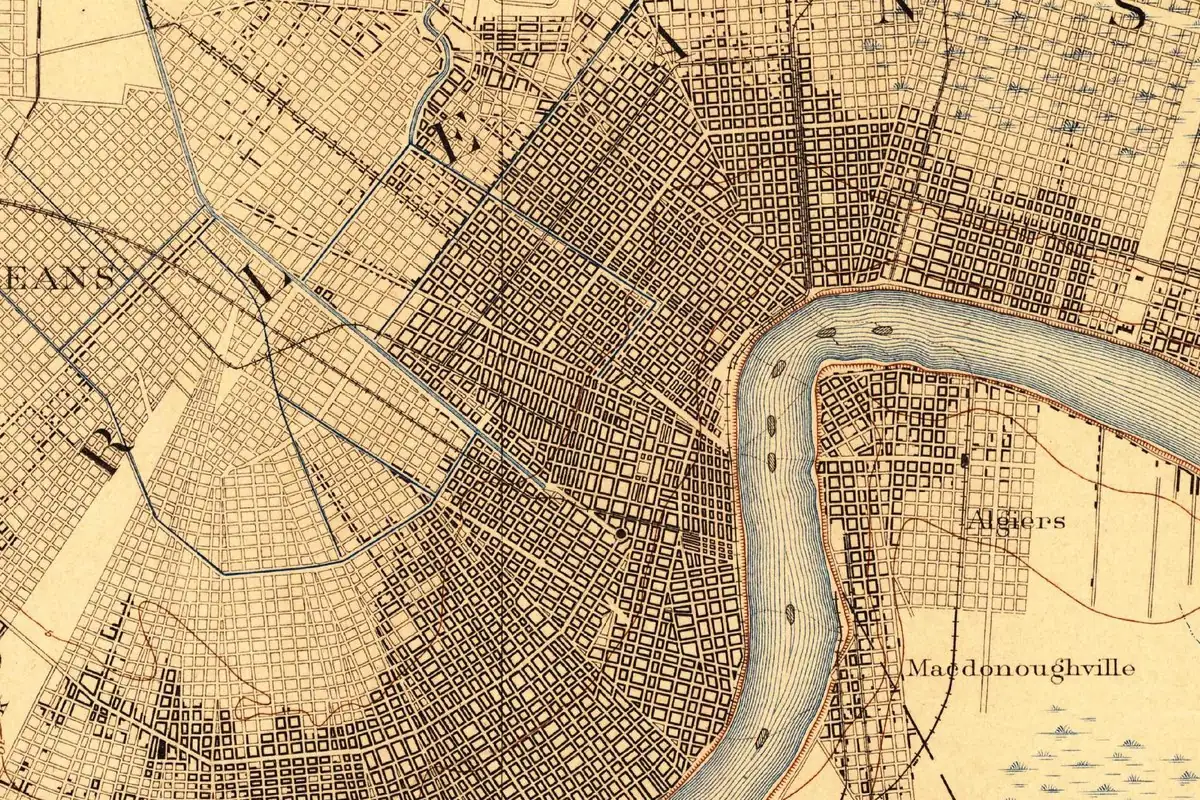
- U.S. Geological Survey, New Orleans sheet (1891). The map at the top of this page.
Spot something wrong, or know more? Tell us here. You can also email us or use our contact page. Corrections are noted here with their date, never made silently.