How Hilo, Hawaii Got Its Name: A Navigator Without a Story
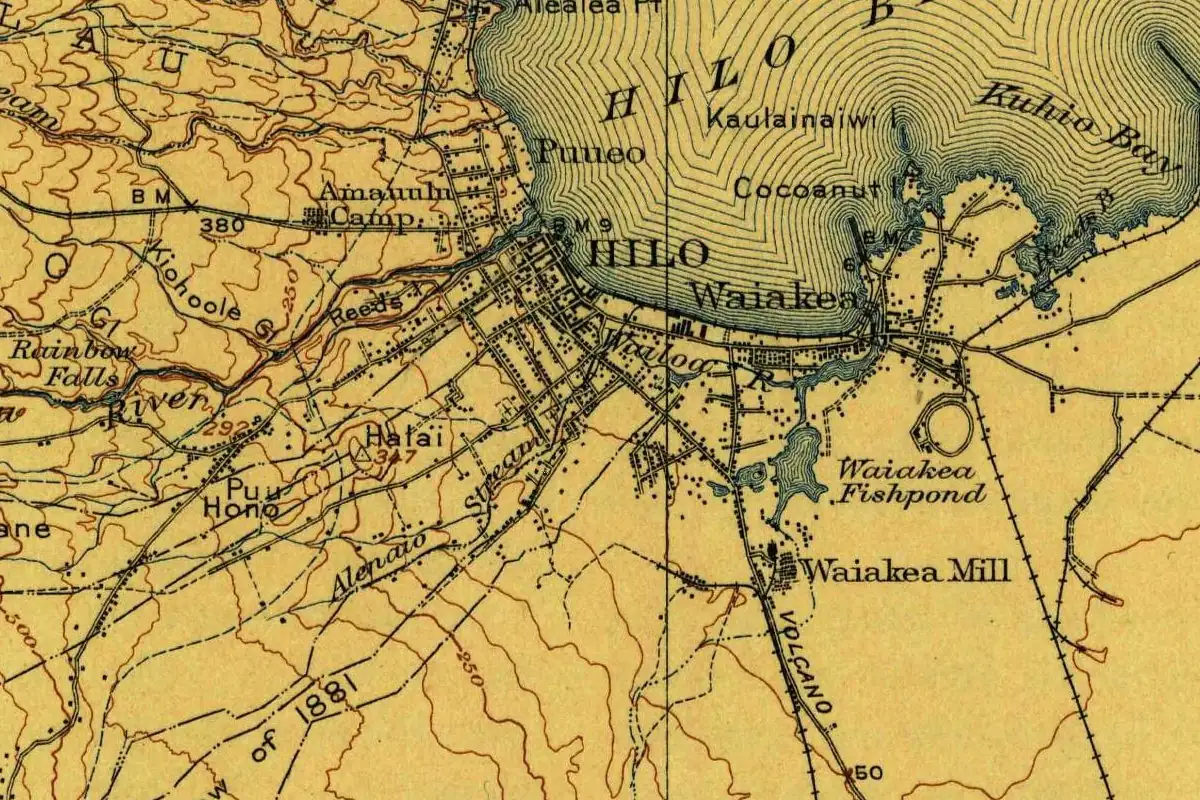
Hilo, Hawaii, carries the name of an ancient Polynesian navigator, according to the place-name lists of 1903 and 1922, and neither list says who he was. The town and the bay share the name of the district around them, and the word on its own means “twisted.”
One line for a navigator
The older list is W. D. Alexander’s Hawaiian Geographic Names, which came out in 1903. Alexander gave each name a meaning in brackets, but only “when known.” Hilo got one: “Hilo; [name of an ancient navigator]; (district); Hawaii.” Right under it come the town and Hilo Bay, which simply share the district’s name.
That’s the whole entry. There’s no name for the man, no date and no voyage. In a short section on meanings in the same report, Alexander noted that Hawaiian place names sometimes “embody names of persons of whom no tradition remains.” He doesn’t say whether Hilo is one of them, and you won’t find anything more about the navigator in his book.
Thrum’s two answers that aren’t rivals
Thomas Thrum took the question up again in the place-name appendix he wrote for the revised Hawaiian dictionary of 1922, and he said he’d made “full use” of Alexander’s work. His entry reads: “Hilo (hi’-lo): twisted. Name of Polynesian navigator. Bay and town, Hawaii.”
It can look like two explanations, but Thrum doesn’t set them against each other. “Twisted” is what the word hilo means, and he warned at the top of the list that “not a few definitions are given literally,” because some names are very old and the compilers weren’t familiar with the character and traditions of certain localities. The navigator is the person the early lists say the name belongs to. Nobody in these sources argues with him, and nobody offers a different origin.
The twisted thread and the new moon
You can check the literal meaning in Lorrin Andrews’s Hawaiian dictionary of 1865. There hilo is a verb, “to twist, as a string on the thigh; to twist with the thumb and fingers,” the way people rolled cord by hand. The same word was also a night in the calendar: “the name of the first night in which the new moon can be seen, as it is like a twisted thread.” Alexander’s 1891 history mentions that night too. In the month of Hinaiaeleele, “the first night, Hilo, of this month was kapu loa. No fire could be kindled.”
It’s a lovely image, a thin twist of moon. But it’s a meaning of the word, not a story about the place. None of these early sources says the district was named for the moon night, or for anything twisted.
A Wailuku in Hilo
One more curious detail. A stream in Hilo carries a familiar name: Alexander lists it as “Wailuku; (stream); Hilo; Hawaii,” the same name as the town on Maui. Alexander’s 1891 history notes that, according to Ellis, the banks of “the Wailuku River at Hilo” were the most famous spot for the periodical fairs held around the islands. If you want to know what Wailuku means, the Maui town’s story has the translation, and it’s a grim one.
Sources & further reading
- W. D. Alexander, Hawaiian Geographic Names (U.S. Coast and Geodetic Survey, Report for 1902, Appendix 7, 1903), pp. 395, 399, 403, 424. Names that “embody names of persons of whom no tradition remains” (p. 395); meanings in brackets “when known” (p. 399); “Hilo; [name of an ancient navigator]; (district),” with the town and Hilo Bay listed under it (p. 403); the Wailuku stream in Hilo (p. 424).
- Thomas G. Thrum, “Hawaiian Place Names,” in Andrews and Parker, A Dictionary of the Hawaiian Language (1922), pp. 625, 632. The note that “not a few definitions are given literally,” because of the age of some names and the compilers’ unfamiliarity with local traditions, and that “full use” was made of Alexander’s list (p. 625); “Hilo: twisted. Name of Polynesian navigator. Bay and town, Hawaii” (p. 632).
- Lorrin Andrews, A Dictionary of the Hawaiian Language (1865). Hilo: to twist; “the first night in which the new moon can be seen, as it is like a twisted thread.”
- W. D. Alexander, A Brief History of the Hawaiian People (1891), pp. 52, 88. The sacred night Hilo (p. 52); the fairs on “the Wailuku River at Hilo,” after Ellis (p. 88, note).
- GNIS feature 359187 (U.S. Geological Survey). The federal record for Hilo, with no note on the meaning.
Spot something wrong, or know more? Tell us here. You can also email us or use our contact page. Corrections are noted here with their date, never made silently.